
The Wheel is a conservative options approach built around stocks you’re comfortable owning. This approach is among the most widely used options strategies in the U.S. market.
→ Sell a cash-secured put on a stock you are genuinely fine owning.
→ If assigned, switch to a covered call and let premium work down your cost basis over time.

This strategy allows you to generate consistent monthly income by systematically collecting premium, with many disciplined traders targeting 1–3% per month on deployed capital, depending on market conditions and risk tolerance.
The 15 strongest Wheel candidates for this week
A cash-secured put entry with a defined downside cushion
A covered call plan if assigned
Clean numbers: cushion, breakeven, upside-to-strike, collateral
Roll candidates with specific strikes, dates, and expected credits
Scenario guidance for if the stock drops 3–5%, drops 5%+, or rallies
The actual plan for managing the trade from open to close
1. You start with the cash-secured put. If the stock stays above your strike at expiration, the put expires worthless. You keep the premium. No further action needed.
2. If the stock falls and you are assigned shares, then you sell the covered call. Not earlier. Not because it looks attractive. Only after assignment.
This matters because most Wheel mistakes come from forcing both legs when the market only gives you one.
It deliberately spans a range of collateral sizes — some setups tie up a few thousand dollars, others tens of thousands — along with different sectors and premium levels.
The week’s full opportunity set is visible regardless of account size. Each setup shows its collateral requirement up front, so the capital involved is clear before any decision.
How the report is used — as research, as a watchlist, or not at all — is each reader’s own call.
Each setup has two phases.
Phase 1 is the put — it always shows a full priced contract.
Phase 2 is the covered call, sold only if shares are assigned.
When that call can be priced today with real market data, Phase 2 shows the full contract: premium, break-even, delta, yield.
When it can’t — because the call belongs to a later cycle, after assignment — printing numbers would be guesswork, so Phase 2 shows the plan instead: the target strike and delta to use once the shares are owned. The header “If Assigned (Next Cycle)” marks the second kind.
Every setup shows a manage-by date. It is the day to check the position and decide whether to let the put run, close it, or roll it. When a company reports earnings before the option expires, close the put rather than rolling — a roll moves to a later expiration and carries a new put through the same report. In that case the manage-by date falls before the report, and the setup’s note says so. Treat the manage-by date as part of the trade.
Manage-by dates are set from scheduled earnings dates at the time of analysis. Companies sometimes move their report dates. Verify the earnings date at your broker before entering, and again as the manage-by date approaches.
The Wheel Strategy FAQ covers the questions most people ask starting out, and the Member Manual walks through how to read and use this report.
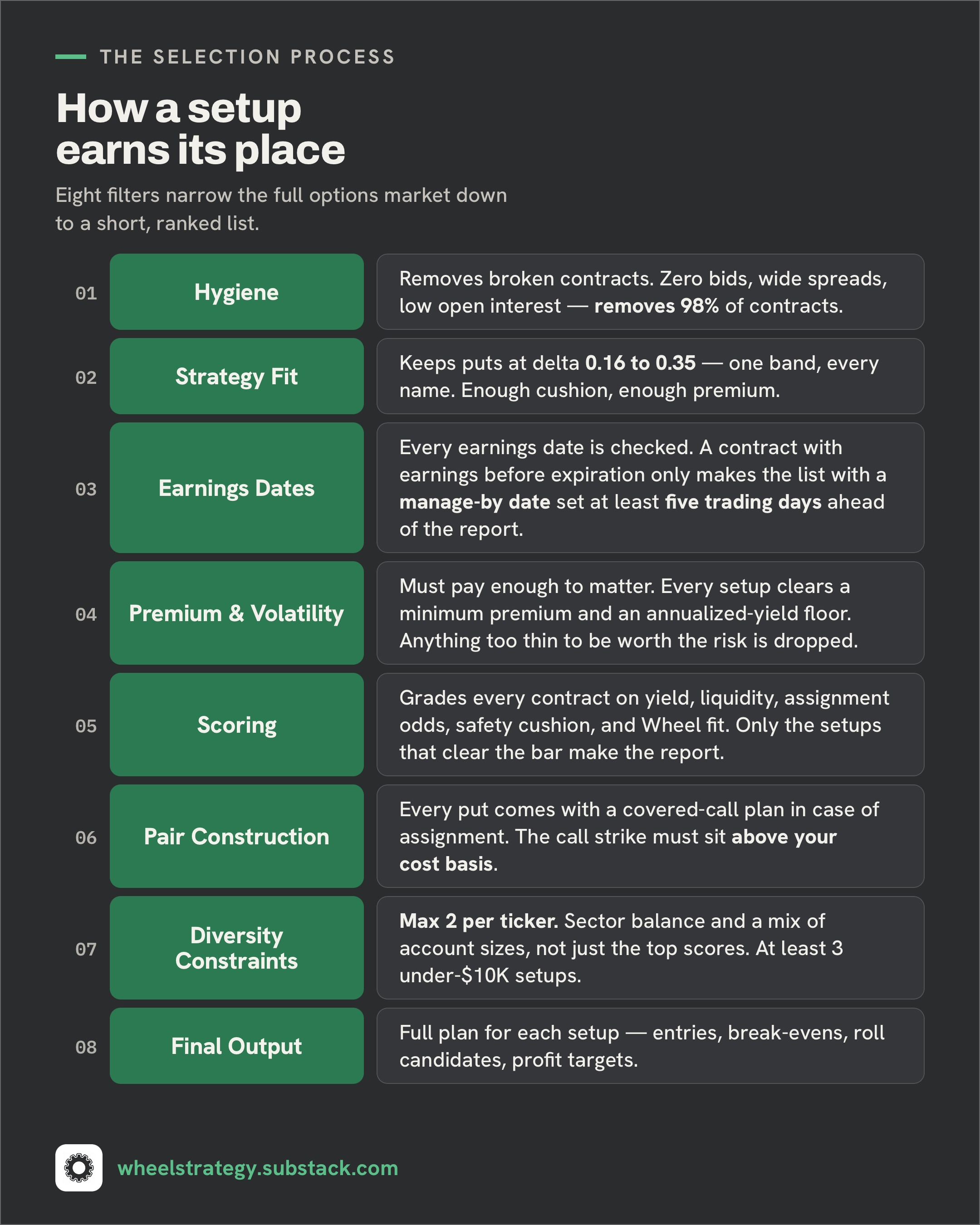
Every setup in this report passed all of these criteria before making the list. This is strict filtering designed to eliminate low-quality setups before they waste your capital.
Disclaimer. These setups are educational content, not personal investment advice, and nothing here is a recommendation to buy, sell, or hold any security. The numbers reflect market conditions at the time of analysis — markets move, so the bid/ask at your broker will differ. Always verify the live option chain before placing any order, and use limit orders, not market orders. Options trading involves substantial risk and is not suitable for all investors. The author may hold positions in securities discussed. Do your own research and size positions to your own risk tolerance.
Why it’s here this week: Johnson & Johnson spans pharmaceuticals, medtech, and consumer health. Healthcare held up while technology sold off last week, and a defensive name tends to carry steadier tape. The 5.2% cushion is tighter than most here, and earnings are not until October, well clear of this expiration.
JNJ pays $257 on $24K collateral for 11.2% annualized. This is a cash-secured put only; if assigned at $240, the next-cycle covered call targets about $247.50 near 0.30 delta, held above the $237.43 cost basis.
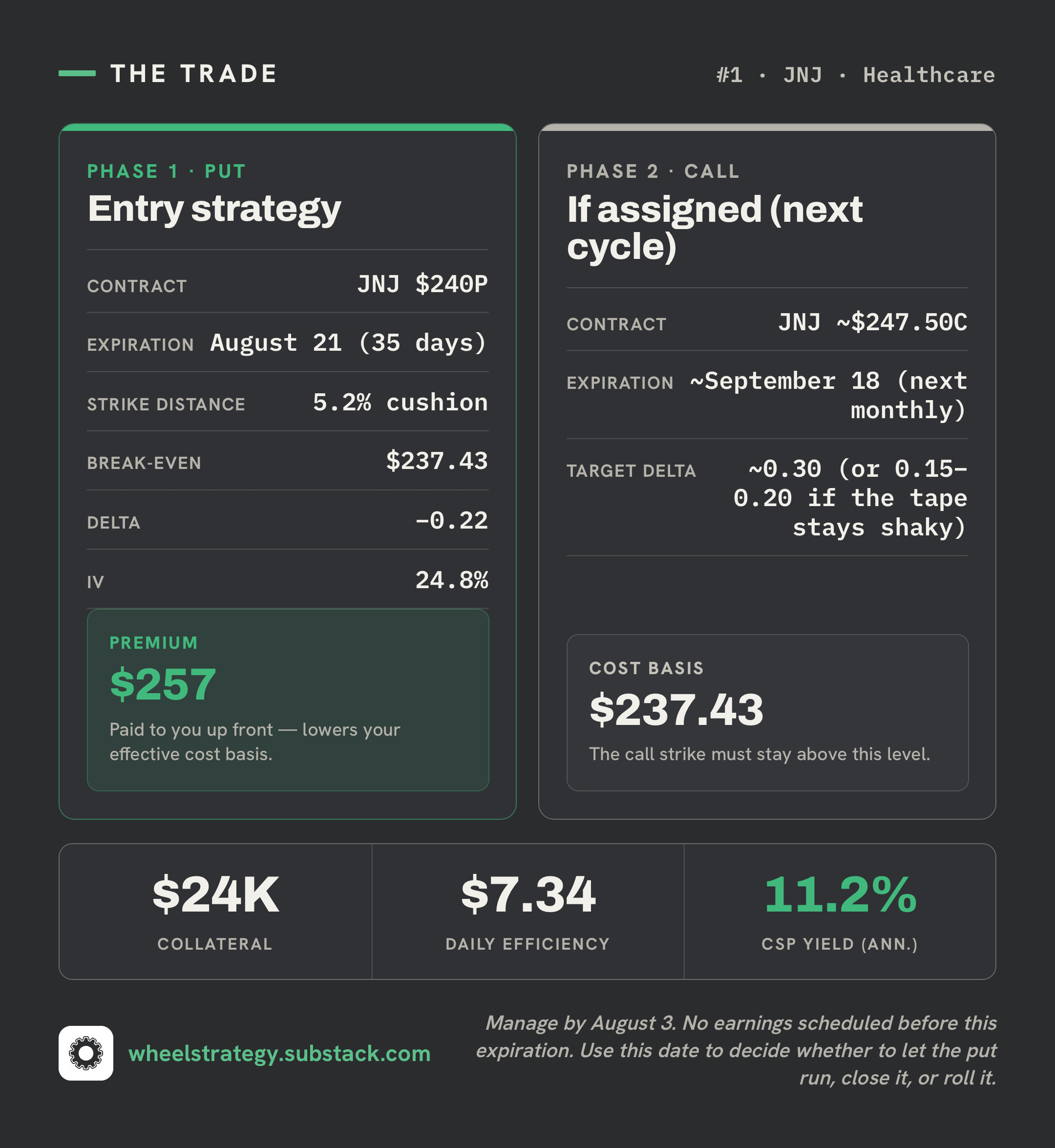
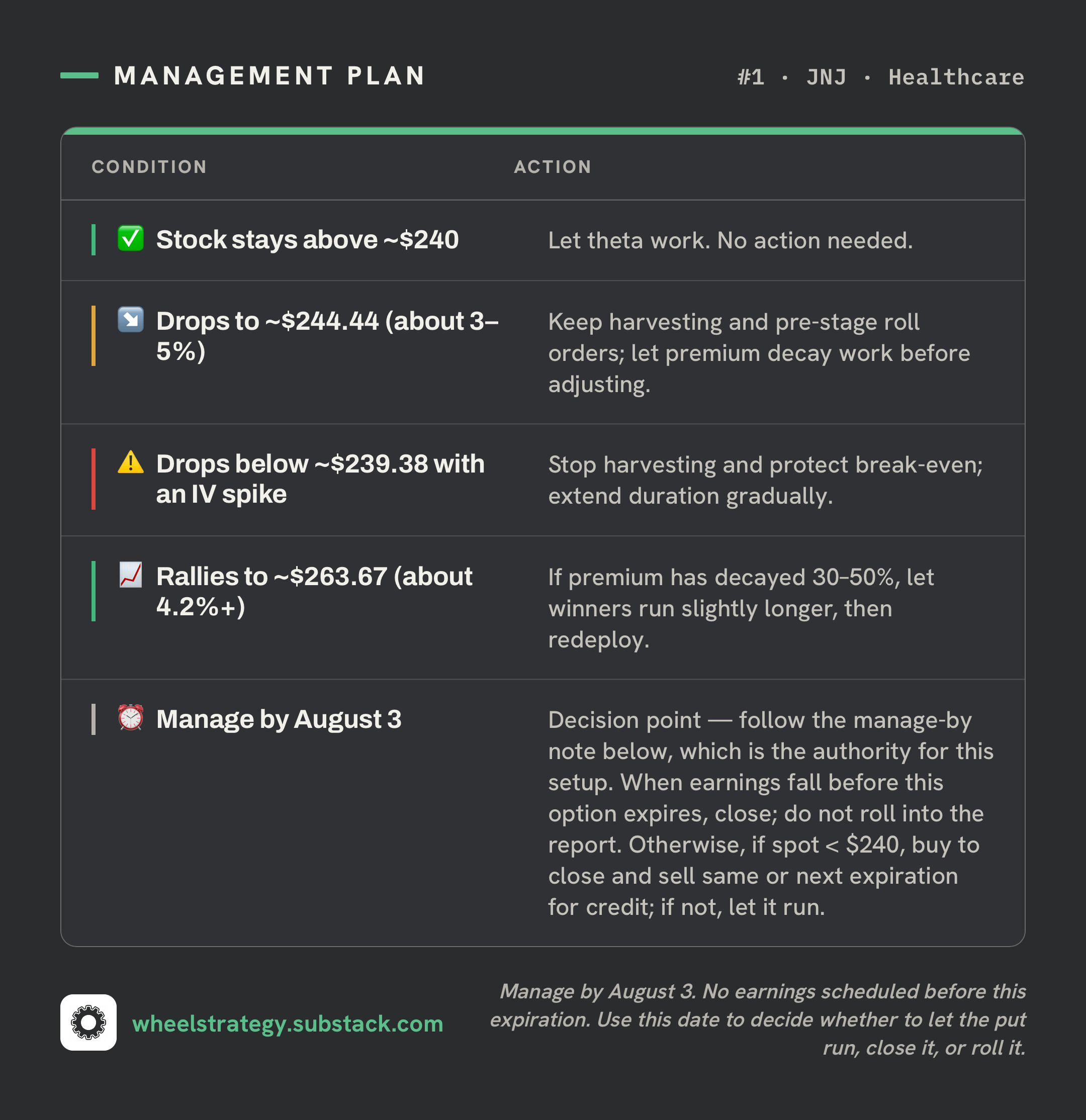
Cost basis is $237.43 (strike minus premium). No rush on the call — wait for shares to steady or an IV bump.
Sell the ~$247.5 call (~0.30 delta) in the next monthly cycle (~September 18) — never below the $237.43 cost basis.
If the tape stays choppy, step down to 0.15–0.20 delta and roll up-and-out for a credit.
Why it’s here this week: Morgan Stanley runs investment banking and wealth management at scale. Financials firmed on strong early bank earnings last week, and a $332 premium pairs with a 7.2% cushion. The ex-dividend date falls July 31, which touches the covered-call leg, not this put.
MS pays $332 on $20K collateral for 17.3% annualized. This is a cash-secured put only; if assigned at $200, the next-cycle covered call targets about $205 near 0.30 delta, held above the $196.68 cost basis.
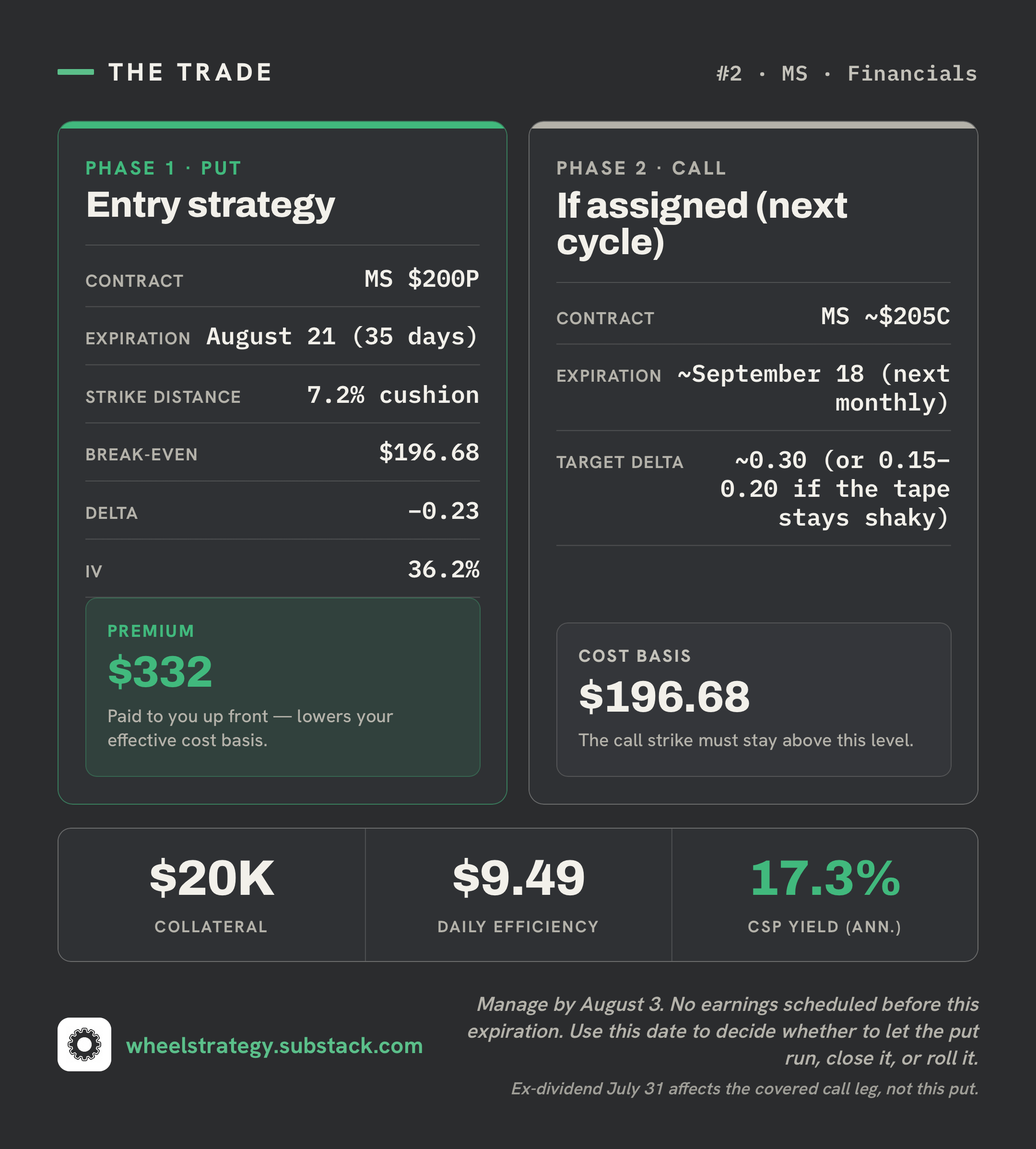
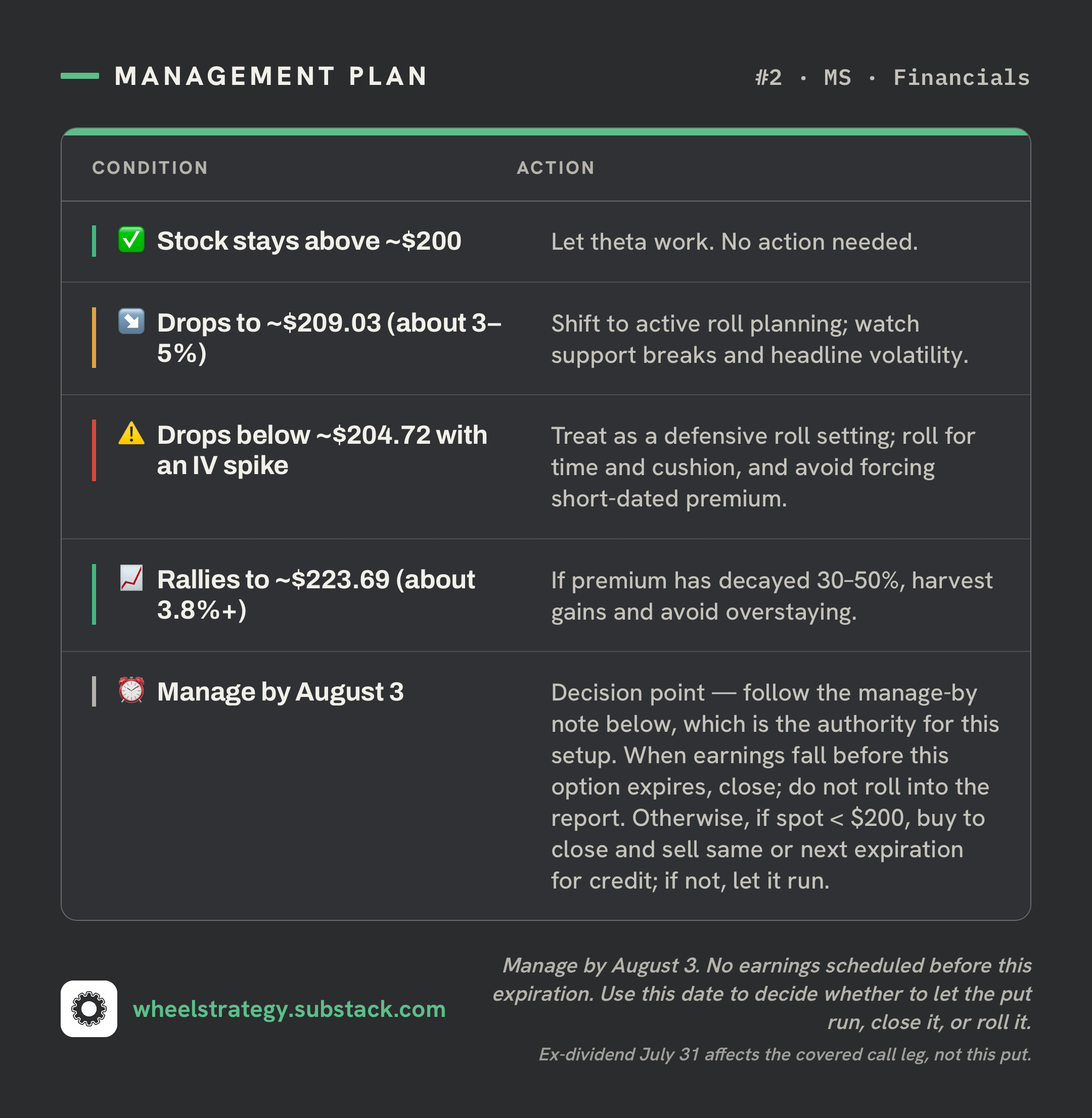
Cost basis is $196.68 (strike minus premium). No rush on the call — wait for shares to steady or an IV bump.
Sell the ~$205 call (~0.30 delta) in the next monthly cycle (~September 18) — never below the $196.68 cost basis.
If the tape stays choppy, step down to 0.15–0.20 delta and roll up-and-out for a credit.
Why it’s here this week: Citigroup is a global bank with consumer and institutional arms. It pulled back about 9% over the past month, which resets the entry, while the sector led on strong bank earnings. A 7.2% cushion and $174 premium cleared the filters, with earnings not due until October.
C pays $174 on $12K collateral for 15.1% annualized. This is a cash-secured put only; if assigned at $120, the next-cycle covered call targets about $122.50 near 0.30 delta, held above the $118.26 cost basis.
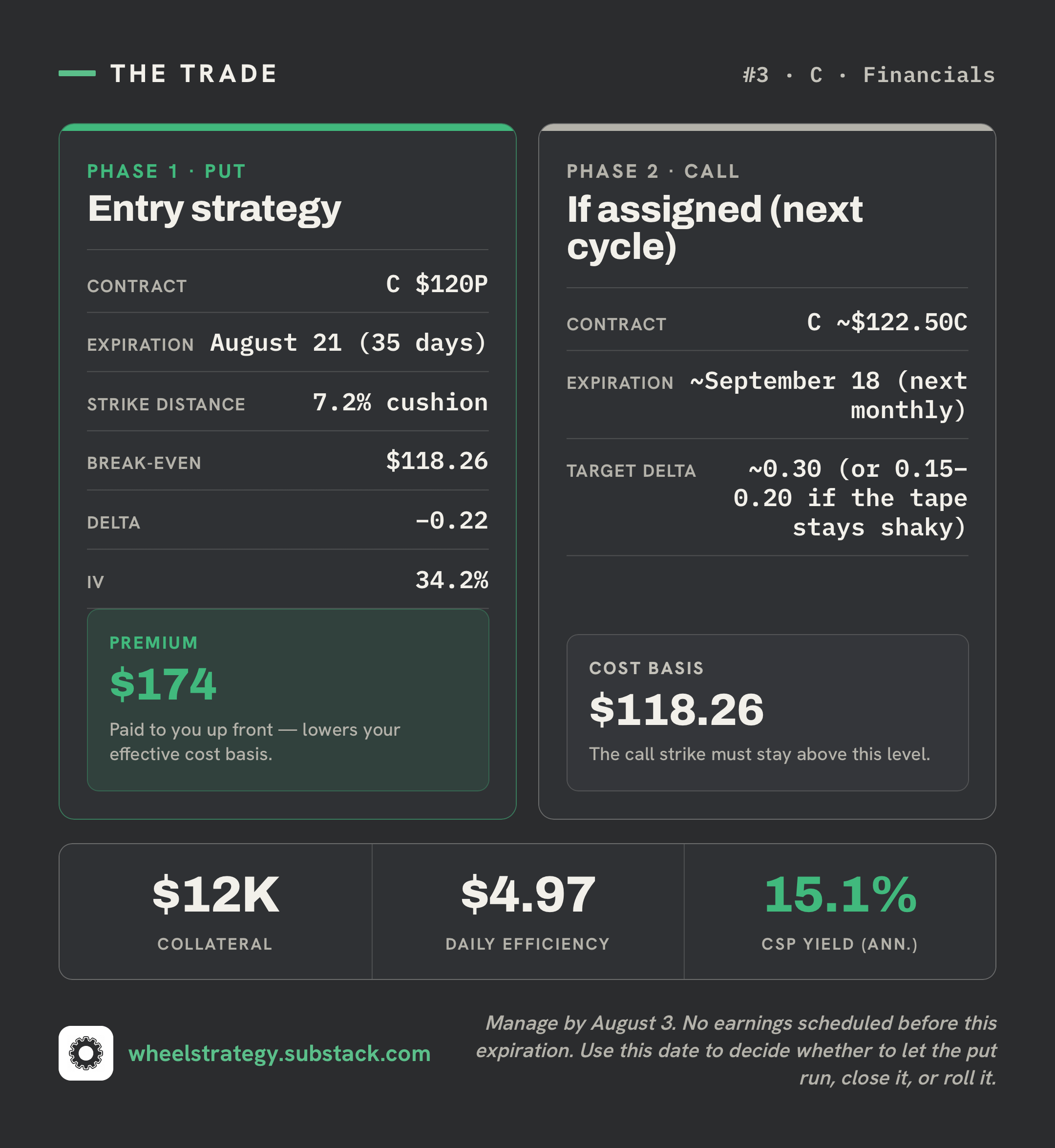
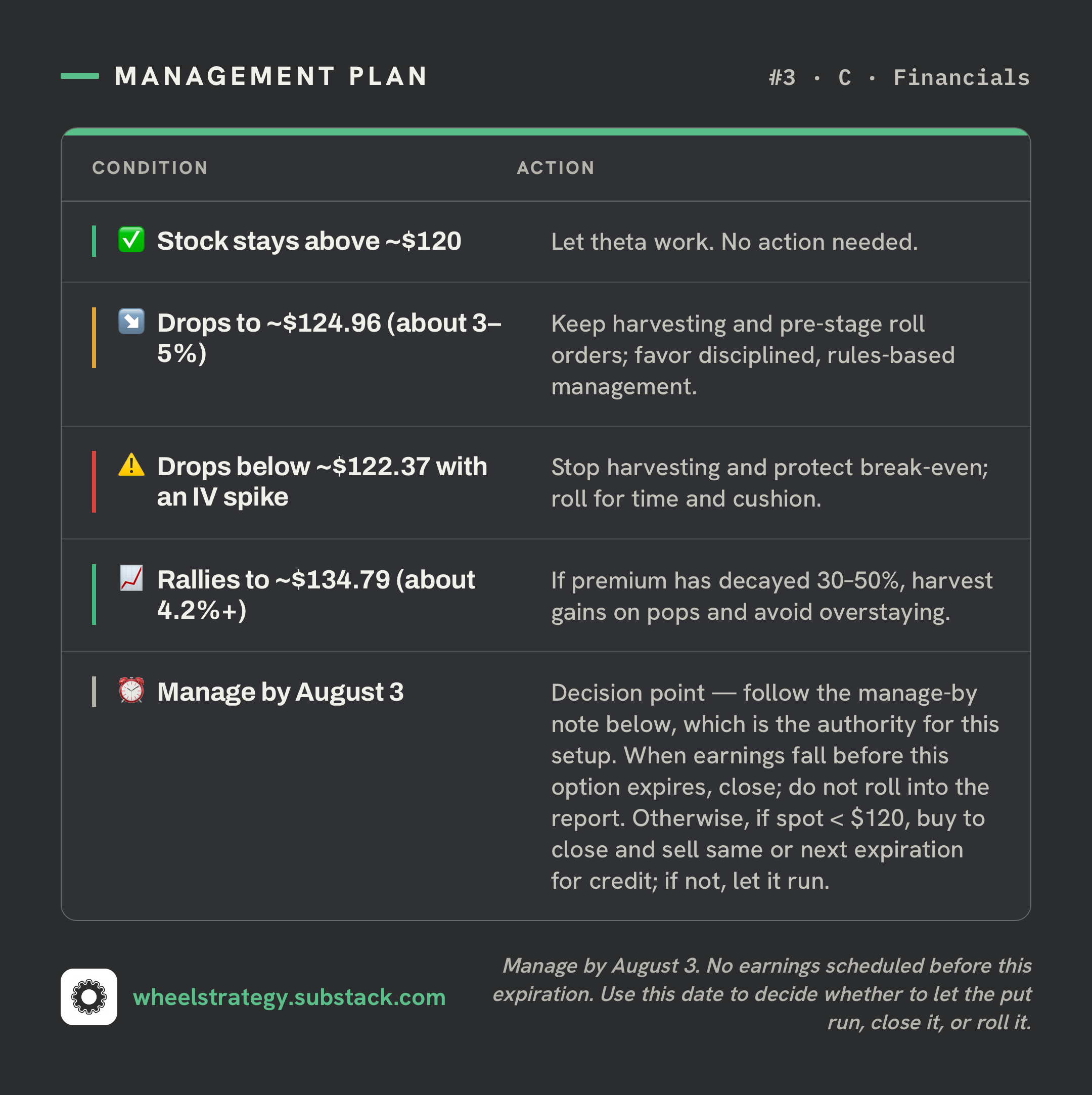
Cost basis is $118.26 (strike minus premium). With IV subdued, don’t rush the call — wait for an IV bump or steadier tape.
Sell the ~$122.5 call (~0.30 delta) in the next monthly cycle (~September 18) — never below the $118.26 cost basis.
If the tape stays choppy, step down to 0.15–0.20 delta and roll up-and-out for a credit.
Why it’s here this week: Wells Fargo is one of the largest US retail and commercial banks. At $8.3K collateral, it is the most accessible setup in the free five. Volatility is near the bottom of its year, so the premium is modest against a 5.7% cushion.
WFC pays $108 on $8.3K collateral for 13.7% annualized. This is a cash-secured put only; if assigned at $82.50, the next-cycle covered call targets about $85 near 0.30 delta, held above the $81.42 cost basis.
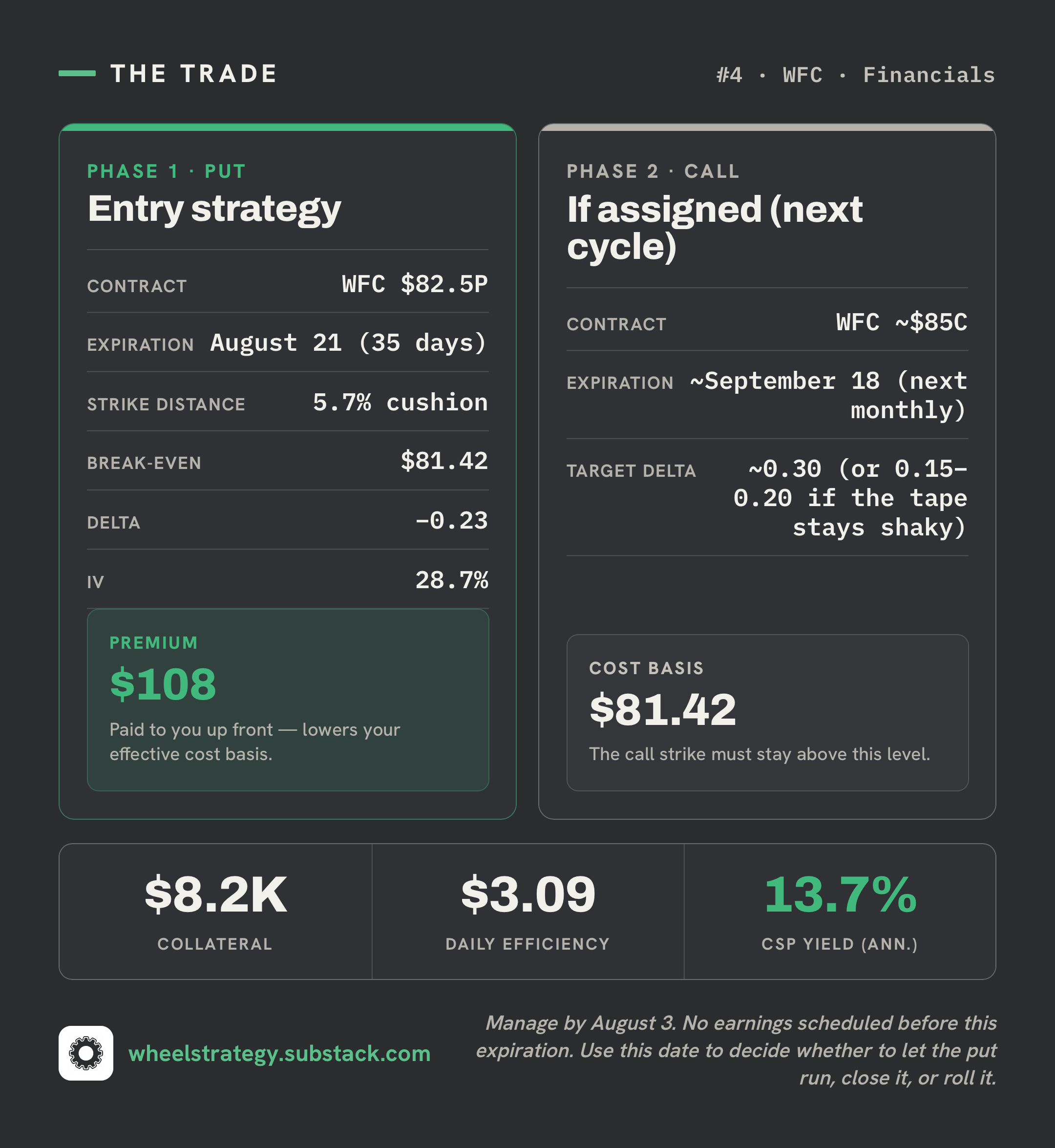
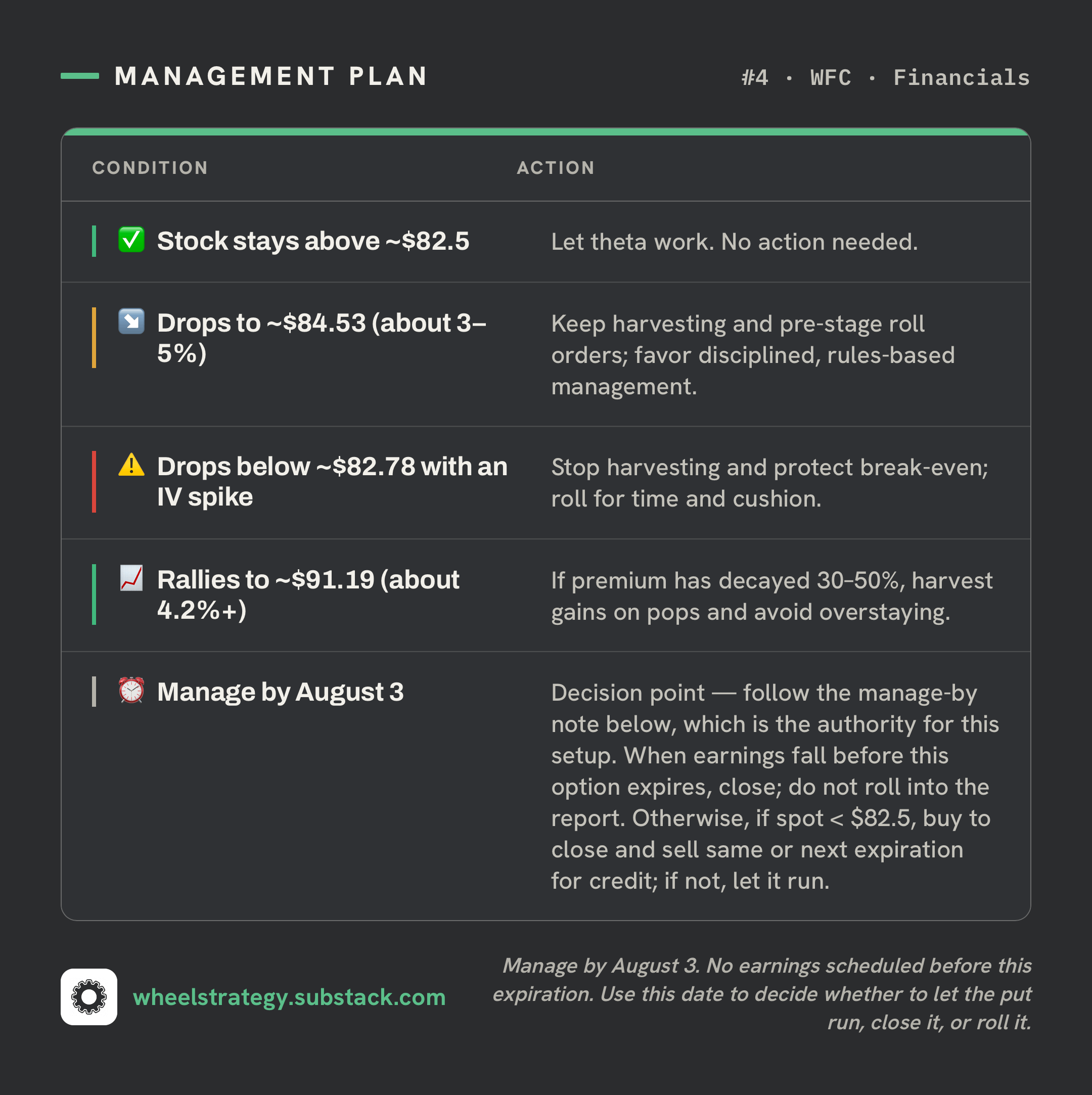
Cost basis is $81.42 (strike minus premium). With IV subdued, don’t rush the call — wait for an IV bump or steadier tape.
Sell the ~$85 call (~0.30 delta) in the next monthly cycle (~September 18) — never below the $81.42 cost basis.
If the tape stays choppy, step down to 0.15–0.20 delta and roll up-and-out for a credit.
Why it’s here this week: IWM tracks the Russell 2000, so a put spreads risk across roughly two thousand small caps. The equal-weight market rose last week even as the megacap indices fell, which favors broad small-cap exposure. No single company’s earnings can gap it, and the 4.1% cushion is the tightest here, so size it with that in mind.
IWM pays $334 on $28.2K collateral for 12.4% annualized. This is a cash-secured put only; if assigned at $282, the next-cycle covered call targets about $290 near 0.30 delta, held above the $278.66 cost basis.
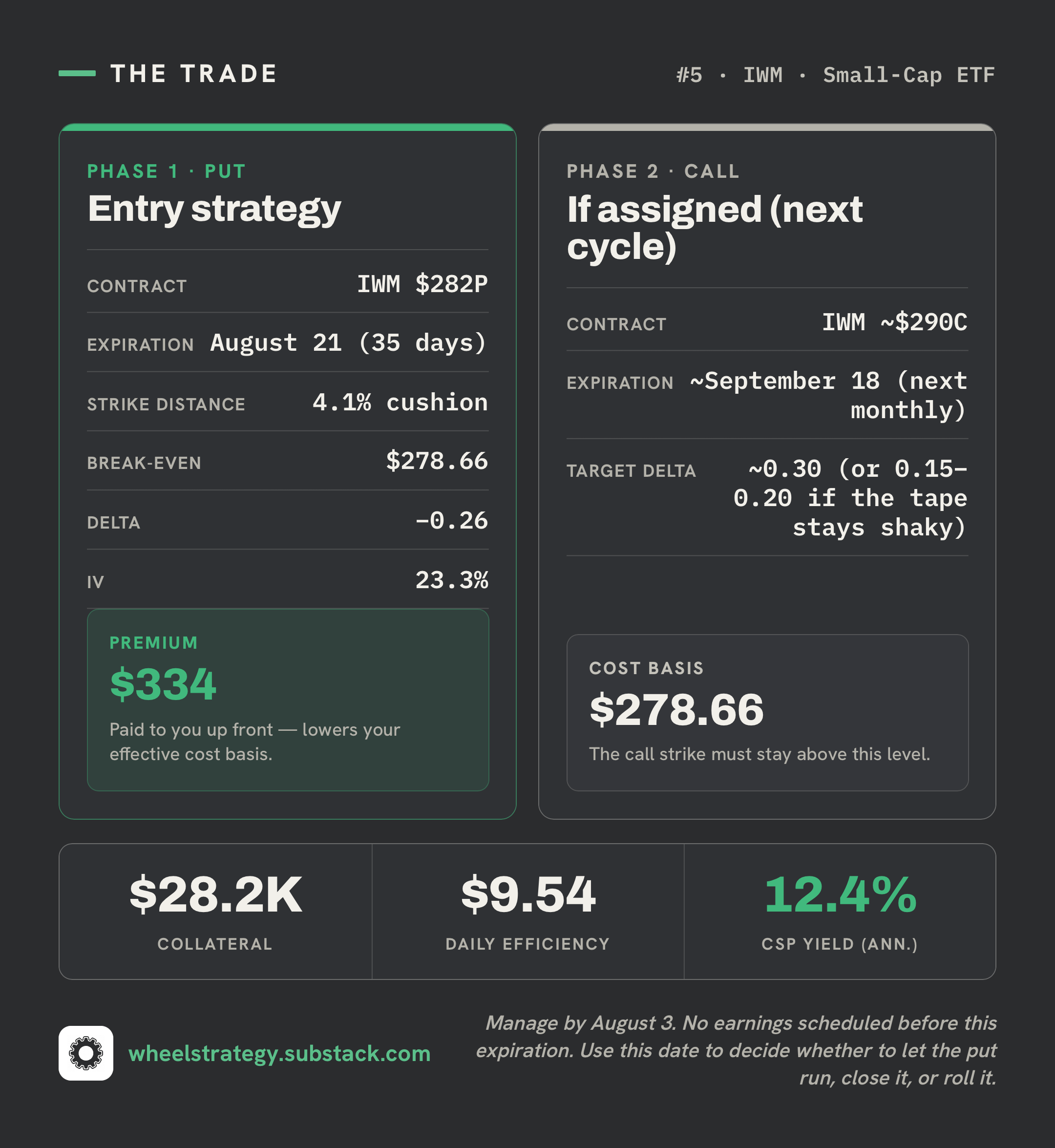
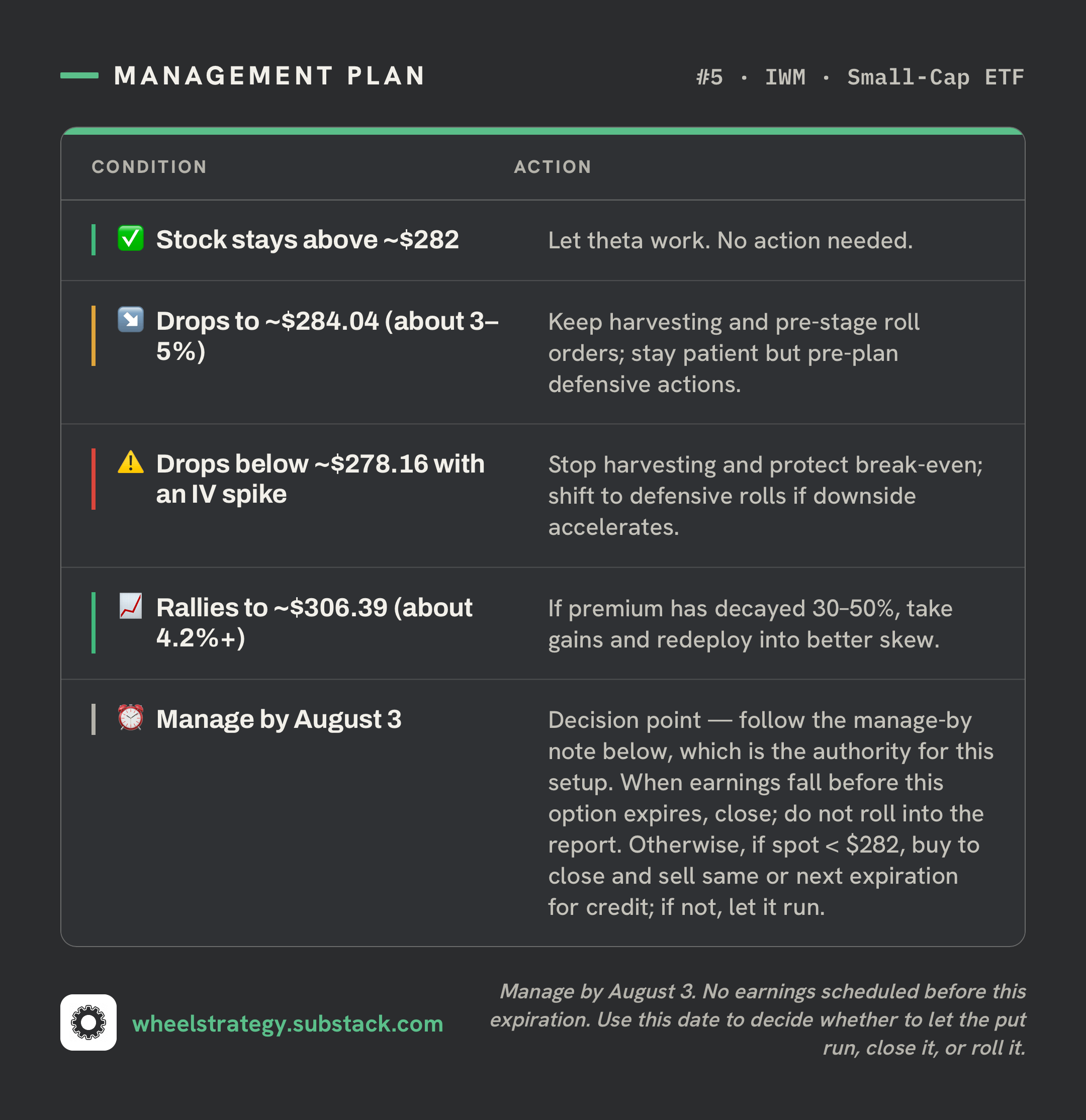
Cost basis is $278.66 (strike minus premium). No rush on the call — wait for shares to steady or an IV bump.
Sell the ~$290 call (~0.30 delta) in the next monthly cycle (~September 18) — never below the $278.66 cost basis.
If the tape stays choppy, step down to 0.15–0.20 delta and roll up-and-out for a credit.
Ten more setups sit below, spanning industrials (GE, UAL), healthcare (GILD, MRK, CVS), tech (ZM, AFRM), consumer staples (TGT, DG), and financials (USB). IV ranges from 25% to 63% across the ten, with premiums up to $432 and collateral from $6K to $32K. Members receive the full list each week — complete opportunity set, same depth on every setup.
Paid subscribers also receive: a downloadable PDF with the complete 15-setup report, ready to print or save for the week.

Comments
Nothing yet. Say the first thing.
Sign in to join the conversation.