
Every year, sometime around April, or October if you filed an extension, you hand a stack of numbers to a CPA or a piece of software with a red logo. A document comes out the other side. You sign it. You file it. And most entrepreneurs walk away believing they just did their taxes for the year.
They didn’t. They reported them.
That distinction sounds like semantics until you look at what’s actually sitting inside a tax return: a record of decisions that were already made, usually without much deliberation, sometime between January 1 and December 31 of the prior year. The entity you operated under. The salary you paid yourself, if any. Whether you funded a retirement plan. What you spent money on, and when you spent it. None of that gets decided on the return. It gets described on the return. By the time your preparer opens the file, the math has already been written. Their job is to report it accurately, not to have shaped it.
A tax strategy is the opposite motion. It’s the set of decisions made across the year, sometimes years in advance, that determine what numbers eventually land on that document. The return is the receipt. The strategy is the purchase.
Most business owners have never separated these two things in their head, and it’s an expensive habit. Not because their preparer is bad at their job. Most preparers are quite good at the job they were hired to do, which is compliance: take what happened, apply the code correctly, file on time, avoid penalties. That’s a real and necessary function. It is also a completely different function from deciding what should happen in the first place.
A familiar moment captures the confusion perfectly: the owner gets a call in March saying they owe far more than expected and reacts as though the number is a surprise the tax code sprang on them. It isn’t. The number was determined by decisions made the previous spring, summer, and fall. The March phone call didn’t create the liability. It just delivered the news, months after anything could have been done about it.
This piece is the map.
The Premium Newsletter is where the map becomes a route: the exact entity election timeline, the retirement plan structure sized to your actual numbers, the reasonable-comp file that holds up if the IRS ever asks. Built for entrepreneurs done finding out in April what should have been decided in June.
One timely decision usually covers the subscription. Most years, it covers it several times over.
A tax return is an after-action report. Form 1040, Schedule C, Schedule SE, whatever forms apply to your situation, all of them ask a version of the same question: what occurred? They ask how much you earned, what you spent, what entity structure you used, whether you funded a retirement account, whether you sold an asset. Every line is retrospective. There is no line on any IRS form that asks what you’re planning to do next year, because the form isn’t built for planning. It’s built for reporting.
This is easy to forget because the return feels like the main event. It’s the document with your name on it, the one an accountant spends hours preparing, the one that determines whether you owe money or get a refund. But the return doesn’t create your tax outcome. It reveals one that was already baked in months earlier, the moment you decided (or failed to decide) things like how to pay yourself, whether to elect a different entity classification, or whether to fund a retirement plan before the window closed.
A tax strategy is a system of decisions, made on a calendar that has nothing to do with April 15, that shapes what will eventually show up on the return. Some of those decisions are structural and made once every few years: how the business is organized, whether an S-corporation election makes sense given current profit levels, how ownership is split across entities. Some are annual and revisited every December: how much to contribute to a retirement plan, whether to accelerate or defer income, whether this is the year to harvest a loss or realize a gain. And some are ongoing and almost invisible, like tracking material participation hours for a real estate activity under IRC §469(c)(7), or documenting a reasonable compensation analysis so a salary figure can survive scrutiny.
None of that happens on the return. All of it determines what the return says.
This isn’t only a business-entity story either. The same split shows up on the personal side of the return. Whether to bunch several years of charitable giving into a donor-advised fund in a single high-income year, whether to convert a traditional IRA to Roth in a year when income dips, whether net investment income tax under §1411 is even in play this year or next: every one of those is a decision with a deadline that falls well before the return gets filed, and every one of them gets reported, not created, on the 1040. The entity and retirement examples below are just the clearest place to see the dollar amounts, because they’re the largest lever most self-employed people have.
Here’s the cleanest way to hold the two ideas side by side.
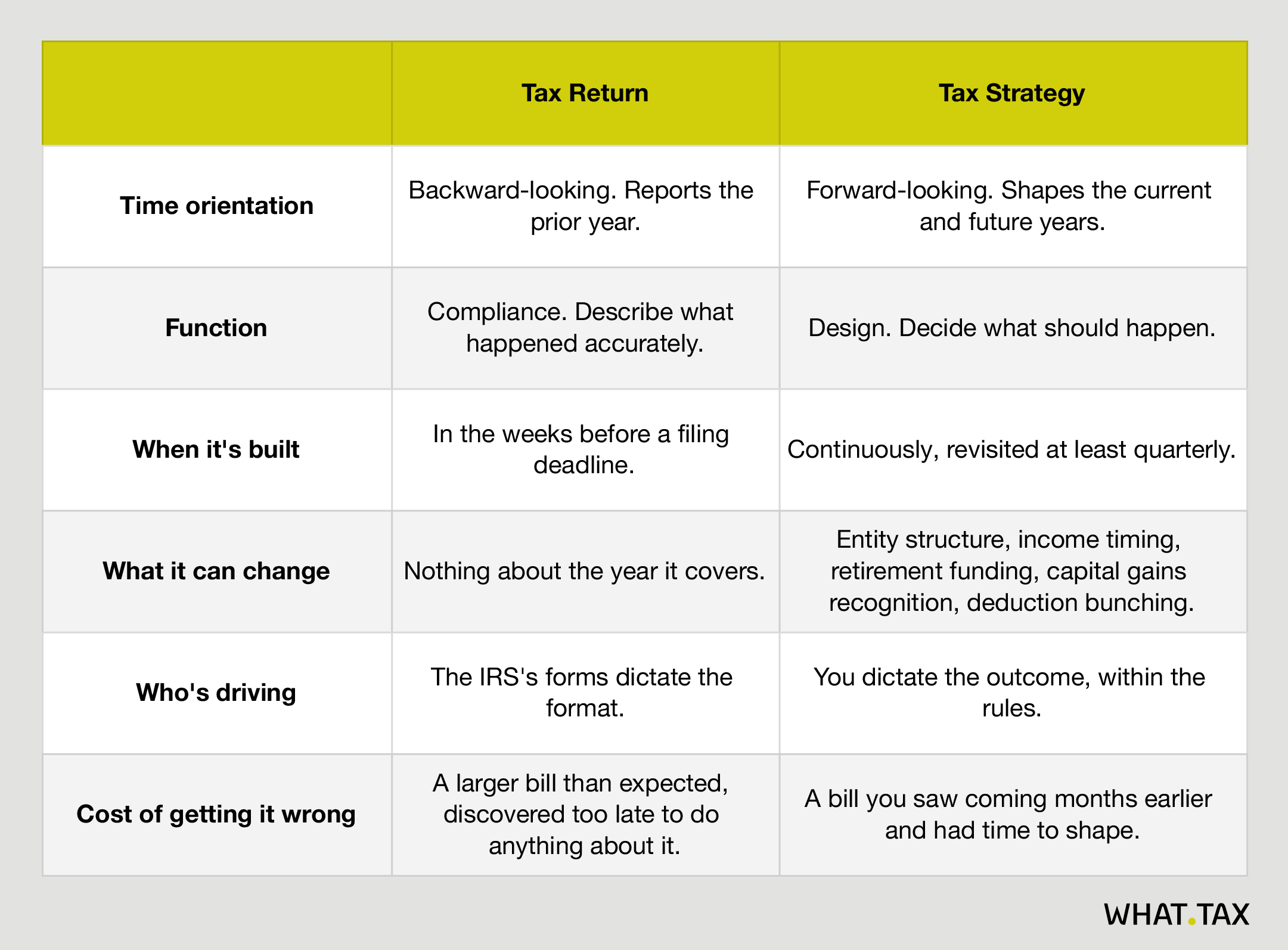
Notice that “cost of getting it wrong” row. That’s the whole argument in one line. A return can be perfectly accurate and still represent a terrible outcome, because accuracy and optimization are not the same thing. A preparer who correctly reports that you owed $47,000 has done their job well. Whether you owed $47,000 in the first place was never their question to answer, and in most engagements, nobody was ever asked to answer it.
This is where a lot of confusion lives, because it isn’t strictly true that nothing can be influenced at filing time. A few things genuinely can. SEP-IRA and solo 401(k) employer contributions can still be funded up until the extended due date of the return, which means a business owner filing on extension in September can still fund a retirement contribution for the prior tax year. You make elections like §179 expensing on the return itself, not before it. In limited circumstances, you can still choose depreciation methods at filing time.
But that short list is the exception, and it’s a narrow one. Almost everything else that determines the size of the bill is locked in well before your preparer ever opens your file:
Your entity classification for the year is locked. An S-corporation election under Form 2553 generally has to be filed within two and a half months of the tax year it applies to, which means the door closes in mid-March for a calendar-year business, more than a year before that year’s return is even due.
The wages you actually paid yourself through payroll are locked. You cannot retroactively decide in March that you should have run a different salary through W-2 wages in the prior October. Payroll either happened, or it didn’t.
Whether you materially participated in a real estate activity for §469(c)(7) real estate professional status is locked, because participation hours are a fact pattern. You either logged them during the year or you didn’t; nobody can manufacture hours after December 31.
The timing of income received and expenses paid in a cash-basis business is locked. If you invoiced and collected in December instead of January, that income belongs to the year you collected it. There’s no do-over.
Whether you sold an appreciated asset during the year, or held it, is locked. So is whether that asset was held long enough to qualify for long-term capital gains treatment.
Add it up, and the honest picture is that maybe five percent of what determines your tax bill is still adjustable by the time you sit down with a preparer. The other ninety-five percent was decided, or failed to be decided, throughout the year that already ended. A tax strategy exists specifically to control that ninety-five percent. A tax return only ever gets to describe it.
Even that narrow five percent has a ceiling worth naming. Funding a SEP-IRA on extension in September can shrink a bill, but it can’t undo a missed S-corp election from the previous March, and it can’t retroactively convert wages that were never run through payroll. The flexibility that survives to filing season is real, but it’s a rounding error compared to what closed months earlier.
Numbers make this concrete faster than any amount of explanation, so here’s an honest comparison using 2026 federal rates, the first full tax year shaped by the One Big Beautiful Bill Act’s permanent framework.
Take a single-filer consulting business netting $180,000 in profit for the year. Run that profit through two different paths.
The business stays a sole proprietorship. No entity election, no retirement plan, standard deduction only. Self-employment tax applies to 92.35% of net earnings at 15.3%, which comes to $25,433. After the deductible half of that self-employment tax and the standard deduction, the qualified business income deduction under §199A (fully available here since taxable income sits well below the 2026 phase-in threshold of $201,775) brings taxable income down to roughly $120,946. Federal income tax on that comes to $21,625. Total federal tax bill: $47,058, an effective rate of just over 26% on the original $180,000.
The same business elects S-corporation taxation. The owner draws a documented, defensible salary (the kind that would hold up against the Watson factors, not a token figure designed purely to dodge payroll tax) and runs a 401(k) through the entity, deferring the 2026 employee limit of $24,500 and adding an employer profit-sharing contribution on top. The portion of profit that flows through as a distribution, rather than wages, escapes self-employment tax entirely. Between the reduced payroll tax base and the retirement plan reducing taxable pass-through income further, the federal income tax bill drops to roughly $16,114, and combined employer-and-employee payroll tax comes to $15,300. Total tax bill: $31,414.
Same $180,000. Same year. A $15,644 difference in cash tax alone, on top of $49,500 funneled into a retirement account that didn’t exist in the first version of the story at all.
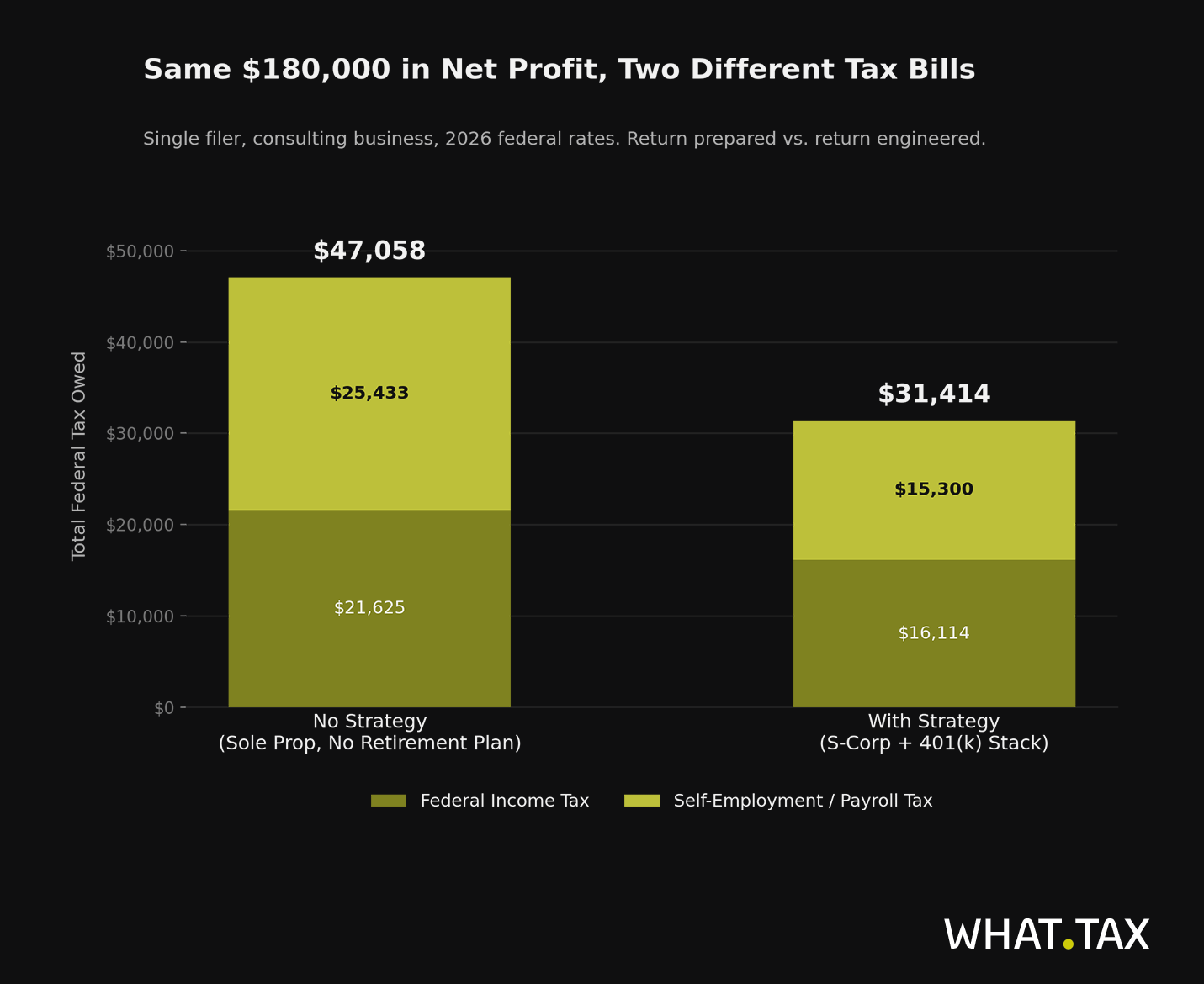
That gap didn’t appear on anyone’s tax return because the preparer made a smart choice in April. It appeared because a set of structural decisions- the entity election, the salary figure, the retirement plan design- were made and executed correctly throughout the year before the return ever existed. The return in path two isn’t better because someone found a loophole. It’s better because someone built the year differently, and the return simply reported what got built.
This isn’t a knock on tax preparers. It describes how most engagements are structured. A compliance engagement is priced, scoped, and staffed around one job: take the facts as they are and file an accurate return by the deadline. That’s a legitimate and necessary service, and many in the profession do it well. But the billing model rewards accurate reporting, not proactive redesign of the underlying facts. Many preparers see a client’s numbers for the first time in February, months after the decisions that actually mattered- the entity structure, the salary, the retirement contribution deadline- had already closed.
Ask a preparer in March why your S-corp election wasn’t filed the previous spring, and the honest answer is usually some version of “nobody asked me before then.” That’s not negligence. It’s the natural result of a relationship that only activates once a year, right around the one moment when almost nothing can still be changed.
There’s also a simple economic reason this pattern persists. Compliance work is priced as compliance work: a flat fee or an hourly rate tied to producing a correct filing by a deadline, not to the size of the liability that filing reflects. A planning engagement, the kind where someone is actively modeling your entity structure, salary, and retirement contributions months before year-end, is a different service with a different scope, and most business owners have never been offered it, let alone asked for it. They assume the person filing their return is also the person planning their year, because both tasks involve the same forms and the same person. Often, only one of those things is actually happening.
The $15,644 gap in the example above is a single year’s number. What makes the return-versus-strategy distinction matter over the long run isn’t that one year’s difference. It’s what happens when that difference gets captured and reinvested year after year instead of quietly disappearing into a tax bill nobody examined closely.
Take the full annual gap from the example above: $15,644 in cash tax savings, plus $49,500 in retirement contributions that wouldn’t have existed otherwise. That’s $65,144 a year. Invested consistently at a steady 8% annual return, a reasonable long-run assumption for a diversified portfolio, here’s what a decade of that gap compounds into.
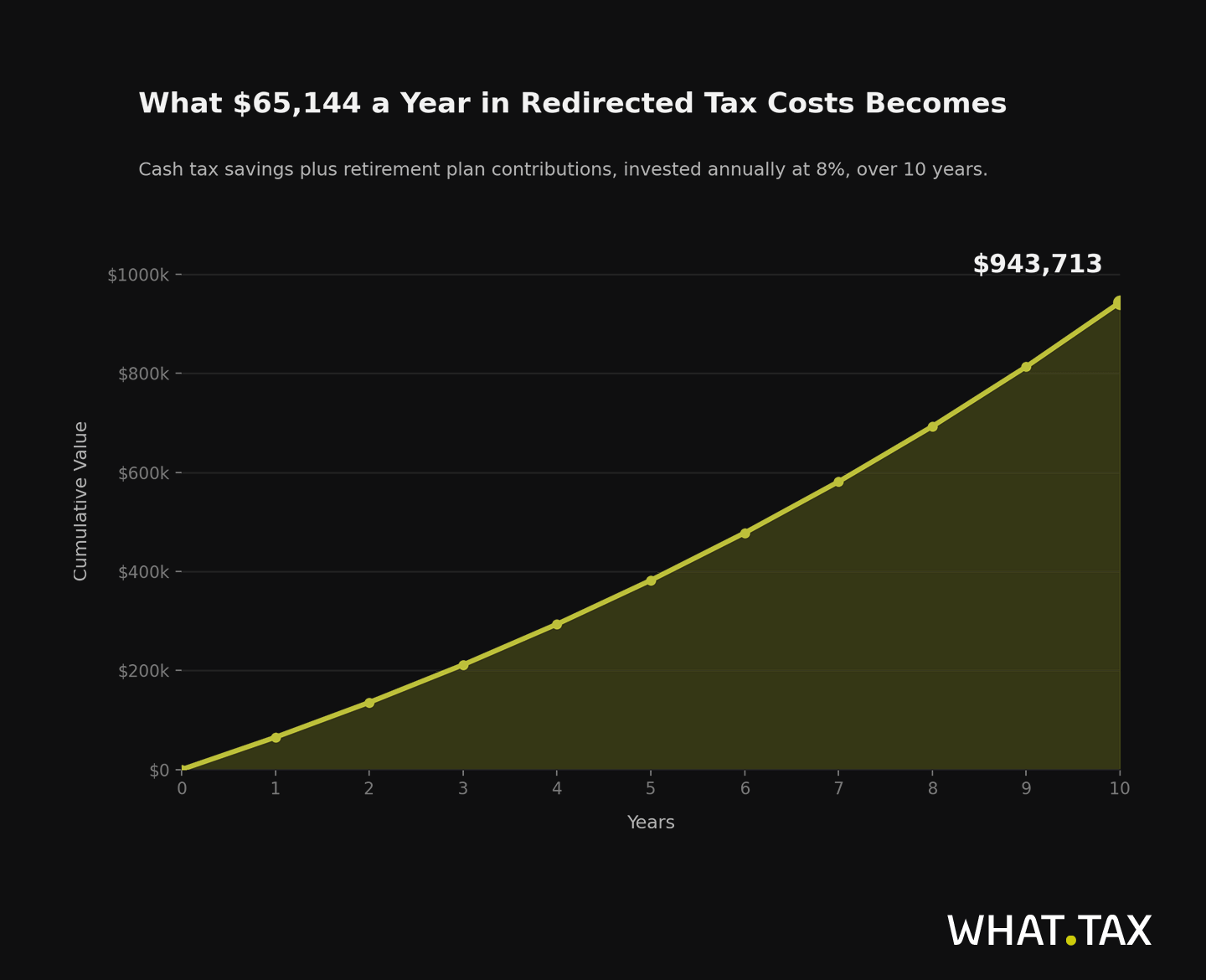
That’s not a projection about the tax code changing in your favor. It’s simple compounding math applied to a gap that already exists, right now, inside a lot of businesses that have never once separated “filing a return” from “running a strategy.” The retirement portion of that number will eventually be taxed on withdrawal, and markets don’t move in a straight 8% line every year. But the underlying point holds up against every reasonable caveat: a dollar redirected from an avoidable tax bill into an investable account this year is worth far more than the same dollar paid to the Treasury and never seen again.
None of this happens by accident, and it doesn’t happen once a year either. A real tax strategy behaves less like a decision and more like a maintained system, with a few recognizable parts.
A written, multi-year income projection, revisited at least quarterly, so that decisions like retirement plan funding and entity structure are made against where the business is actually headed, not where it happened to be twelve months ago.
A documented entity and compensation structure, reassessed as income changes, since the salary that made sense at $90,000 in profit stops making sense at $300,000, and the entity election deadline doesn’t wait for you to notice.
A retirement plan design chosen for what the business is projected to earn this year, not what it earned last year, since contribution limits and plan types both depend on current, not historical, numbers.
A calendar of deadlines that fall before December 31, not after, because almost every meaningful lever closes at year-end while the filing deadline creates the illusion that there’s still time.
A decision log. Not a formal document necessarily, but some record of why a given salary figure, entity choice, or contribution amount was set the way it was, so the following year builds on reasoning instead of guessing at what last year’s version of you was thinking.
That system is the actual work. The return that comes out the other end in April is just the paperwork confirming it happened.
None of this requires predicting the future or gaming the IRS. It requires treating the months before December 31 as the part of the process that actually matters, and treating the return itself for what it is: a report card on decisions that were made, or weren’t, while nobody was paying close enough attention.
If this is the first piece of mine you’ve read, welcome. I write about the parts of the tax code that actually move the needle for people building something of their own: entity structure, retirement plan design, timing strategies, the kind of decisions that have to be made months before a return ever gets filed. If that was useful, the free list is the easiest way to keep seeing pieces like it, and paid subscribers get the full mechanics behind them: the exact entity and retirement plan builds, salary figures, and filing sequences, not just the outcomes.
This article is for informational purposes only and does not constitute tax advice. Consult a qualified tax professional before making decisions about your estimated tax payments.
If you get value from this newsletter, please consider liking this post. It makes a significant impact and helps this work reach more entrepreneurs.
Thank you for your support.
No posts
Comments
Nothing yet. Say the first thing.
Sign in to join the conversation.