
Hi, I’m Dr. Sirisha, materials scientist with 20 years in manufacturing. You probably went swimsuit shopping recently and wondered which one to pick out. Today we are exploring what makes swimsuits stick or sag, and why some tend to lose their stretch.
In this issue:
Why a $500 racing suit can lose its edge after just a few meets
How your activity decides the fiber
Beijing Olympics & broken records
Supply chain and sustainability in swimwear
Elite swimmers pay up to $500 for a single racing suit, and some retire it after a few meets. Not because it rips but because the tight compression fibers stretch and lose their snap back quality letting it go slack. Meanwhile, the suit you wear a few times in the summer at the beach can last for years.
A swimsuit looks like a simple piece of clothing, but it has to do a lot of technical work.
It has to stretch. It has to recover its shape. It has to survive water, salt, chlorine, sunscreen, sweat, UV light, body movement, and repeated washing. It has to feel comfortable on skin, dry quickly, and hold color.
Elastane, also called spandex, Lycra, is about 20% of the swimsuit fabric, but it does much of the work: stretch out, snap back, repeat, thousands of times. It acts almost like a molecular spring. The problem is that spring breaks down over time in chlorinated water as chlorine converts to hypochlorous acid, and breaks down elastane’s molecular bonds fiber by fiber. A spandex-heavy suit can lose more than 60% of its tensile strength after roughly 300 hours in a chlorinated pool. The fabric stops snapping back, and a suit that was compressing muscle on Friday is baggy by the next meet.
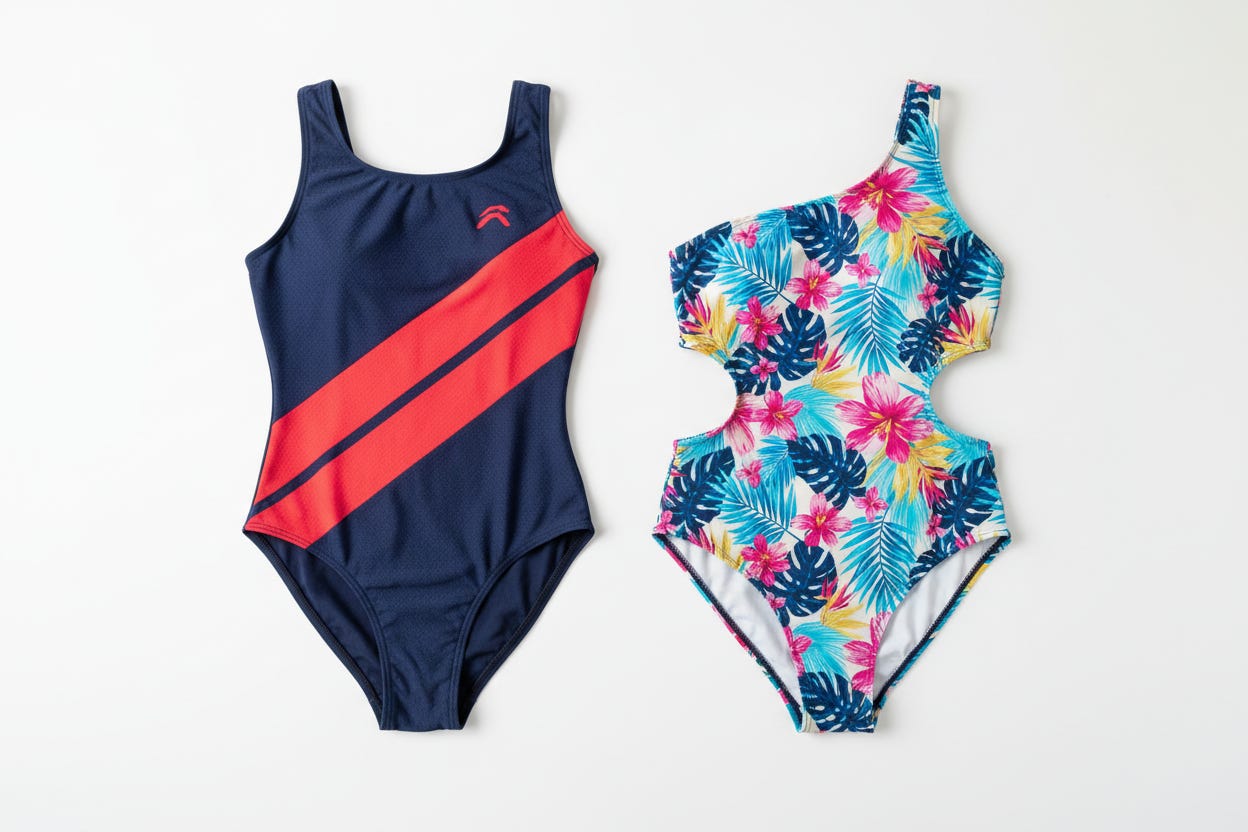
Image Credit: SwimOutlet
That’s why the fiber wrapped around the elastane matters as much as the elastane itself. Nylon is soft, takes dye beautifully, and stretches four ways, ideal for a beach suit that sees chlorine occasionally, but it fades and sags fastest under repeat exposure. Polyester is stiffer and less silky, but it absorbs far less water, which keeps chlorine away from the elastane underneath, an advantage for anyone doing regular laps. PBT (polybutylene terephthalate), a specialty polyester yarn, mostly skips the trade-off: it can be textured during manufacturing to stretch on its own, needs little or no spandex, and survives 200 to 300-plus pool hours without sagging.
Image Credit: SwimOutlet
So
beachwear is built on nylon,
everyday lap swimmers land on polyester,
and practice and racing suits are built on PBT.
Speedo’s LZR Racer, co-developed with NASA was worn for 23 of the 25 world records set at the 2008 Beijing Olympics. These full-body suits built from panels of bonded polyurethane and neoprene, reduced drag by 24% and boosted buoyancy. After the 2009 world championship, FINA now World Aquatics banned non-textile, bonded suits starting in 2010. They decreed that fabric had to be woven or knitted with no fastening devices and strict coverage limits. Coverage was capped at waist-to-knee for men and shoulder-to-knee for women.

Image Credit: DPA Picture Alliance Archive/Alamy Stock Photo
Competitive swimsuits runs on a narrow global chain. A handful of specialist mills in Italy and Portugal weave most of Europe’s competition swimwear, while final assembly for major brands is spread across factories in China, Vietnam, and Cambodia.
Traditional materials like nylon and polyester are petroleum based. These materials are often produced in high volume and after a short lifetime, pieces often end up in a landfill or second hand market.
Brands are now shifting toward bio-based materials and recycled inputs i.e. regenerated nylon reclaimed from fishing nets, recycled polyester from plastic bottles and some competition lines are now built from majority recycled fiber. Manufacturing at this scale isn't there yet, which keeps most of these lines in small production batches, but one bright spot is more brands exploring localized manufacturing to close that gap.
The journey to sustainability is limited by the materials chosen, process innovation, and manufacturing constraints. Sustainability is never a single fix, it's a collective effort across people and technology, spanning the full loop from how raw material is sourced to how it's eventually reclaimed and recycled.
It’s interesting, whether we look at semiconductors or swimwear, raw material sourcing, recyclability and manufacturing systems jump out as common constraints.
So, what is in your swimwear? Nylon, Polyester, Elastane/Spandex or PBT?
Drop a note in the comments….
No posts
Comments
Nothing yet. Say the first thing.
Sign in to join the conversation.