
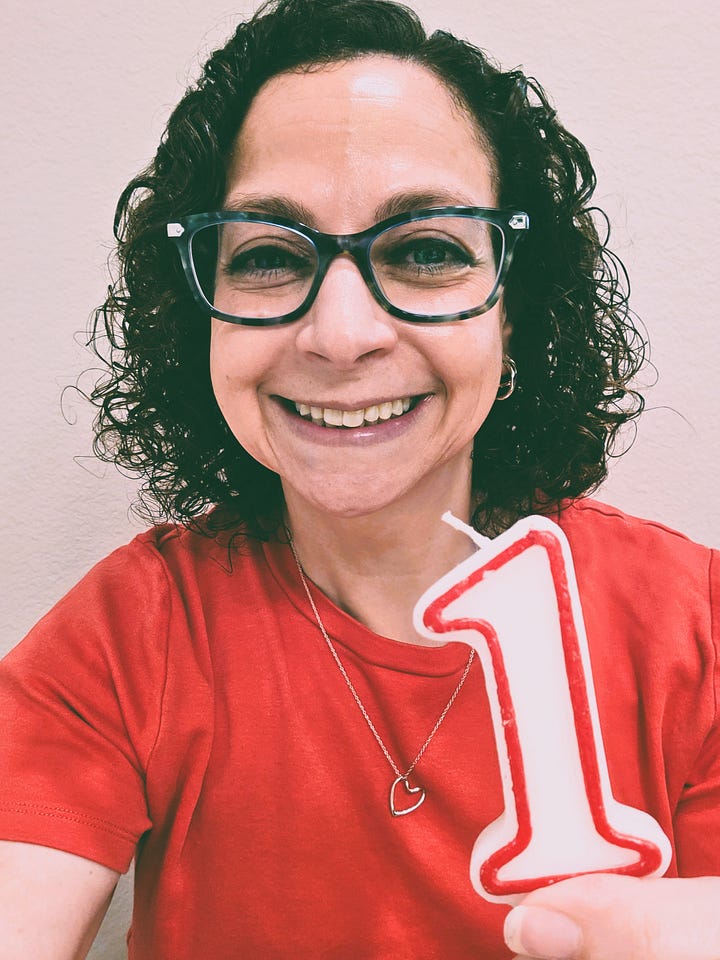

Today, as I celebrate one year of writing “What’s Her Problem?,” those words feel insufficient to express my gratitude to each of you. Every person who has read or listened to an article, clicked a link, made a comment, given a like, interacted on Notes, and, especially, subscribed, has made this venture worthwhile. The goal has always been to use personal storytelling to advocate for and connect with others.
I have two special surprises for Free Subscribers:
For the month of August only, I have removed the paywall from the two most recent episodes of the Interview Series! If you missed out on those conversations, this is your chance to catch up!
For this week only (7/31-8/6), I’m offering a 20% discount on annual subscriptions. That’s $48/year instead of the regular rate of $60. Even better? You will be locked in at that rate for all future annual renewals. If you’ve found my articles valuable, please support my work by upgrading to a paid subscription!
In preparation for this 1st birthday, I asked you, the readers, to submit questions. I’ve selected four to respond to here. Thank you to everyone who participated!
First of all, I want to mention that Melanie is a Nationally Board-Certified Health and Wellness Coach who writes the Substack Your Best Life Made Easy: Thriving After 50, which is both for the 50+ and the 50- crowd, as she puts it. I hope you’ll check it out.
Melanie, thank you for the question and for being such an engaged reader. As my physical therapy team would tell you, I have a pretty long list of goals, some of which are more realistic than others. And I do keep a written list that I refer back to periodically to make sure we’re not losing the plot.
I think the most realistic thing on that list is to rely more on my cane than my walker. I tend to use the cane inside the house, where I feel safe on flat surfaces and have walls to lean on for balance checks. Out in the real world, uneven surfaces are nerve-wracking. Lots of opportunities to trip and fall, as well as the odd sensation of sort of floating in space if I don’t have two hands on my walker. But I do think this is achievable and so does my PT team.
Walking with just the cane outside is something we work on pretty regularly at PT, and I’ve started working on it at home too, but in both cases, I bring someone with me for supervision and assistance, in case I do lose my balance. The catch is that I don’t travel lightly (to put it mildly), so once I try to carry a bag, a bottle of water, or any other objects with me, my balance goes south pretty quickly. So, we’re working on that. The key is to work towards goals like this slowly and steadily without causing any setbacks along the way.
What would it mean to get there? It would make a lot of logistics easier for me, for activities like shopping or traveling, and even getting through doors (!), which is why I prioritize it so highly. But from more of an emotional meaning perspective, I think it would take me to the next level of feeling independent.
The cheeky answer to your question is that I want to learn how to play tennis again, but right now, that still feels like an accident waiting to happen. So, I’m not sure how realistic it is, but it’s definitely on the long list of goals!
Yes, this question has come from my father, who asked politely if family members were allowed to participate in the AMA (which, for the record, they certainly are!). And he asked a great question.
As he has seen up close, I have good days and bad days on the mental health front. I think the work of maintaining your mental health is a never-ending process. Not because it’s impossible to conquer but because no one’s perfect, life is unpredictable, and there are always improvements to be made. For example, I still cry easily in frustration over setbacks or feeling unheard by physicians, but that doesn’t mean I’m not handling things well. It means I’m still trying and that it’s normal to have difficult moments along the way. Especially when you have multiple conditions that you’re managing simultaneously, as so many of us do, it can be hard to parse out which symptom to attribute to which disease, and that can exacerbate the mental health challenges.
I’d like to point you towards two resources where I’ve spoken about mental health and chronic illness:
The first is a blog post I wrote about a year ago for Launch Psychological Associates, which outlines my top 8 Tips for Managing Chronic Illness and Mental Health.
The second is a panel on “Mental Health and Heart Disease” that I participated in for WomenHeart in May 2026. I am one of their WomenHeart Champions. As I mentioned in this Note, the other panelists and I all have different conditions, but the emotional experience of heart disease has been the same for all of us. The panel was moderated by a fellow WomenHeart Champion who is a psychologist. Even she faced the same challenges as the rest of us, when it came to the mental health aspect of her sudden cardiac event. Knowing that everyone’s schedules are busy, I do think this video is worth your time:
Dear Anonymous, whoever you are, thank you for reading “What’s Her Problem?” and asking this important question. To start with, I want to make sure no one thinks it’s all hopefulness, sunshine, and roses. I know that my articles often end with an issue tied up neatly in a bow, but that’s not the case all the time, as you can probably tell from the answer to the previous question. So, knowing life with chronic illness can feel messy or challenging and it would be easy to lose hope, how do I keep that hopefulness alive? Here are a few ways that come to mind:
The most concrete answer I can give here is about science and medicine. So many advancements are being made in research and treatment options that there is always a chance something that can help you is on the horizon. I wrote about how that has been the case for many of my fellow Hypertrophic Cardiomyopathy patients, with the advent of a new class of drugs, and why I was hopeful, even if I couldn’t take advantage of that opportunity.
The same idea holds true for other diseases though. For example, I was recently talking to a friend about how, 20 years ago, no one knew what Fibromyalgia was, but now it is widely recognized and has defined treatment plans. I remain hopeful that help in new forms might be just around the corner.
In the category of “more abstract ways I stay hopeful,” I make sure I always have things to look forward to in my personal life. I’m fortunate to have a great support system, so I might be looking forward to something as simple as an upcoming phone call I’ve scheduled with a friend or a tv show I’m excited to watch. I might also have something big like a trip, an outing to a tennis tournament, or attending a wedding on my calendar. But if a big event feels overwhelming, think about what feels manageable. I play mahjongg online with my sister and our first cousins about once a month. A friend and I catch up on Zoom and watch tv shows together nearly weekly. Another friend and I exchange long video messages. All simple but meaningful.
I am also motivated to stay hopeful by my desire to be here for certain future events. When my sister announced her pregnancy last December, she bought me a picture frame with the baby’s ultrasound image in it that says “My Favorite People Call Me Aunt.” It’s true! In addition to my adorable nephew, who was born in June, my godson, his two siblings, and their two cousins all call me Aunt Deb. As someone who has had a couple of near-death experiences, I think there are reasons I am still here. One part of that reason is to share my story, but the other part is to actively participate in the lives of these kiddos as they grow up. That gives me hope.
Lastly, I’m hopeful because I see examples of other people with chronic illness remaining hopeful and living great lives. I’m grateful for communities like the Hypertrophic Cardiomyopathy Association, WomenHeart, the other writers in the chronic illness and disability space on Substack, and any online group I’ve ever interacted with because that’s how I know it’s possible.
Hi Jessi! Thank you for this, and I hope you’re feeling as well as possible. I think the most important thing I can say is that a new chronic diagnosis IS overwhelming. There is so much to process, as well as appointments to plan and questions that need answers. So, the first thing is not to feel like you’re an anomaly or that you’re not dealing with it the right way, if that’s how you feel. There is no right way. There’s only what works for you. If your head is swimming or you’re doing a lot of what-iffing about how this new diagnosis might impact your relationships, your work, etc., all of that is completely ok!
Three things help me feel less overwhelmed and able to handle what lies ahead:
Arming Myself with Information. I consider myself a student of my diseases, constantly educating myself about them. I’m always willing to find new paths forward, learn new things, do detective work, and search for answers. Even if I end up hitting a dead end, I’ll just start down another path. The more I know, the better prepared I feel to face it.
Mental Health Therapy. This is one of the tips included in the blog post I mentioned in a previous answer, and I firmly believe in talk therapy. I first started talking to a therapist a few months after I was diagnosed with Hypertrophic Cardiomyopathy (HCM) in 2011, and I have continued to do that on and off (but mostly on) ever since. I’ve been working with the same therapist for quite some time, and since she knows so much of my medical journey, she’s really helpful in providing perspective. At first, with HCM, and especially the fact that I needed open-heart surgery, she helped me reframe my thought process. Instead of looking at it like a death sentence, which I very much did, it became something I could manage with the tools she provided. She reminds me now that even if I’m having a tough moment, I’ve come pretty far.
Finding Community. That can look like a lot of different things. A Facebook group where people with your diagnosis chat about their experiences. A patient advocacy group. An online or in-person support group. A one-on-one conversation with someone else with your diagnosis. Just don’t try to manage it all on your own. I wish I had been more open to leaning on my support system and talking to other patients much sooner after I was diagnosed with Hypertrophic Cardiomyopathy, and I truly believe my path would have been a smoother one as a result.
Even if you’re overwhelmed now, you’ve got this! And reach out if I can ever be helpful in your journey.
Thank you again to everyone who submitted questions! If you’ve missed out on any articles in this first year, you can go back to them at any time by visiting the “What’s Her Problem?” Archive. I’ve got loads of topics lined up for us to tackle together in year 2.
If you’ve gotten any value out of reading or listening to my articles, please subscribe or upgrade. Your support means so much!
1st Birthday Subscription Discount
Each issue of “What’s Her Problem?” includes questions for further discussion. Leave a comment below!
This week’s question:
Do you have any other questions for me? I will periodically be opening the “Ask Me Anything” inbox in an official way, but feel free to message me with questions any time, or drop them in the comments, and I’ll keep them for future reader-focused articles.
Up Next:
I receive Social Security Disability Benefits (SSDI) and recently underwent my first Continuing Disability Review process. Next Friday, 8/7, I’ll take you through that experience and all the emotions that came with it.
Comments
Nothing yet. Say the first thing.
Sign in to join the conversation.