
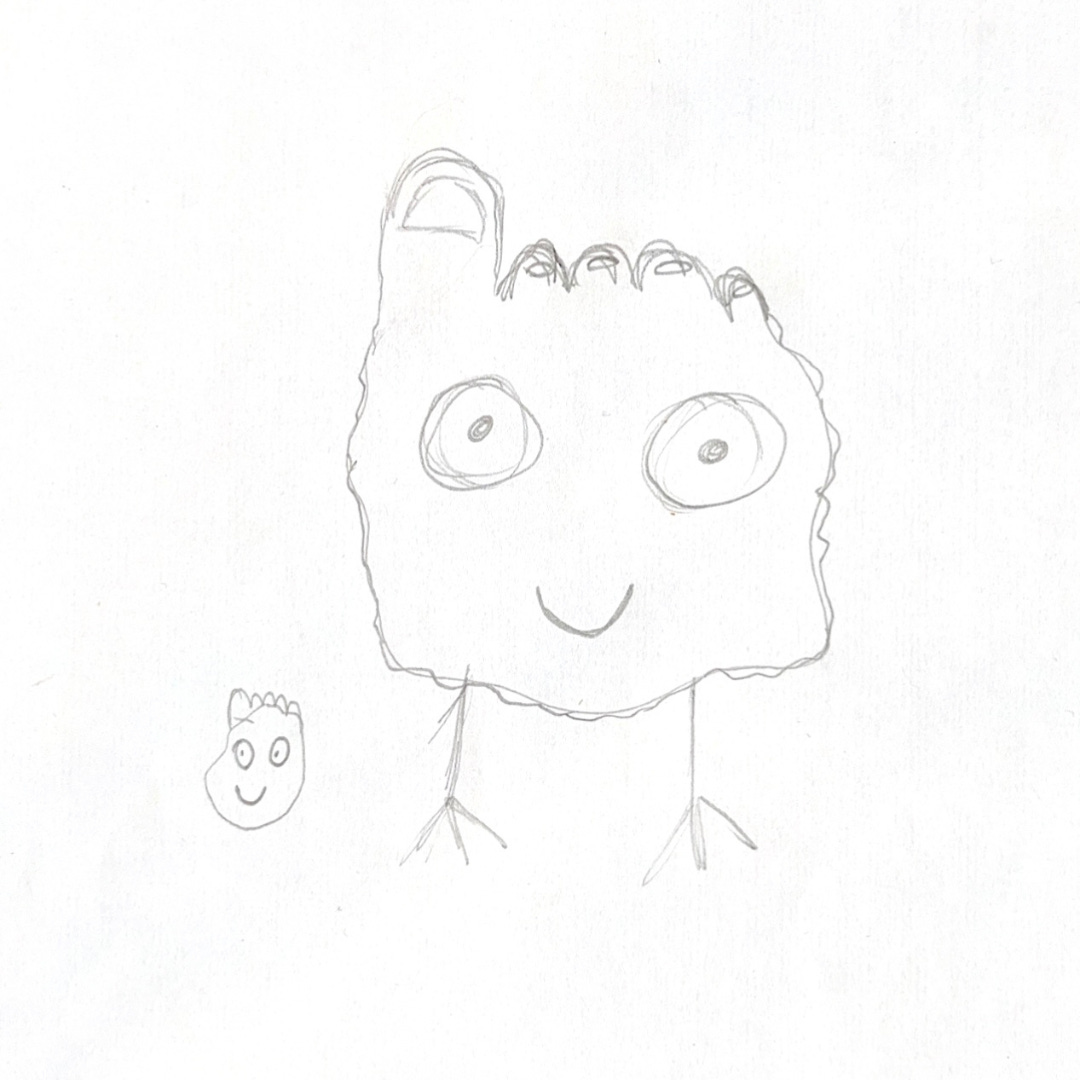
When Maisie was about five, I collected her from school one day and it was clear she'd been crying. The teacher had said they couldn't get to the bottom of it, and the moment we got outside the school gates she burst into floods of tears. She was inconsolable and crying so hard I had to scoop her up and carry her the 15 minute walk home.
Once we got in, I made her a hot chocolate (there's not much in the world that a hot chocolate can't help), curled up on the couch with her in my lap, and tried to calm her down enough to try and tell me what happened. Through those impossibly blue eyes, still brimming with tears, she looked at me like I held all the answers in the world, and with her voice catching on every word she said:
'Starr... called... me... a... chickenuggetfoothead.'
'Oh' I said, 'I'm sorry, that's really awful.'
She nodded with tears ready to spill again at any second.
'And are you?'
'Am I what?' she sniffed.
'Well, are you a chickenuggetfoothead?'
She looked slightly off to the side for a minute and I could see this question had taken her aback. She considered it for a moment, and then tentatively said 'No?'
'Oh good!' I said.
‘Just because someone says it doesn't mean it's true.’
I'll never forget the little smile that dawned across her face and her determined:
'No! I'm not a chickenuggetfoothead - I'm Maisie!'
And that was it – off she went, happy, content, and absolute in her sense of self.
This five-minute conversation with my daughter has become the foundation of how I help women rewrite their internal narratives. Not because I think they are chickenuggetfootheads, but because it's the simplest, and probably most obvious, demonstration of what happens when we take on board other people's ideas and stories of who we are.
I've had so many conversations where people tell me something about how, or what they believe, they are – not good at getting things done, bad with money, reckless, pathetic, stupid, unreliable, lazy... And often these things, these traits they think they have (or are), are directly in conflict with how they've demonstrated themselves to be. So when I reflect back what I see, I also have to ask: 'Well are you?'
More often than not, when we dig down into what these things are, or where they come from, they can be traced back to tiny moments and often off the cuff comments from a teacher, a parent, a grandparent, or sibling, or a friend, or even in one situation a random stranger at the park. Moments where we have taken what someone has said to us and not just held onto to it, but carved it deeply into the stories of who we are, into something we believe so much it drives us forward, to try harder, to push through, to please more, to prove we're responsible, or clever or kind or loveable.
But trying to prove the unprovable is an impossible game. While we're fighting this belief we've tied ourselves to we'll never be free of it. But if we stop and question it – Am I? Are we? Really?
Just because someone says it does not make it true.
When I had postnatal depression and postnatal psychosis in the year after Maisie’s birth, I had so many intrusive thoughts I literally couldn't sleep at night. I spent most of my days terrified of what was in my mind. Then I was taught that the best way to deal with them is to notice the thought, name it (‘this is an intrusive thought’), and then put it aside – it's not real, it does not serve me. Ridiculously simple, and strangely effective.
The danger comes when you either focus on them – why you're having them or what they mean – or you pretend you're not having them, which is the mental version of sticking your fingers in your ears and saying 'Lalalala I can't hear you' while obnoxiously loud music plays from 20 foot speakers all around you.
We all have these voices in our heads that say not very nice things to us, and like my intrusive thoughts it's how we work with them that matters. I like to call the nasty voice in my head Rumplestiltskin, after the fairy tale character, because as soon as I say his name - as soon as I recognise the nasty thought as not my own - he will stamp his little stompy green goblin legs and disappear.
That does mean there are times when I’ll be in the middle of something - a job interview or a meeting say - and whilst I’m sat there listening I’m also actively thinking: ‘Rumplestiltskin. Rumplestiltskin. Rumplestiltskinrumplestiltskinrumplestiltskinrumplestiltskin.’ But I figure that’s better than sat there thinking ‘you’re such a liar, no way you can do that, mwahahahaha who says such a stupid thing, you should be so embarrassed, who do you think you are?’ If the voice is going to be there I’d rather it was stomping its foot until it fell through the wooden floor of the barn than ruling the entire kingdom of my mind.
Recently someone asked me how they get rid of the voice. I think it's a process. I don't know if we ever get rid of it altogether. I reckon I've had mine for nearly 50 years, it's not disappearing in a puff of smoke anytime soon, but what has changed though is its power – and its power over me. I no longer believe it's true just because someone else said it.
If this thing you’ve been believing is not true, what else are you believing about yourself that's not true? How would you define yourself now? Who would you like to be in the future?
So here's your homework: The next time your own Rumplstiltskin voice pipes up with its tired old script, ask yourself the question that saved Maisie's day, and changed how I see myself forever. Are you? Really?
I am definitely not a chickenuggetfoothead. Are you?
No posts
Comments
Nothing yet. Say the first thing.
Sign in to join the conversation.