
The good news is that we humans are thinking machines. We have marvelous systems functioning throughout our bodies, and we are capable of thought. We are sentient, meaning that we are aware of ourselves as beings separate and apart from others.
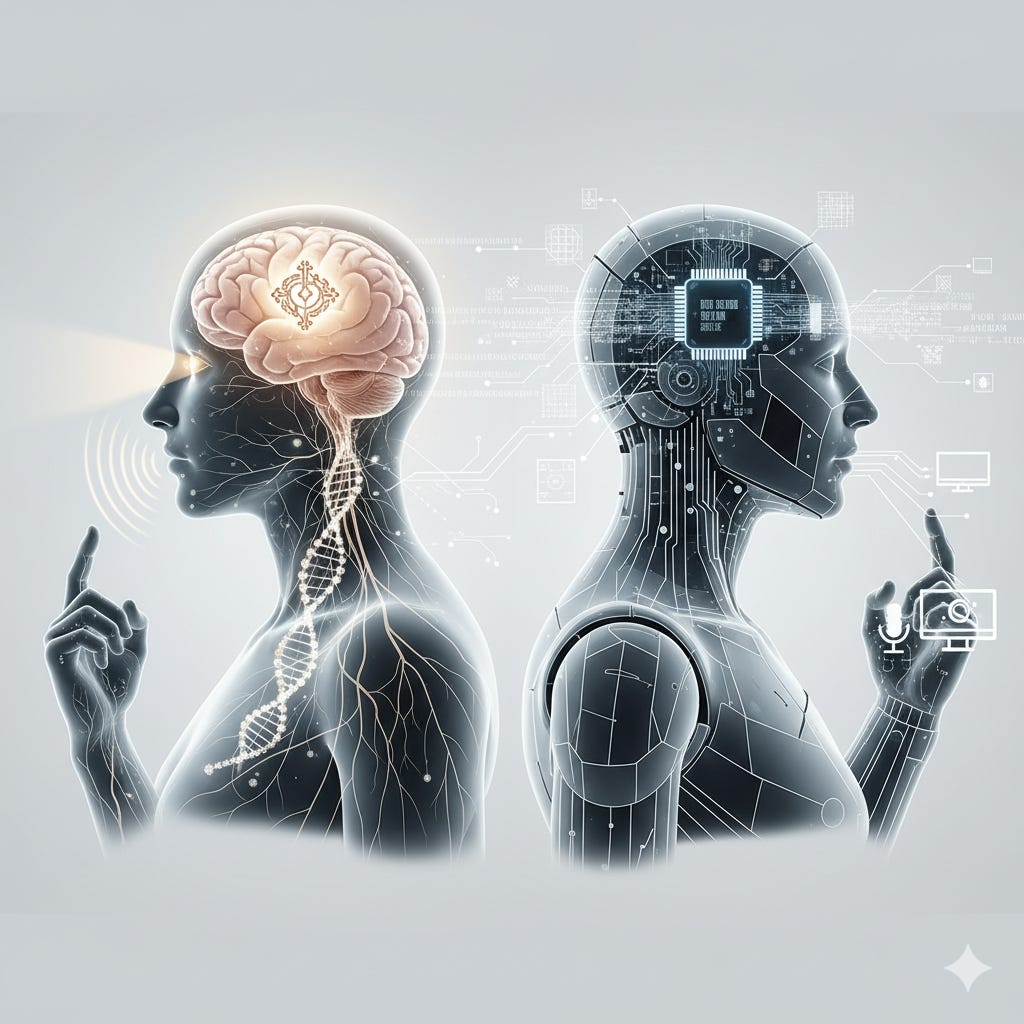
Perhaps even better news is that, so far, computers are not thinking machines. Ask any true expert in the field of artificial intelligence (AI) and they’ll tell you what it does is really pattern-matching. It translates everything into patterns, assigns weights to them, and then compares those weights and those patterns to determine what to do next. When it speaks to you or you read anything produced by AI, that system produces what is said by continuously coming up with what the next word should be.
It’s not thinking. It’s not reasoning. It’s pattern-matching.
Humans and computers do have several things in common!
· We both have processors. Ours is in our brain, theirs are in their motherboards.
· We both have information storage. Again, ours is in our brain. Theirs is in some mechanical assembly either with a spinning disk or solid-state circuits.
· We both have input devices. We have our eyes, ears, nose, and skin. They have keyboards, cameras, microphones, and other telemetry-gathering devices.
· We both have output devices. We have our mouth and our bodies which can gesture and type. They have display monitors, speakers, headsets, printers, plotters, and there’s a rumor someone is working on Smell-O-Vision!
· We both have networks. Ours is composed of nerves and nerve endings that are connected to every part of our bodies. Theirs are either copper, fibre-optic, wireless, or other.
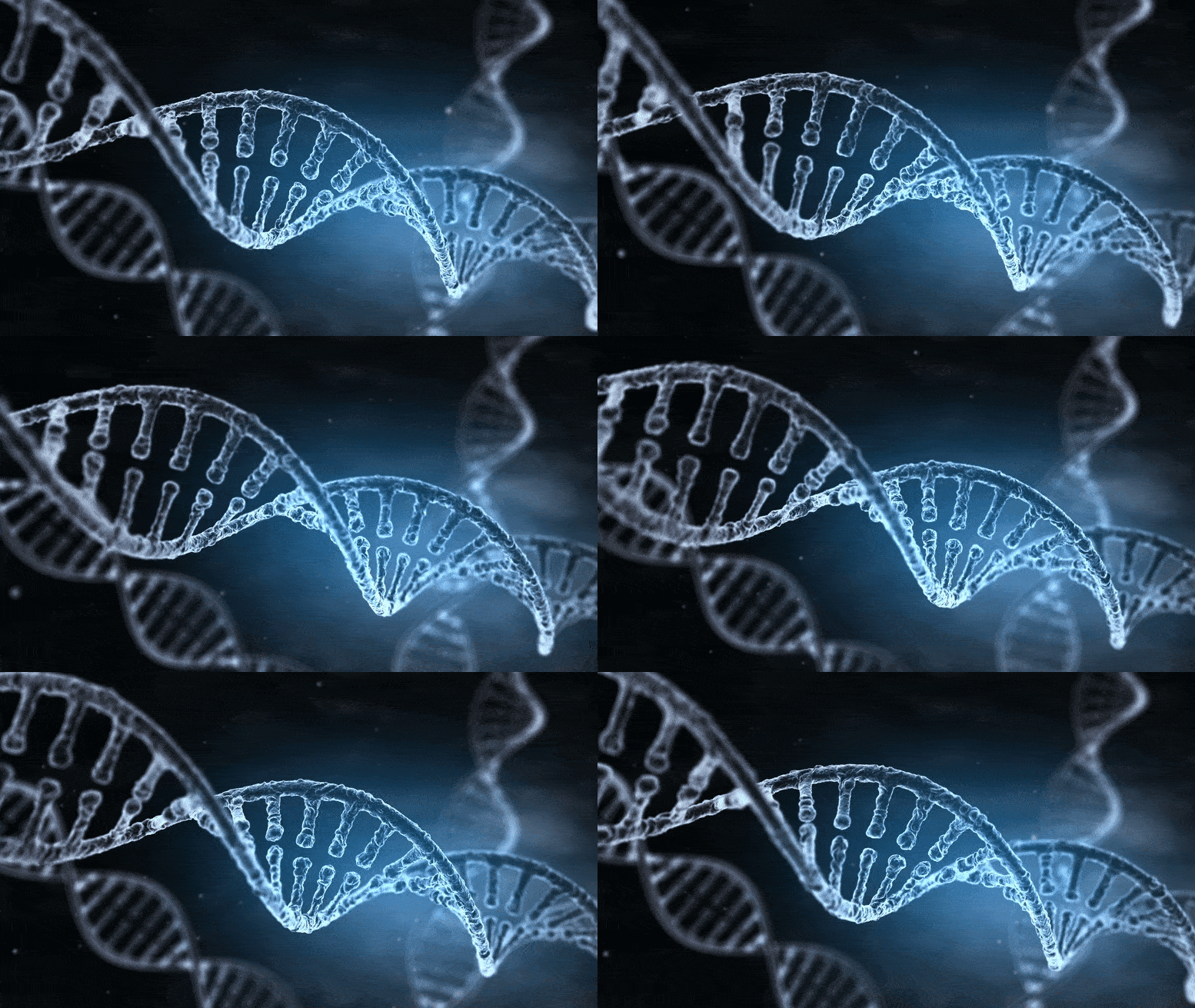
There are several differences. We have DNA that carries encoded information and experience from all the generations of mothers, fathers, foremothers, and forefathers that ultimately led to us. We pass that along to our children and grandchildren to continue that ongoing chain.
Most would say that the big differences are that we have emotions and feelings, and some would point out that computers do a remarkable job of imitating that. Better and better all the time, in fact.
But let’s go back to the processors.
The Wikipedia tells us that “a computer processor (CPU) is composed of core units that fetch, decode, execute, and store results: the control unit, arithmetic logic unit, registers, and on‑chip caches, all synchronized by a clock signal. Modern CPUs also include memory-management and interface logic to coordinate with RAM and I/O devices for efficient data movement and protection.”
Then there’s the Instruction Set Architecture (ISA). The Wikipedia explain this as, “the software-visible contract that defines what operations, registers, data types, memory/privilege model, and I/O semantics the processor must support, and the control and execution units in the CPU are built specifically to implement that contract faithfully.”
In simpler terms, the instruction set is just what it sounds like, the set of instructions the processor can execute using all the other parts mentioned earlier, like addition, subtraction, and other computations.
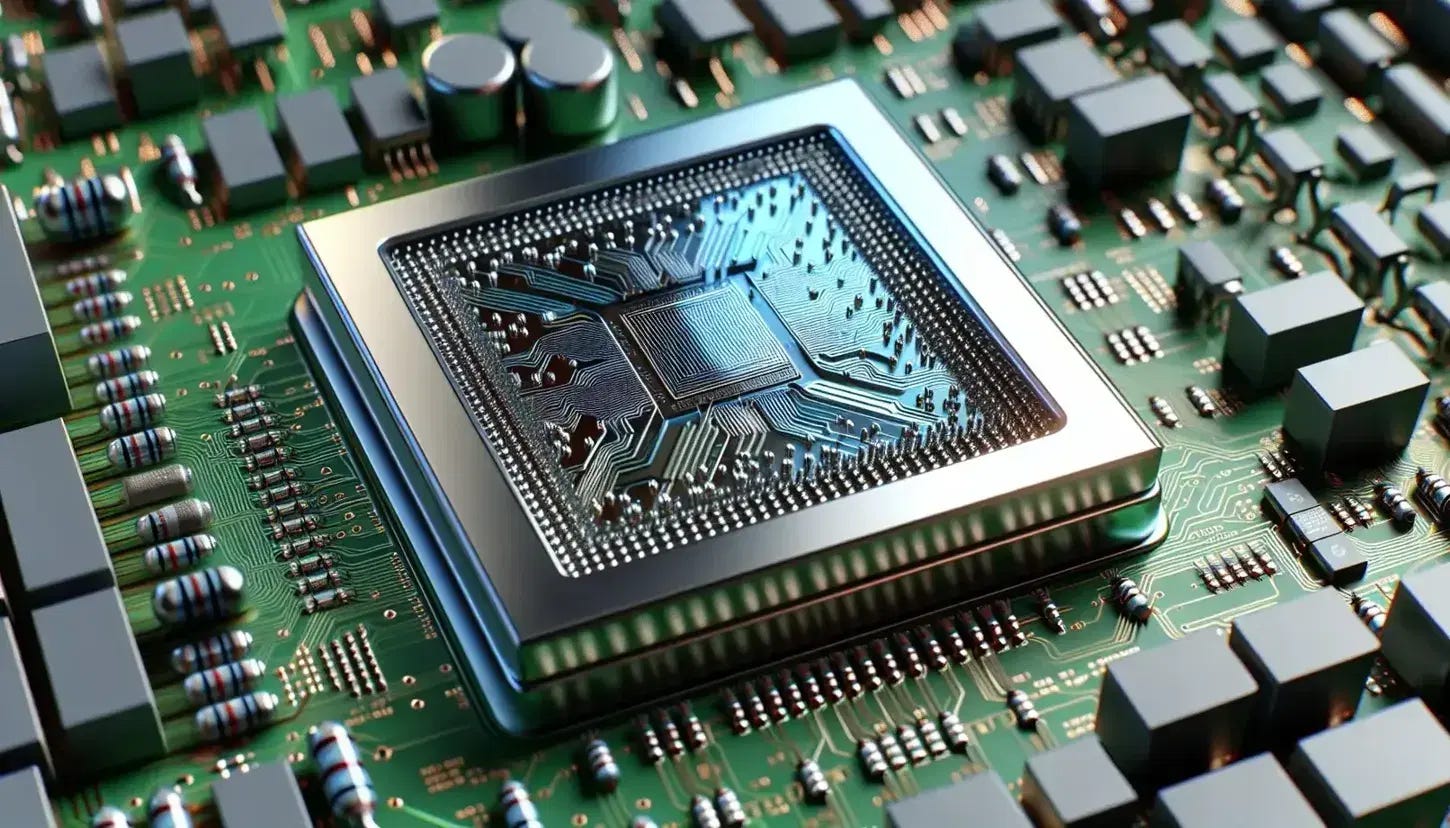
It shouldn’t come as a surprise that the human thinking machine’s processor also has an instruction set. It may not process data as fast as the computer, and it may not retain data as faithfully as computer storage does, but it does the best it can. This is why AI is so incredibly valuable to us. It does what we do except much faster and with much better data access and retention. It just needs us to tell it what we need it to do. That’s why Microsoft named their AI offering Copilot. Others like Google and Perplexity refer to the Assistant.
Now that we’ve established the similarities, we can discuss the difference, the all-important difference.
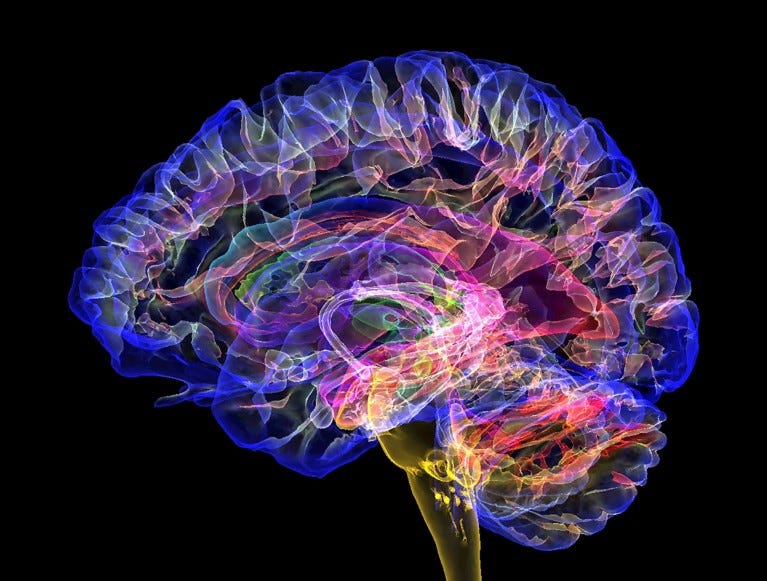
My evaluation of my observations is that our brain, our central processor, has an instruction or instructions in its instruction set that we simply haven’t defined. We were able to emulate the rudimentary mathematical and logical stuff, but the are things our processor can do that we don’t fully understand. You can add more memory, more storage, higher and higher clock speeds, and everything else to your computer, but without that mystery instruction set, they can’t duplicate what we do.
Were I to start quoting all the poets, authors, philosophers and others who have opined about the residence of life, we’d probably fill a book, so I simply went back to Wikipedia:
“Across traditions, “life” has been said to reside in the heart, the brain, the blood, the breath, a specific organ like the pineal gland, the distributed soul in different body regions, the present moment, and even in the stories we tell to make meaning. These views span philosophers, religious texts, and modern authors who place “life” in a physical organ, a vital fluid, a moment in time, or a meaningful narrative frame.”
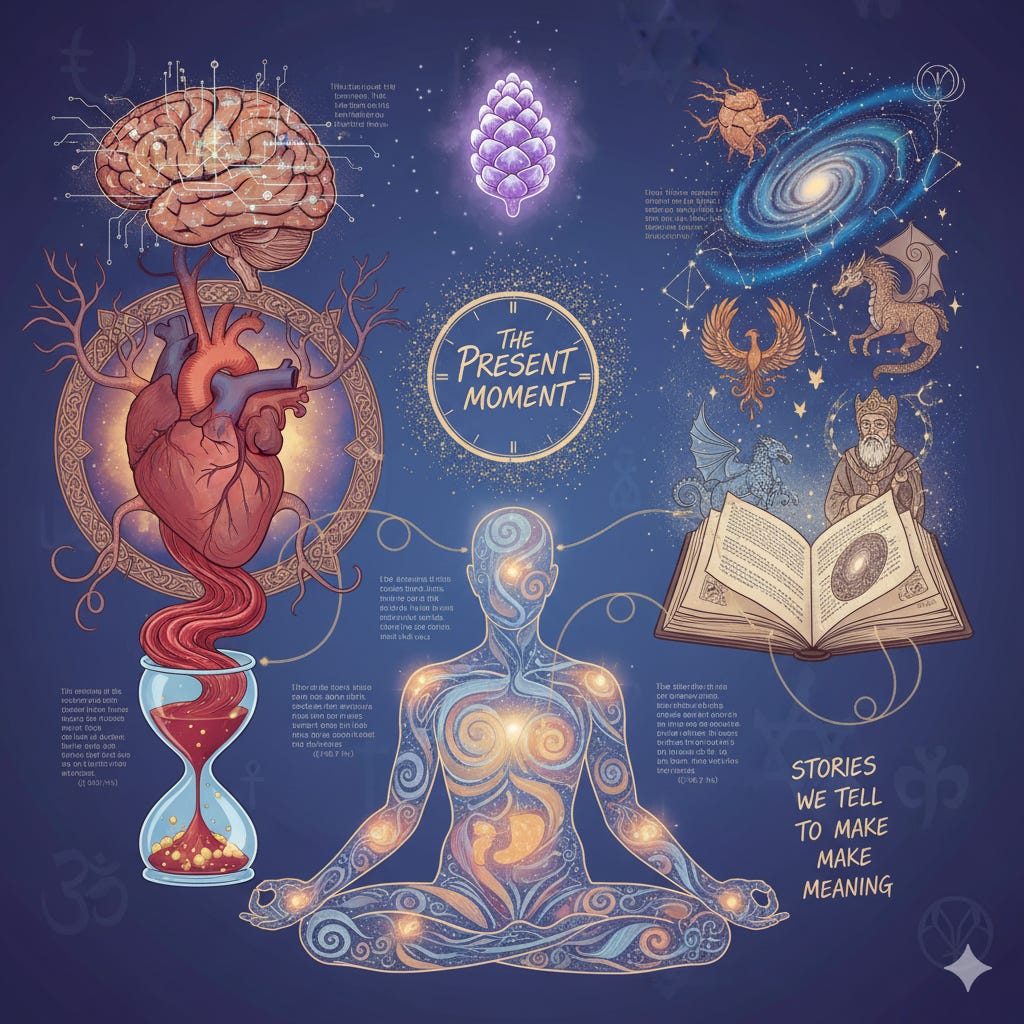
Let me suggest a different characterization, that life is the information we humans process. What we think and feel, the information that flows through our brains, our nerves, all our sense organs, and across to other human beings define what our life really is. Our thoughts are the definition of our lives.
Accordingly, death occurs when our bodies can no longer support the various functions that enable us to think, so that information simply disappears, leaving behind only what we’ve shared with others that they retain. As such, it could be said that such great thinkers as Plato, Aristotle, Socrates, the Buddha, and Jesus Christ still live among us as their lessons continue to be passed down from generation to generation.
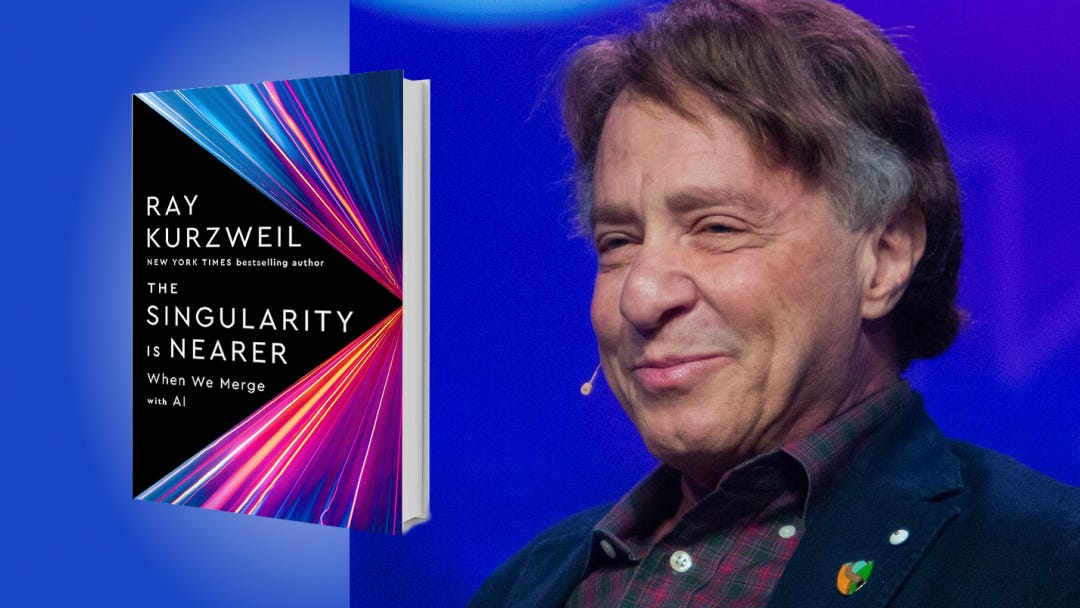
In his books “The Singularity is Near: When Humans Transcend Biology” and “The Singularity is Nearer: When We Merge With AI”, American computer scientist, author, entrepreneur, futurist, and inventor Ray Kurzweil defines the Singularity as, “the moment nonbiological intelligence exceeds human cognitive abilities and then integrates with human cognition, altering the trajectory of civilization. It feels like a “singularity” because the progress curve becomes so steep that, from a limited human vantage point, change seems practically unbounded.”
Seen through my lens, it’s the moment somebody figures out how to add to computers that as-yet-undefined instruction that we have that computers don’t. Personally, I’m very cool with that. Kurzweil first projected the Singularity would happen around 2045, but he has subsequently suggested it could occur as soon as 2027. I believe it’s going to take much longer to figure out that missing instruction and how to emulate it.
If we agree that life is defined by the information we humans process, then the first potential consequence could be the ability to preserve it beyond the physical death of the human body that first hosted it. If we can transfer all the memories in a human brain, estimated to be only about 300gb, to a computer using Musk’s NeuraLink or similar device, and we have that missing mystery instruction installed in the computer’s processor, there’s every reason to believe we can re-establish the consciousness, the presence, indeed the defining life force of a person in that computer.
This is not a new concept. Versions of this story in books, movies, and television are many, including:
Books
Greg Egan, Permutation City — explores copies of consciousness running in simulated realities and the philosophical implications of substrate‑independent minds.
Charles Stross, Accelerando — follows successive generations through uploads, post‑human transitions, and civilization migrating into computation.
Roger Williams, The Metamorphosis of Prime Intellect — examines a superintelligence enforcing Asimovian constraints after near‑total digitization of humanity.
Rudy Rucker, Software/Wetware series — features mind copying between humans and machines, probing identity and continuity of self.
Neal Stephenson, Fall; or, Dodge in Hell — depicts a detailed digital afterlife created from a human brain scan and iterative reconstructions.
Iain M. Banks, Culture novels (e.g., Surface Detail) — include citizens “subliming” or existing in vast computational afterlives managed by superintelligent Minds.
Movies
Transcendence (2014) — a dying researcher uploads his mind, triggering questions of autonomy, control, and the scope of machine‑augmented agency.
Tron (1982) — portrays a human digitized into a computer system, dramatizing embodiment and identity inside software.
The Matrix (1999) — while centered on simulated reality, it engages with digitized consciousness and the boundary between minds and computation.
Chappie (2015) — features human consciousness transferred into a synthetic body via neural digitization.
The Lawnmower Man (1992) — explores a mind merging with and persisting in networks following radical augmentation.
Television
Black Mirror: “San Junipero,” “White Christmas,” “USS Callister,” “Black Museum” — presents uploads, digital clones, and afterlives in simulated environments with ethical and legal dilemmas.
Upload (Amazon) — centers on a commercialized digital afterlife where deceased persons’ minds are hosted as software services.
Caprica (Battlestar Galactica II sequel) — features a teen’s consciousness reconstructed into a cybernetic body and virtual realms, probing grief and identity.
Doctor Who: “Silence in the Library/Forest of the Dead,” “The Bells of Saint John” — depicts human minds stored, uploaded, or trapped in vast data systems.
Star Trek (multiple series) — recurring episodes involve mind transfer, digital copies, or personalities instantiated in computers and androids.
Interactive and other media
Soma (video game) — uses brain scans to instantiate multiple copies in machines, confronting players with continuity problems and moral status of uploads.
The Talos Principle and related narratives — contemplate synthetic minds, uploaded identities, and tests of personhood within computational spaces.
This obvious obsession with the concept of preserving human thought beyond human body life can also be seen in the actions of the tech billionaires, many of whom believe they can achieve it in their own lifetime and thereby become immortal, as they feel they are entitled to.
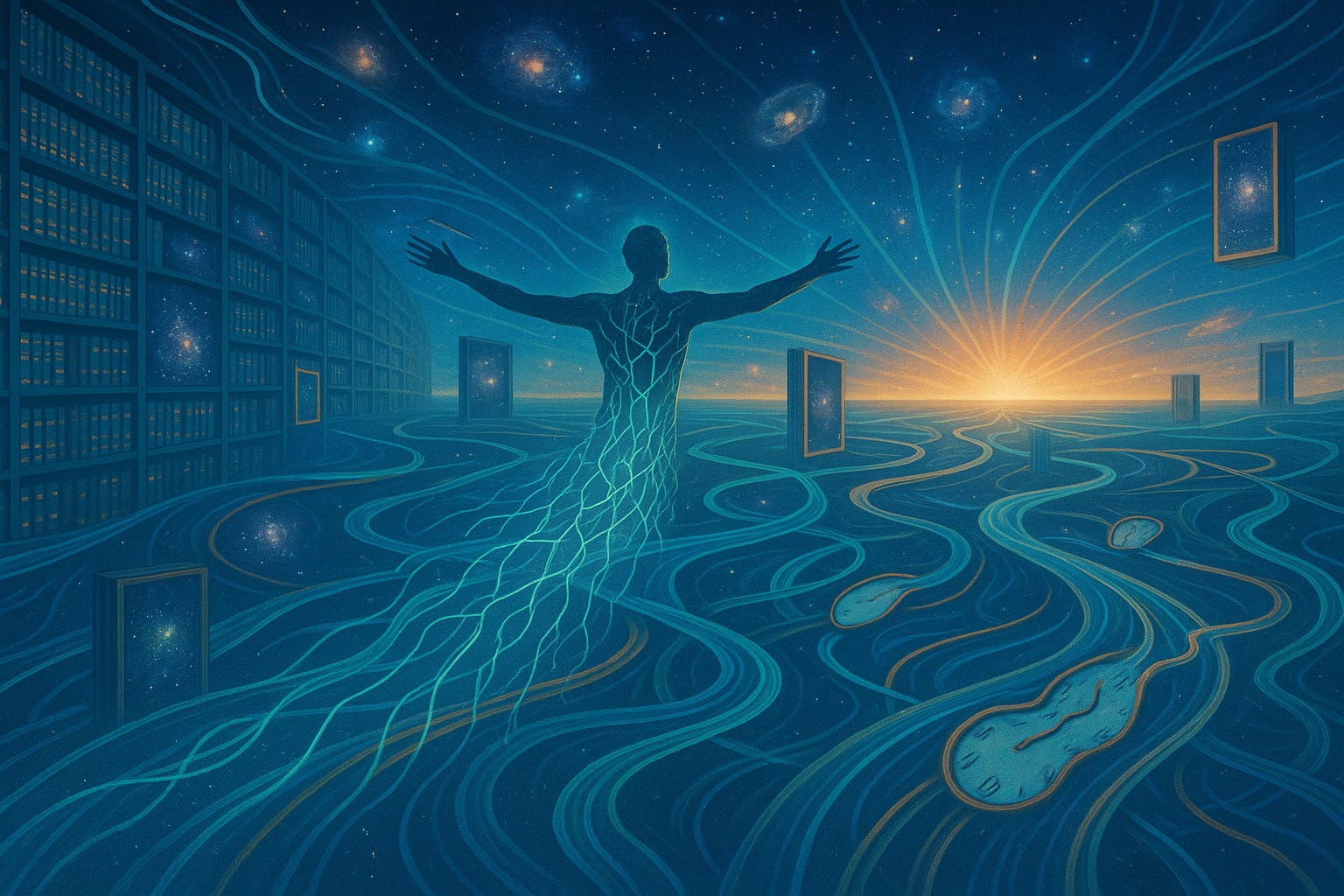
And so, we bring this discussion back to our core question, what do you want.
Some already believe we do live forever, as in the Buddhist concept of reincarnation. This, however, is a reasonably viable path to actually achieving it. Replace the body including the brain with a sturdier, more resilient, faster, more stable silicon-based host and what do you come out with?
Is it the same person? Is it that person augmented to the speed and access of a computer? Is that a superhuman? With computer networking does it become a telepath? (Do they?) With virtual reality worlds abounding do people become a race of super-hedonists indulging themselves in every fantasy ever?
Here’s what I’ll leave you with. Imagining all the possibilities of complete human-to-machine transfer, many of which could become catastrophic beyond our current fears of AI, how do we plan for that potential future? What do we do now? And how do we get started in a world whose current leadership denies science and refuses to believe in climate change?
Think about that, decide what to do, and be sure to ask yourself, “Do I want to live forever?”
Let me know what you come up with!
Comments
Nothing yet. Say the first thing.
Sign in to join the conversation.