
After several hours of hanging with my hosts, Melanie and Erik in Astoria, Queens, I packed up the last of my gear and headed down the street to Aretha. Erik helped me to carry my luggage the three blocks to the car where we said our goodbyes. I thanked Erik again for his generosity and hospitality, gave him a big hug, and jumped in the Buick.
It took me just 45 minutes to get from Astoria to Mickey Spillane’s Restaurant in the northern burb of Eastchester. My friend Meghan who had arranged the gig as a fundraiser for a group called The Home Program was waiting patiently for me right out in front of the restaurant. I found a spot to park for a few minutes while I unloaded my gear, and began to load-in.
I had my stage all set up and the car stowed in a parking lot across the street within a half an hour. To finish getting things ready, I arranged my merch on a pair of tables and set up a tip jar near the stage. With everythingin place, I sidled up to the bar and ordered a Pilsener Urquell on tap, which was cold and delicious.
Meghan was already chatting with several members of the foundation as I made my way over to say hello. I met several of the terrific folks who help to keep their volunteer run organization humming. Everyone was incredibly kind and appreciative that I made the event a part of my tour. The truth was that I was more than happy to offer my services to help support such an important cause, and such a good friend.
At just after 5:00 I began my first of two sets. Just moments after I began, the rest of Meghan’s family arrived. Her daughter Lily, who had come with Meghan to see me play in Kingston a couple of years ago arrived first, followed by Meghan’s husband Sean, and their youngest daughter Cassidy, who lives with autism. Almost immediately, Cassidy began to dance with utter joy. It filled my heart to the brim and beyond to see her getting so much happiness from the songs.
I continued playing for about 45 minutes until I took a short break for another pilsner and more conversation. Sean introduced himself and I said hello to Lily and Cassidy. I also got to meet several more members of their community, including the folks that Sean has done extensive film and documentary work with all over the world. After learning a bit about some of Sean’s travels and experiences, I went back to the stage for a slightly shorter second set. Cassidy and Meghan both danced throughout much of the performance, with onlookers watching along with rapt attention. The joy was palpable.
After the sets had finished up, I moved Aretha back to the loading zone and stowed all of my gear in the back before making the short drive to Meghan and Sean’s house. I parked on the street before entering the house and settling in the kitchen for another hour of conversation with Meghan before bed. Eventually, I made my way up to the guest room and crashed out for the night.
In the morning, I was up before 7:00 and managed to get a bit of WAIM work accomplished before the rest of the house was up for the day. Lily got up early to attend to the dog, while Sean and Meghan were up by 8:00 to help get Cassidy around for her day at school. Once the morning duties had been fulfilled and Cassidy had climbed aboard the bus for the day, Meghan and I popped our shoes on, and hit the road into Manhattan for a day of urban exploring.
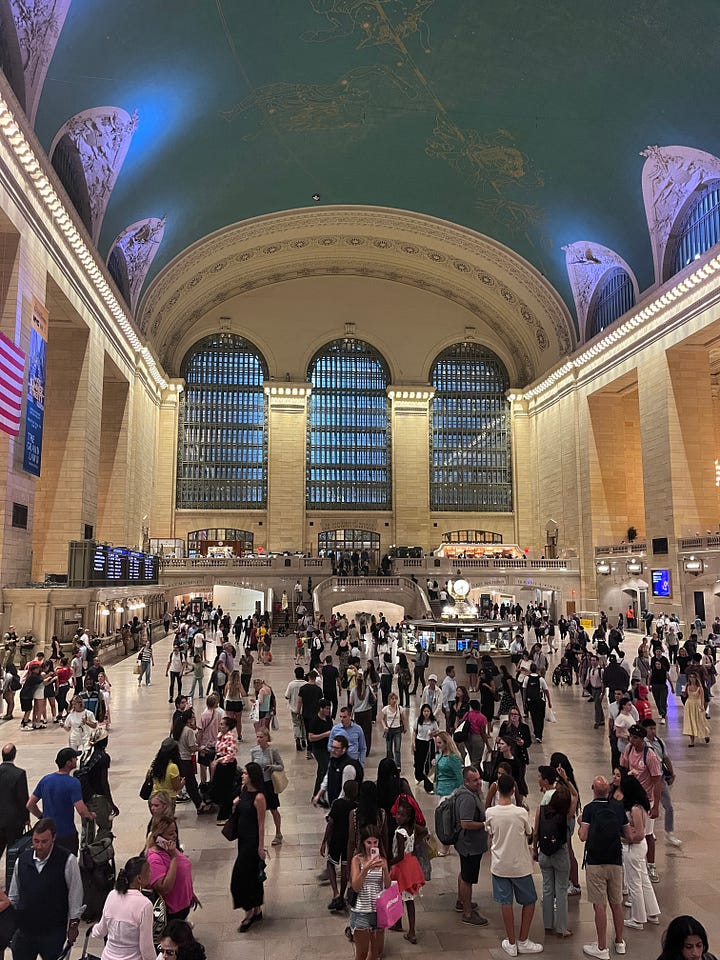
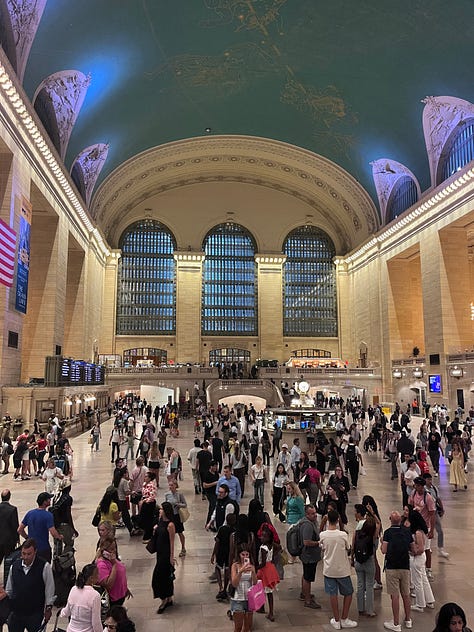
We made a short drive to a nearby commuter rail station and snagged the first available train into the heart of the city. After less than 40 minutes on the train, we emptied out of the subway car and into the heart of the legendary Grand Central station. As we walked into the grand hall, I was stunned by the beauty and openness of the design. While you are first drawn to the massive windows on each end of the building, and to the light they bring inside the building, I was most fascinated by the gorgeous green painted ceiling decorated with the signs of the Zodiac. The mural is designed to appear like a green and gold galaxy of destiny hanging above the myriad travelers.
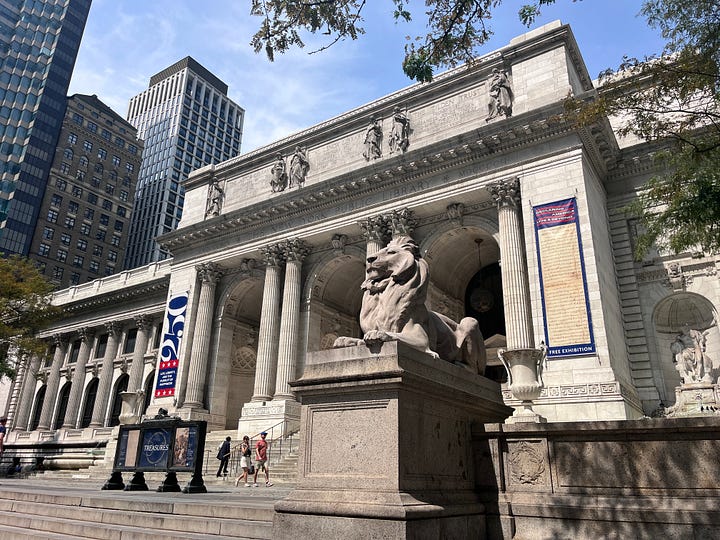
After gawking for a while at the gorgeous design Grand Central we made our way through the crowds to en exit and wound our way through the neighborhood, including a lovely stroll through Bryant Park, to land at the main branch of The New York Public Library. The Library still has a fully functional reading room and a massive research facility, but it is now seen by most visitors as a museum.
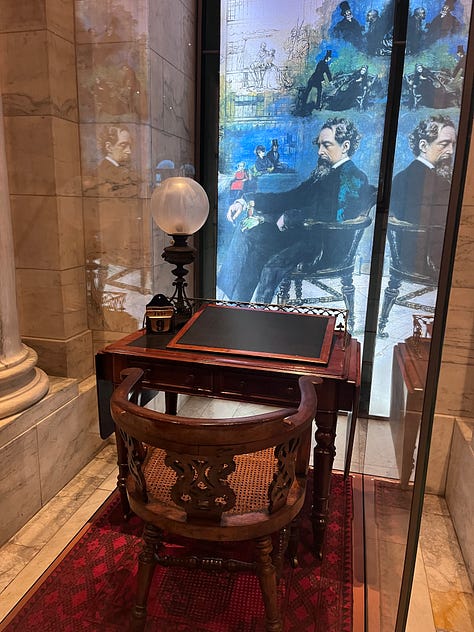
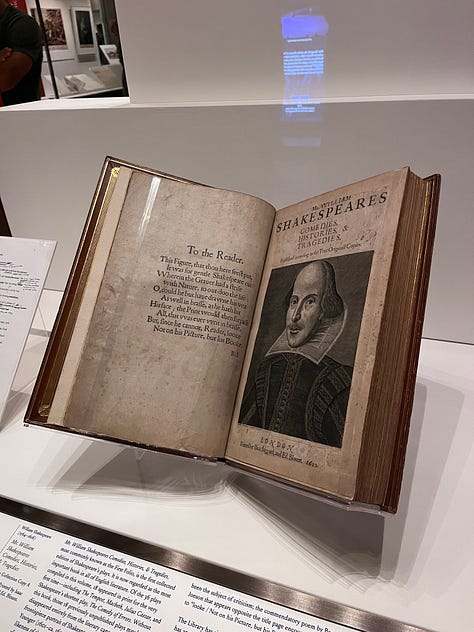
Inside the library’s impressive collection we saw a writing desk that had belonged to Charles Dickens, and were wowed by an enormous full color book featuring naturalistic paintings by John James Audubon. I stared for several minutes at a gorgeous Gutenberg Bible, a tactile example of the power and influence of the printing press and the way that it has irrevocably shaped our modern world. The library also has six of the original Shakespeare Folios. These editions of the Bard’s work were the first of his works to ever be printed, and were copyrighted just two years after Shakespeares’ death.
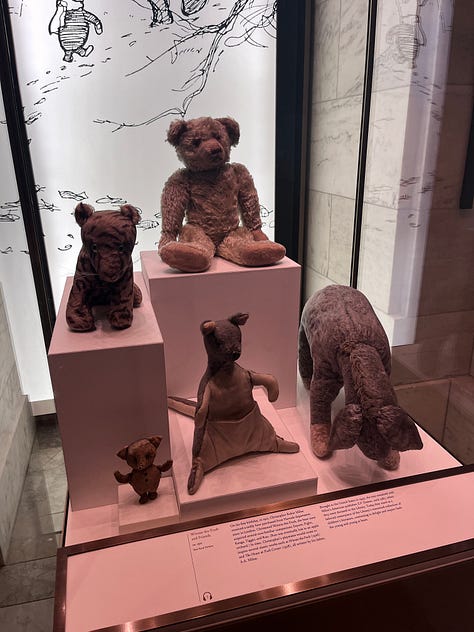
I strolled along the displays of priceless books and ephemera, thinking of their immense importance to our culture. As I walked rather aimlessly, I turned to the right to get a surprise glimpse of some very beloved old friends. In a case in front of me, just a few feet away, sat the original stuffed toys that writer A. A. Milne had given to his son, Christopher Robin Milne. The first of these toys, a stuffed bear that the boy Christened, Winnie the Pooh would go on to be the star of some of the most adored stories in all of children’s literature.
Over the course of a few years, Milne bequeathed other toys that would become Tigger, Piglet, Roo, Kanga, Owl, Rabbit, and Eyesore. All of these original animals, save for Roo who was lost in an orchard, are now on display at the New York Public Library. To stand in front of them was to commune in some way with a five year old version of myself. Looking at those ragged old toys, I couldn't help but be brought to tears. I had no idea how much I had missed my dear, old friends.
Upon exiting the library, we continued walking south for a bit until we found a station to catch the train down to the Lower East Side. We arrived at The Tenement Museum with just a few minutes to spare before our 12:45 tour began. The museum is set in a former tenement building that was in use from 1863-1934. When it was built, the structure was one of the nicest buildings in the neighborhood, but as the area became increasingly more crowded after the Civil War and up to the dawn of the 20th century, the living conditions became more difficult.
These tenements were dark, dirty, and forced tenants to schlep water and coal up and down as many as five flights of stairs several times a day. Until 1905, when electricity was first installed in the building, there was no light in the hallways or stairwells so any travel within the building after dark became precarious under the best of circumstances. At one point as many as 700 people were living in the building with just four outhouses available for toilets.
The building was shuttered as a residence in 1934, but a pair of shops were allowed to remain open on the street level. In the 1980s, a pair of architects and historians heard rumors about the building and managed to arrange a visit. What they found was a living museum that had been kept in amber for more than fifty years. Over the course of several decades they raised enough money to renovate and secure the building so it could be used as a way to keep its history alive.
During the tour, our guide Emily even addressed the fact that the building is valuable because it can be used to show how immigrants lived in New York a century ago, but in using the building as a museum, they are aiding its erosion. The museum is forced to conduct a delicate dance between preservation and storytelling. Because of this reality, the museum is constantly performing careful restorations that seek to both preserve the historically accurate physical artifacts that these spaces are, while still making it possible for the space to work as a piece of living history that is constantly changing.
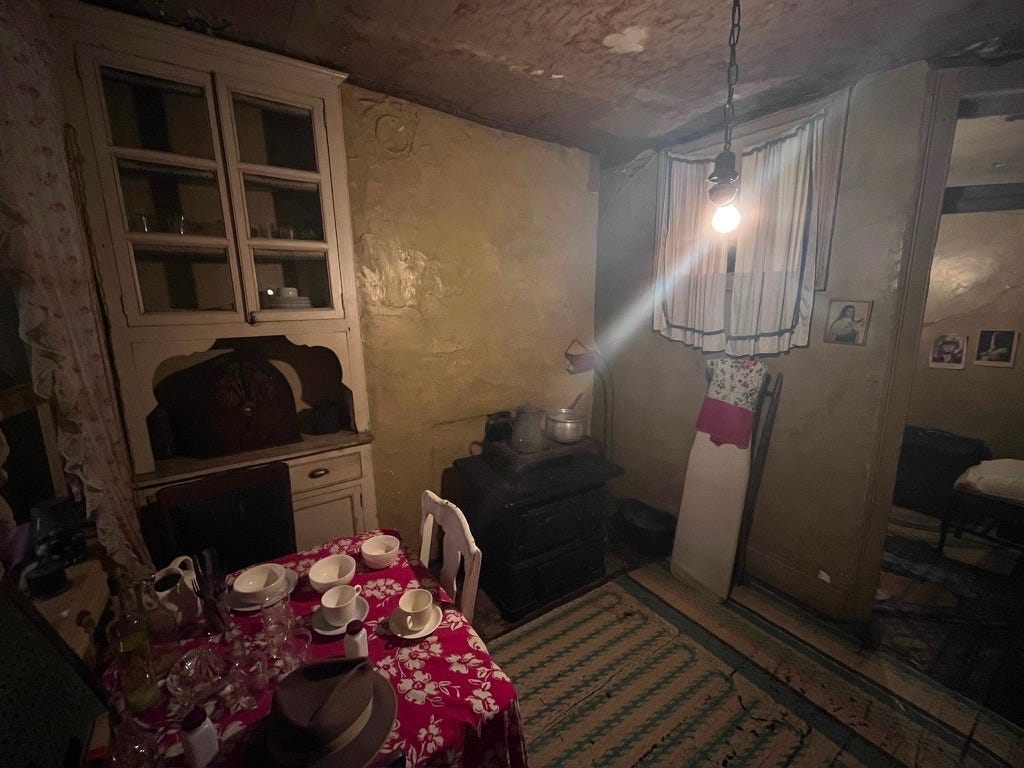
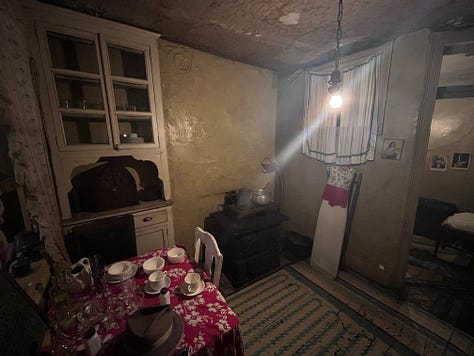
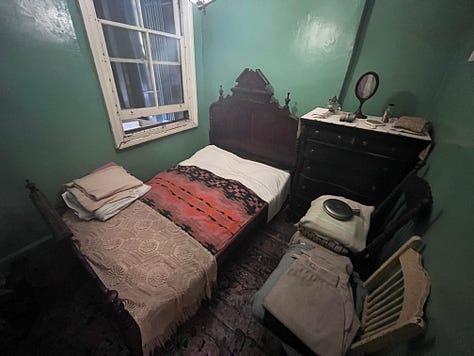
At the museum they tell the story of a dozen different immigrant families. Our particular tour focused on two families; The Rogashevskys, a family of Lithuanian Jews that first arrived in New York in 1901 and moved into the building on Orchard Street sometime before 1910; and the Baldizzi’s who came to America from Sicily some twenty years after the Rogarshevskys. Over time, the two families became friendly, often passing meals back and forth through an open air shaft that sat between their two apartments.
Using census records, historical data, and family recollections, The Tenement Museum has done a remarkable job of reconstructing these homes to look as though one were stepping into 1912 or 1933. These rooms did not possess the squalor of Jacob Riis’ famous photos from the tenement houses of New York in the late 1800s. These dwellings were terribly cramped and incredibly modest, but these rooms were all kept and looked after with a sense of pride. The Rogarshevskys managed to fit a family of eight and a border into their three room tenement. During the warmer months, all of the children and younger member of the family would go out to sleep on the roof or the fire escape to escape the heat and the tight quarters inside the apartment. Despite the cramped conditions, the space was cared for with love and attention.
Our guide Emily also did an incredible job to relate the full history of immigration in America, and she was careful to point out that immigrants today may not live like the Rogarshevskys or the Baldizzis, but they still face myriad hardships including cramped conditions, and compromised living quarters. My experience at the Tenement Museum is one of the best examples that I have ever seen of a guide drawing a straight line from the past to the present. After the tour ended, Meghan and I took a minute to thank Emily for her great work, and to tell her how much we appreciated the way she talked about the current immigrant experience with the same degree of empathy that she had for the former denizens of the tenement we had just toured.
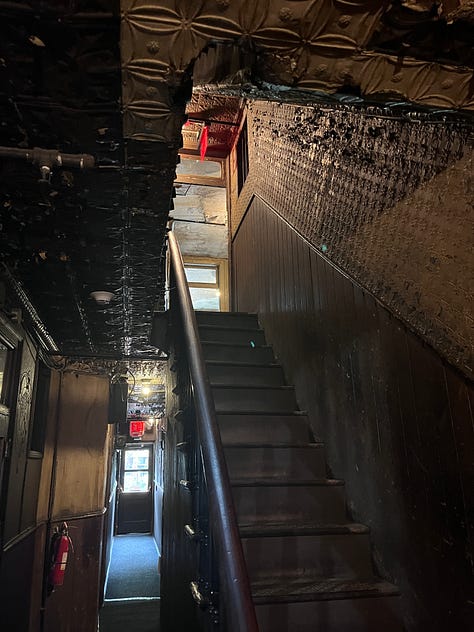
Standing out on the street, I was once again struck by the sheer level of bravery it must take to leave your home and enter a new country where you do not know the language, the customs, or the culture. I thought of my own family coming from Sweden through Nova Scotia and on to Michigan’s Upper Peninsula where they hoped to find a good life working in the copper mines. My great grandfather was just nine when he arrived. I wondered what toys or books he might have brought with him on the trip.Was there a Swedish equivalent to Winnie the Pooh that he pack into his bags before his family set sail?
Meghan and I began walking further along Orchard Street, which in the early 20th century was the busiest neighborhood on the planet. I imagined streets filled with push carts, produce vendors, garment schleppers, and street side salesmen hawking their wares. For a moment I felt as though I could almost reach back through time and touch the past.
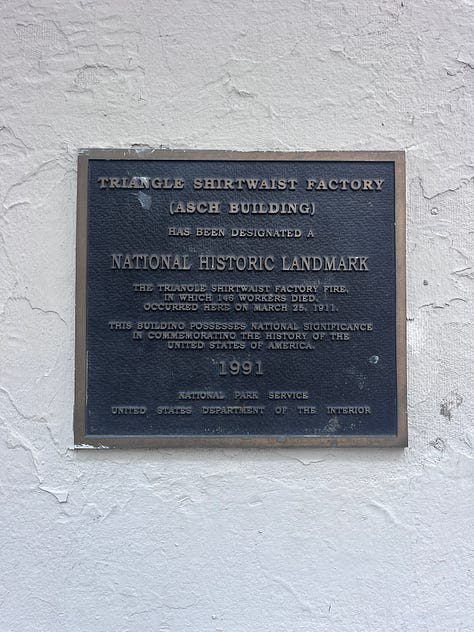
We continued walking until we reached our next destination, a quick stop at the Asch Building, the site of the famous Triangle Fire in 1911. The fire was one of the worst industrial disasters in the history of America, killing 146 garment workers, including 123 women and girls who made up the bulk of the company’s employees.
These women and girls worked in sweatshop conditions, and on the day of the fire were unable to escape because the doors to the 9th floor production room were locked from the outside to keep workers from taking unnecessary breaks. Additionally, there were no sprinklers in the building, a blatant violation of fire code. Once the fire broke out and began to spread quickly, these workers had no where to go. Many women and girls simply jumped to their deaths from the ninth floor windows while holding hands together in pairs.
The fire eventually led to the formation of International Ladies' Garment Workers' Union which did lead to some improvements like slightly safer working conditions. More than a century later the Triangle Fire stands as a sharp reminder that business owners will often do whatever they are able to do to limit the power and safety of their workers while also increasing their profits. Even today, we regularly see workplace accidents and tragedies that could have easily been avoided if corporations were not so laser focused on profits over people.
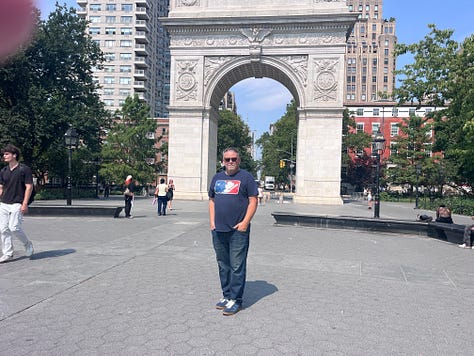
From the Asch Building we ambled through Washington Square Park and into Greenwich Village. The park with its famous arch is legendary for being home to the folk and civil rights movements of the 1960s. It is still a neighborhood buzzing with unique cafes, shops, bars, and people. As Meghan and I were walking along 7th Avenue, she pointed to a building with a series of rainbow flags out front. We changed course a bit, and made our way to the Stonewall Inn for a mid-afternoon cocktail.
The Stonewall is famous for being the site of the legendary Stonewall Riots that occurred in June of 1969 when patrons of the notorious gay bar decided to fight back against a police raid. The riots occurred at a time when living as a gay person, even in comsopolitan New York City, left you a second class citizen at best. Gays and lesbians were routinely subjected to police harassment and beatings, especially when congregating together.
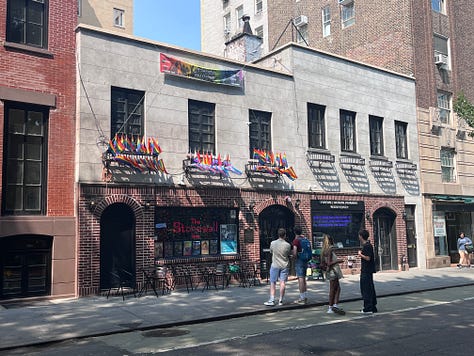
In the 1950s and 60s, there were very few bars where gays and lesbians could go and drink openly. The Stonewall, a mafia owned bar, was one of the few exceptions, but its openness also made it a target with the NYPD. On June 28, 1969, patrons of the stonewall refused to comply with the police during a raid that took place just hours after the death of Judy Garland was announced. Over the course of two days, more than 1,000 protestors arrived in response to the continued police presence.
This historic stand was eventually the foundation for Pride Month, which takes place in June each year. The Stonewall riots also helped to pave the way for gay rights legislation and led a push towards equality for everyone despite who you might love or how you might self-identify. knowing all of this history, we talked through the front doors of the building.
Meghan and I sat down at the end of the bar and chatted with a couple of regulars and the bartender. The inside of the Stonewall is quaint and cozy. It’s hard to believe the number of people that might have been crammed in here on that hot night in June of 1969. As we sipped our gin and tonics, we took in the history, and chatted about the 21st century goings on in the bar. It warmed my heart to know that the Stonewall still has regulars, and is still largely an LGBTQIA spot even though it happily makes space for straight tourists like me.
As I finished my drink and headed back out in to the Manhattan sunshine, I realized that I have never wondered where I might be welcome. Because I am a white, straight dude, the world is essentially my oyster. No one has ever told me I wasn't allowed in an establishment unless it were a private club. In that case, the bigotry was based on money instead of skin color or sexual orientation. I have largely been free to visit wherever I would like without ever being made to feel unwelcome. As such, I cannot imagine how sacred a space like the Stonewall must be for the folks in that community. I was honored to raise a glass in one of America’s most important watering holes.
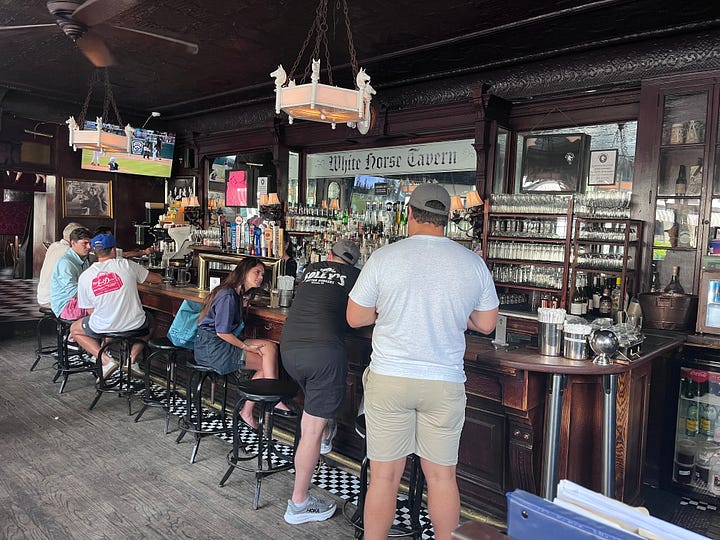
As the afternoon sun slowly rolled down towards the horizon, Meghan and I continued our walk through the Village until we ended up at a spot that I had earmarked earlier in the day. The legendary White Horse Tavern is a beautiful big old building that was first opened as a bar and restaurant in the 1880s. When it was first opened it was a longshoreman’s bar, known for stiff drinks and roughneck behavior. Today, it is one of the oldest continually run taverns in the city.
By the 1950s, the White Horse had become a legendary spot for Bohemian culture. Jack Kerouac was tossed from the bar more than once for excessive drunkenness. There is allegedly still graffiti in the men’s bathroom that reads, “KEROUAC GO HOME!’, but I cannot say for sure as I made the mistake of not visiting the bathroom on my trip. The bar was also a favorite drinking spot for cultural luminaries like James Baldwin, Hunter S. Thompson, Bob Dylan, and Norman Mailer amongst others.
The bar’s most famous patron was the great Welsh poet, Dylan Thomas who sipped his last few pints at The White Horse Tavern just before his untimely death in 1953. Even today, there is a gorgeous portrait of Thomas drinking at the White Horse that hangs in the main bar room. Meghan and I each enjoyed a beer and a shared a delicious plate of ceviche.As I walked out the door after our light lunch, I found myself singing the John Cale version of Do Not Go Gentle Into That Good Night very quietly to myself.
We exited the White Horse and began our walk to a nearby subway station where could catch a ride back to Grand Central and then eventually back up to the northern burbs. As we approached the station on 23rd Street, I spied the legendary Chelsea Hotel just down the block. I had first visited the Chelsea on my maiden voyage to New York in the summer of 2002. At various times, the Chelsea has been home to Leonard Cohen, Mark Twain, Dylan Thomas, Patti Smith, and Arthur Miller, amongst myriad others. I very much wanted to see how it had been refurbished in the intervening years since I had first seen it.
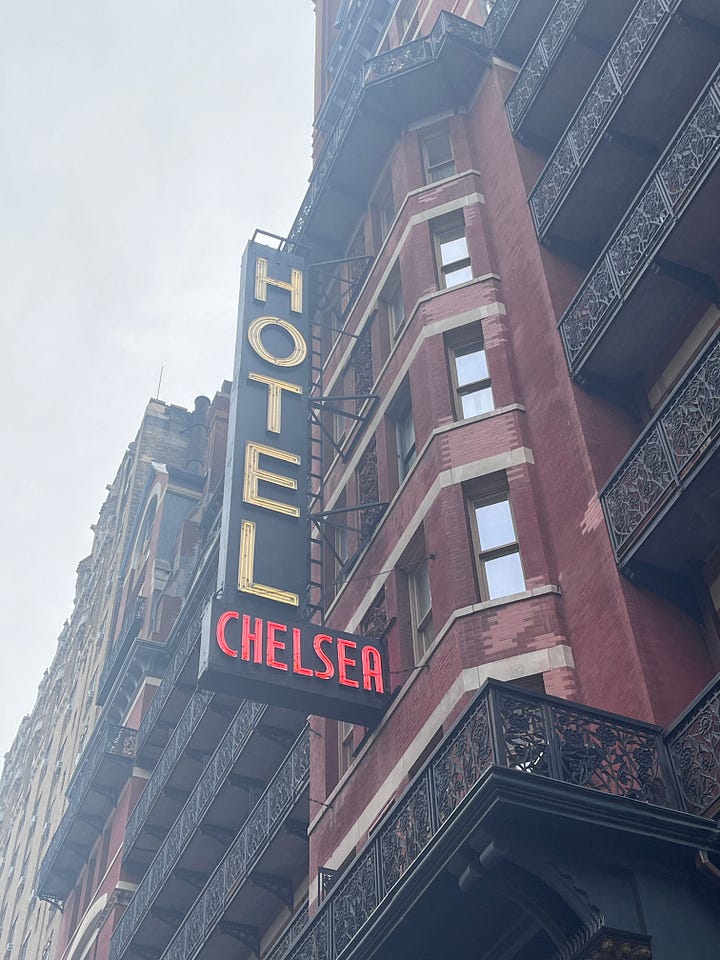
A young man opened the heavy wooden doors for us and Meghan and I walked into the lobby. So as to not seem like tourists with no business in the hotel, Meghan invented an imaginary friend who had a room upstairs that we hoped might come down for a visit. As we sat on plush grey couches taking in the scene, we would occasionally reference our invisible friend, hoping to summon him to appear before us. After ten minutes of chit chat and gawking, we gave up the ruse and headed out the door. The Chelsea looked pretty great, but I doubt that they have many starving artists staying there these days.
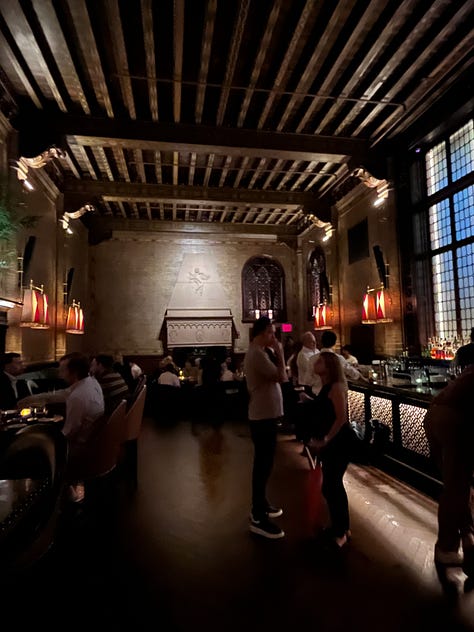
After making our way back to the train station, we headed back to the north for our connection at Grand Central Station. It would have been easy to jump n the next train home, but Meghan was not done showing me surprises for the day. We boarded a nondescript art-deco elevator, and headed up one floor to the hidden gem that is The Campbell Room. As the elevator arrived on the second floor, the door behind us opened onto a dimly lit, oak paneled room with an enormous stone fireplace at the other end. Along one wall, was a huge oak bar framed by a massive stained glass window. This had once been the private drinking club of Cornelius Vanderbilt.
Vanderbilt’s offices had once been located in the heart of Grand Central Station. At the end of each day, he would descend from his office, an area which overlooks the present-day Campbell Room, down to his private club for brandy, cigars and more blathering about business. The room, while riddled with capitalist greed, is nothing short of stunning.
I ordered a pricey old fashioned and a pair of waters for me and Meghan. With no room at the bar to stand, and not a free table seat in sight, we made our way to the corner and chatted next to the piano. We quietly watched the after work crowd sipping their cocktails and making small talk before finding the way to their home-bound trains.
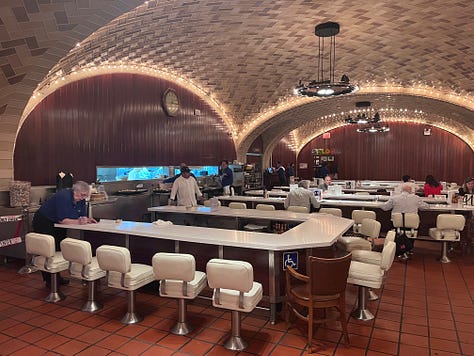
Meghan and I both found ourselves a bit hungry after a very long day of walking and exploring. The ceviche had been delicious but it was long gone. We made our way over to the famed Oyster House in Grand Central and found a pair of seats at the bright white lunch counter. I ordered four fresh oysters from Price Edward Island and a bowl of New England clam chowder. I don’t know why they insist on acting like New England and Manhattan chowders are of equal value. If I say I want chowder, you can be sure I do not mean a soup with a tomato sauce. Meghan opted for the gazpacho and we settled in for a delicious meal.
Fully sated from our seafood dinner, and pooped out from nearly 20,000 steps in the city, Meghan made our way to the next train, back to the Fleetwood station, and then finally to her car for the short ride home. By the time we rolled up to the house it was well after 8:00. Meghan, Sean, and I talked for quite a while before Megahn and I both hit the wall and made our way to an early bedtime.
As I drifted to sleep I felt immensely grateful that I had spent such a remarkable day in a truly amazing place. Moreover, I had been able to share the day with my friend, offering Meghan the chance to partake in a wide swath of Manhattan history and hijinks that she doesn’t normally get to engage in. We should all be so lucky to have such terrific days with such terrific people. My cup runneth over.
Cheers,
Matty C
Comments
Nothing yet. Say the first thing.
Sign in to join the conversation.