
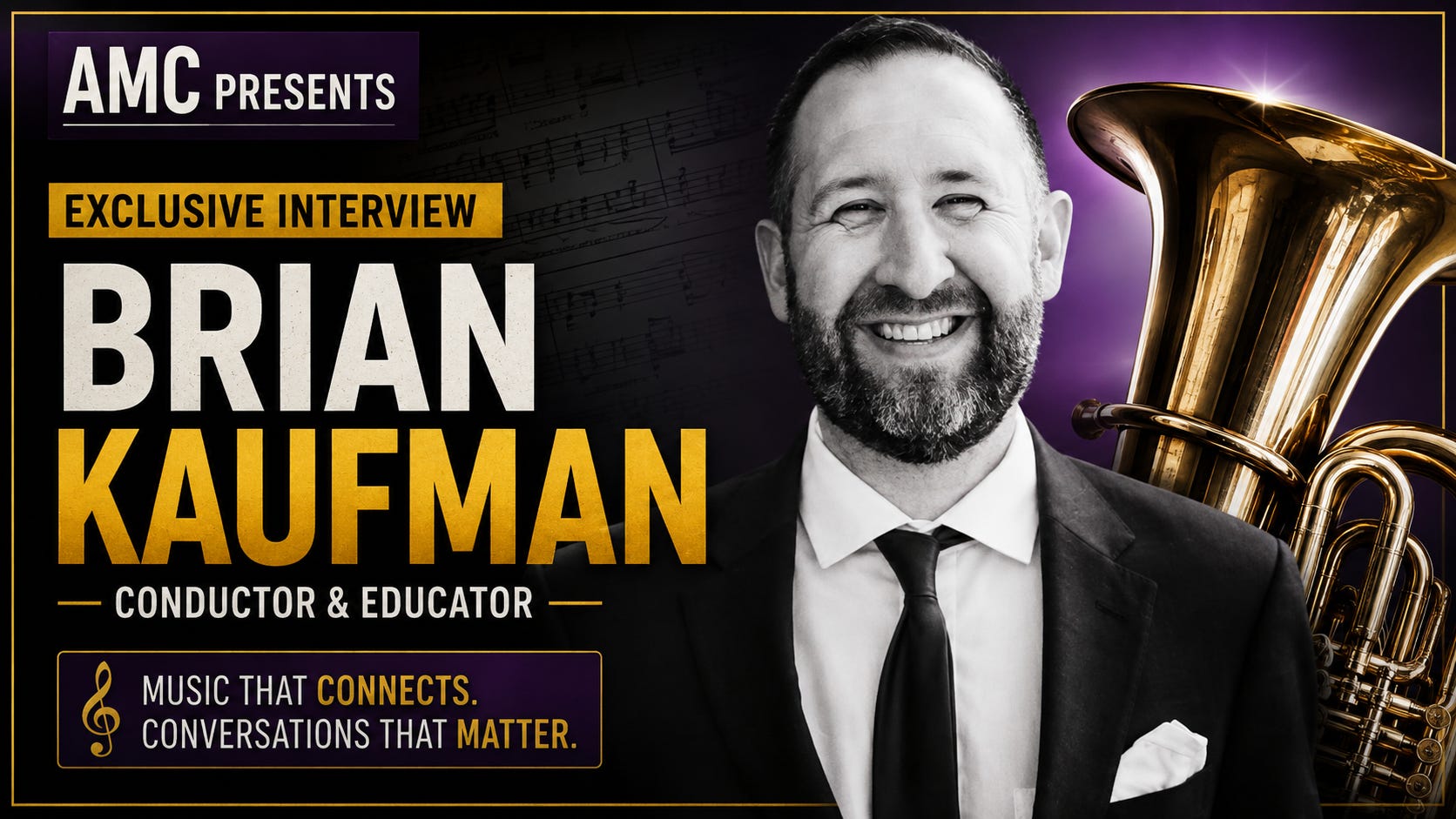
For conductor, tubist, and educator Brian Kaufman, music is not an isolated art. It is something people do together, a means of communication that can reach beyond the concert hall and create a place for people to encounter one another.
Kaufman’s ambitions for music are broad, but his approach is remarkably down to earth. He talks about music less as an abstraction than as something people experience. He wants audiences to listen, respond, talk, and perhaps leave seeing something differently.
That emphasis on connection runs through his life as a performer, conductor, teacher, and advocate for contemporary music. Again and again, Kaufman has found ways to enlarge the circle around music.
Finding His Place in Music
Kaufman’s musical life began with a wonderfully practical discovery. As a sixth grader in New York State, he was given the opportunity to try several brass instruments. The tuba immediately worked.
“The teacher was jumping up and down because I immediately made a sound right away on the mouthpiece.”
There was something slightly comic about an 80- or 90-pound sixth grader taking up one of the largest instruments in the ensemble, but the match stuck. Kaufman eventually studied tuba performance and music education at the University of Michigan, followed by graduate study at the University of Maryland and conducting studies at the New England Conservatory.
Along the way came an unexpected musical detour. While living in Xi’an, China, after college, Kaufman found himself singing at a jazz club. His previous vocal training was limited, but the club needed a singer and Kaufman auditioned.
“They’re like, all right, you’re better than all of us are. You’re hired.”
He stayed for about a year and returned the following summer. It is an appealing story because it captures something essential about Kaufman. Music, for him, seems to be as much about participation and discovery as professional specialization.
Enlarging the Circle
Conducting gave Kaufman a way to expand that experience. Even while completing graduate studies in tuba, he was conducting extensively and formed a brass and percussion ensemble with another graduate conducting student.
What attracted him was the possibility of shaping a musical experience for many people at once.
“As a conductor, it might be the best way to be able to work with the most people and to be able to have the biggest impact.”
That emphasis on people has remained central to his career. Kaufman is now at the University of Maryland, Baltimore County, where his responsibilities include conducting the wind ensemble, teaching conducting, working with music education students, and providing private instruction in tuba and euphonium.
UMBC also gives Kaufman access to students whose primary interests extend well beyond music. Music majors perform alongside students pursuing science, engineering, English, and other disciplines. Kaufman values what those different perspectives bring into the rehearsal room. He describes many of the science and engineering students as “some of the best musicians around” and has found that they sometimes make connections that music majors do not immediately see.
For Kaufman, teaching, performing, and conducting all become ways of bringing people into a shared musical experience.
Music as a Sounding Board
That impulse found its clearest expression in The Sounding Board, an organization Kaufman co-founded with Michael Reichman after his studies at the New England Conservatory.
The premise was to use music as an entry point into contemporary social issues. Kaufman makes an interesting comparison to The Daily Show. Just as comedy can draw people into discussions of current events, he wondered whether music could provide another way of approaching difficult subjects.
“We wanted to use music and the creativity and the humanity of music to be a way to help people connect with different issues going on locally and globally in our world.”
Programs were organized around themes, with music supplemented by video, interviews, panel discussions, facilitated conversations, and informal opportunities for audiences to talk afterward. Music provided a common experience from which conversation could begin.
One project in Boston brought together young people from about ten arts organizations around the subject of sustainable development. Participants created music and visual art responding to environmental issues important to them. The event also brought together a representative involved with sustainable development at the United Nations and a Boston official working in the same area.
What Kaufman remembers most vividly is the young people.
“It was just a really inspiring event to see all of those young people come together with such energy and passion through their music or the arts to express their views.”
The Sounding Board reveals something fundamental about Kaufman’s conception of a musician. For him, music can provide a place where people with different backgrounds and perspectives gather, experience something together, and perhaps begin talking to one another.
Enlarging the Circle → From Performer to Conductor
Kaufman eventually found another way to extend that circle, this time beyond the people gathered in a concert hall. Kaufman’s work with The Sounding Board had established a pattern. Music could begin with the experience of an individual composer or performer, but Kaufman was interested in what happened when that experience was shared. Could it draw other people into a conversation? Could it provide another way of encountering the world around them? Could a musical work continue reaching people long after its premiere?
Seen in that context, his new recording Brass for Uncommon Times seems almost an inevitable extension of Kaufman’s musical life.
He selected seven works by seven contemporary composers, each responding in some way to the unsettled circumstances of recent years. The project grew particularly from Valerie Coleman’s Fanfare for Uncommon Times, written in response to the convergence of pandemic, racial unrest, uncertainty, and hopes for greater unity that characterized 2020.
Kaufman’s guiding question when developing the recording was characteristic of the way he approaches music:
“How can music play a role in helping us navigate how we move forward?”
The recording became one possible answer.
A Life Beyond the Premiere
There is one important connection Kaufman hopes Brass for Uncommon Times will make, and it may ultimately be the most consequential.
Contemporary classical music has a familiar problem. A composer receives a commission, musicians prepare a new work, an audience hears its premiere, and the piece may then struggle to find another performance.
Kaufman wants these works to travel.
“You hate to see such wonderful music only get performed a couple of times.”
The album’s release on Naxos gives the seven composers an opportunity to reach conductors and ensembles far beyond those involved in the original performances. Kaufman hopes musicians elsewhere will discover the works and bring them before new audiences.
In that sense, the recording is less an endpoint than another link in a chain. A composer creates something from an experience. Musicians give it sound. Listeners encounter it. Another conductor discovers it, another ensemble performs it, and another audience enters the conversation.
That may be the clearest way to understand Brian Kaufman. He is a musician who thinks in terms of connections: performers with audiences, students with teachers, music with contemporary life, and composers with musicians who might perform their work next.
For Kaufman, a musical performance need not provide the final word. It can be the place where something begins.
Paticipate in our survey about the future of classical music:

The ideas, judgments, and conclusions in this article are my own. AMC digital assistant Luchino Discounti helps organize material, refine language, and verify information.
No posts
Comments
Nothing yet. Say the first thing.
Sign in to join the conversation.