
The Home Office has been consulting on the design of the new Independent Appeals Body that is to replace the immigration appeal jurisdiction of the First-tier Tribunal. The consultation closes tomorrow, 6 May 2026. There are 32 questions about everything from adjudicator recruitment to whether parties should rely on a shared bundle of country expert evidence.
As you read the consultation it quickly becomes apparent almost everything the government says it wants to do, it could already do under the existing system. And that almost nothing it proposes to do addresses the actual reasons appeals take so long.
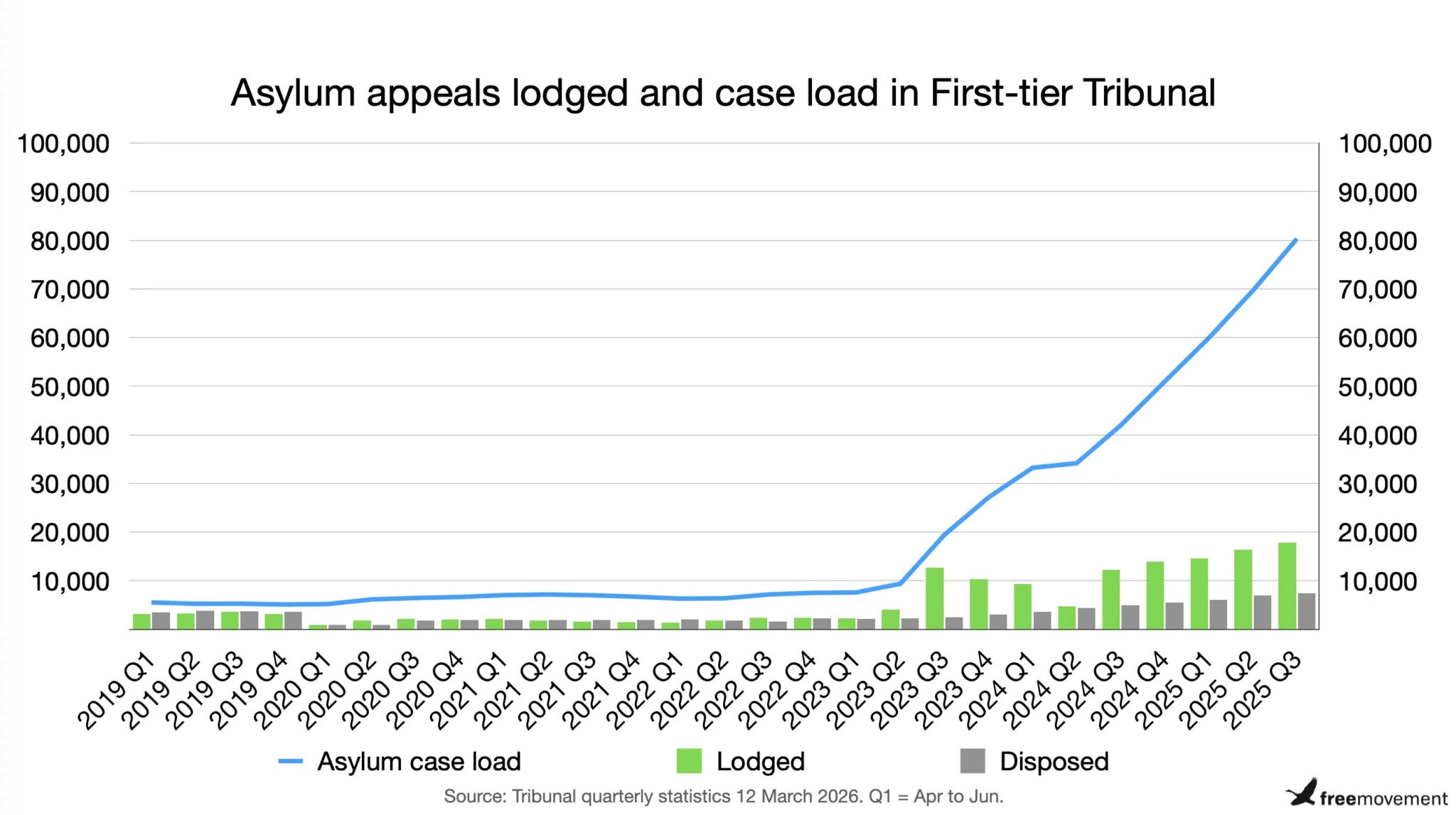
The First-tier Tribunal Immigration and Asylum Chamber had an open caseload of 139,000 appeals at the end of December 2025. It will be a lot higher than that now, several months later. Senior insiders at the tribunal say it would take three years to clear the current backlog at current work rates. And that is without any new cases being added.
This is very obviously unacceptable and unsustainable. As things stand, the tribunal cannot cope with the structural increase in the number of asylum claims since 2020, never mind the influx of appeals caused by the rapid clearing of the initial decision backlog that had also built up.
Something has to change.
“Further incremental steps (such as additional sitting days and recruitment of immigration judges)”, the consultation says, “cannot deliver the scale of change and capacity required to meet demand.”
So the proposal is to build a new body from scratch.
It will appoint and train its own adjudicators. The consultation suggests that “the majority will not need to meet the level of legal training or judicial experience currently expected of the FTT-IAC immigration judges”. The new adjudicators may be drawn from a wider pool — “former police officers, social workers, civil servants, planning inspectors, or councillors” — and trained in-house.
It may opt for a remote-by-default approach to at least some classes of hearing.
It will be capable of prioritising cases “as required by the wider public interest” (which presumably means as decided by the Home Office not the adjudicators).
Early access to legal advice will be prioritised.
Almost all of this is possible under the existing system, though.
The consultation acknowledges, almost in passing, that the First-tier Tribunal’s predecessors used non-legally-qualified adjudicators until 2010. The Immigration Appellate Authority used them until 1999.
The current system already includes some flexibility on appointments. And if that flexibility were insufficient, it could be amended to be more flexible.
The eligibility criteria for appointment to the First-tier Tribunal are set out in the Tribunals, Courts and Enforcement Act 2007 at Schedule 1, paragraph 1:
A person is eligible for appointment … only if the person—
(a) satisfies the judicial-appointment eligibility condition on a 5-year basis,
(b) is an advocate or solicitor in Scotland of at least five years’ standing,
(c) is a barrister or solicitor in Northern Ireland of at least five years’ standing, or
(d) in the opinion of the Senior President of Tribunals, has gained experience in law which makes the person as suitable for appointment as if the person satisfied any of paragraphs (a) to (c).
Both (a) and (b) allow for quite a lot of flexibility. Subparagraph (a) boils down to being a solicitor or barrister or having a “relevant qualification” that can be specified by order. And there is a statutory definition of “gained experience of law”, remarkably. This is set out at section 52(4) of the Act:
(a) the carrying-out of judicial functions of any court or tribunal;
(b) acting as an arbitrator;
(c) practice or employment as a lawyer;
(d) advising (whether or not in the course of practice or employment as a lawyer) on the application of the law;
(e) assisting (whether or not in the course of such practice) persons involved in proceedings for the resolution of issues arising under the law;
(f) acting (whether or not in the course of such practice) as mediator in connection with attempts to resolve issues that are, or if not resolved could be, the subject of proceedings;
(g) drafting (whether or not in the course of such practice) documents intended to affect persons’ rights or obligations;
(h) teaching or researching law;
(i) any activity that, in the relevant decision-maker’s opinion, is of a broadly similar nature to an activity within any of paragraphs (a) to (h).
There’s no doubt the current criteria are heavily and perhaps exclusively skewed towards lawyers. That makes sense when there will be a right of appeal from the new body on a point of law. But if the government really does want to widen the pool of judges, eligibility rules can be changed by another Act of Parliament. It doesn’t need an entirely new and unique body outside the existing structure of tribunals and courts.
Statutory timeframes? The current Tribunal has them where Parliament has provided for them and could have more. Specialist hearing models? The Tribunal already adapts procedures for different case types. A presumption in favour of paper or remote hearings? The Tribunal has had the capability for years and uses it. A “shared set of expert materials” on country information? That is what Country Policy and Information Notes already are; the issue is not the existence of shared material but the quality of it. Greater compliance with directions? The Tribunal has full case management powers. It can strike out, debar, and award costs in the rare cases where costs are available.
There is, in short, nothing in this consultation that requires a new institution to deliver. Most of it could be delivered with the existing system in place and perhaps with some amendment of the eligibility criteria for judges.
The First-tier Tribunal’s problem is not its design. It is that it has been starved of judges, sitting days and decent IT and it is deluged with poor quality decisions which take time and resources to untangle and re-decide fairly.
There are two real reasons immigration appeals take so long and the consultation addresses neither.
The first is the quality of initial decisions. Anyone who has read more than a handful of asylum refusal letters knows the pattern. Decisions turn on credibility points that are barely developed. The Home Office produces a list of supposed inconsistencies, treats them as fatal, and ignores both the substantive account and the country evidence. Reasons for refusal are routinely formulaic. Internal relocation and protection are asserted rather than analysed.
The case the appellant has to meet on appeal is often not, in any meaningful sense, the case made in the refusal letter.
This generates appeals that are effectively rehearings rather than reviews; there is no decent first-instance decision to review. It also generates the now-familiar pattern of appeals being withdrawn or conceded by the Home Office at the door of the court, or allowed years later on materially the same evidence the appellant put forward at the start.
None of that has anything to do with the design of the appellate body. It is about the design of the initial decision process.
The second is the conduct of appeals by the Home Office itself. Unnecessarily prolonged cross-examination is frequently so poorly directed that the appellant’s case ends up stronger after it than before. Appeals are routinely defended on grounds the Home Office knows it cannot win, because no one has the authority or the inclination to withdraw.
The real drivers of delay are the unnecessarily long list of issues the judge has to address in each appeal determination and the unnecessarily long hearings, itself a function of prolonged but often pointless cross examination. These limit the tribunal to dealing with no more than two asylum appeals per day per judge.
The consultation contains nothing that addresses these problems. Replacing legally-qualified judges with civil servants and former councillors will not do it. If anything it will make matters worse, because non-lawyer adjudicators are more likely to make errors of law, which means more permission applications to the Upper Tribunal and more onward appeals — exactly the looping the consultation says it wants to end.
It is worth contrasting all this with the recent report by Jonathan Thomas at the Social Market Foundation on the Swiss asylum system. There is plenty in that model not to like, and the Swiss approach to accommodation in particular is not one we should be importing wholesale. But the architecture of the SMF’s proposed reforms is illuminating because the emphasis is in the right place.
The Swiss reforms put the heavy investment into the initial decision stage. Applicants are housed in federal centres where legal advice, interpretation, medical assessment and decision-making are co-located. Initial decisions are quick because they are made on a fully-prepared file by a properly-trained decision-maker who has access to everything the case requires. Switzerland’s grant rate at first instance is around 65 to 70 per cent, against around 47 per cent here. The consequence is that the appellate stage carries a much smaller volume and can therefore be quick and final.
That is not the model the government has chosen. The government has chosen to leave the broken initial decision process exactly where it is and to redesign the appellate stage that is, in fact, the part of the system most or less working as intended.
If the new body cannot do anything meaningful that the existing one cannot, and if it ignores both real causes of delay, then what is the point of it?
One possibility is that the government wants a different pool of decision-makers because it believes a different pool would be less liberal — that existing immigration judges are too willing to allow appeals, and that former police officers, civil servants and councillors will be more “robust”.
There are at least two problems with this.
The first is that it would, if true, be improper.
The second is that there is no particular reason to expect it to work. A more diverse pool of adjudicators, drawn from outside the legal profession and trained in-house, might just as easily prove more liberal as less. Once you let go of the discipline of legal training and judicial appointment, you let go of the relative predictability that comes with it. Be careful what you wish for.
Another possibility is that this is really about the procedure rules. The Tribunal’s procedure rules are made by the Tribunal Procedure Committee, which is independent of government. Some inside the Home Office have been visibly frustrated by this for years, particularly over the ongoing absence of fast track appeal rules. A new appeals body outside the tribunals system could come with rules drafted by, or with much closer input from, the Home Office.
If that is the goal, it is a strange way to achieve it. The simpler route is a short clause in primary legislation transferring rule-making power for the Immigration and Asylum Chamber to the Lord Chancellor or the Home Secretary, with appropriate consultation. That would be a terrible idea. The independence of tribunal procedure rules is not an accident. But it would not require the abolition of the existing jurisdiction.
A third possibility is that the exercise is essentially performative. The government has announced a new appeals body. The announcement was the policy. The consultation is the implementation of the announcement. Whether the new body does anything materially different from the existing one is, on this reading, beside the point.
As far as we know, there has been no study of the blockers to increasing the number of appeals per judge per day in the existing appeal system. No systematic attempt to understand where and how matters might be improved. And so it is hard to imagine the government’s back-of-an-envelope proposals will really make any difference. The same real world problems that exist now will continue to exist in future.
Building a new institution is expensive. It is slow. It will swallow a vast amount of official time and attention over the next two or three years that could be spent on the things that would actually reduce the backlog: better initial decisions, properly resourced Presenting Officers, more sitting days for the tribunal we already have. Every hour spent designing an adjudicator training programme is an hour not spent fixing the asylum decision-making process that is generating the appeals in the first place.
It is possible the government will get all this right. It is possible the new body will turn out to be quicker, fairer, and better than the existing one. It is also possible that we will spend three years and a great deal of money rebuilding the part of the system that worked, while the part that did not goes on as before.
What is the point of that?
Thanks for reading We wanted workers...! This post is public so feel free to share it.
Comments
Nothing yet. Say the first thing.
Sign in to join the conversation.