
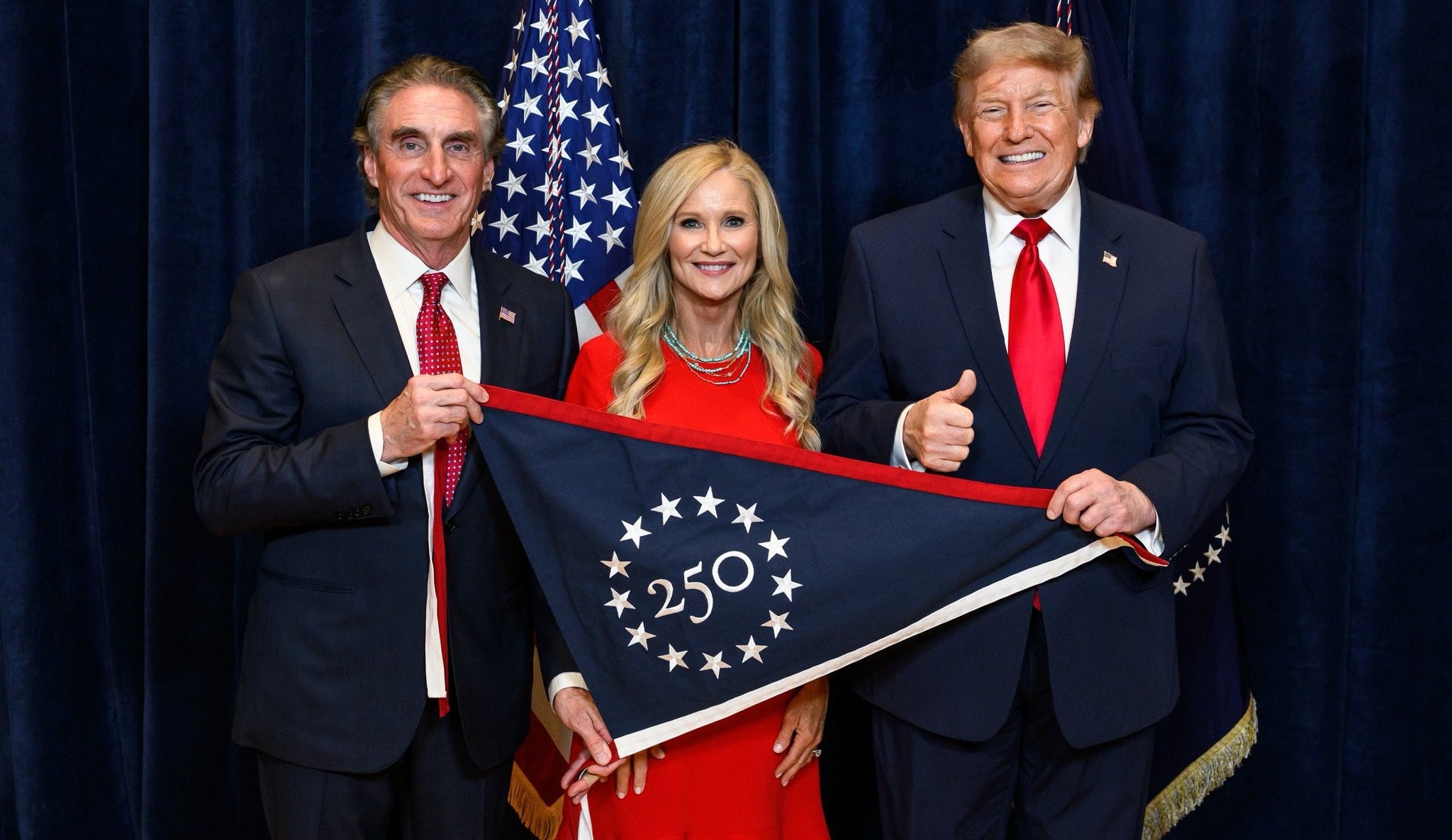
Three Interior department staffers told POLITICO they watched officials routinely shred official documents and use disappearing Signal messages, even for routine scheduling, to keep communications from being preserved as the Federal Records Act requires. “They’re terrified of written records,” one former official said. Two other former officials said Interior Secretary Doug Burgum used a private email account for department business early in his tenure. Interior staff described a “culture of secrecy” under Burgum, who wanted to add a secure conference room, or SCIF, near his 6th floor office even though Interior already has a SCIF three floors below.
Today’s reporting comes one day after news broke that the Interior department’s Office of Inspector General acquired a new employee: Dennis Kirk, a co-author of the federal workforce chapter of Project 2025 and a former senior personnel official in Trump’s first term. The OIG declined to confirm the hire. Kirk arrives at an office that has had no Senate-confirmed inspector general since January 2025, when President Trump fired 17 inspectors general across the government without giving Congress the 30 days’ notice federal law requires.
In short: Interior’s watchdog was fired, left vacant for eighteen months, and is now hosting one of the architects of Project 2025. At least five investigation requests from members of Congress are sitting in that office right now, and its integrity has been compromised. Congress cannot outsource its constitutional oversight duty to an inspector general’s office taken over by the White House.
Our position is that the next step must be subpoenas, not more letters. House Natural Resources Committee Chairman Bruce Westerman and Senate Energy and Natural Resources Chairman Mike Lee hold the gavels and the authority to compel documents and sworn testimony, and every week they decline to use it is another week the shredders can keep running. The House and Senate must fully investigate Interior’s Signal use and records-retention violations, Burgum’s personal email, and the ethics office file on his North Dakota meetings, then put the secretary under oath about all of it.
Secretary Burgum’s reflecting pool debacle plays into all of this as well. A department caught withholding exculpatory evidence from federal prosecutors carries that credibility problem into every courtroom. Interior employs thousands of federal law enforcement officers whose testimony can send people to prison, and it defends itself against dozens of public lands lawsuits at any given moment. To address this credibility crisis, Congress needs to build a factual record now, under oath, because nobody else is positioned to do it.
House Natural Resources Committee members have asked the acting inspector general to open investigations into three senior Interior officials:
Karen Budd-Falen, associate deputy secretary, over the $3.5 million water rights deal her husband’s ranch secured with a lithium mining company that had approvals pending before Interior during her first Trump term tenure. She never disclosed the profit. Budd-Falen also worked on grazing and land management policy for more than a year before receiving a partial ethics waiver in March 2026 while still holding BLM permits for her ranching operations in Wyoming and Nevada.
Jenifer Chatfield, deputy assistant secretary for fish and wildlife and parks, for advancing permit matters benefiting her family’s captive wildlife business. The New York Times reported that Chatfield moved a permit application listing her as one of the applicant facility’s veterinarians through the agency’s permitting process within a day.
Matthew Giacona, acting BOEM director, for working on the same issues he lobbied on for an oil and gas trade association.
House Natural Resources Committee members have separately asked the OIG to examine how Interior handled the Lincoln Memorial Reflecting Pool vandalism allegations, and Senators Sheldon Whitehouse and Martin Heinrich, the ranking members of the Environment and Public Works and Energy and Natural Resources committees, sent their own request on August 4.
On July 31, U.S. Attorney Jeanine Pirro moved to dismiss felony vandalism charges against former Olympic canoeist David Hearn, telling the court that Interior had provided less than fulsome information at the outset and that prosecutors would not have sought a grand jury indictment had the department turned over evidence already in its possession. The motion disclosed that a National Park Service employee had flagged the peeling liner on June 11, eight days before Hearn’s arrest. Interior’s eventual production indicated a rushed and botched installation by the contractor, working under no-bid contracts on a project whose costs grew from an initial estimate of $1.5 million to $2 million into more than $16 million. The day after the dismissal filing, Burgum claimed again that vandals had damaged the pool.
Whitehouse and Heinrich told the Inspector General that Interior’s withholding of exculpatory evidence walked Justice Department lawyers into a violation of their obligations under Brady v. Maryland and Giglio v. United States, the latter of which requires prosecutors to disclose information bearing on the credibility of a government witness.
Interior employs thousands of federal law enforcement officers across the National Park Service, U.S. Park Police, Bureau of Land Management, U.S. Fish and Wildlife Service, and Bureau of Indian Affairs. A documented federal finding that Interior personnel withheld exculpatory material from prosecutors is potential impeachment evidence about those individuals in future criminal cases where they testify, which could put poaching prosecutions, Archaeological Resources Protection Act cases, and other public lands enforcement at risk.
The same finding brings risk on the civil side as well. Courts reviewing Interior’s decisions under the Administrative Procedure Act presume the agency acted in good faith and generally confine review to the administrative record the agency itself assembles. A federal prosecutor’s on-the-record conclusion that the department withheld material evidence could give litigants a basis to challenge that presumption and seek discovery beyond the record. Interior is a defendant in dozens of public lands cases, and Burgum is named in most of them.
Burgum’s January 2025 ethics agreement barred him for one year from participating in matters involving North Dakota without written authorization from agency ethics officials. Public Domain reported that his official calendars show two 2025 meetings in his Washington office with former North Dakota colleagues he had appointed or served alongside: Attorney General Drew Wrigley and Agriculture Commissioner Doug Goehring. The calendars contain no record of ethics officials weighing in beforehand, though they show he consulted ethics staff before dozens of other meetings. Interior called them “personal meetings” with “old friends.” During Burgum’s tenure as governor, North Dakota sued the Interior department at least five times, and Wrigley signed a brief supporting Utah’s attempt to seize more than 18 million acres of federal public land.
Interior briefly pulled the calendars off its records library, then reposted them after Public Domain asked about their disappearance.
Mark Lee Greenblatt, the Interior inspector general Trump fired in January 2025, warned this week that installing a political operative inside an independent oversight office creates a conflict that erodes public confidence in the office’s independence. He noted that Dennis Kirk’s placement inside an IG’s office has drawn objections before, when he was assigned to the Office of the Intelligence Community Inspector General earlier this year.
Interior manages roughly 500 million acres of public land, the national park system, Tribal programs, and hundreds of billions of dollars in public assets. Its inspector general is the office responsible for reviewing senior-level misconduct, contracts, grants, ethics, and whistleblower retaliation inside that department.
The Center for Western Priorities is calling on the House Natural Resources Committee and the Senate Energy and Natural Resources Committee to use their subpoena authority to obtain:
Interior’s records-retention policies and guidance covering Signal and other ephemeral messaging platforms, along with any communications directing or approving the destruction of records.
All Interior-related communications from Burgum’s personal email accounts, and any documentation of whether those messages were forwarded to official accounts within the 20 days the Federal Records Act allows.
The Departmental Ethics Office file on Burgum’s meetings with North Dakota officials, including any authorization sought or granted, and an explanation of why the secretarial calendars were temporarily removed from Interior’s website.
All documents concerning Dennis Kirk’s hiring, his job description, his reporting lines, and any communications between the OIG, the secretary’s office, and the White House regarding his placement.
The status of every pending OIG referral involving a senior Interior official, and a written commitment that Kirk is walled off from each.
The complete June 11 National Park Service email thread on the peeling liner, its full distribution list, and every Interior communication about what the department told and withheld from the U.S. Attorney’s Office.
Sworn testimony from Burgum, Chief of Staff JoDee Hanson, Karen Budd-Falen, Jenifer Chatfield, Matt Giacona, and Acting Inspector General Caryl Brzymialkiewicz.
Congress should also refer the alleged records destruction to the National Archives and Records Administration, which is required to be notified of any unlawful removal or destruction of federal records.
POLITICO’s reporting provides part of the answer: Burgum never wanted this job. People familiar with the discussions said he pushed for secretary of State, then Commerce, then White House chief of staff, and agreed to take Interior only after Trump created the National Energy Dominance Council and installed him as its chair. The department that has the power to enforce Trump’s hatred of wind turbines is close to his heart. (It probably doesn’t hurt that Trump is very fond of Burgum’s wife.)
Compare Burgum’s antics to the standard this president applied the first time around. Ryan Zinke lasted under two years and left with 18 opened or requested investigations and a criminal referral sitting at the Justice Department. Scott Pruitt lasted roughly 500 days, undone by a $50-a-night condo from a lobbyist, a predilection for Trump hotel mattresses, and a $43,000 soundproof phone booth.
Burgum has now drawn allegations of unlawful records destruction, an apparent breach of his own ethics agreement, three deputies referred to the inspector general, a $16 million failure of a pool renovation, and a U.S. attorney telling a federal judge that his department misled prosecutors. Yet Burgum is still there, and last week the president attacked the prosecutor instead.
At the end of the day, Doug Burgum lied to the president to cover his own incompetence. Trump doubled down on Burgum’s lies, and firing him now would be an admission that Burgum‘s handling of the reflecting pool and America’s botched 250th birthday celebration was an embarrassment to the White House.
For more information, visit westernpriorities.org. Sign up for Look West to get daily public lands and energy news sent to your inbox, or subscribe to our podcast, The Landscape.
No posts
Comments
Nothing yet. Say the first thing.
Sign in to join the conversation.