
September 2025 has been a strong month for DM equities, with Japan indices leading the way. NKY index jumped to record highs, ending the month +6.3% as the best DM equity market in September, almost double the percentage point returns of SPX, and even surpassing German DAX on the year.
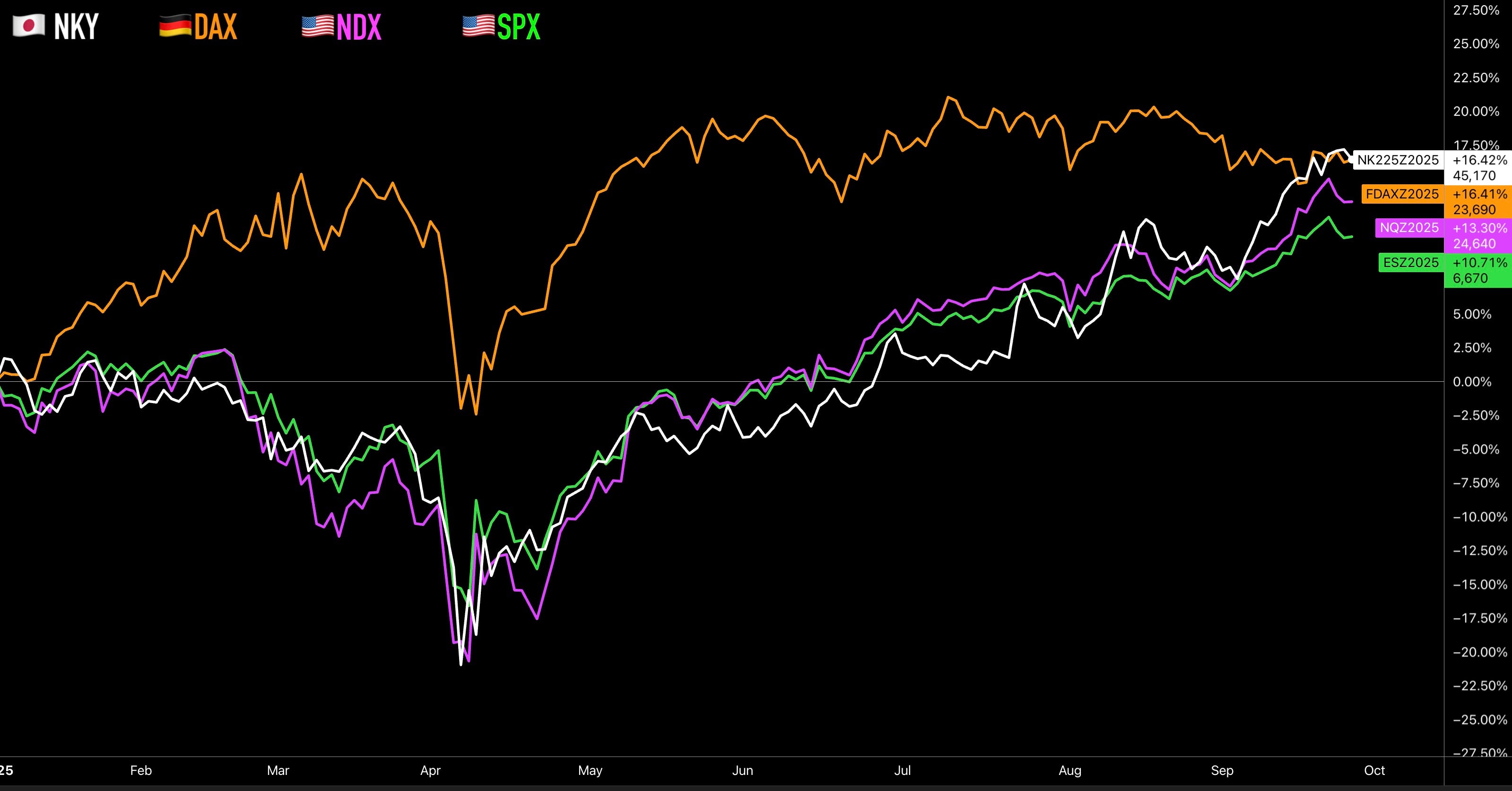
What’s more, the Japan equity rally that kicked off in September had arguably been driving US indices to their respective record highs throughout the month as well.
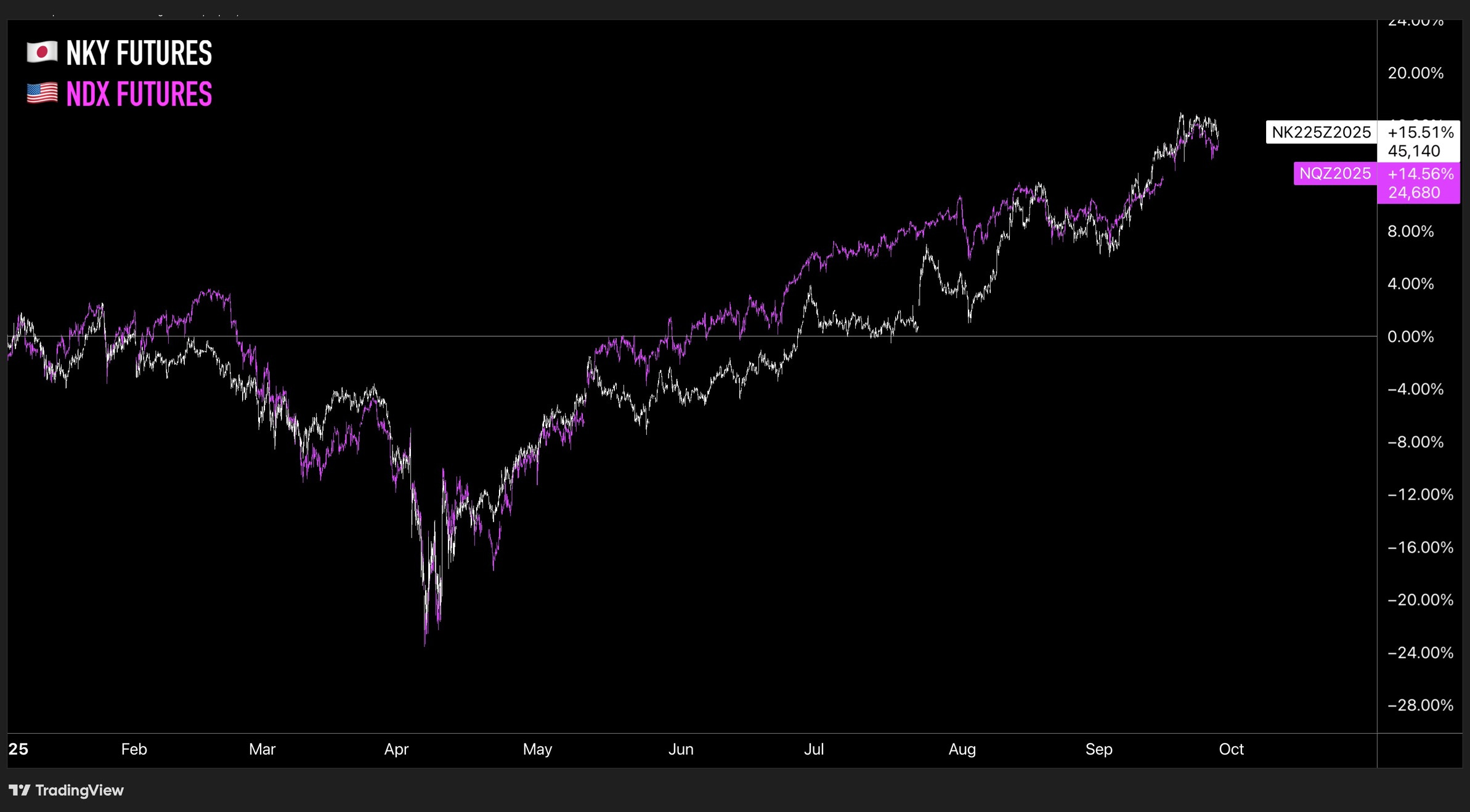
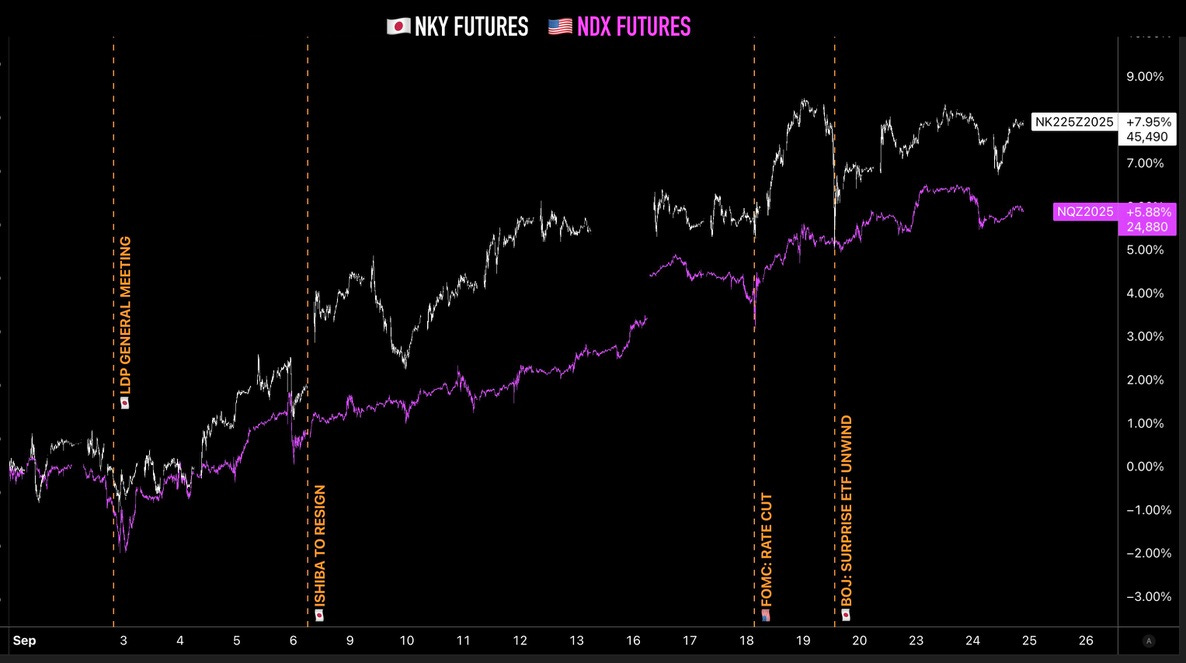
Prior to September, NKY and NDX futures were trading % for % in tandem - but then, sometime in early September, NKY’s upside path broke off from that of NDX (also hitting its own record highs).
September % returns: NKY +6.3%, NDX +5.8%, HSI +4.9%, TSX +4.75%, SPX +3.75%, SX5E +2.45%, IBEX +2.35%, DOW30 +2.1%, CAC40 +1.7%, UK100 +1%.
So, with Japan leading US / global equities to the upside in September, one can argue that Japan is driving US / global equities to the upside in September - or at least consider this to be a reasonable possibility, as opposed to “US leading Japan to the upside” while underperforming that which it is supposedly “driving" - which is not impossible or irrational either. Either way, it warrants a further look.
Here is a simple chart of NKY vs NDX futures % performance in 2025 - and I highlight two periods in particular: 1) from May (post-Liberation Day “correlation of 1” crash AND immediate recovery) until August, and 2) September.
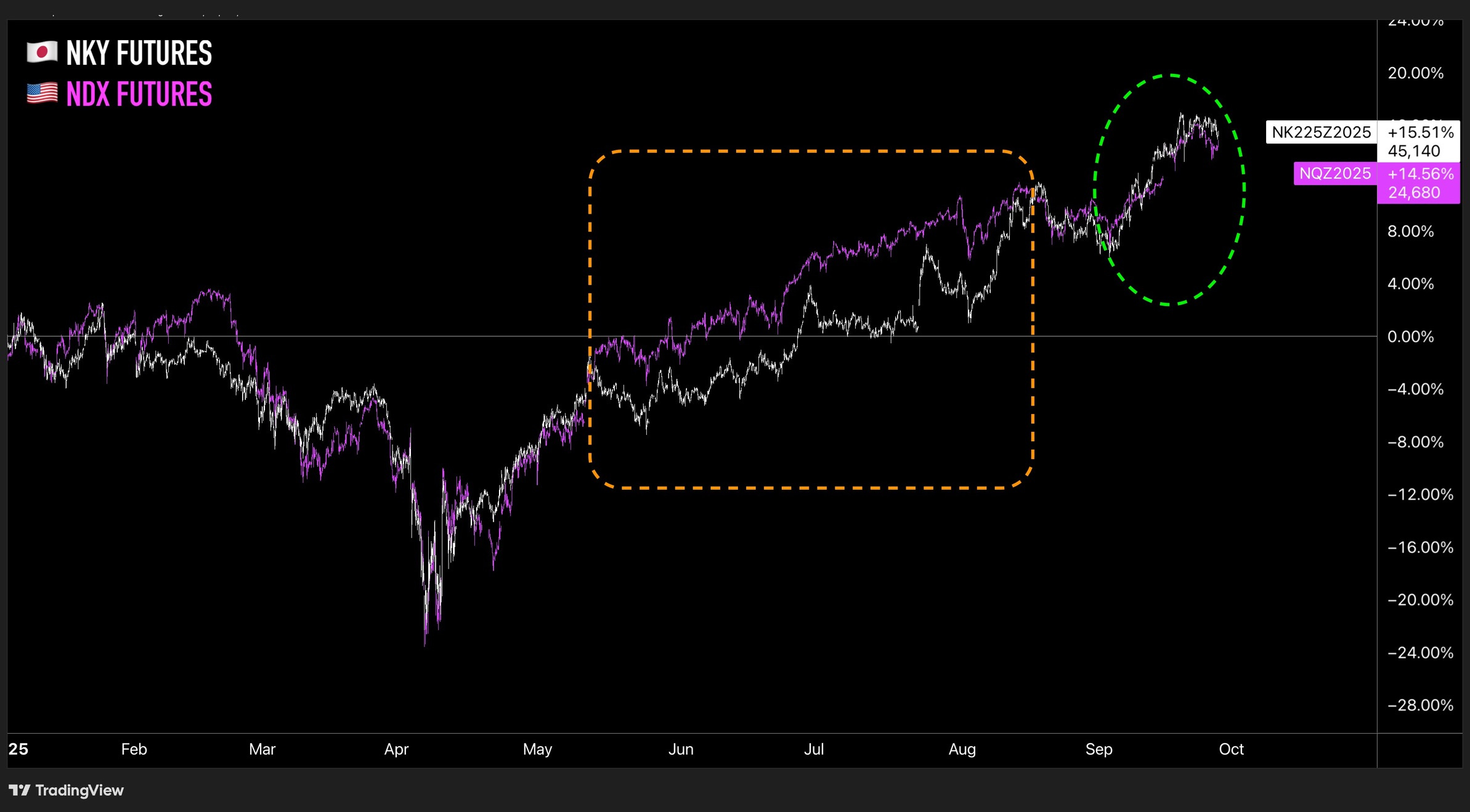
First, we can see the clear % for % mirroring price action between the two from the start of the year, pre-during-post Liberation Day. Then we see a slight divergence in relative performance in May, and a few subsequent moments of performance differences since - though both still on an uptrend over the longer term. Then, we see a highly correlated period of downside heading into September, and the high correlation maintaining as the indices sharply reverse to break out higher thereafter.
Here is a chart of the actual NKY vs NDX futures 40-day (2 month) correlation YTD. Several key points to note.
NKY and NDX correlation surges to over 0.9 from March, before the April 2nd Liberation Day global cross-asset mayhem - and by and large remain highly correlated around 0.9 with moments of intermittent and temporary de-correlation. Meaning - NDX and NKY index futures are basically trading in tandem throughout the year.
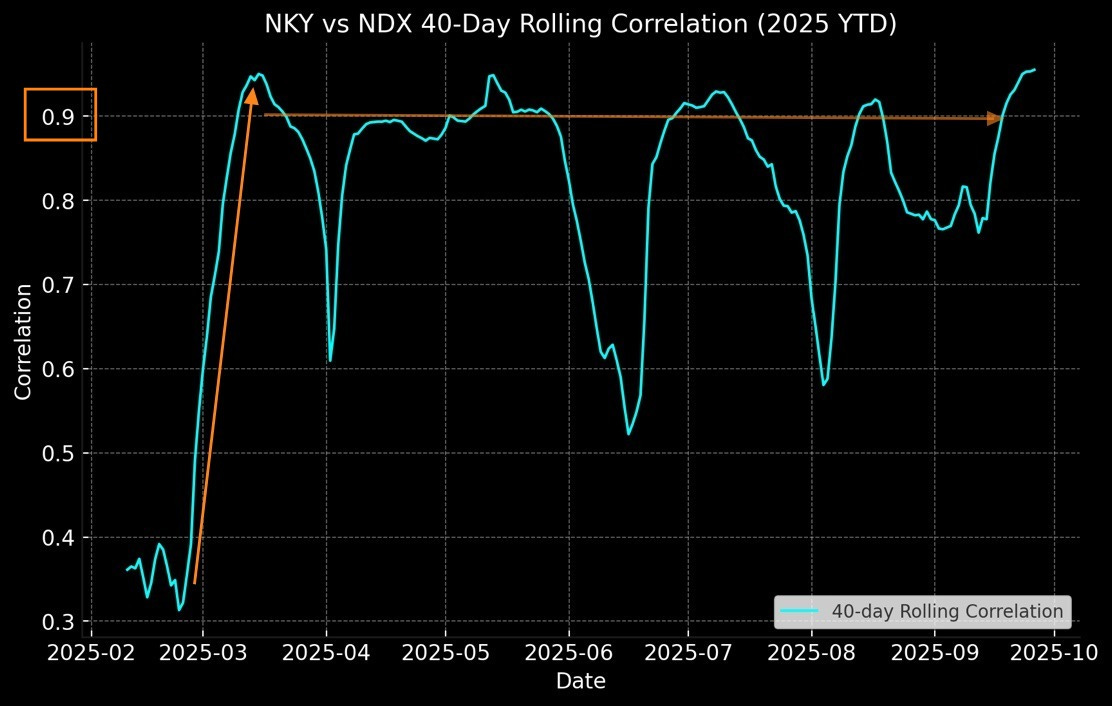
2) Each of these intermittent periods of temporary de-correlation are hitting higher-lows in succession before rebounding back above 0.9 correlation. And most recently, 40-day rolling correlation itself has broken to new highs on the year.
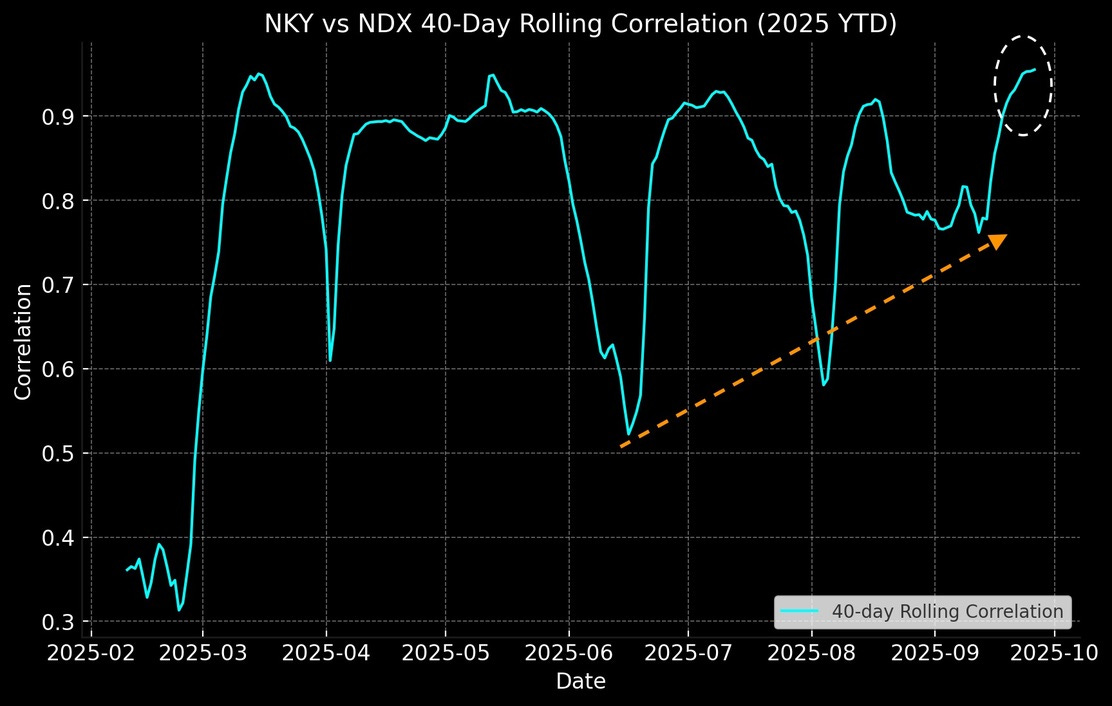
The significance of this path in rolling correlation is as follows. If/as the dips (lows) are getting progressively higher (higher-lows), it signals that even in periods of temporary decoupling, the baseline level of co-movement is strengthening. In other words, the “floor” of NKY vs NDX correlation is moving upwards - thereby showing a larger pattern of correlation strenthening. (Also note that the reason for using specifically a 40-day rolling correlation “look-back” time frame is that much of macro-market correlation analysis defaults to 20-day or 60-day rolling periods, i.e. 1 month and 3 month respectively - 40-day is the “overlooked” mid-point compromise between higher frequency short term noise signals and long term sluggish response.)
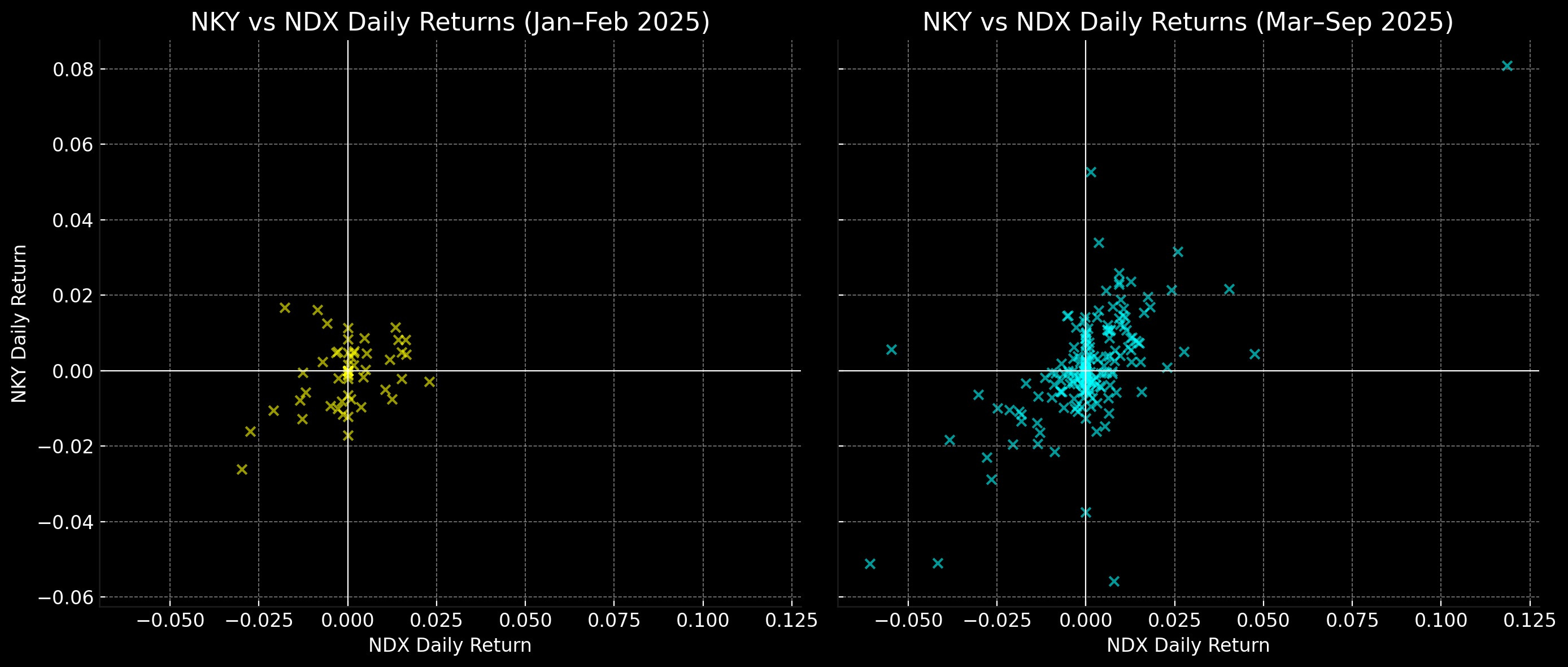
So, once again - here is the NKY vs NDX futures performance comparison YTD, and the 40-day rolling correlation pattern:
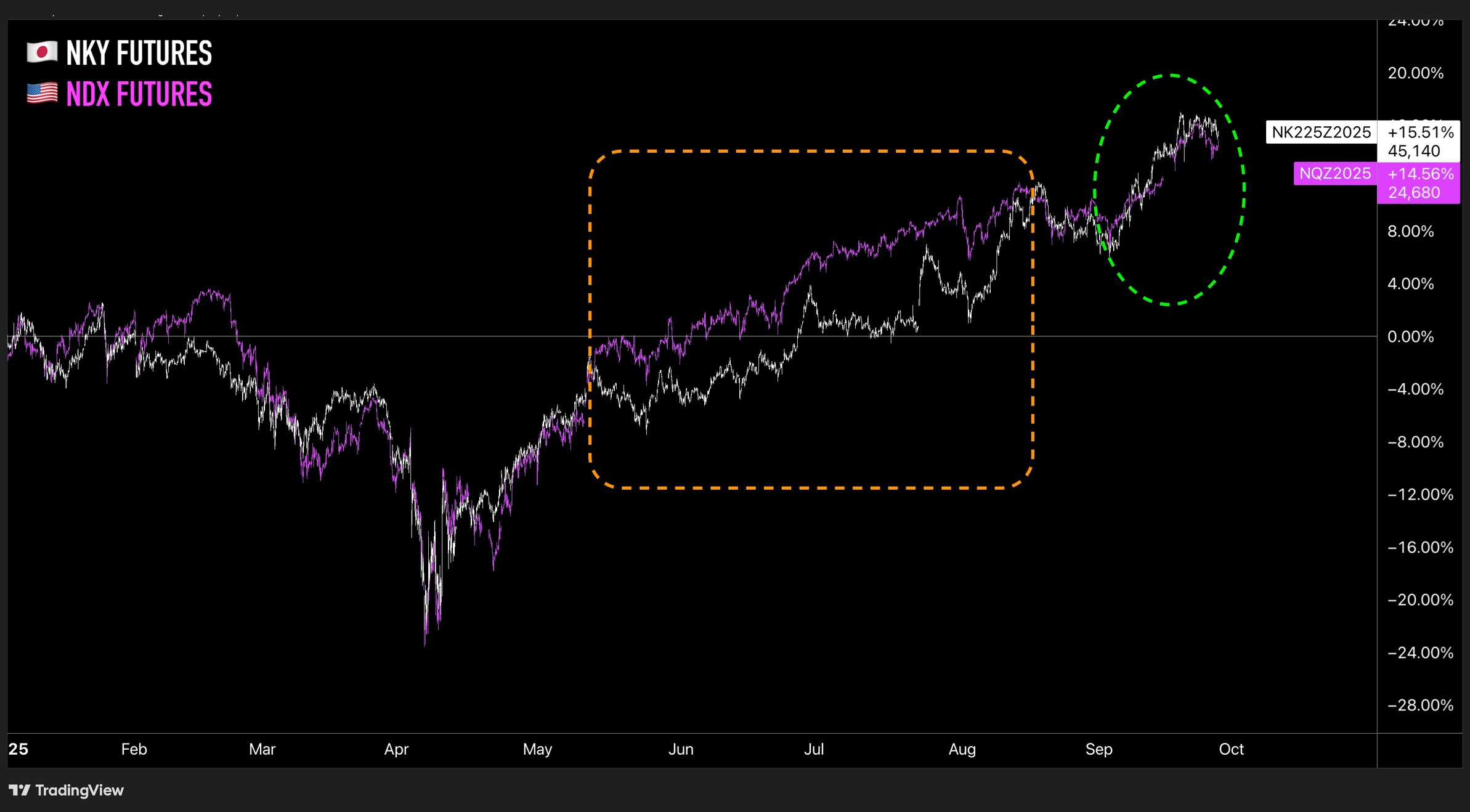
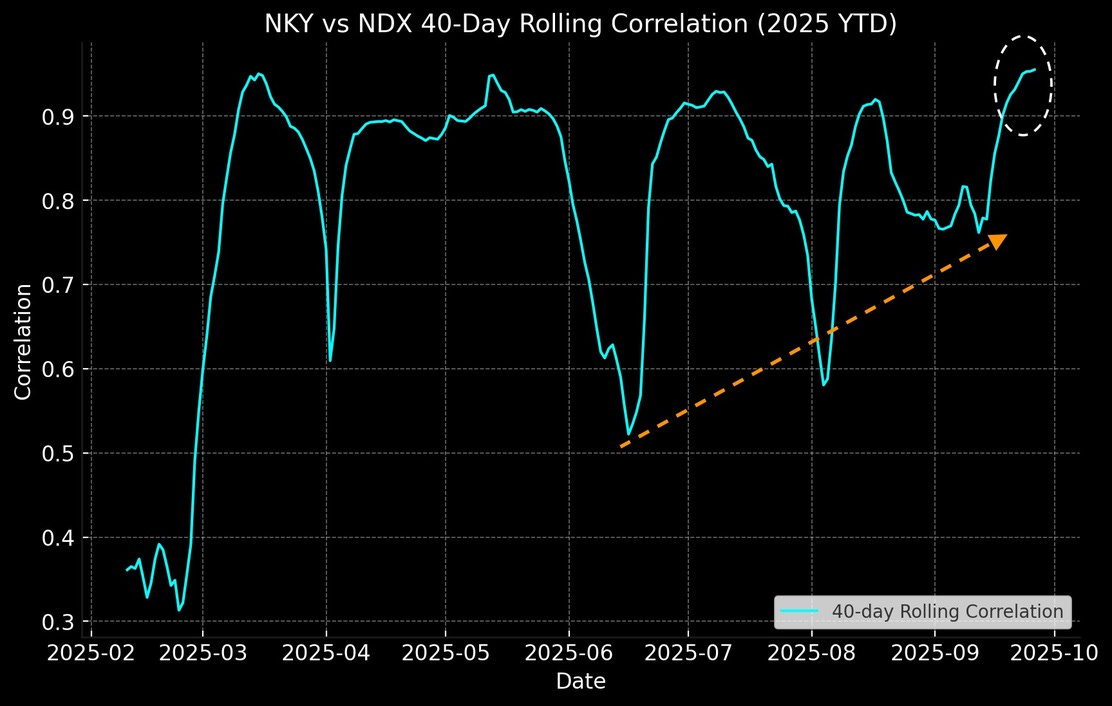
Based on the above, it is fair to say that NKY is leading NDX to the upside in September’s strong performances.
Now - let’s look at WHO is / may be driving NKY higher to outperform the world in September.
Recent MOF flow suggests that it is not foreigners - who have been net buyers of Japan equities for all but one week in an otherwise unbroken 20-consecutive week Japan equities buying trend since Liberation day/week. But in the month of September foreigners had net-unloaded -¥3.7 trillion worth of equities in just 2 weeks.
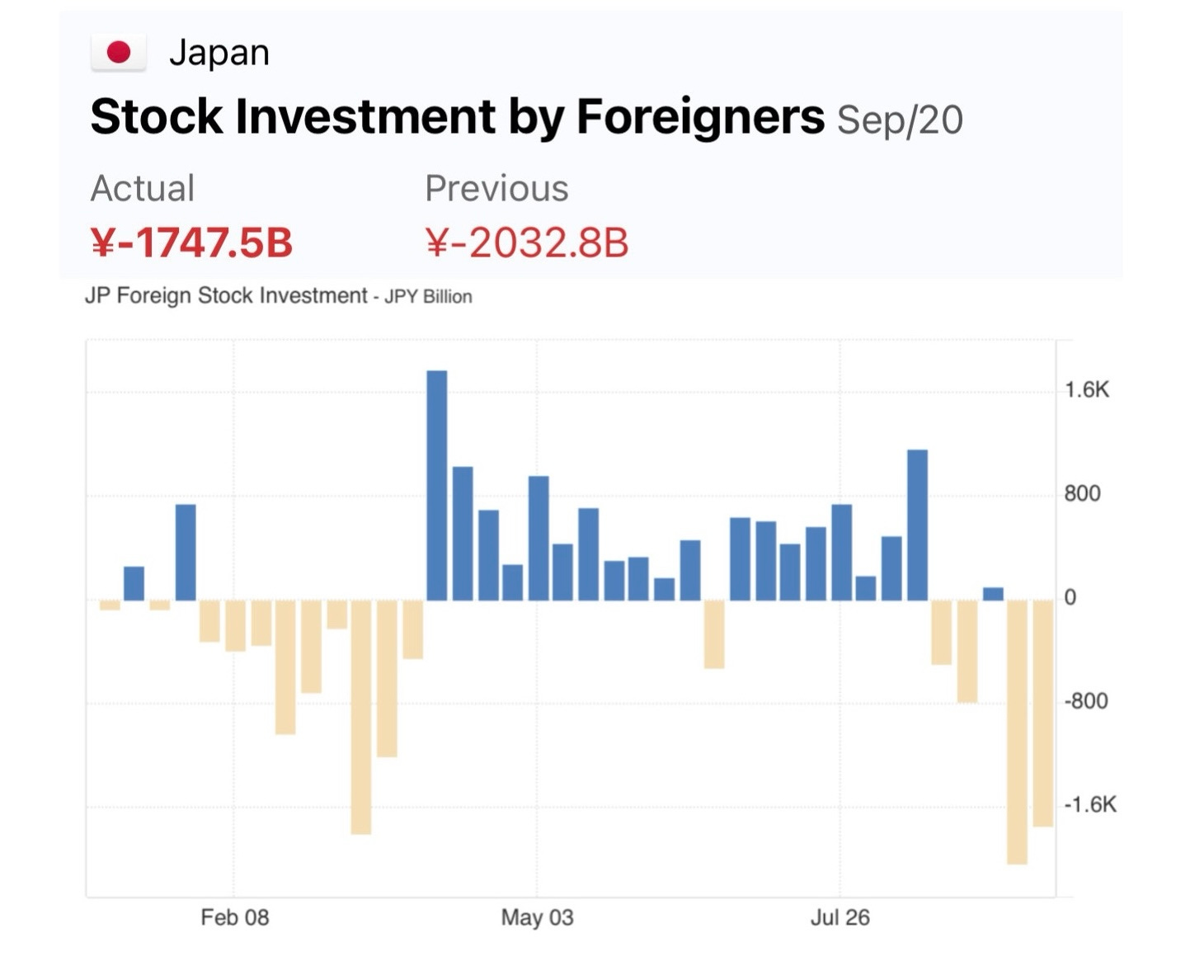
Note that this September foreign selling is a seasonal trend that has occurred every year for the past decade.
Nonetheless, foreigners have been profit-taking just as Japan equities have broken out to new highs and outperformed the rest of the world. It’s quite possible that these flows have been reallocated to the U.S. and other DM and/or EM markets - and if the former, would explain where the non-Japan upside is coming from, at least in part. Also note that this data is NET-buying and selling - meaning there are also foreigners buying Japan amidst the greater selling.
But either way, Japan continues to rise and outperform despite foreign outflows. So then who is buying Japan? Domestic Japan.
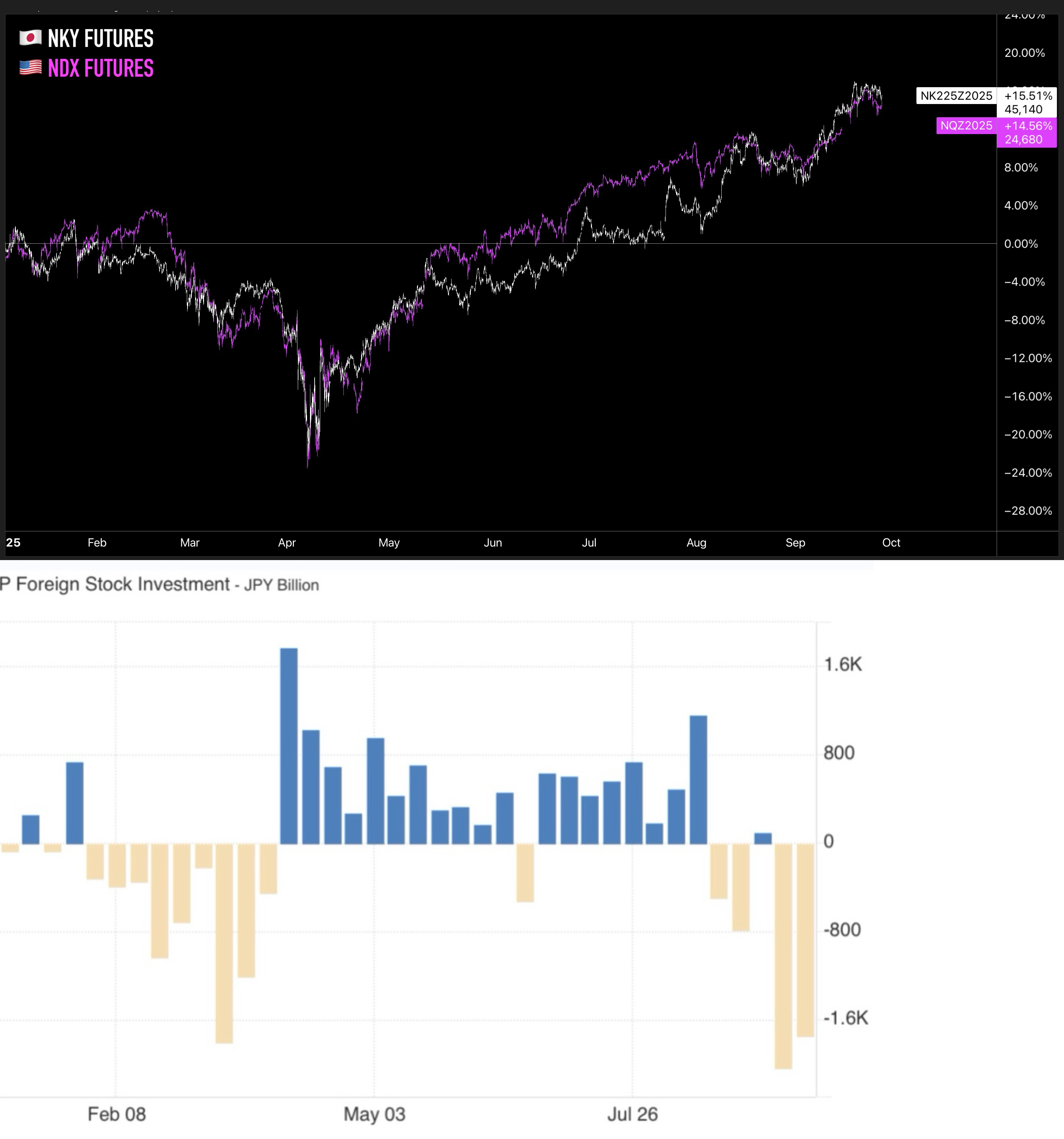
Which therefore makes more sense when we then ask and answer - who / what is moving NKY, not only to the upside, but to suddenly gain further momentum vs that of US and the rest of the global indices: Japan political developments and specific catalyst moments are moving Japan equities higher - which in turn are moving US / other DM indices higher in September. In other words, US / non-Japan equity indices are moving on Japan political developments.
Here is the Japan LDP leadership elections calendar (including the Ishiba sudden resignation announcement and subsequent immediate change in events) from my previous articles:
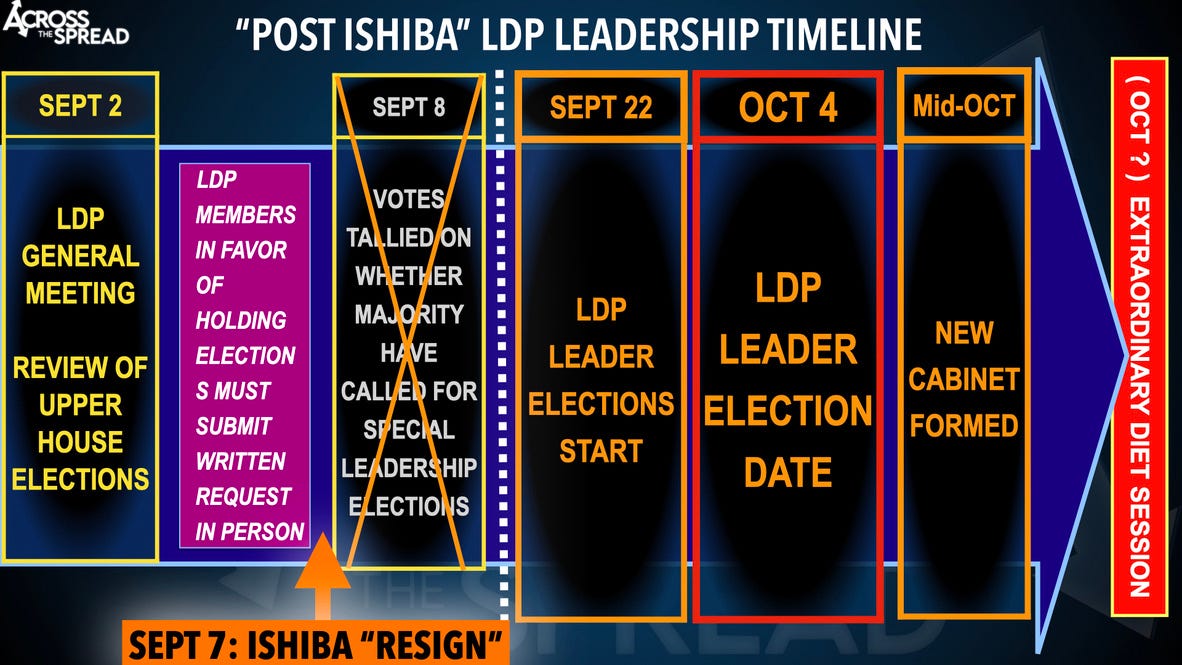
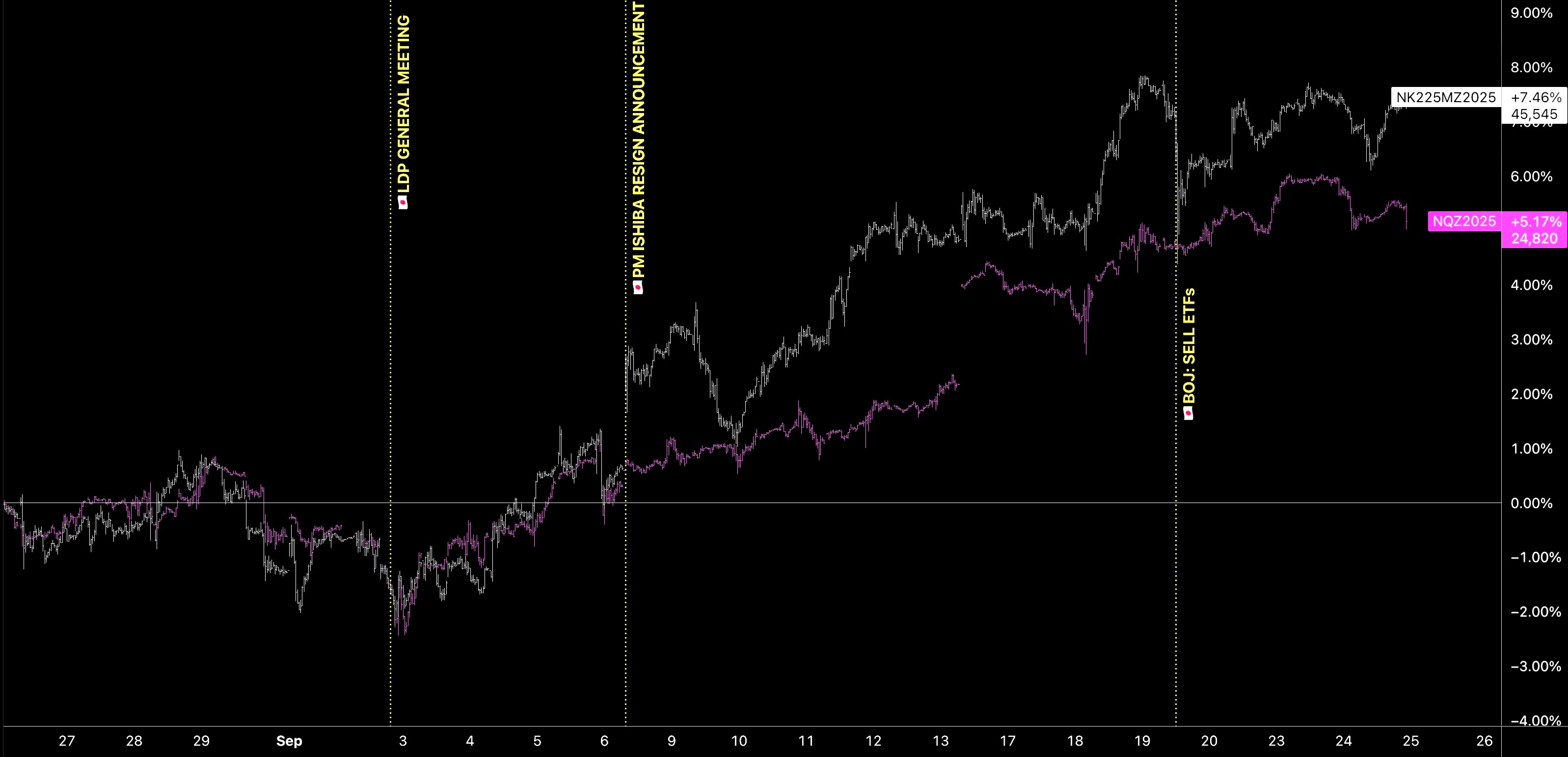
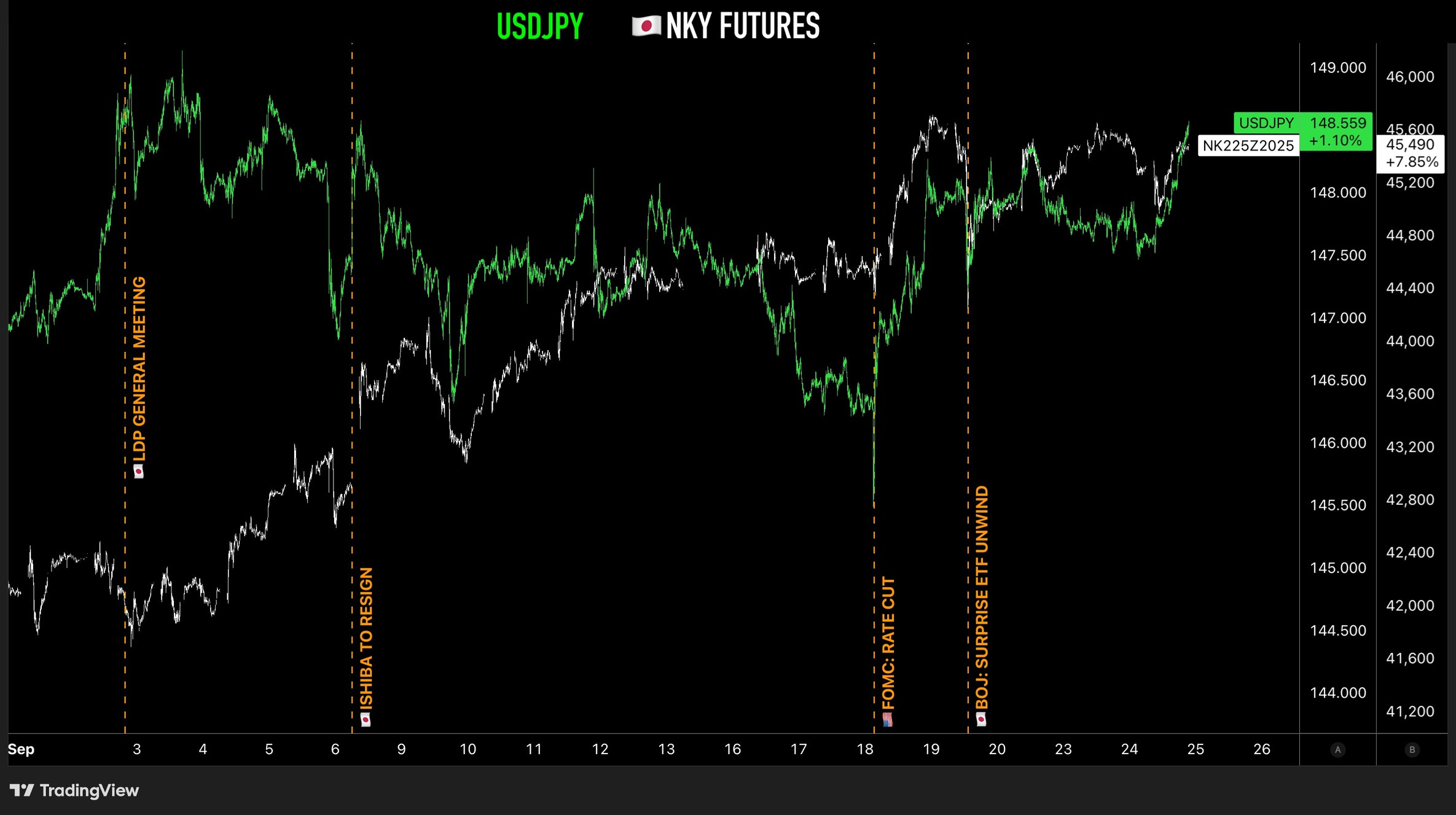
Here are these moments and events mapped onto what transpired in markets - and you will see the exact moment-to-moment market reactions attributed accordingly.
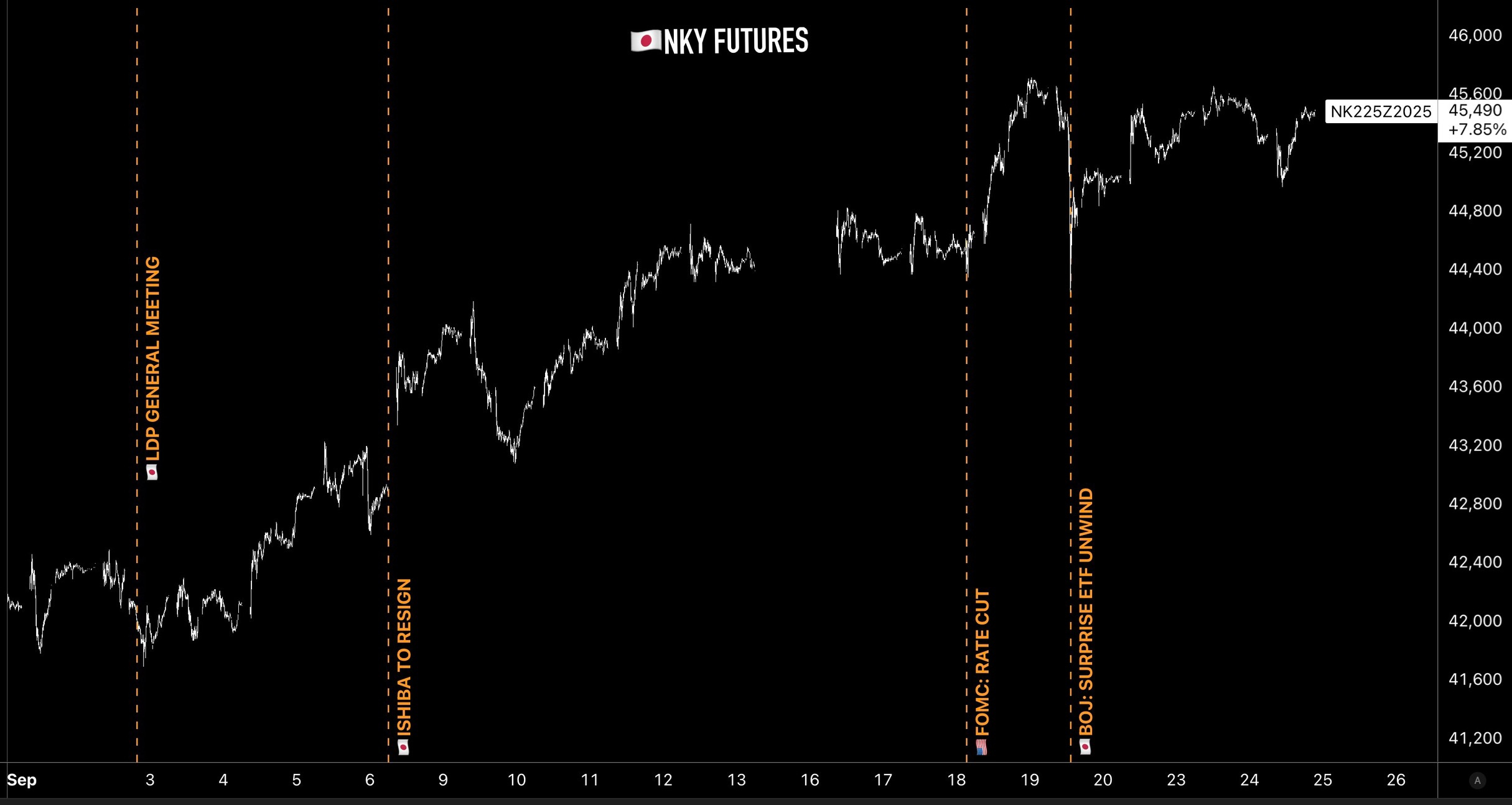
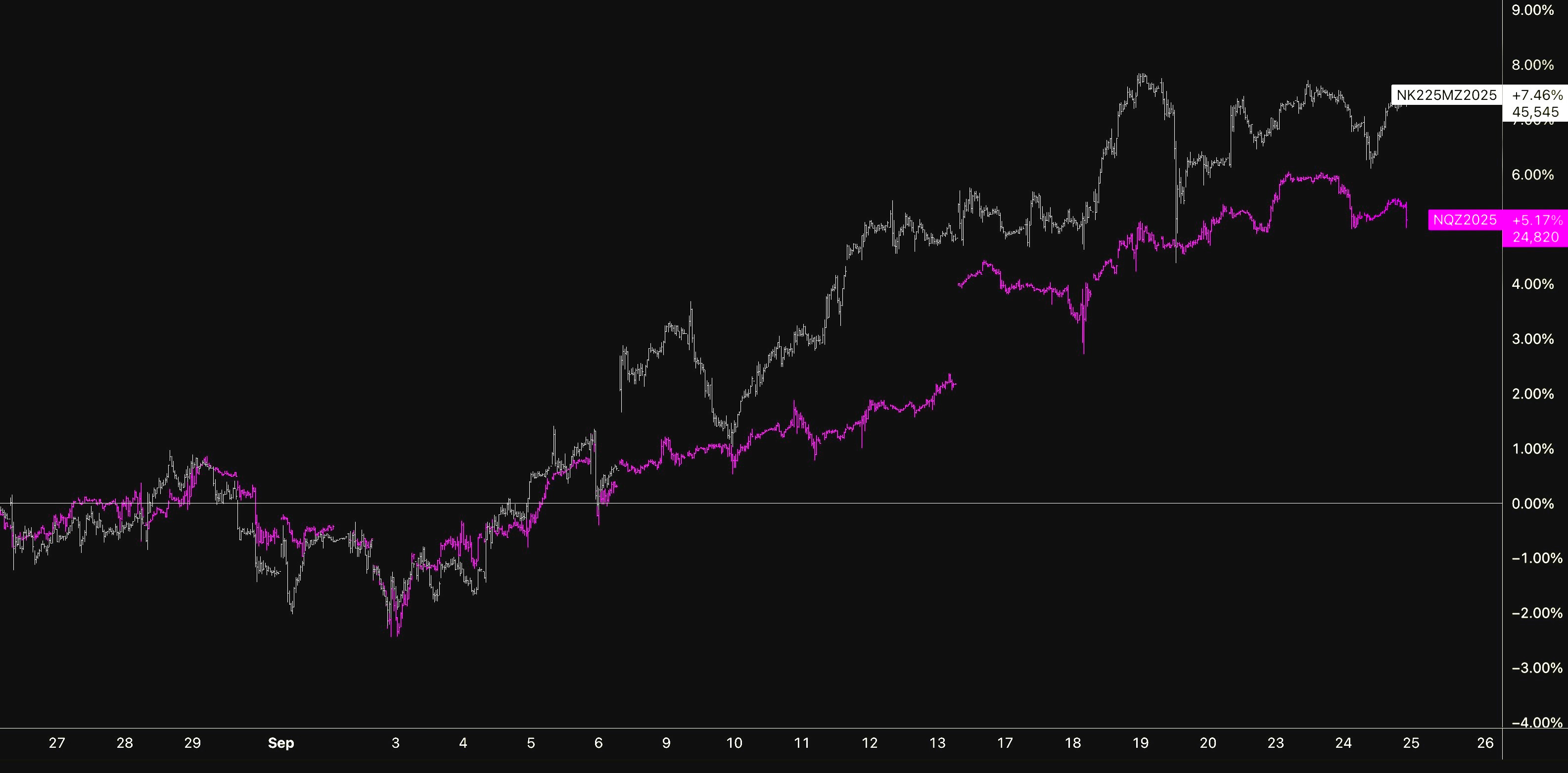
Same NKY futures chart + NDX futures to track the relative outperformance - where the “beta” stops:
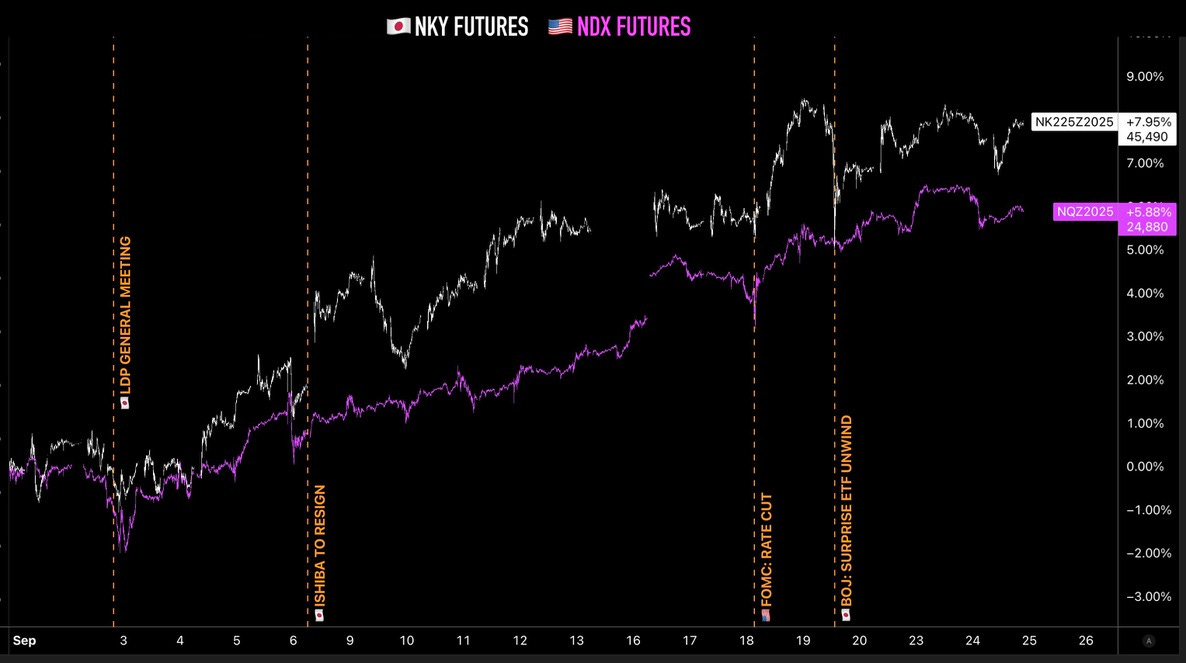
Same chart +USDJPY - which I will get further in depth on FX later, but for now:
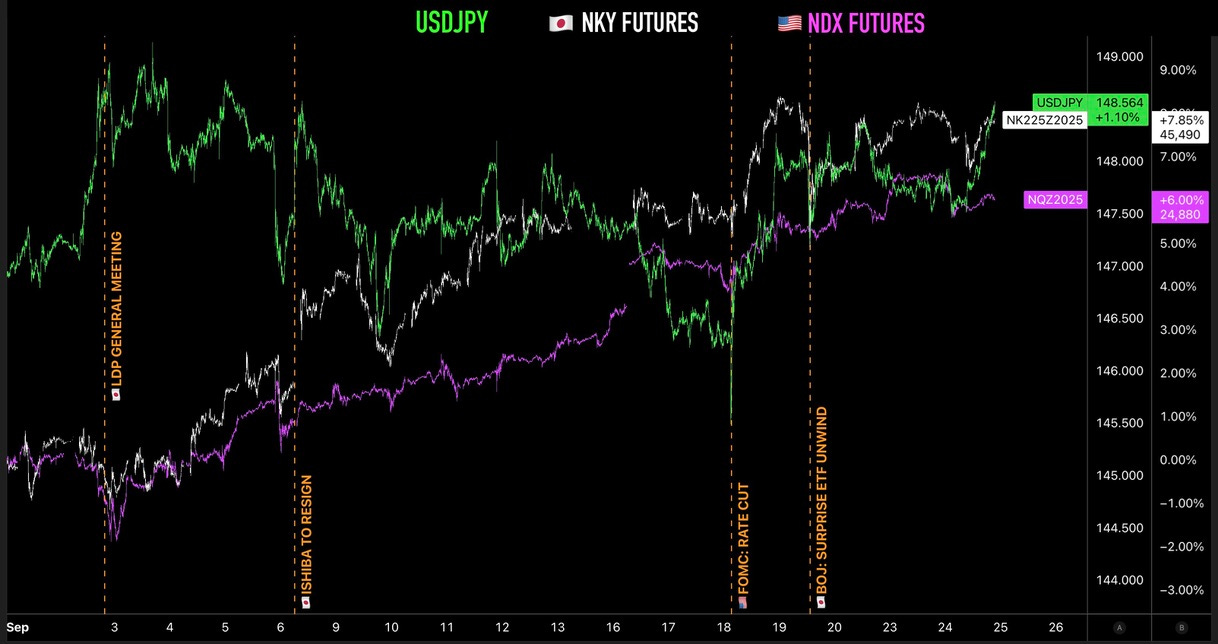
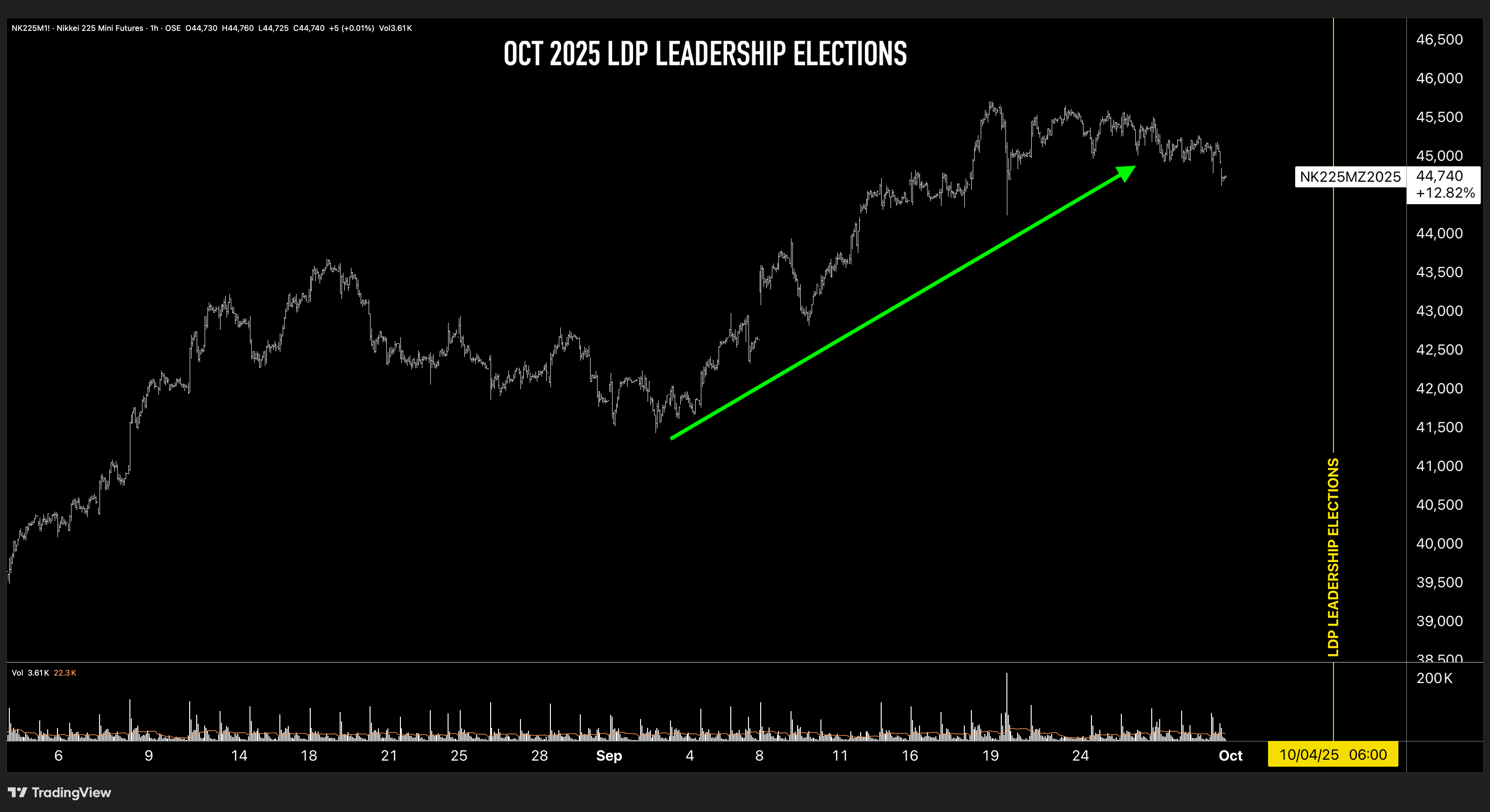
So, the % for % NKY outperformance has been triggered by political developments in Japan as we head ever closer to the LDP leadership election this weekend October 4th.
Notice I included two moments in the above charts that are not Japan political developments - the September FOMC and BOJ meetings. I did this to show what has NOT mattered (relatively speaking) / been a driving factor in market impact.
First - the September FOMC. This didn’t matter for equity (and beyond) markets, and unsurprisingly so - because what transpired at September FOMC? A fully priced-in -25bp Fed Funds rate cut that was delivered, and dot plots that are so scattered that their usefulness in any “definitive forward guidance” is absent. “NDX rallying to new ATH’s because of Fed easing” ← seriously... come on.
Look at the broad narratives currently underway - they’re just straight up “don’t know what’s driving equities to these levels, because the macro / earnings fundamentals don’t align…”
What that shows is that there is a non-US based reason and explanation for US equity market upside.
So the September FOMC rate cut is inconsequential to the September equity market upside, given how well-priced-in it was, and how disconnected a -25bps to Fed Funds is to immediate-term equity market reactionary behavior.
Now let’s take a look at the other major central bank decision that came out - one that was an unexpected surprise, as well as being far more directly influential to equity markets: Bank of Japan suddenly unveiling a plan to begin unloading their ¥37 trillion equity ETF holdings. THAT actually matters to equity markets standalone, let alone relative to some fucking 100% expected FOMC rate cut.
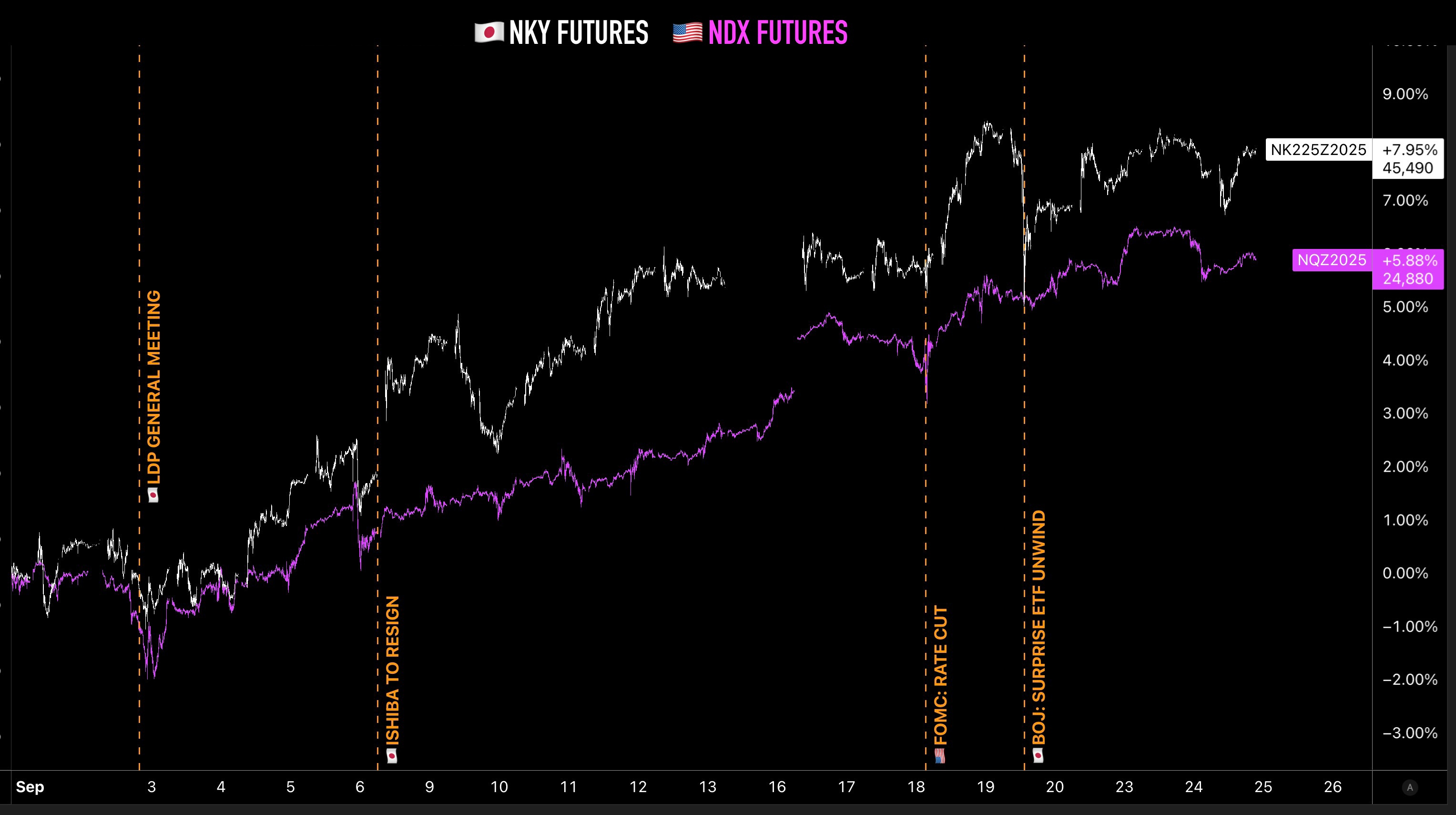
Amazingly, when the Bank of Japan shock-announced their plan to SELL their Japan index ETF holdings into the markets, the reaction by Japan indices was one of an initial “crash” - but a literal flash crash that was instantly reversed and then erased, as if no such announcement was made.
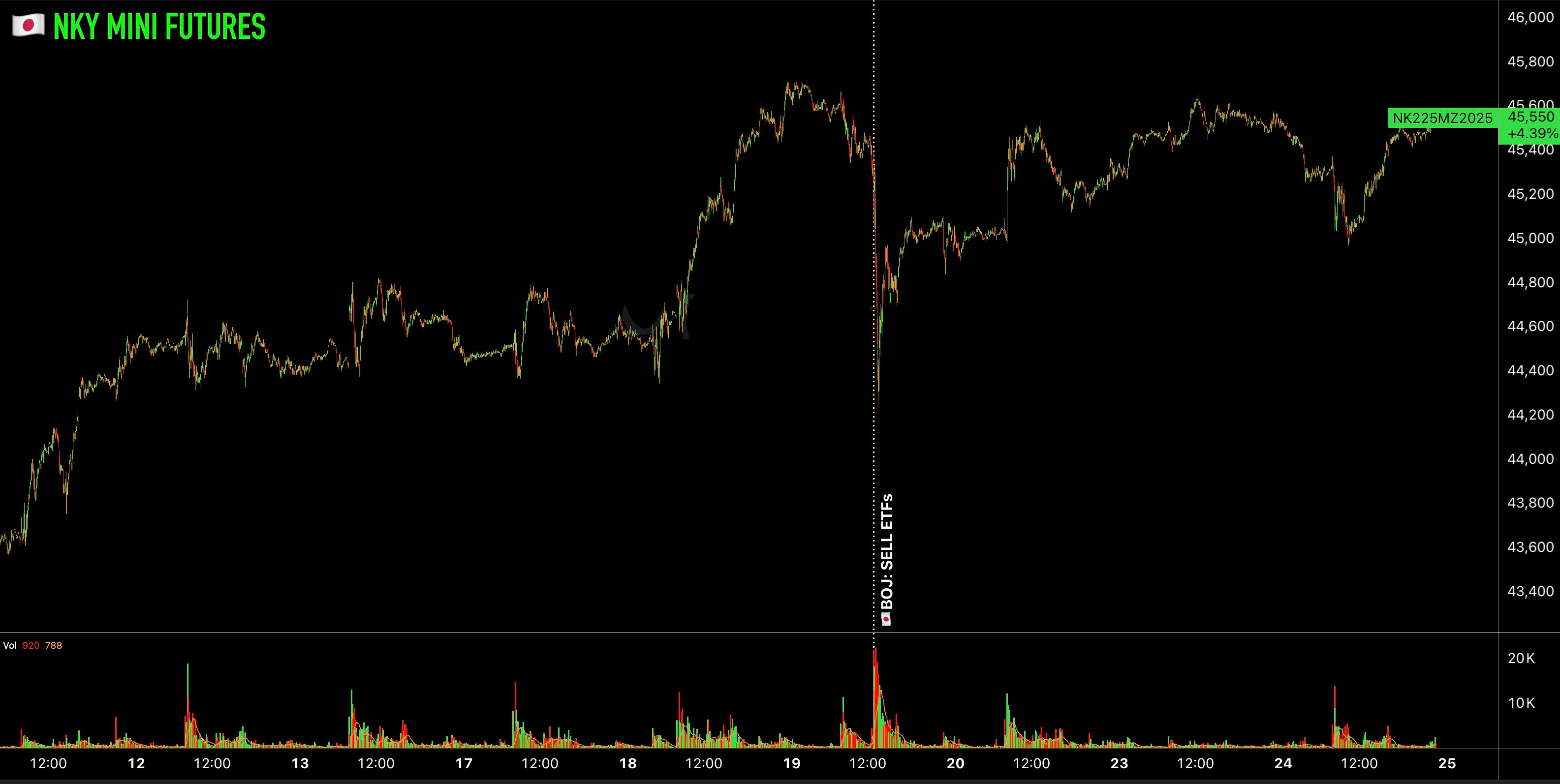
Perhaps (and very likely) this is due to the fact that this BOJ ETF portfolio unwind is to happen at a pace that would literally take over a century to complete. But, as I explained in my BOJ note from that day - this is also a potentially massively bullish development for Japan equities. Nonetheless, the central bank that actually mattered to equities for this moment, BOJ, had no sustained downside impact whatsoever - NKY (and thereby global major indices) resumed new levels of upside despite this policy announcement (another massively bullish signal for Japan equities in and of itself).

So with all of that said, let’s take a look at that which had pushed equities to record highs, and more importantly, that which is doing so in speculative anticipation of the major catalyst coming this weekend: Japan LDP Leadership Elections.
This article will be an explainer of what the unprecedented political picture in Japan is as it currently stands, and a scenario analysis of potential political-to-market outcomes, which are already being priced in and impacting global markets (as I’ve shown above).
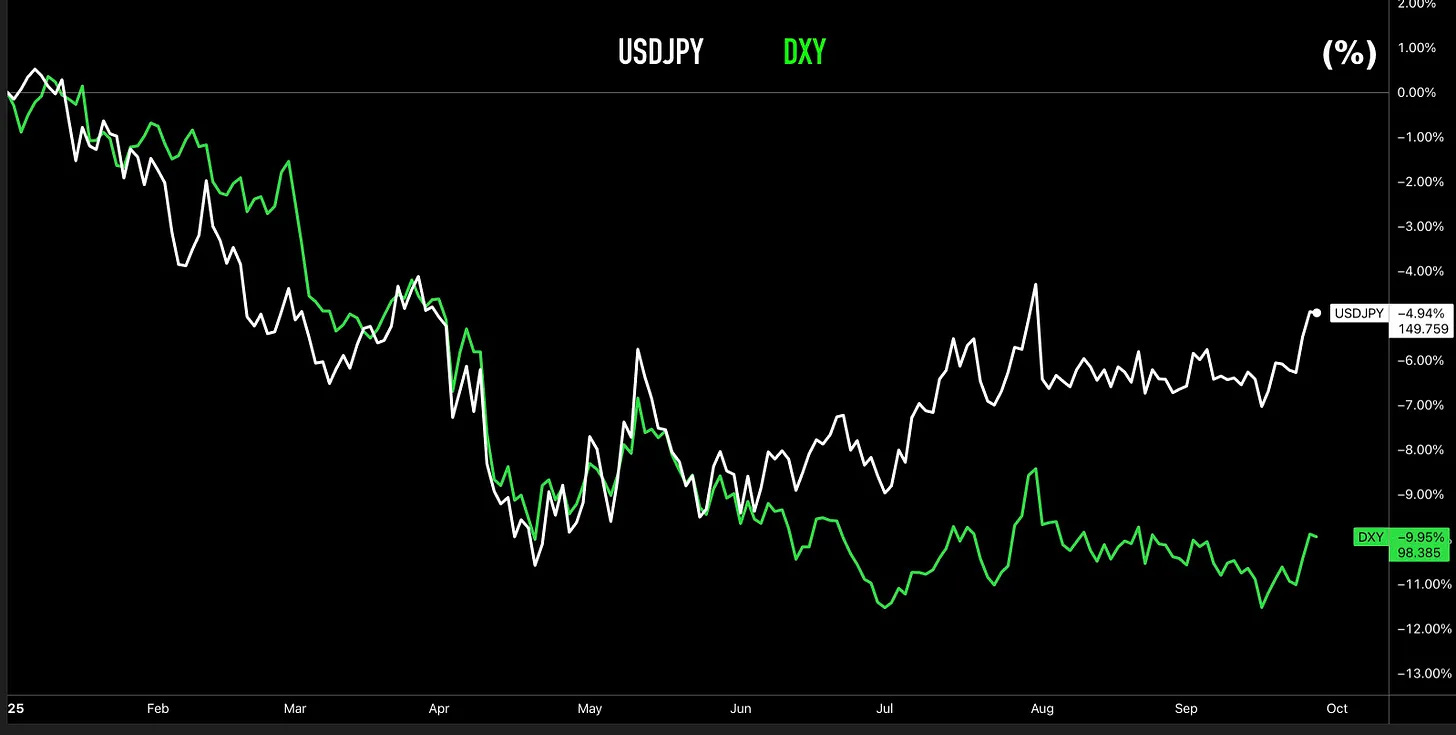
In addition to the straight forward facts, I will also include my personal views and market commentary / personal trade positioning at the end - spoiler alert, to put it simply: NKY-led sharp (through temporary) equity index downside, USDJPY downside, and long-end JGB yield downside (though less conviction and less of a move in relative magnitude).
Saturday October 4th is the day that the LDP will determine who the successor to PM Ishiba, postwar Japan’s biggest self-serving political clown who’s unprecedented actions continue to reverberate throughout markets and have caused all of this historic political turmoil in the first place.
That said, voting is already underway - which I will explain further, along with the “this time is entirely different” aspect of this process.
For now, here are the five candidates in the running to become the next LDP president, and thereby presumably the next prime minister of Japan, in no particular order:
Sanae Takaichi
Shinjiro Koizumi
Yoshimasa Hayashi
Toshimitsu Motegi
Takayuki Kobayashi
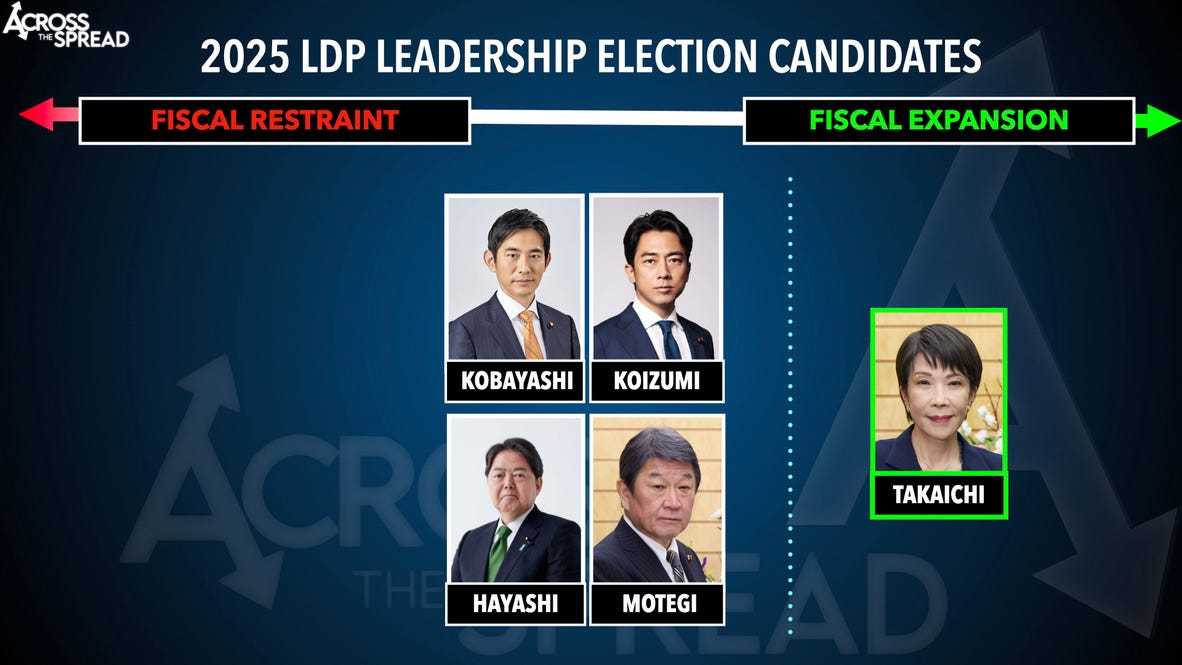
Here is how they land on a “spectrum” for that which matters to markets:
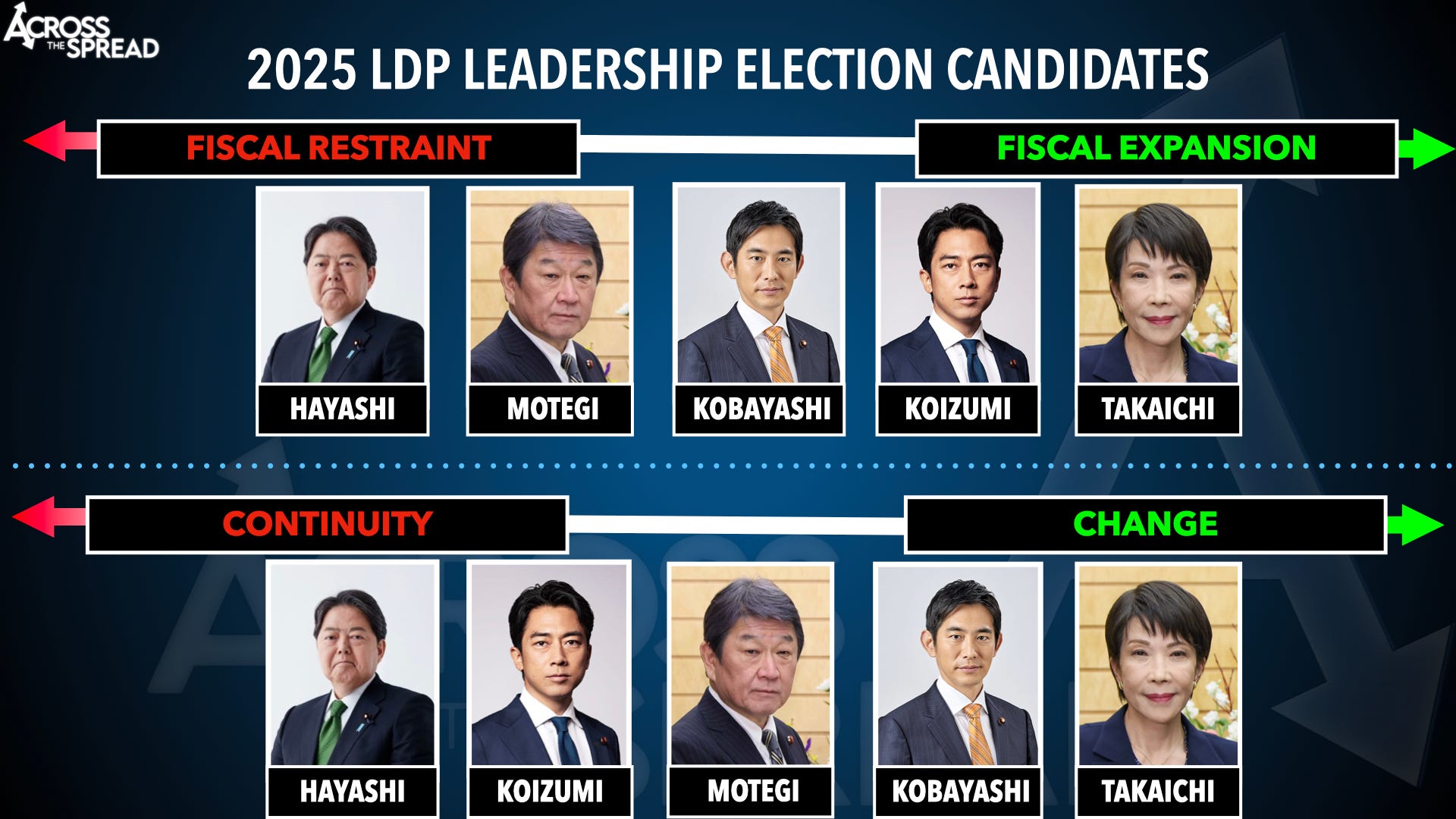
But at the end of the day, here is how markets are viewing and acting on LDP leadership outcomes (correctly or not in approach):
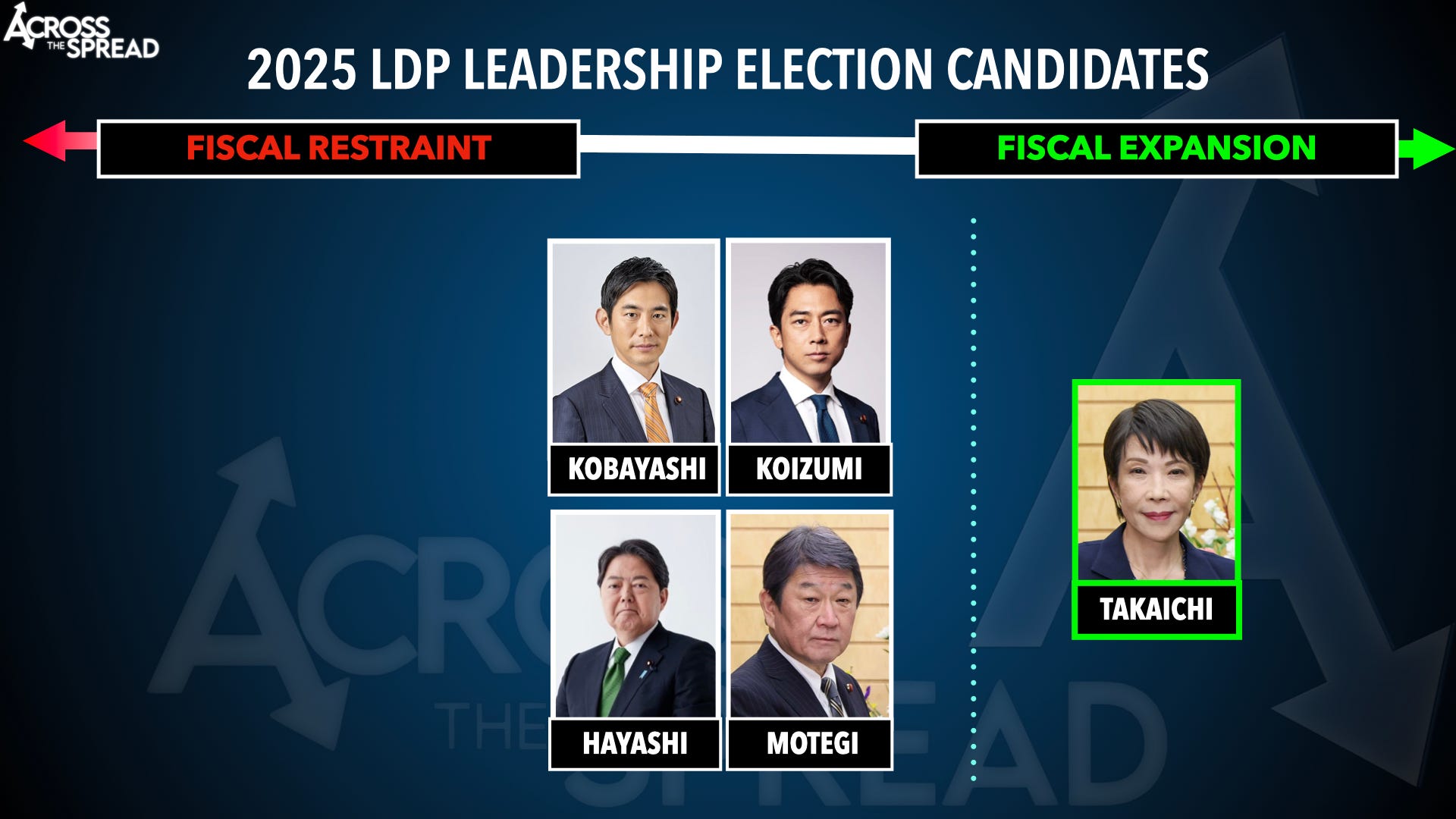
Indeed, markets are looking at this in a binary outcome: Takaichi win or loss.
The reason is because of the perception that of the five, Takaichi is the real outlier as it relates to economic policy.
Those who are focused on the actual political fundamentals will argue that this is an oversimplified, nonsense approach for analysis. And as someone who has spent every “waking” hour (which implies “sleep” involved - for which little/no such luxury has been afforded) in the past 2 months of my life in immersing myself deep and wide into this broad topic in order to truly understand the nuances of every element of this matter - I would agree that this is an oversimplified nonsense approach. However, I am not approaching this (or anything) from a political angle - I am solely and purely interested in green and red blinking ticker market impact and behavior - and however markets behave is how they behave, “nonsense” to an irrelevant stance or otherwise.
That said, the markets’ oversimplification, and outright misunderstanding of the complexities and unprecedented differences present market risk (and/or opportunity) as well, which I will apply as appropriate.
Before diving in, let me underscore what I just said, and remind everyone what the core fundamental purpose and aim of Across The Spread is. And I truly hate having to re-state the following disclaimer because of how obvious it is, but it is unfortunately warranted in the current environment of political hyper-sensitivity and recent personal “threats” received, and it is ultimately mission critical.
As it relates to anything that comes out of Across The Spread: the entire and only reason that I am discussing political matters at the moment is because it is materially impacting major global financial markets. My work and commentary itself genuinely does not care about any of these people in (or not in) office, anywhere - Japan or otherwise. I do not care about political parties or the governments that they run and oversee. I do not care about voters, citizens, and nation states that these political actors (are supposed to) represent, and I do not spend a moment thinking about what is “good” or “bad” for anyone. It is my job to be completely cold-blooded objective, and purely market-opportunistic/risk cognizant, because markets themselves do not care if some clown in public office is “good” or “bad,” or if its “right” or “wrong” - markets just blink green and red accordingly. And therefore, I too do not care. Will I use colorful language, such as calling Ishiba a clown? Absolutely - not just because that too has objectively played out to certainly be the case, but because it is not just my analysis itself, but also my raw authenticity and style in which I convey my analysis that draws people in - as well as keeps people out. Either way, that’s the approach - always has been, always will be. If that bothers you and you wish to unsubscribe, please do so - and I say that genuinely with no hard feelings - we’re simply not a mutual product-fit, nothing wrong with that. If you think I’m “for” or “against” or “in support of” or “propagandizing” or whatever, you are not understanding the purpose of my work. If you can’t turn off your own political lens or are bothered by “bad language/form” over the market-content itself, then you aren’t cut out for the true brutality that markets will blindly run you over with. And finally, to the “Japan nationalists” out there who have been throwing threats in my direction because they are irritated by a non-pure-Japanese foreigner identifying JGBs as the world’s most dangerous market, or calling out PM Ishiba being a clown (both of which have shown to be objectively dead-on accurate) - on behalf of myself, my family, and the broader Across The Spread community, my message is simple: Fuck off. I will never stop, and certainly not from your ineffective and cowardly “backlash.”
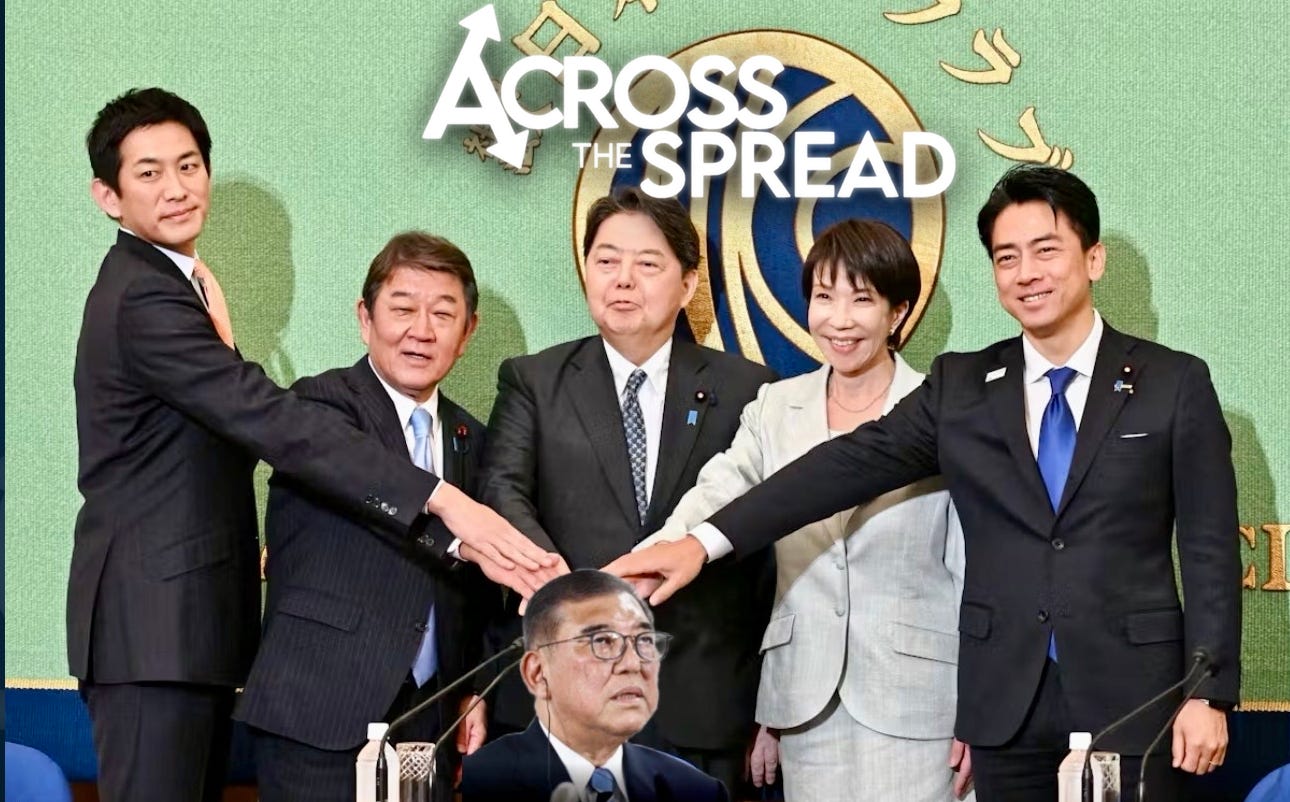
Back to the start of this article - why is NKY (and thereby global DM indices) having such a strong month of September? Its really because of one individual: Sanae Takaichi and her prospects of potentially becoming the next LDP leader and Japan PM.
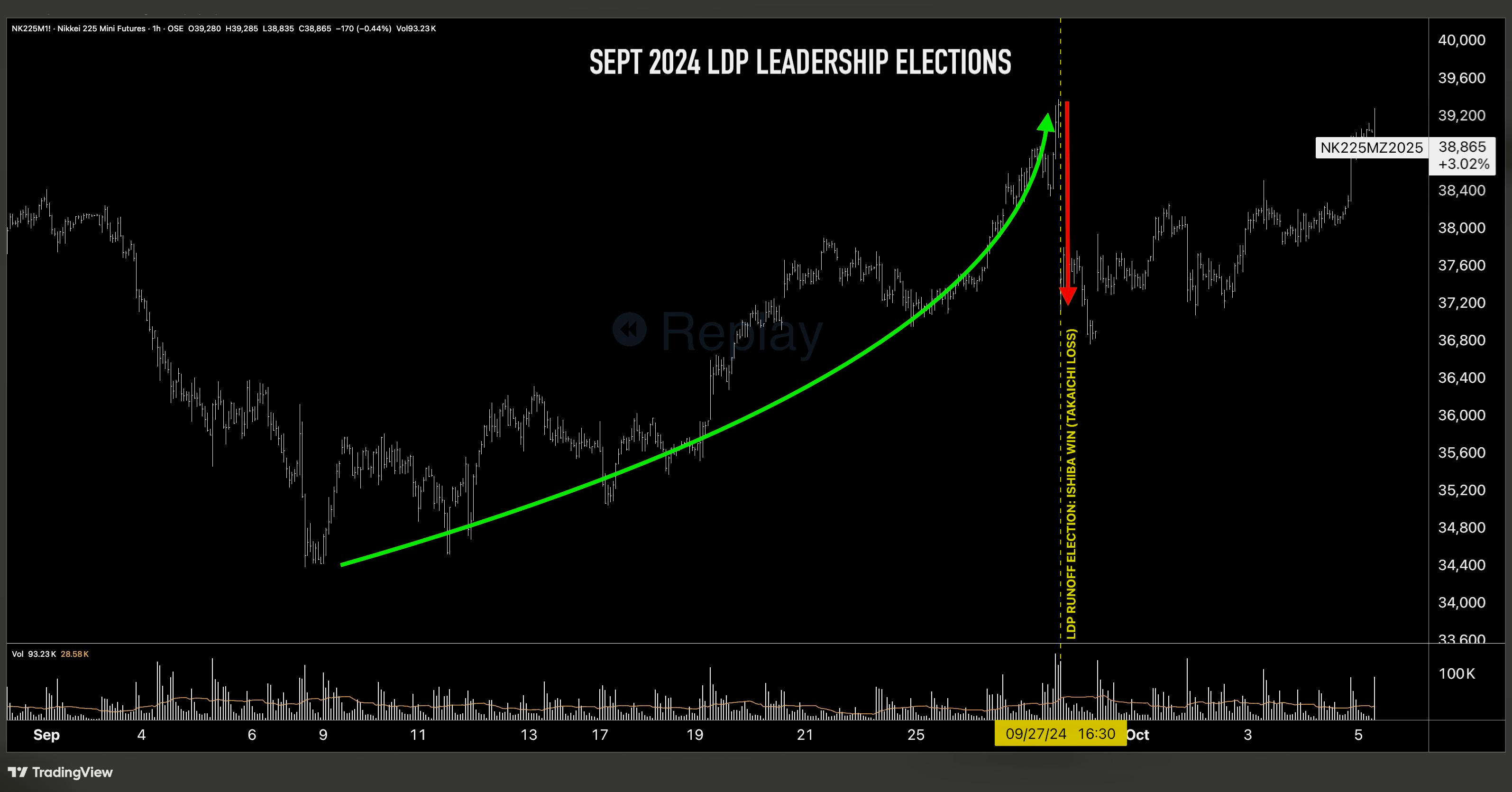
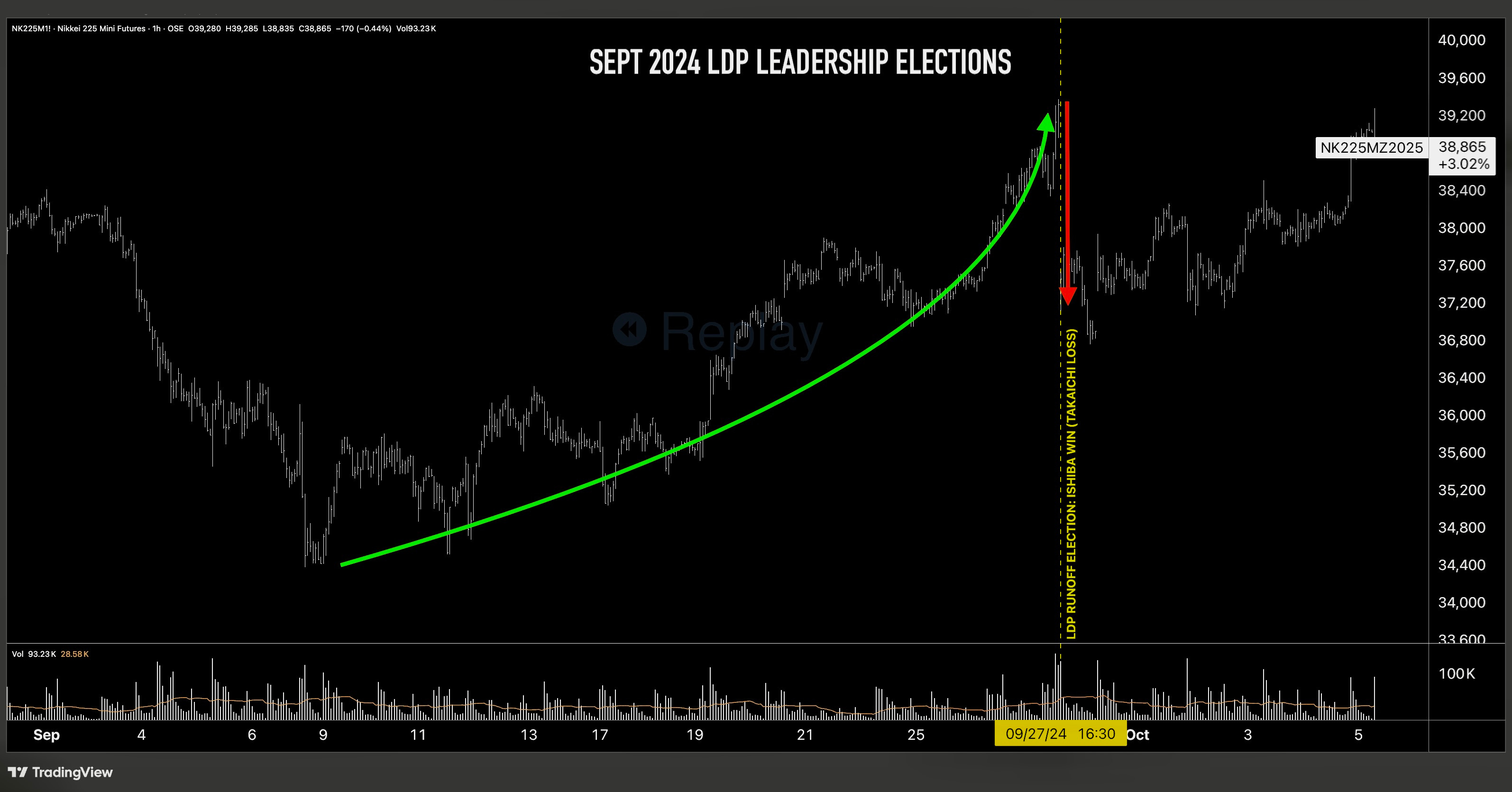
We actually saw this occur in last year’s 2024 LDP leadership elections as well - where expectations of a Takaichi-win started getting priced in and rallied NKY +10% in a week, +5% of which occurred in 2 days, and +2% of which occurred into Japan PM session close during the voting process itself - as she her popularity had surprised both markets and certainly the LDP elites. And when said elites then begrudgingly chose Ishiba in the second-round runoff between the two candidates (after Japan PM session close / before NKY futures market-reopen at 4:30PM), NKY futures immediately plunged limit-down -5%, USDJPY dropping -4 handles, and then clown Ishiba suddenly and completely reversing his years-long reputation of “anti-BOJ-easing” that very weekend to “BOJ must remain accomodative” before Monday market open (which saw NKY crash -5% anyway, but exposed this clown as an ideology-empty clown all along).
The reason that Takaichi is of primary market focus is because of her perceived outlier economic policy stance. We will get to the fundamental realities afterwards - but this is how markets are behaving.
Sanae Takaichi is seen as (and frankly, is) a major advocate of late-PM Abe’s economic and non-economic policies. She is explicitly: pro-fiscal and monetary expansion/easing, pro-growth, pro-government support of households and sectors which she feels are in need. She also leans favorably towards a weaker JPY, citing weaker currency merits rather than downsides. And although nobody is outright “pro-more-debt” - she has maintained a posture of JGB issuance as a necessity to carry out fiscal expansion, as her belief is that aggressive fiscal and monetary measures and proactively targeted policies now will set Japan on a path of sustained growth that will “pay for” / cover deficit financing. In other words, her vision for reducing Japan’s debt/GDP is to grow the GDP denominator at a faster pace.
This approach in and of itself isn’t very “fringe” and “outlier” - frankly, its what Japan has been doing without her in LDP leadership anyway. But she has made consistent remarks deemed controversial in recent years, which then further solidifies her outlier public reputation as a “right-wing conservative” and “fiscal/monetary dove” (and no, these are not “contradictory” in Japanese politics).
Take her perception on Bank of Japan - both on policy, as well as the “independence” of the institution itself.
“Government sets the direction of fiscal and monetary policies, and the Bank of Japan is responsible for the specific policy means.” -Sanae Takaichi, Sept 24 2025
The above comment is actually a more restrained Takaichi for this round of elections - here is how it was covered:
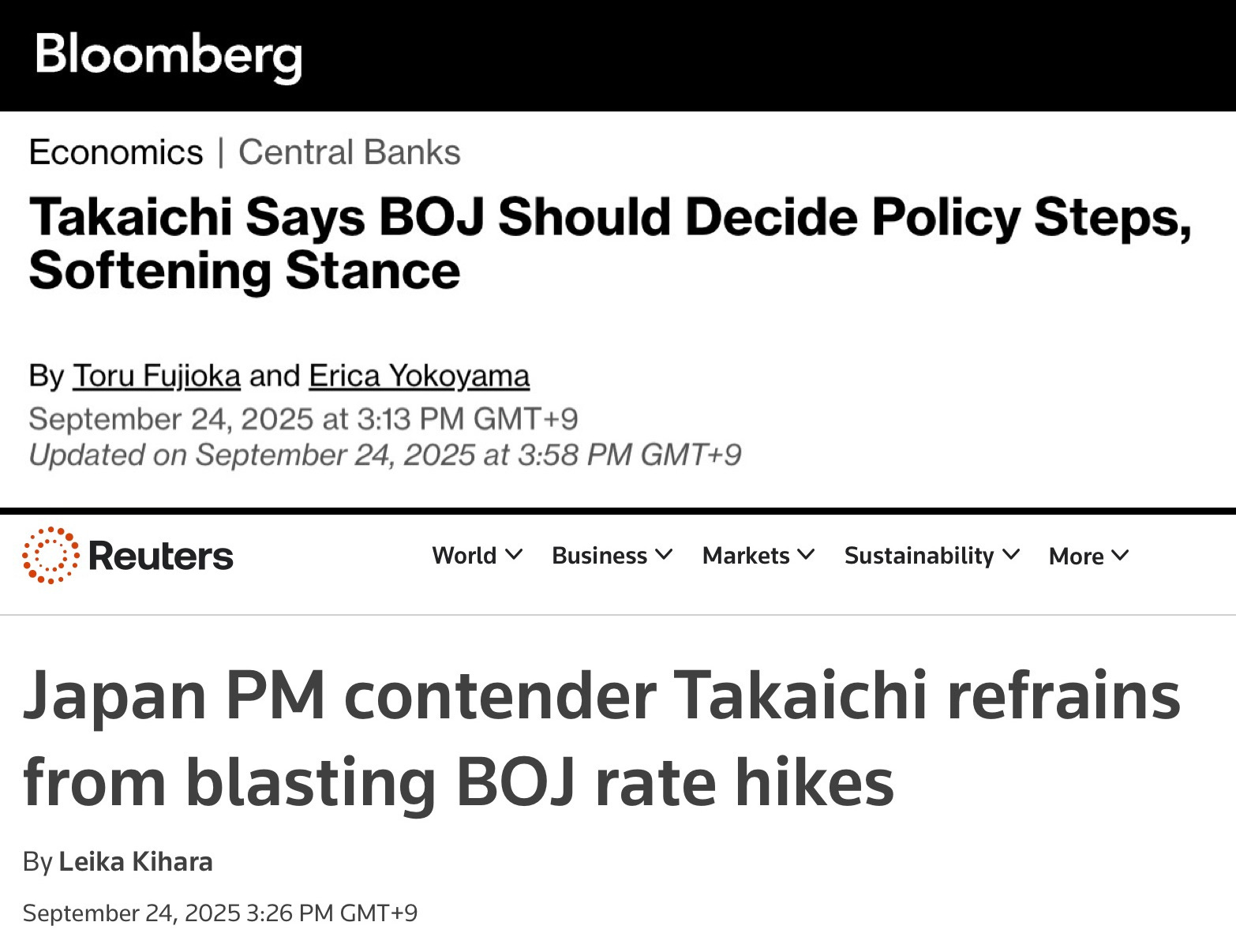
These headlines imply that Takaichi saying BOJ should decide BOJ policy (execution methods) is a stance softening, and that she had previously / regularly blasts BOJ rate hikes - as is indeed the case.
This is Takaichi’s commentary exactly a year ago during the late-September 2024 LDP leadership elections before she eventually lost to Ishiba:
“I think it would be stupid to raise interest rates now.”
-Sanae Takaichi, Sept 24 2025
Regarding the most recent comment of the government setting fiscal and monetary policy, and the BOJ to execute accordingly - though it may seem (and frankly, is) controversial, it is not “unorthodox” in context of the government - central bank relationship that Abe had firmly established as the existing new normal. See this quote from “Abe Shinzo: Kaikoroku” - his personal memoirs that were published after his assassination:
“Issuing JGBs for COVID stimulus checks does not mean that debt is being passed onto our grandchildren. The Bank of Japan purchases all government bonds.
The Bank of Japan is like a subsidiary of the government so there is no problem.”
-Shinzo Abe
So, Takaichi’s stance on the relationship structure between BOJ and government is just a continuation of the Abenomics framework. What’s controversial is that she is still maintaining and advocating for Abenomics-like policies when BOJ is currently attempting to unwind its (frankly unwindable) Abenomics activities taken, but the relationship dynamic itself is no more or less controversial than that which Abe had enacted. And to be frank - this is what the reality of the situation is - so the difference between Takaichi and the rest is that she is the only one who openly says how it currently is, regardless of whether or not its “right or wrong.”
Now, the other reality is that the sitting Prime Minister of Japan, let alone an LDP minority leader, really cannot outright direct BOJ to “do / not do” something. At least no more than Donald Trump can direct FOMC rate policy (which I suppose he is succeeding in doing) - but the difference with an incoming Abe in 2012 is that at the time, Abe very outwardly campaigned on Abenomics and “Three Arrows” - 1. Bold monetary policy (touting then-Asia Development Bank president Kuroda as his likely BOJ pick to execute this bold monetary policy Arrow 1), 2. Aggressive fiscal stimulus, and 3. Structural reform. And when Abe won in a landslide, then-BOJ incumbent Governor Shirakawa stepped down for a last-minute Parliament-confirmed BOJ Governor Kuroda to launch Abenomics Arrow #1 at his first BOJ meeting in 2013. Takaichi isn’t going around campaigning with an “Ueda-replacement” (much less ringing NYSE bell like Abe did: “BUY. MY. ABENOMICS!”).
Essentially, Takaichi is campaigning on a continuation of Abenomics - but here is what the vast majority seems to be missing. A continuation of Abenomics does not mean all 3 Arrows of Abenomics to restart from scratch - which is what the common narrative is. Abenomics did not deliver on all 3 of its arrows - in fact, it really only delivered on Arrow 1 - bold monetary policy (and boy did it deliver on that). Arrows 2 and 3, fiscal policy and structural reform, came nowhere near the level of execution that Arrow 1 did. Yes, fiscal stimulus was enacted, but it was “underwhelming” and frankly mis-targeted, while structural reform barely took place. So, a continuation of Abenomics in 2025 under Takaichi’s framework is an emphasis on the unfinished latter two Arrows: targeted and effective fiscal stimulus, and structural reform.
This is why markets are trading a Takaichi-win as a partial resurrection of Abenomics, with most impact on equities (blasting higher to new records), followed by JPY (slightly weaker, but far from new highs), while JGBs are behaving least-Abenomics-like, as Abenomics crushed JGB yields, currently, JGB yields are holding back from breaking new all time record highs. Equity markets are the most, if not the only market that is actually materially sensitive to Takaichi vs not-Takaichi outcomes (again, JPY as well, but not as much).
Here, once again, is last year’s Takaichi rally:
And here is the current Takaichi rally underway:
The rally behind this:
I will note that Takaichi’s stance on Ministry of Finance is actually different and unconventional, if not outright aggressive. Takaichi explicitly embraces a movement that literally calls itself “anti-MOF.” However, it’s not what it may seem/sound like - and this gets into the whole rabbit hole of the Ministry of Finance’s influence in elections and politics.
“Anti-MOF” essentially means anti-austerity, and “MOF” in this regard refers to the bureaucracy at the Ministry of Finance. I will elaborate further into this MOF “deep-state” matter in a coming article (and no, this is not conspiracy theory - this a is well known public reality - ask any normal Japanese person about zaimu and if they will know of it because of its understood political influence) - but Takaichi taking this anti-MOF stance aligns with the public perception of her fighting against the body that is determined to (attempt to) not necessarily keep fiscal policy as restrictive as possible as an outright goal in itself,, but to keep public finances in check - which means: increase revenues (or anti-tax cuts / pro-tax hikes) and decrease spending (or slashing budgets and public benefits).
Among the other 4 candidates - yes, we can pick apart what each of their respective “plans” are, but as it relates to markets, it really is a waste of time and energy to do so. And this is once again coming from someone who has put in ungodly amounts of time and energy saying so, rather than someone who has not, and saying so.
Here are the one-liner run downs:
Takayuki Kobayashi (former Minister for Economic Security) pledged to ensure people “feel rewarded for their efforts” and said he would “Redevelop Japan to the center of the world.”
Toshimitsu Motegi (former LDP Secretary-General) said he would “deliver the results the people demand,” promising swift and effective policies such as abolishing the provisional gasoline tax.
Yoshimasa Hayashi (Chief Cabinet Secretary) vowed to “protect the future with experience and a track record” and stressed overcoming difficult circumstances with unity..
Shinjiro Koizumi (Minister of Agriculture) advocated “inflation-responsive economic management,” pledging to raise the basic income tax exemption in line with rising prices and wages.
Note that the latter two, Hayashi and Koizumi, are members of the current despised and failed Ishiba administration - which is an additional challenge they need to overcome. Think VP-Kamala Harris, then-Democratic nominee and her “I can’t think of a single thing I would do differently from Biden” remark (this is just a conceptual example for illustrative purposes, and nowhere near what the Biden-Harris administration vs Harris-Walz campaign dynamic tie-in was). Being in the Ishiba administration isn’t any make or break for these two - everyone knows that Shigeru Ishiba was/is a lone outlier sociopath enemy from within LDP. And let’s not forget the highly unpopular Ishiba-led Upper House election’s LDP campaign stance of cash handouts - those have now been quietly abandoned by these LDP leadership candidates who just ran on that party platform.
Here is why parsing the non-Takaichi candidates apart in nitty gritty detail is a waste of time and energy as it relates to market analysis.
First, and again, as markets see it - it’s “Takaichi or not-Takaichi” - meaning, the rest of these guys are all in the same bucket of “not-Takaichi.” And frankly, the oversimplification is somewhat warranted because they are more or less saying the same thing.
For example -Motegi, Hayashi and Koizumi (the front runner / likely head-to-head runoff candidate vs Takaichi in the second round of voting) have the following economic policy platforms:
Koizumi: Increase average annual wages +¥1 million by 2030
Hayashi: Increase real wages to +1% annually
Motegi: Increase annual average wages by +¥500k in 3 years
These are literally the same exact policy goals, just expressed in different numerics. Raising nominal wages by +¥500k in 3 years = +¥1 million by FY2030 = real wages +1% annually.
As for the “how” - though each are different, they all are speaking in vague generalities and thus are all the same.
So, it’s “Takaichi vs the rest” simply because Takaichi has more of a pronounced detailing and not part of the synonymous-metrics group - not that markets are arriving at this this “rest are the same” because they are this “deep” in the details. Markets are basically and correctly (lazily or otherwise) distinguishing as “Takaichi = change” vs “continuity” from the Kishida-Ishiba administrations.
Takaichi isn’t inherently more fiscally dangerous than any other LDP leader would be in a minority - whoever takes the job will have to buy coalition peace by adopting opposition parties’ active-fiscal agenda. What makes her stand out is that she says the quiet part out loud. While others couch expansion in talk of “temporary relief” or “targeted growth,” she openly frames it as sekkyoku zaisei (aggressive/proactive fiscal policy) insists the government sets macro policy direction with the BOJ as executor, and pitches “future-revenue investment.” That unnerves MOF and markets not because it changes the eventual math, but because it strips away the choreography. Instead of letting MOF stage-manage issuance and blame coalition bargaining later, she telegraphs the spending push up front, making her look uniquely risky even though the outcome would converge there anyway.
The other far more critically significant reason that parsing apart the LDP leadership candidates is a useless market endeavor, even including Takaichi for that matter, is simply because at the end of the day - it fundamentally doesn’t really matter what the next LDP leader’s personal policy proposals are, because the Liberal Democratic Party just gave up their majorities in both Houses of Parliament, and for the first time in its history, are powerless by themselves in passing legislation.
Koizumi wants to do this, Takaichi wants to do that. Wonderful. NONE of you can do shit without the cooperation of these newly empowered minority opposition parties. And the way the current political tide is shifting - which is away from the establishment (LDP, its ruling coalition partner Komeito, and the primary opposition CDP - i.e. the entire establishment as we know it) - the leverage is with these minority opposition winners to form a coalition with, namely: DPP, JIP and Sanseito parties.
I will cover these potential partnerships and their market implications (which are far more JGB / global long-end yield consequential than LDP leadership outcomes) in the coming article. But for now, the message is simple - if the LDP’s minority stance makes them dependent on coalescing and negotiating with another opposition party’s policy platforms, then what in the fuck does it matter what any of these minor differences among the five LDP campaigns and their respective promises are?
Fundamentally, it doesn’t.
But for the immediate term heading into LDP leadership elections this weekend, as global equity markets and JPY have already been moving - it does.
Finally here is my personal market view and actual positioning to trade the LDP elections.
This is not investment advice. This is very very stupid of me to do. If you trade this, you are just as stupid as I am, if not more (somehow). So, don’t. Clear on the disclaimer? Cool.
I’m playing the sharp, swift, and likely temporary equity market pullback - in fact I already have been, and NKY is already rolling over. Here is why - and this is where understanding the LDP leadership selection procedure and how it bridges over to green and red blinking ticker markets comes in.
Comments
Nothing yet. Say the first thing.
Sign in to join the conversation.