

I was a guest on Real Vision interviewed by my old buddy and colleague Ash Bennington to discuss this matter of the US-Japan joint coordination in JPY intervention. The full video is on the Real Vision platform and is available to subscribers of Across The Spread (link for access to subscribers below).
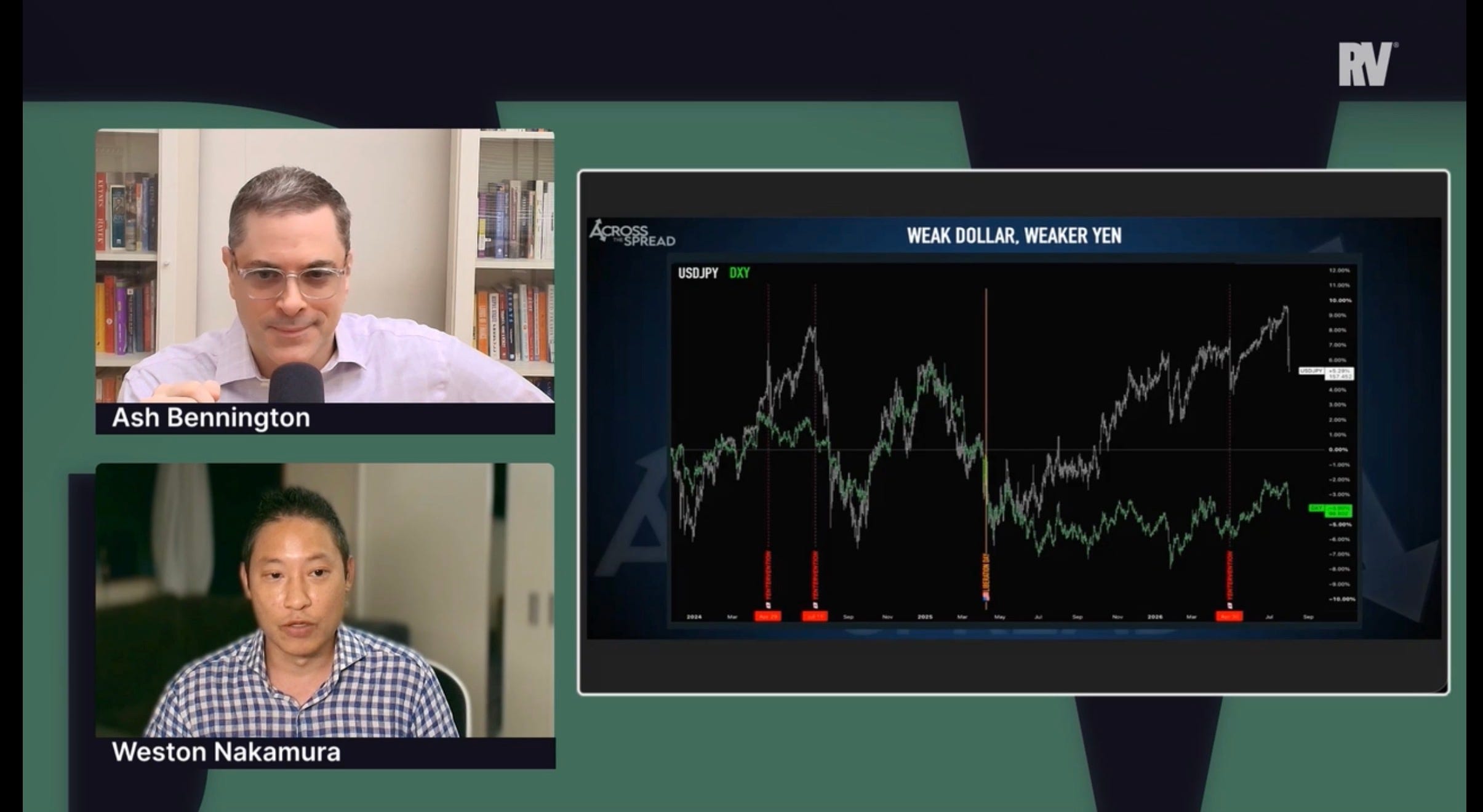
This article is supplemental to what I explain and present in the video with Ash - with little in overlap of material between the video and this article - given how deep and wide this topic stretches.
I suggest both watching the episode in full, as well as reading through what I have here to get the comprehensive big picture on this front and center matter of America’s joint involvement with Japan in coordinated intervention of JPY.
REAL VISION: The Yen Intervention Explained
Ash Bennington sits down with Weston Nakamura, founder of Across the Spread, to unpack the extraordinary joint intervention by the United States and Japan to support the yen.

Across The Spread for Real Vision
Full video access:
This post has bonus content for paid subscribers. Upgrade to get full access.
✓ What does “joint coordination” actually mean (and what does it not mean)?
✓ How did this arrangement actually come about?
✓ What does this (otherwise very stupid) photo…
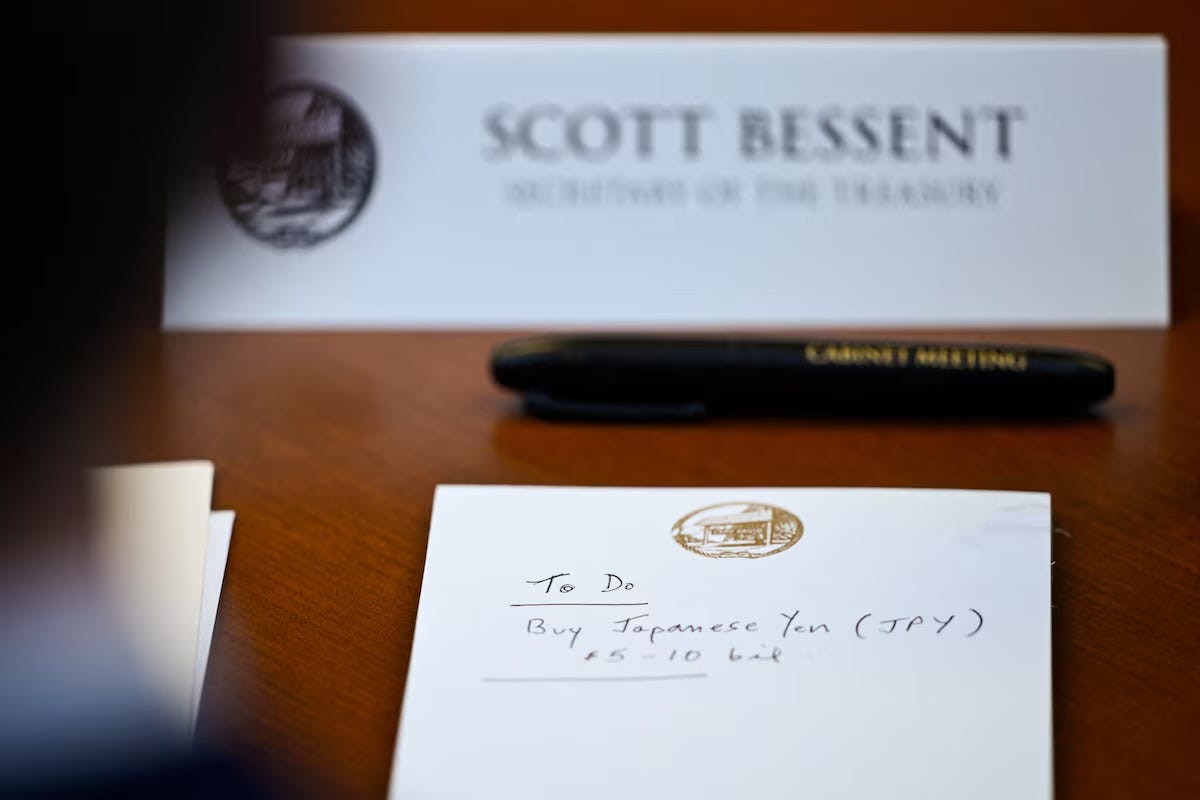
…actually reveal about Bessent / America’s stance in its so-called “joint coordination” with Japan, by the figures?
✓ What are the implications - not just for JPY, but for Japan fiscal and monetary policies?
✓ What does the use of this FIMA system really say about this “joint alliance” - and what are the implications on UST demand?
✓ Why is my longer term (decade forward) outlook more aligned with a USDJPY above 200, rather than this being the start of a decade of JPY strength going forward?
This article will answer all of the above in detail, and more.
First, let’s start with the basics of the U.S. getting involved in yenteventionism.
Why, and why now, America?
Why: in order to prevent long end UST yields from breaking out.
Why now: because long end UST yields are breaking out, alongside USDJPY.
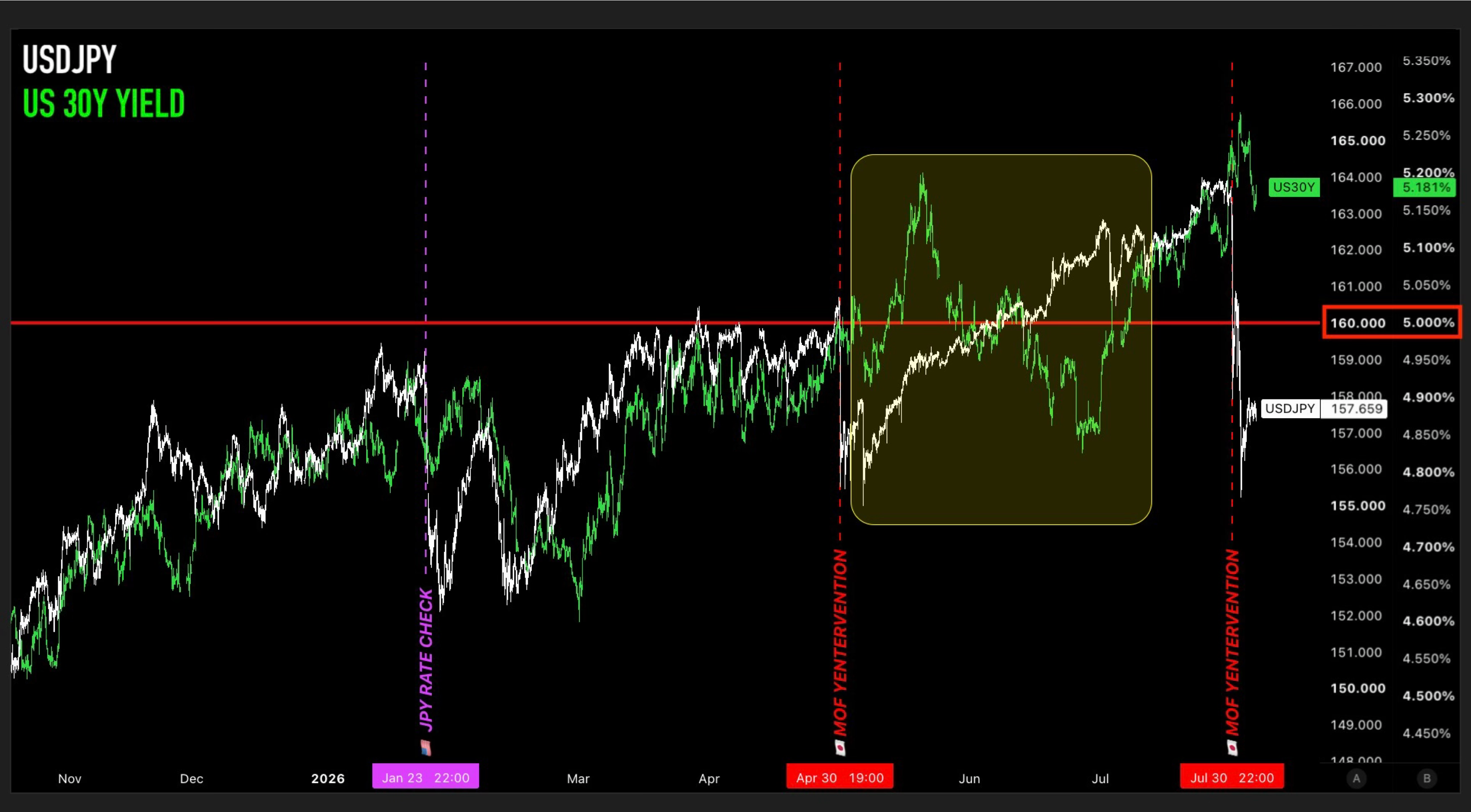
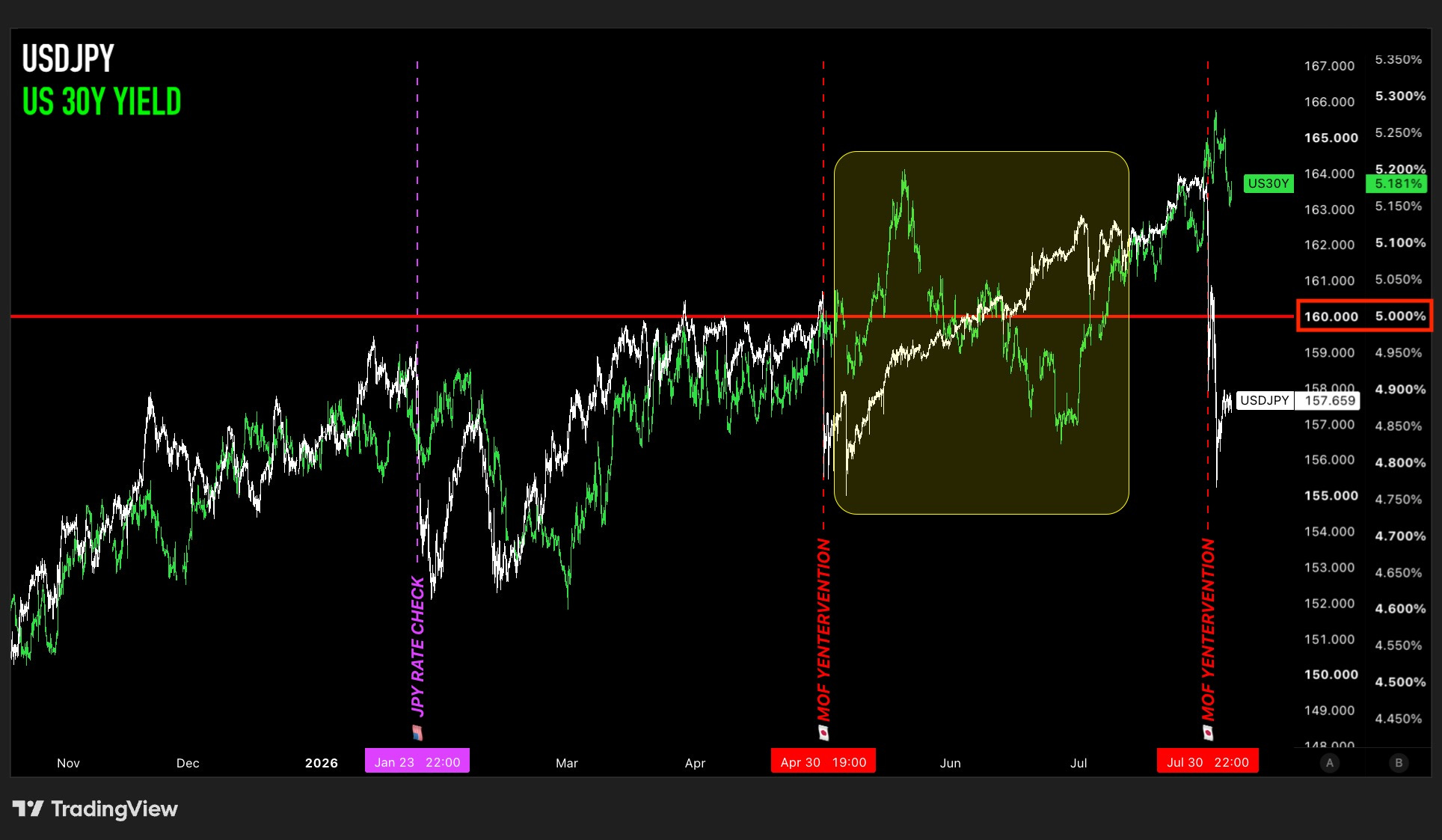
It really is that simple as to the why and why now from the U.S. perspective. That said, its not just a matter of long-dated UST yields breaking out - it’s the combination of both UST yields and USDJPY breaking out to multi decade highs that got Bessent moving on public support for JPY. I mention this because some out there are saying this is “UST-intervention” in terms of what levels of what market to watch (i.e. “forget looking for USDJPY at ___, and look at US 30Y > 5.20% instead for intervention levels”) - no, US yields breaking out alone have not triggered yenterventions, just as USDJPY breaking out alone hasn’t either - as per the period in between this round of yenterventions and the previous April - May yenterventions:
Back to “why” and “why now.” Let me first correct my own question of “why now” - it isn’t a “why now” matter, because this isn’t something that just began “now.” This goes back (at least) to January 23, 2026 - which, much like this recent episode, aligned with a BOJ day, and USDJPY heading towards breaking clear of 160 - when suddenly, the NY Fed came in out of nowhere and conducted rate checks on JPY for the first time since MOF started its unilateral war against JPY sellers in September 2022. This was the first time we saw US involvement, or “coordination” in JPY strengthening.
Note that MOF had attempted its own rate check within an hour after BOJ Ueda’s signature unconvincing press conference that fueled USDJPY upside, and it didn’t do much.
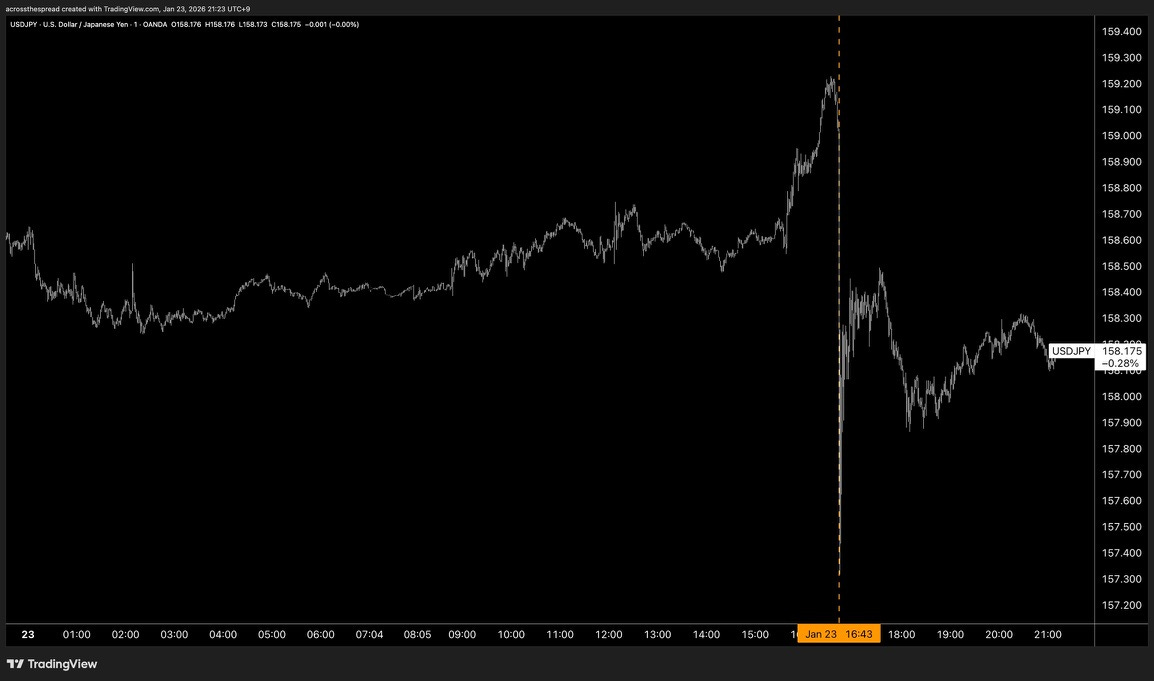
But when the NY Fed came in later that day and conducted its JPY rate check - that crushed USDJPY down to the 152-handle.
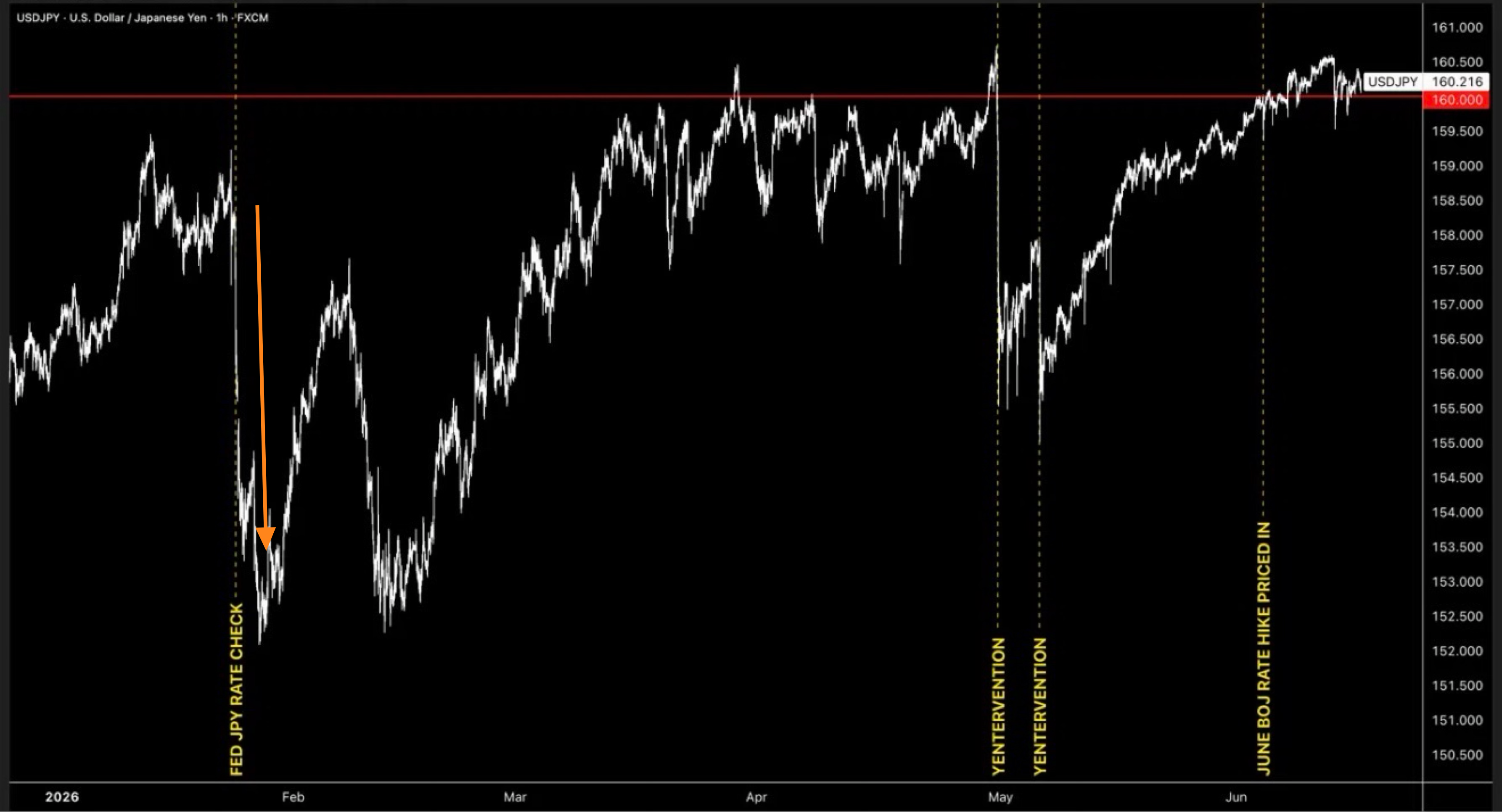
And it was on that day is when US-Japan joint coordination, as “joint coordination” is currently practiced and defined, actually began.
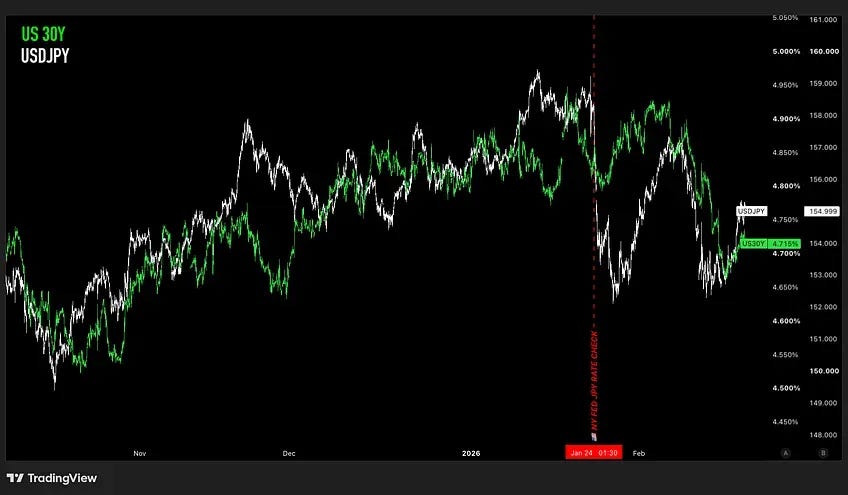
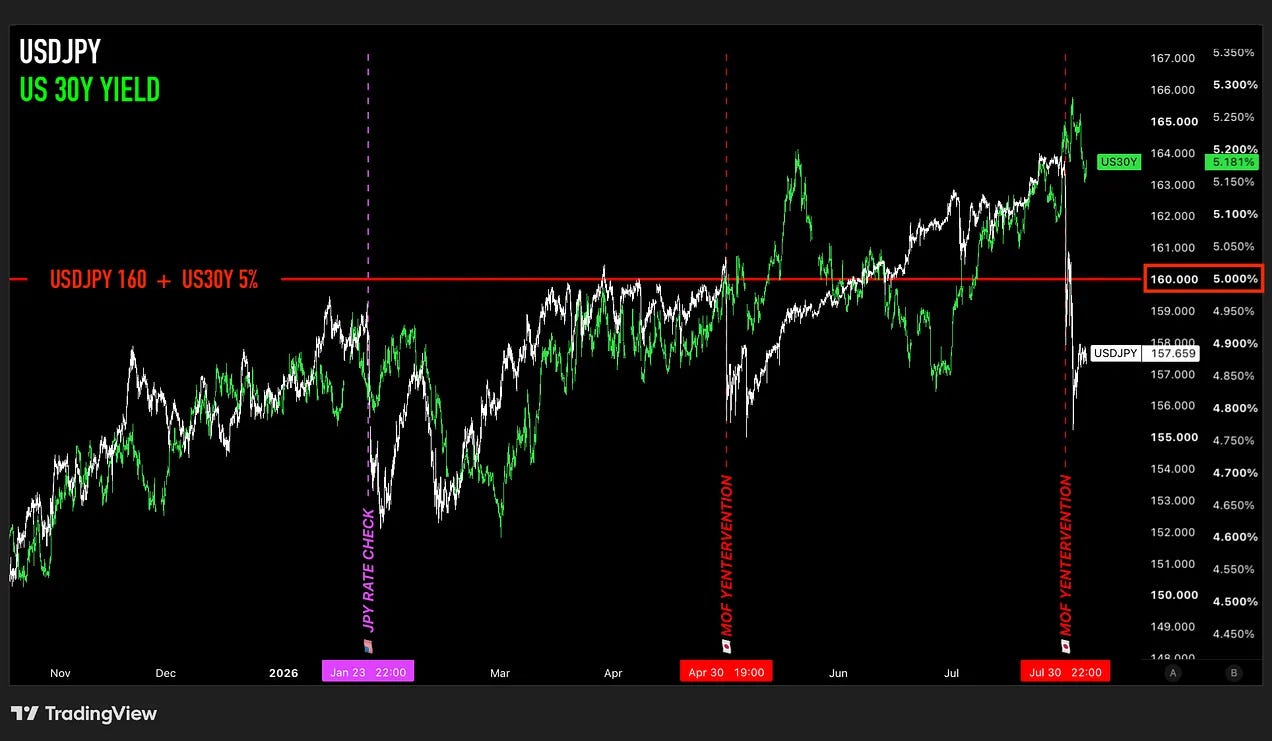
The January 2026 rate check conducted by NY Fed was apparently Bessent’s own initiative - rather than originating with Tokyo calling Washington and begging for Bessent to deploy JPY rate checks. Though this is based on media sourcing anonymously, I believe this to be the case - as Bessent doesn’t just actively participate in USD/FX market manipulation at Tokyo’s request - such actions can only stem from America’s need as Bessent sees it, as was the case this time as well.
Jan 28, 2026 - after USDJPY had also crushed the broader USD complex, here is how Bessent handled direct questioning on JPY intervention and JPY rate checking at the time:
It was later confirmed in Fed minutes that indeed JPY rate checks had occurred:
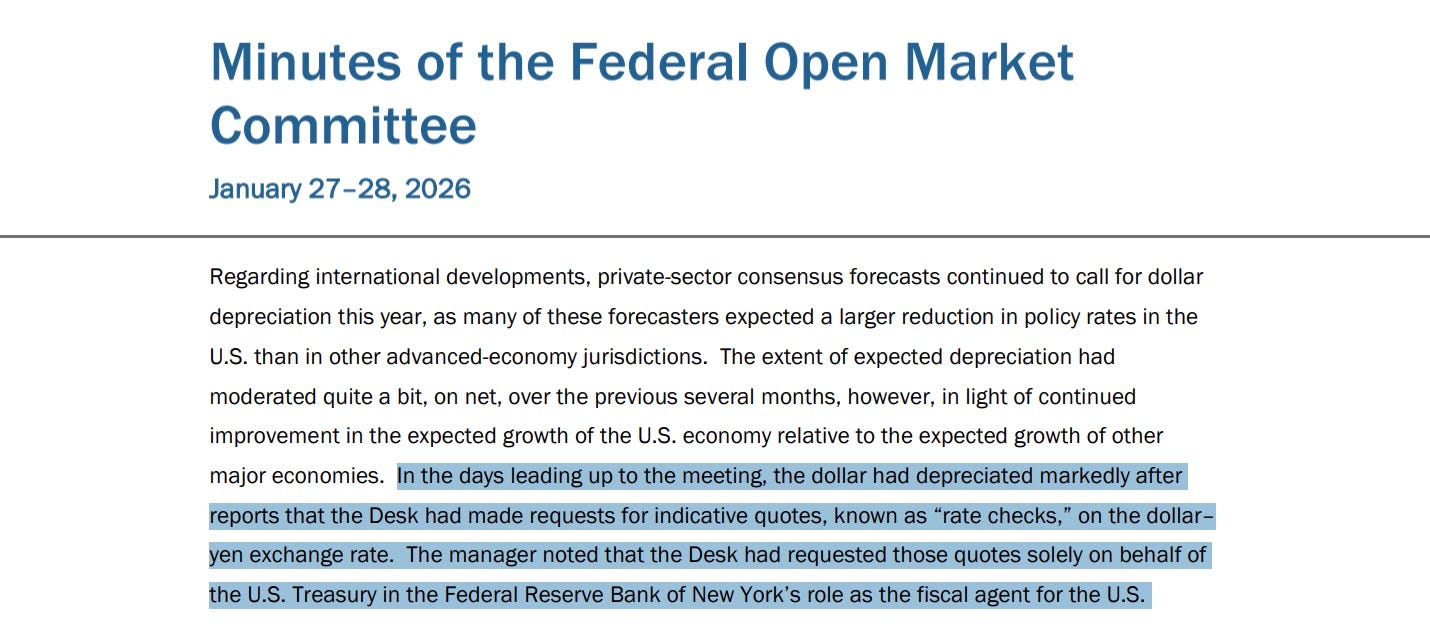
And it also has been confirmed (via the complete absence of any official reporting that would be required by the US Treasury Department if FX market intervention were to have occurred) that no actual market intervention had taken place by the U.S. side in January 2026, or anytime thereafter for that matter.
So, knowing all of this in hindsight, if you go back to the clip above, you can see how Bessent handles (knee-jerk answers) each question:
Is the U.S. intervening to support JPY? “Absolutely not.” (True).
Is the U.S. conducting JPY rate checks? “No comment” (other than an emphatic “absolutely not” on actual market intervention - “no comment” = avoiding yes or no).
This 10 second video clip from January of Bessent in swift and decisive rejection of any accusation of the U.S. engaging in direct JPY buying / USD selling market intervention foreshadows what we are now currently witnessing - as you will see.
Lets further recall markets in early 2026 - particularly during Davos.
Long-dated yields on DM government bonds around the world were shooting higher - very much including those of USTs. And around Davos and beyond, the chatter as to why such a move higher in yields was occurring was being blamed on two things: Trump tariffs, and Trump’s talk of taking Greenland - neither of which were actually the reason behind the move.
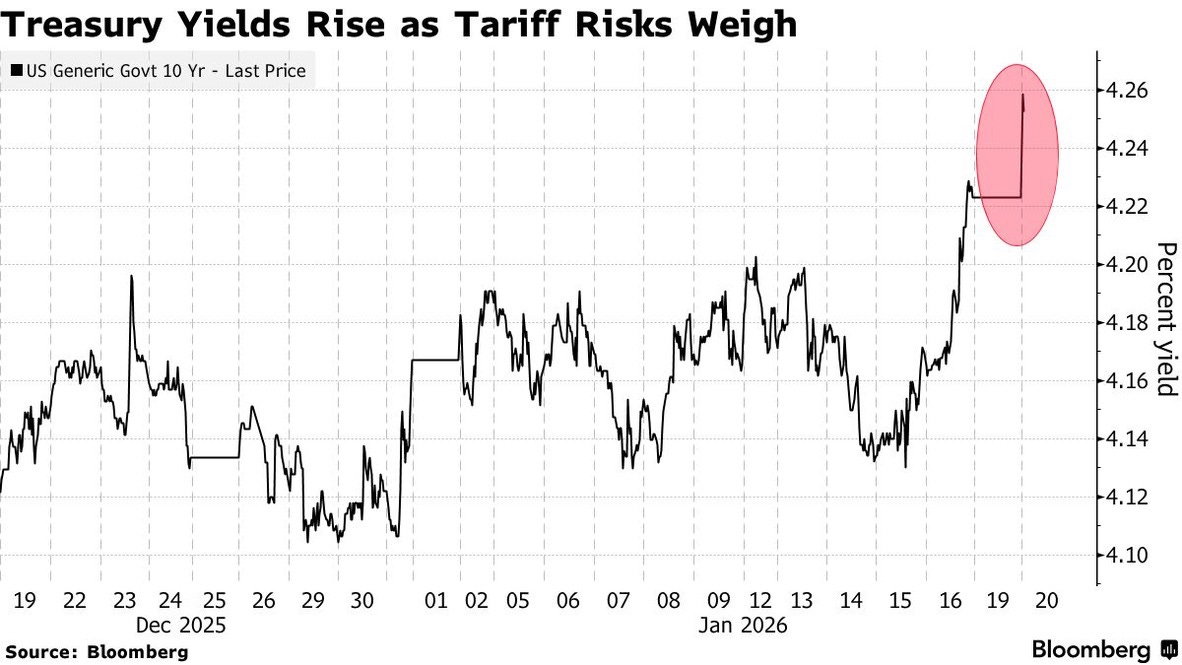
The real reason was that long-dated JGB yields had massively and violently broken out, and that had been spilling out to the rest of the world.
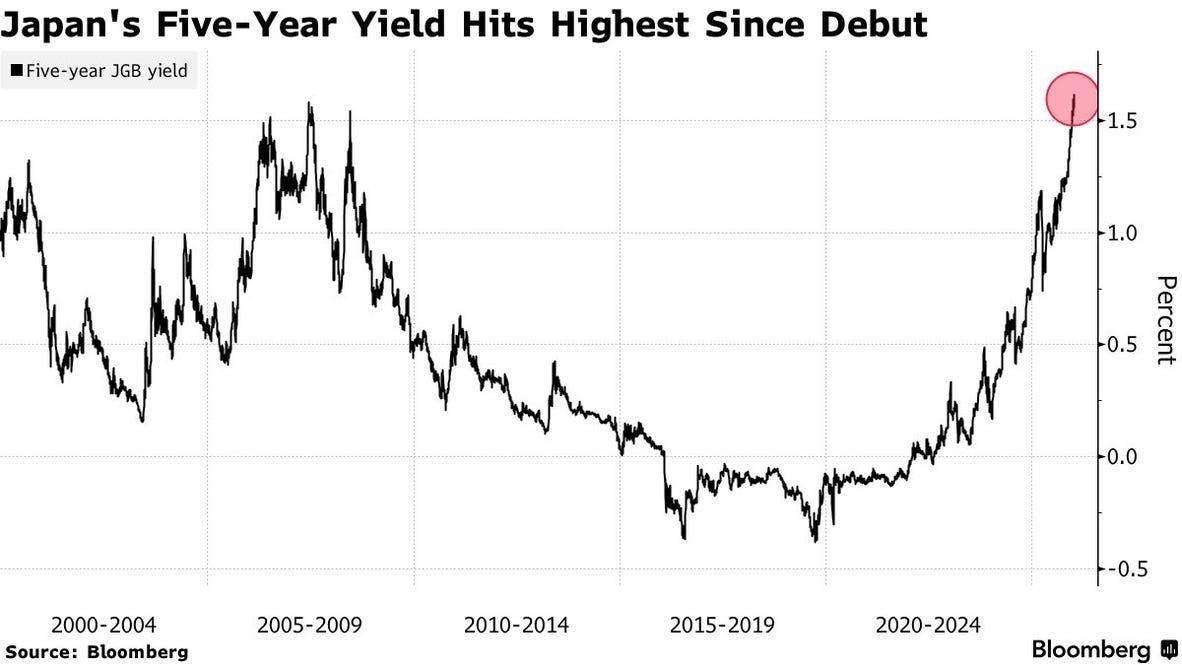
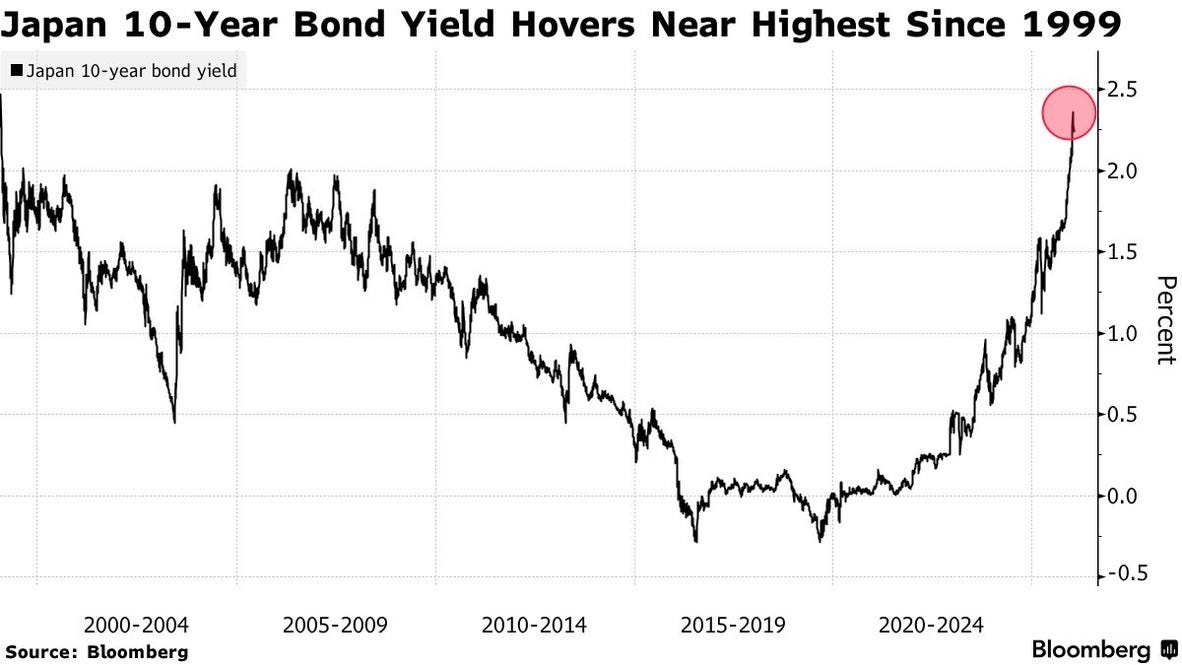
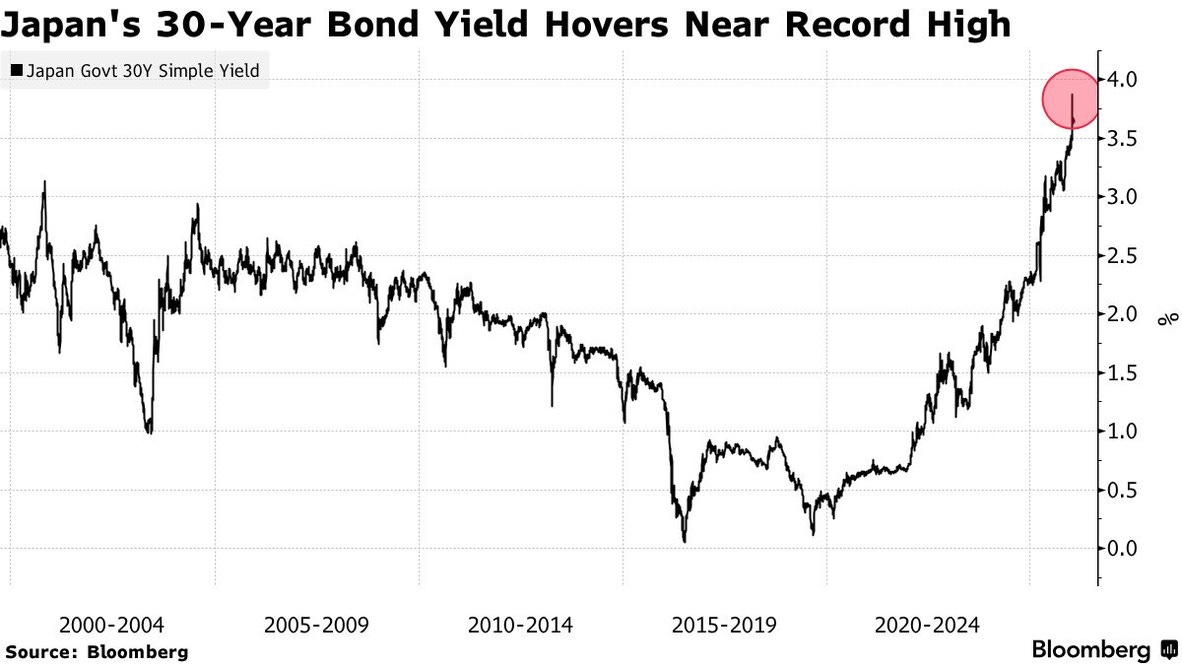
The JGB-led global bond yield surge also spilled over cross-asset as well.
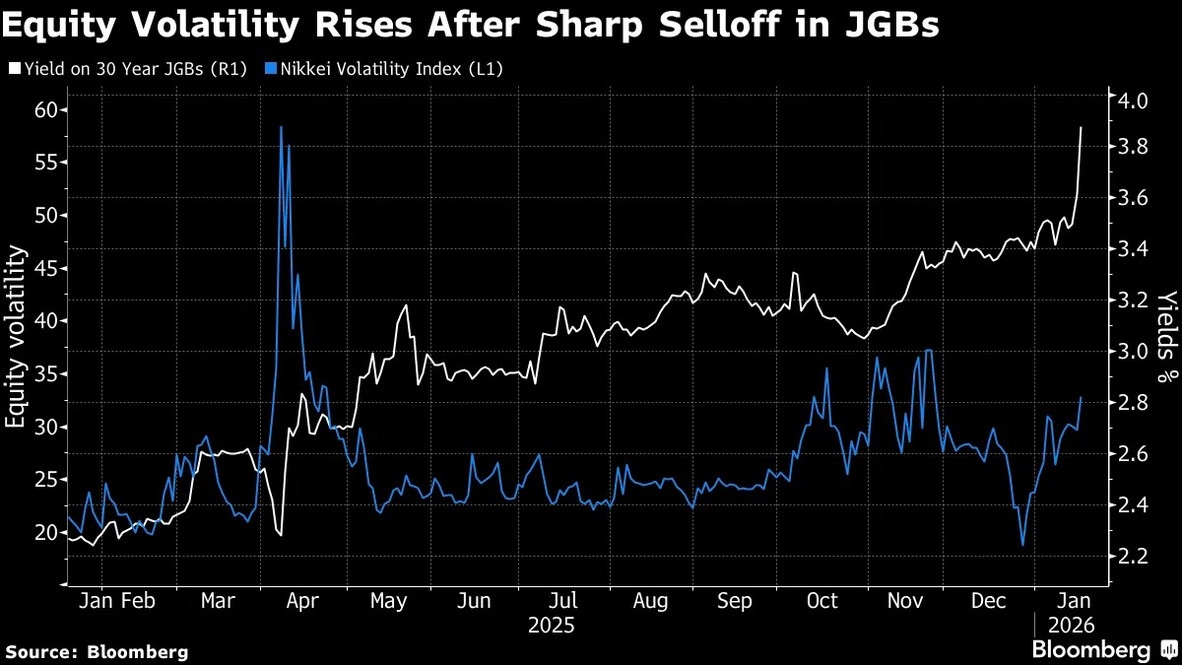
Why were JGBs selling off so aggressively? Well, those are actually two separate questions and matters.
Why were JGBs selling off? Because of Takaichi’s upcoming snap election in February.
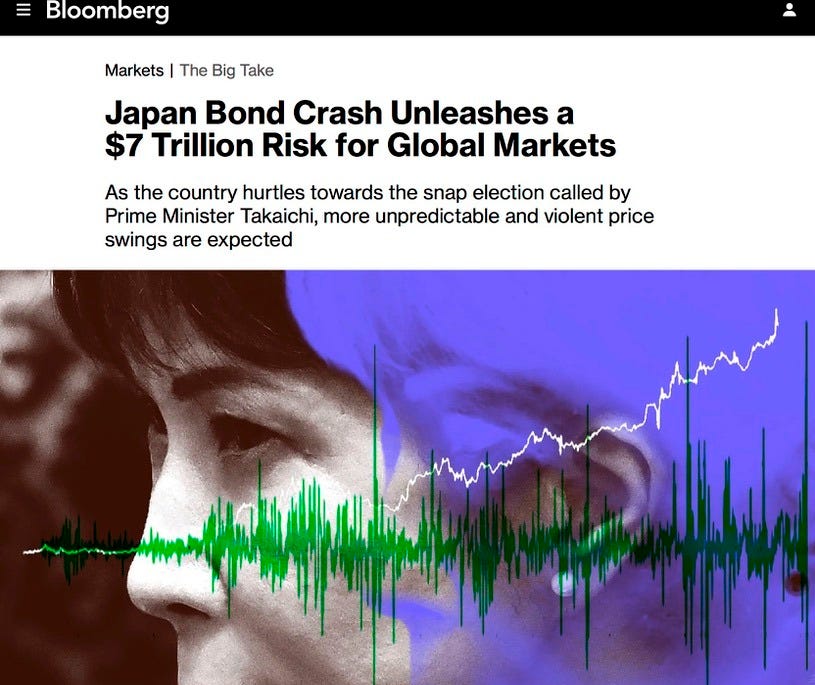
Why were JGBs selling off so aggressively?
Not because of Takaichi - but because of JGB market dysfunction at the long end. As I discuss in my article PM Takaichi and the World’s Most Dangerous Front-End, any fears of Japan’s fiscal state or extra JGB issuance risk would show up in the front end, where Katayama at MOF had shoved basically all of the FY25 supplemental budget into: from 6-month bills up to 5Y JGBs, while 10Y to 40Y JGB issuance was not to be touched - because of this very fragile state the long end JGB secondary market had been plagued by.
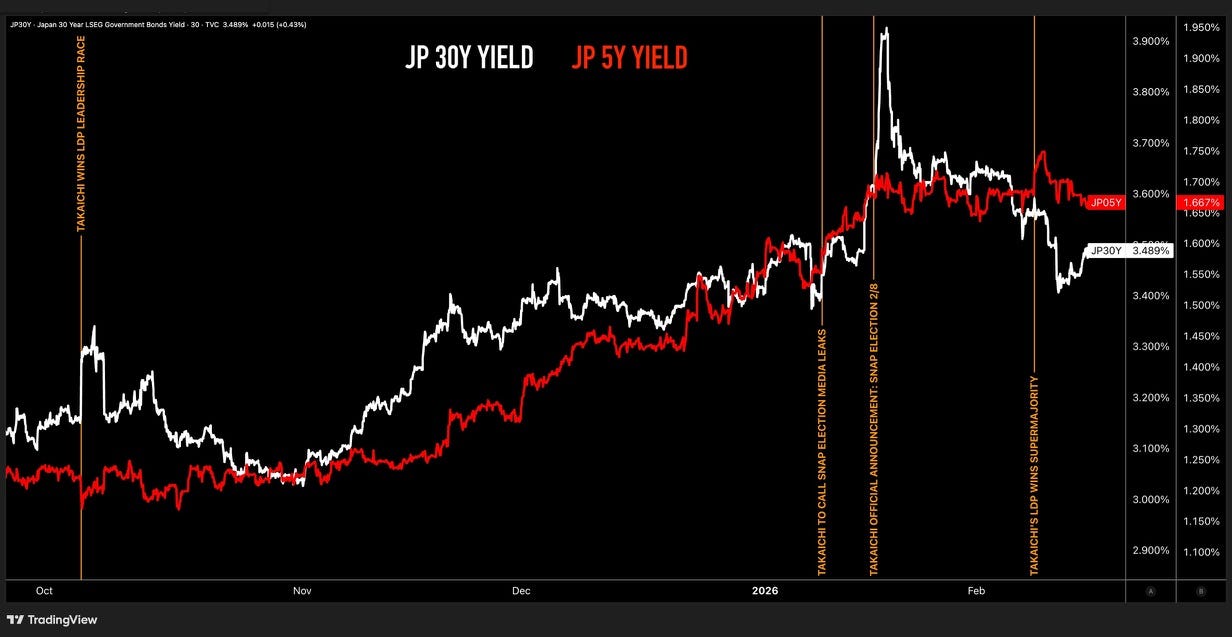
So, what was the trigger for the directional move up in JGB yields that cratered global bond and equity markets? Takaichi election risk. What fueled a six-sigma surge in long-dated JGB yields? Illiquidity and market dysfunction.
The chart below shows that the JGB 30Y move was not fundamentally based, on two fronts: 1) Japan fiscal concerns would be reflected in JGB front end up to 5Y (which is not behaving erratically), and 2) if the spike in yields really was a reflection of a flight out of Japan debt, then 30Y JGB yields would not flash-crash (or flash-spike), only to return back to prior levels. Rather, this shows market instability.
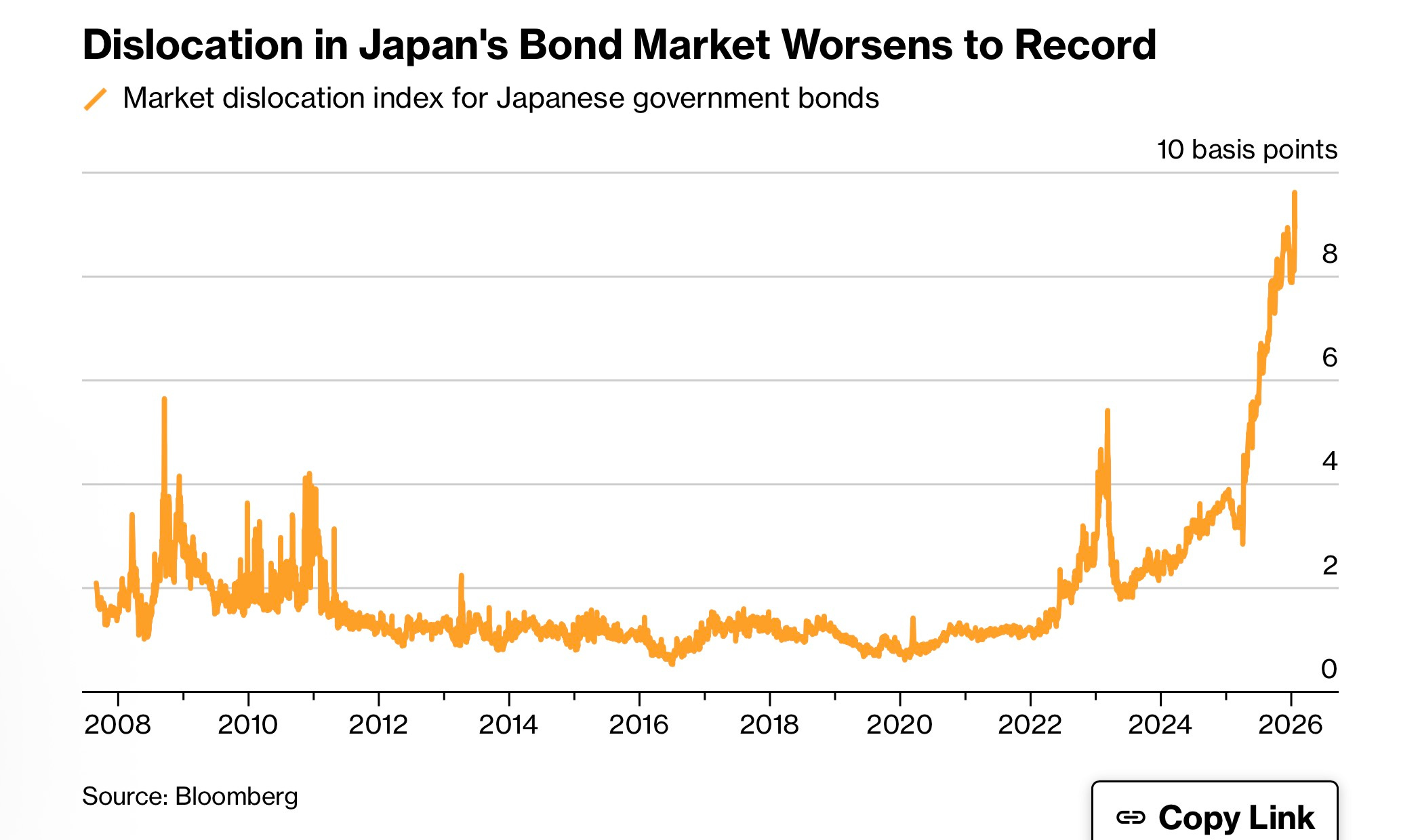
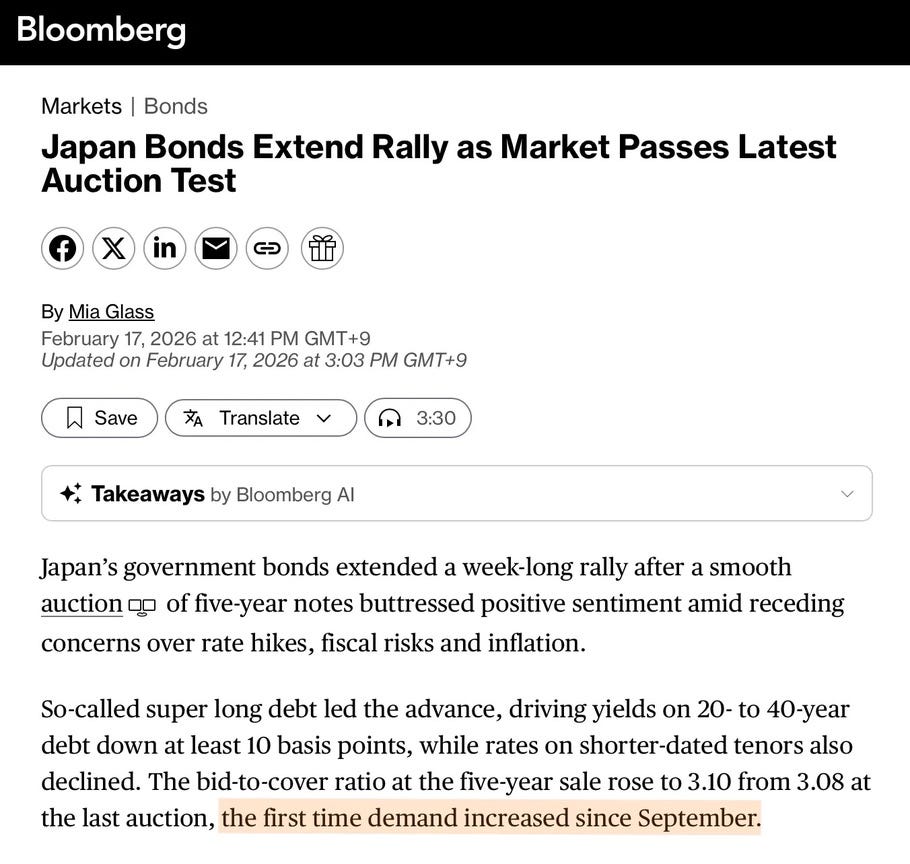
Indeed, it was later revealed by Bloomberg that Japan Bond Wipeout Was Triggered by Just $280 Million of Trading
It took just $280 million of trading to push Japan’s $7.2 trillion government bond market into meltdown.
That was the combined turnover for the country’s benchmark ultra-long maturity bonds as they plummeted on Tuesday, unleashing a $41 billion wipeout across the Japanese curve that sent shockwaves through global markets.
The rout pushed yields to record levels, stoked worries that Japan was heading into a “Liz Truss moment” and led US Treasury Secretary Scott Bessent to seek reassurances for what he called a six-standard-deviation move.
And on that last line from the article - this move in yields got Bessent very much worked up at Davos, where he outright blamed a “six sigma move” in many public appearances.
Bessent says: “I’ve been in touch with my economic counterparts in Japan, and urged them to take the necessary measures to stabilize their bond market.”
But “counterparts in Japan” doesn’t exactly mean physically in Japan - as Bessent’s counterpart and Japan’s “Chief JGB Saleswoman” Finance Minister Katayama was right there at Davos - where she said the following:
…and bond markets did calm down. Two days after Bessent had his hair on fire over Japan blowing up global bond markets - we got the aforementioned first ever act of joint coordination in market intervention between Japan and the U.S. via a NY Fed rate check on JPY.
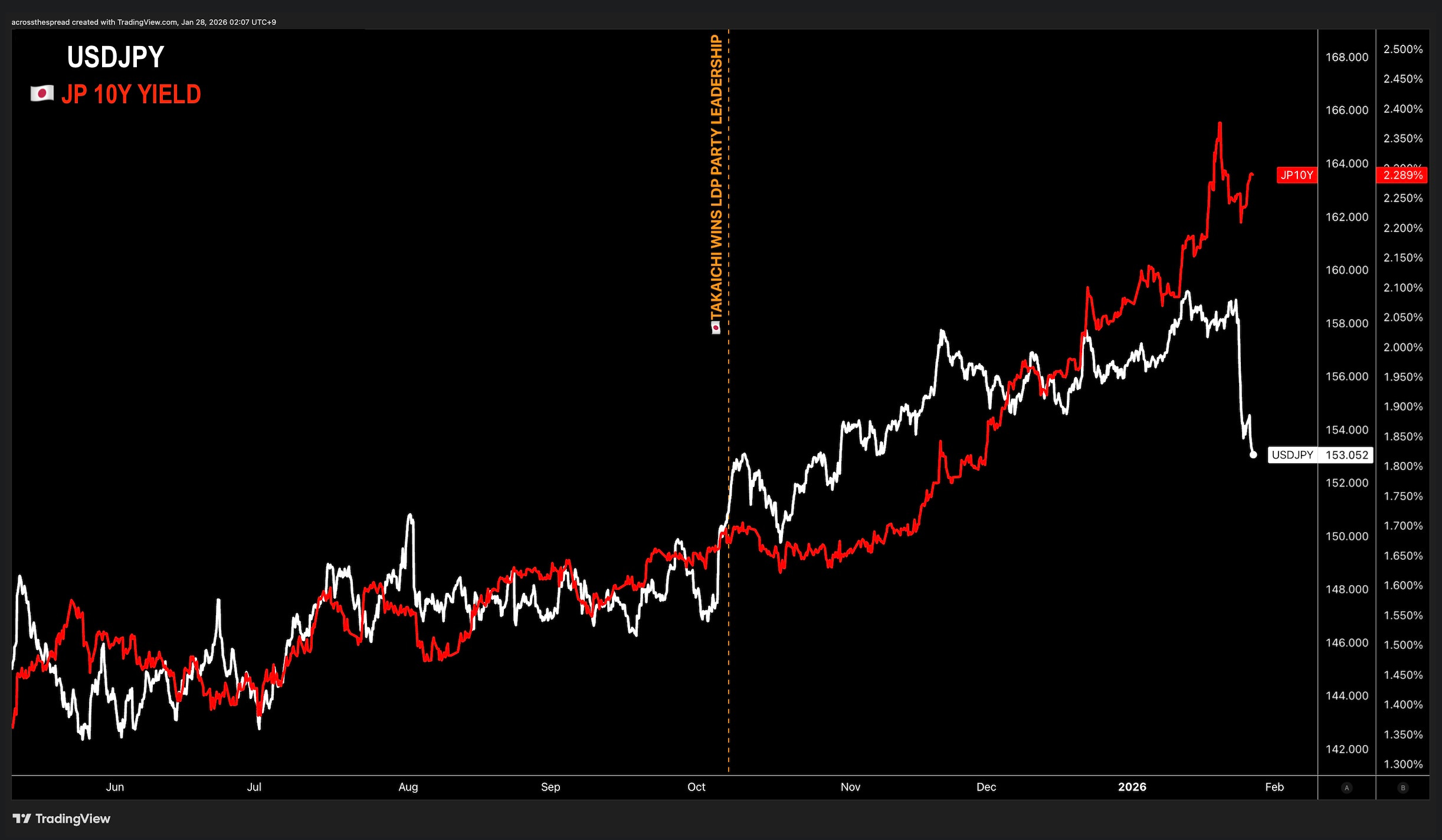
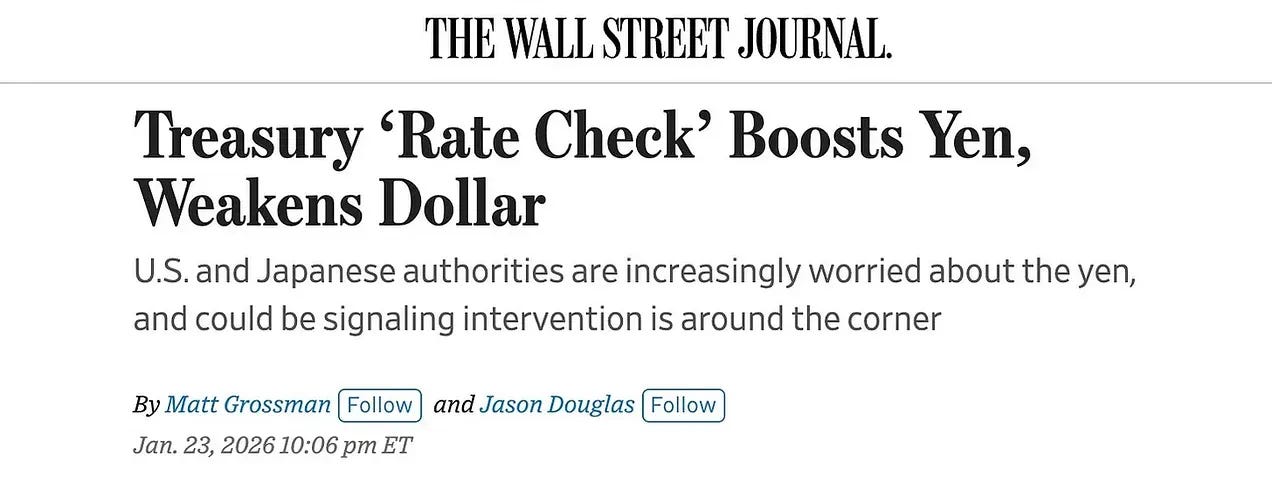
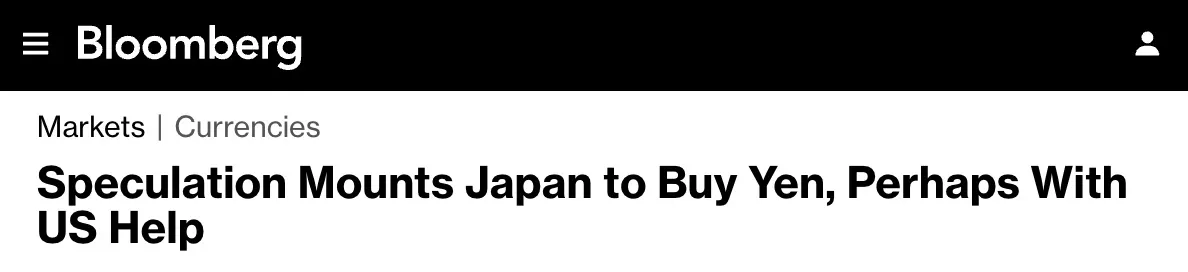
And as Takaichi and the LDP swept snap elections to a supermajority win, JGB yields led the rest of the world’s yields downwards.
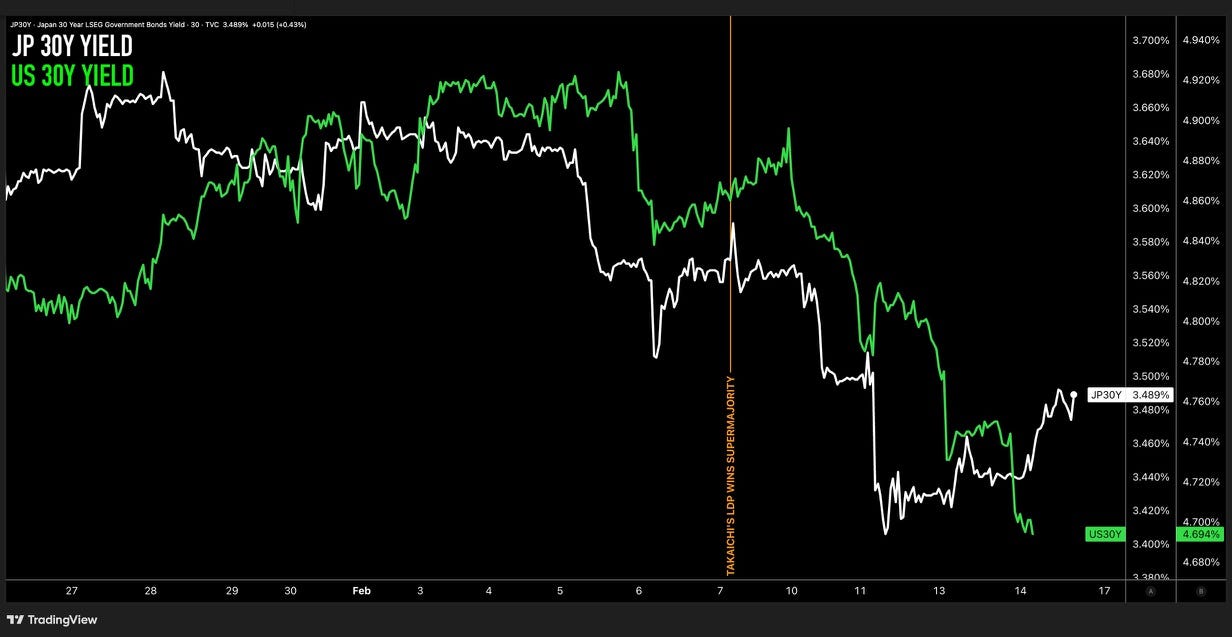
So, what did all of this from late January 2026 reveal that is of direct relevance to current developments? Many things about many key actors.
For one, it was revaled that despite his image and longstanding rhetoric of cliticising the likes of Japan and China on currency manipulation and a preference for a stronger dollar, President Trump is actually just fine with a decline in USD, so long as its under his terms, and is in “rescue” of a declining yen in peril - because that’s not “competitive devaluation” - rather, its something that can be exploited. In other words, his so called “strong dollar policy” can be classified under the various other “signature” beliefs that actually aren’t core ideology based, rather than grouping Trump’s “strong dollar” preference under the far more exclusive short list of genuine core ideologies.
But neither Trump nor Takaichi really matter in this USD vs JPY, UST vs JGB balancing act - these have been delegated to Bessent and Katayama, and therefore they are all that matter. And with that said, January 2026 markets revealed something we haven’t really seen of Secretary Bessent, who has thus far been very calm and collected under various episodes of US-induced market mayhem, but broke into relative “panic mode” during that moment.
The most revealing takeaway about how Scott Bessent perceives market authority from January 2026 is as follows.
When it comes to market jawboning efficacy by government officials:
✓ The U.S. Treasury Department is the body with the most relative influence over FX markets by way of USD (a mere rate checking on JPY crushed the broader DXY complex by several % alongside USDJPY).
✓ Japan Ministry of Finance (+BOJ) has the relative influence over DM bond markets by way of JGBs (fiscal policy, issuance policy, BOJ JGB tapering etc).
In addition, it seems that:
✓ Bessent cares far more about UST markets (in turmoil) than he does about USD.
✓ Katayama cares (slightly) more about JPY getting sold off to multidecade lows than she does JGBs (of course highly dependent on the situation - but when both are simultaneously occurring, she would rather intervene internationally into Bessent’s USD than intervene domestically into Ueda’s BOJ tapering).
Whether or ot this perception is indeed correct isn’t relevant (and broadly, I would say that it is correct). What matters is that this is how these US and Japan financial authorities may very well be preceiving their respective areas of leverage and subservience. And that sets up for a very interesting end of July to come, and this “joint coordination” matter.
As mentioned earlier, its not a simple matter of “UST yields breaking out” for a dollar-yentervention to be triggered, at least not based on recent history.
US yields need to be breaking out alongside USDJPY to alarm Bessent enough to take any action from the US side - and for a very simple and straight forward reason. US yields moving higher can and will happen due to any number of reasons, and there isn’t much that Bessent can do about it (Katayama and Ueda can do far more about impacting US yields in the secondary market than Bessent can). But when US yields are already breaking out and on the verge of cracking a key level - Bessent does not need to have a major price indiscriminate seller then enter the market to liquidate USTs in size - such as Japan MOF, with their eyes squarely on JPY levels. If MOF feels the need to unilaterally yentervene to support JPY downside, they don’t give a flying F what UST yields are doing - they will liquidate what they need to raise USD to then blast said USD downwards.
That’s why at the very least, both US yields and USDJPY need to simultanously breaking out in order to be worthy of Bessent’s attention.
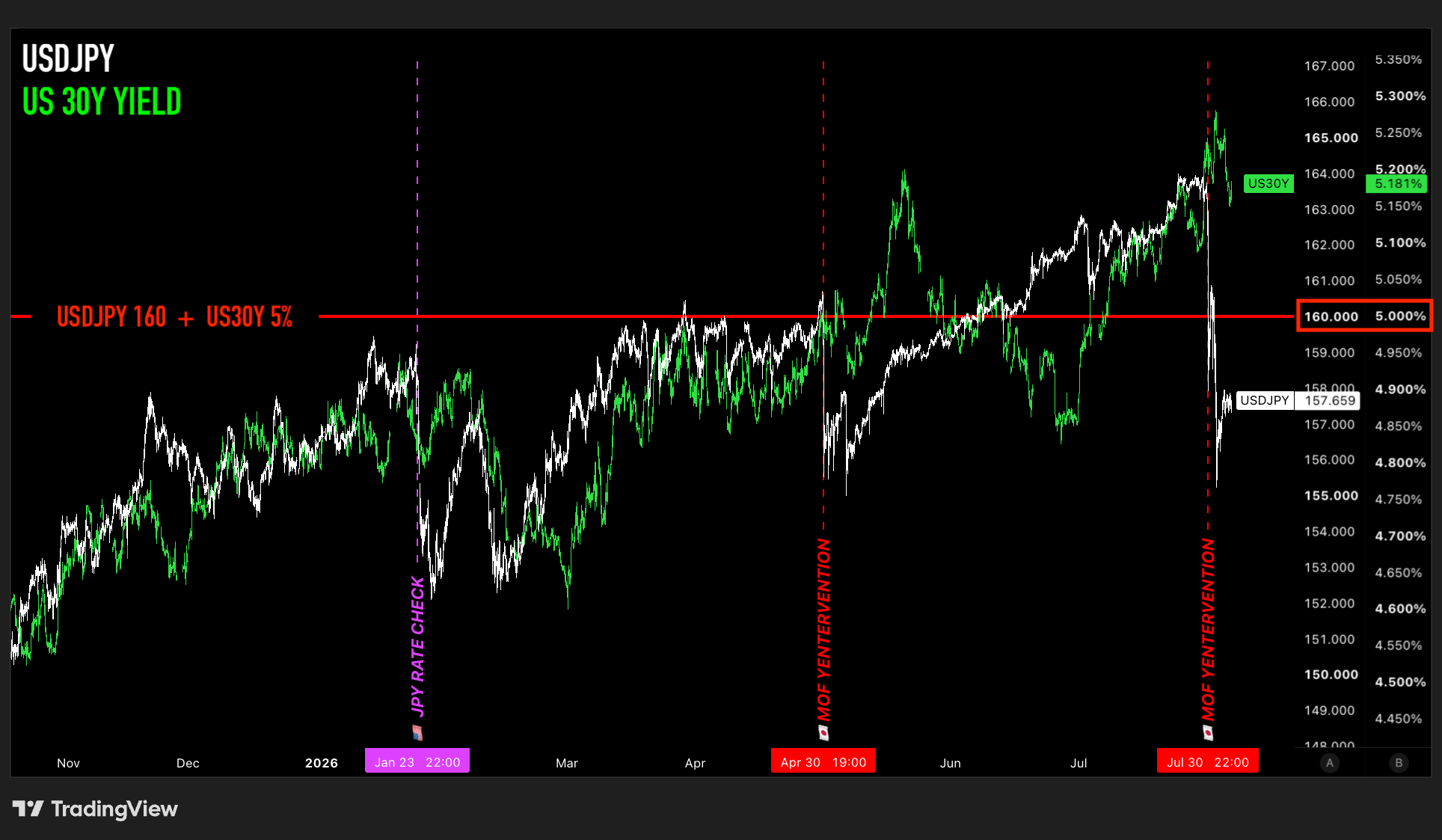
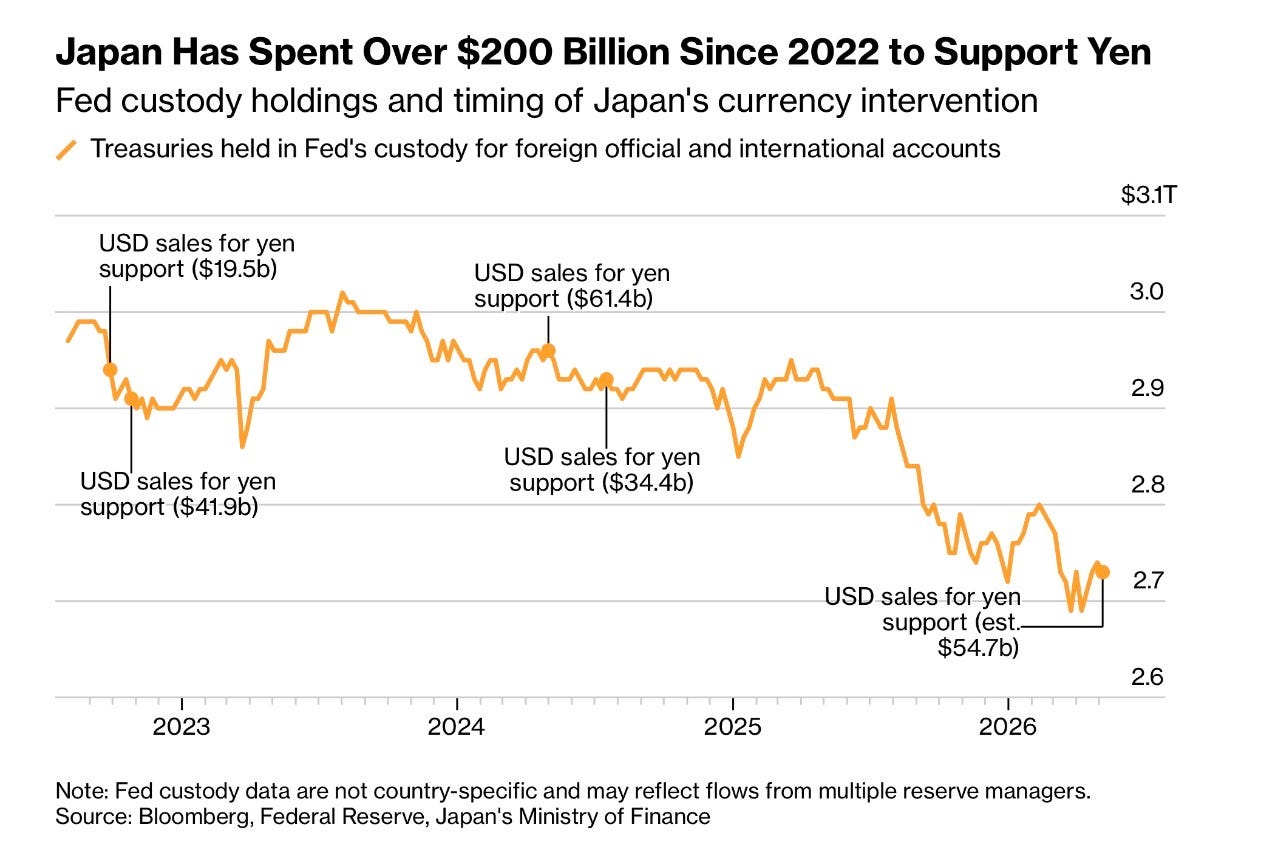
In the late-April to early-May yentervention episode - it seems MOF may have indeed actually sold off UST reserves to then raise USD cash to then smack spot USDJPY downwards with.
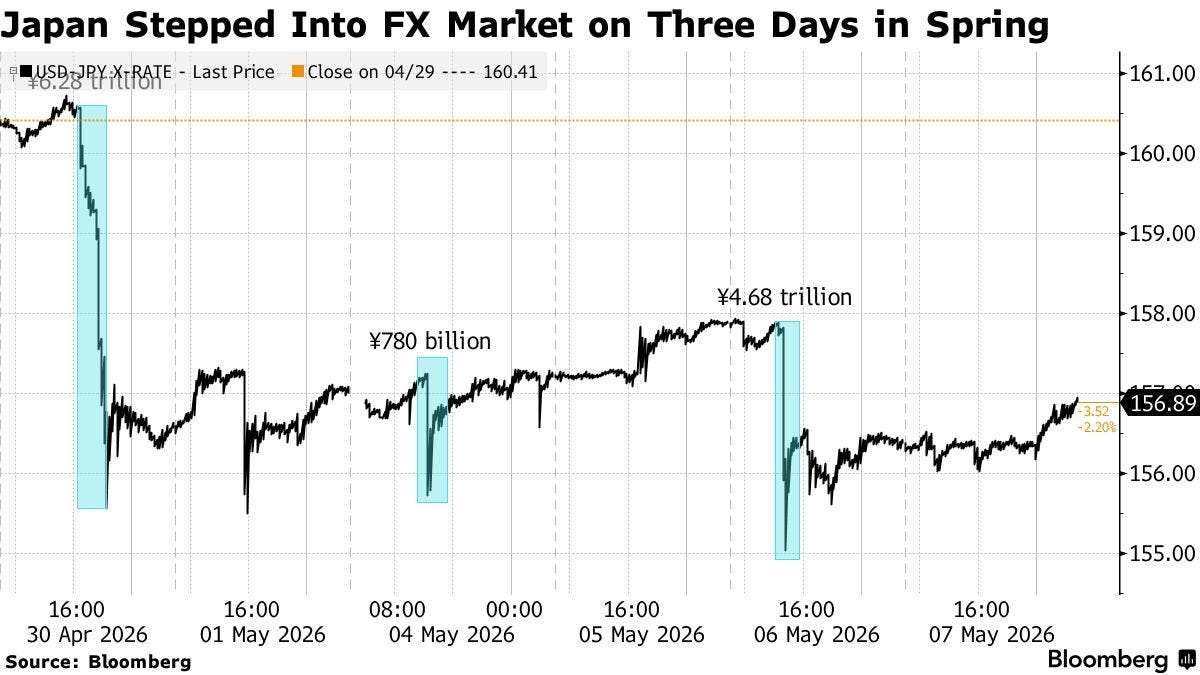
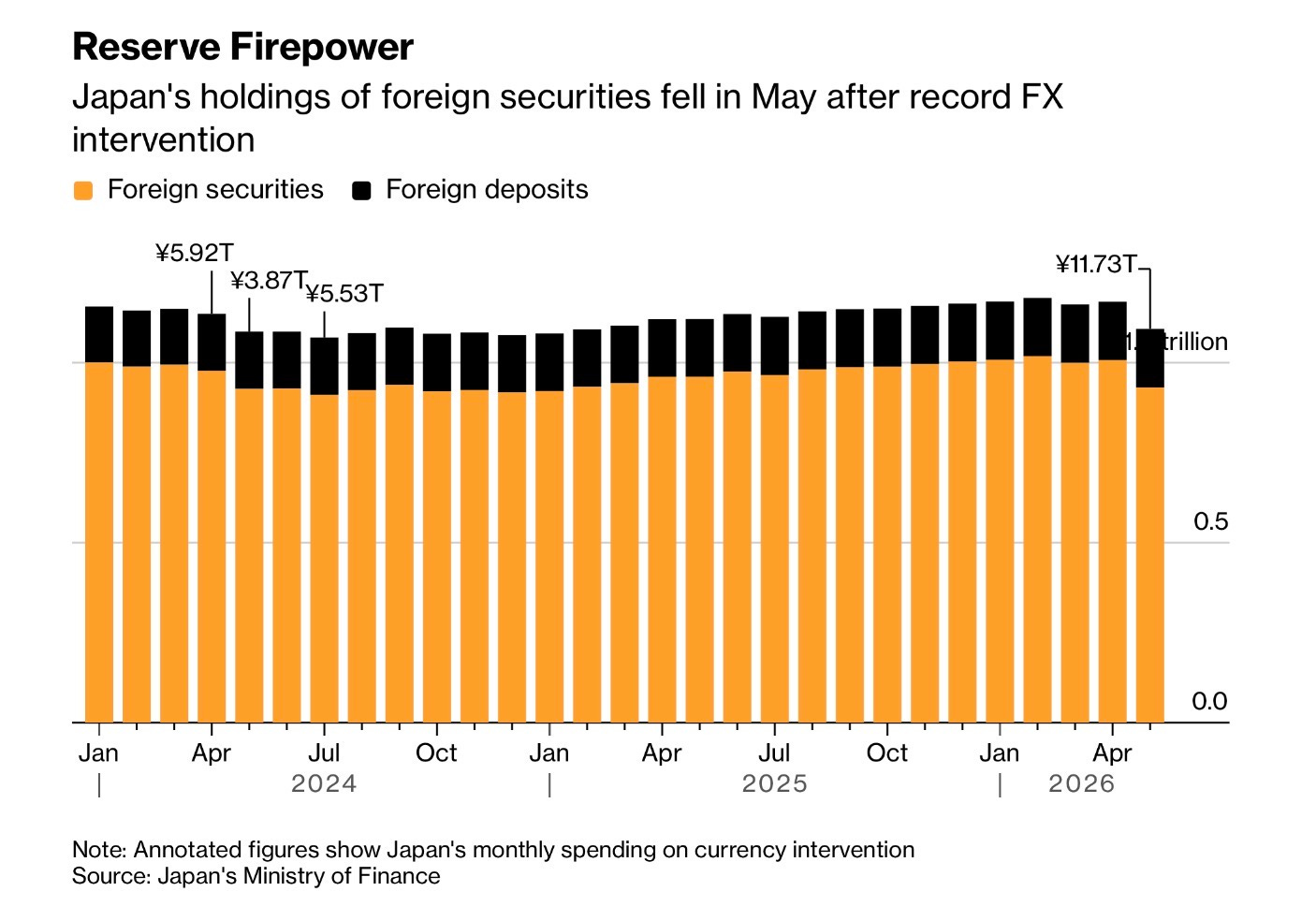
This was always a rather weird series of yentervening from my standpoint, particularly as it was happening. Not just because of Katayama’s rather aggressive warning (more aggressive than any MOF warning prior) of - “keep your smartphones closeby.”
It was weird because it almost seemed like MOF themselves knew it would be very temporary (as it indeed was) in the way that it was lazily executed. It seemed incredibly pointless - so much so that even MOF had to know, or was almost purposely making it pointless. But why in godzilla’s name would MOF purposely dribble out a half-assed yentervention that would easily recover due to a lack of tactical position targeting and strategic ambiguity?
Because Bessent was on his way to visit Tokyo / MOF headquarters later in May.
So, my read, whcih is obviously just personal speculation and nothing more, is that MOF wanted to show Bessent:
✓ MOF unilateral yenterventions alone arent cutting it anymore.
✓ MOF has to liquidate USTs to do these less effective yenterventions.
Combine that with a June BOJ rate hike to 1.0% (which also did nothing for JPY strength), and you got yourself Tokyo using its leverage to pull the US into their JPY forever war. And they succeeded.
Just because MOF (may have) baited Bessent and the U.S. government into publicly joining yenterventionism, does not mean that the U.S. is participating at forced gunpoint by Japan. Quite the opposite. Because while Japan was able to flash its sidearm weapon of leverage during that April-May yentervention funded by liquidating USTs to the tune of some $70 billion stunt, all that did was motivate Bessent to remind MOF where the real leverage in this relationship lay. And we see that in the structure of this so called “joint coordination” arrangement.
First and foremost, you need to truly internalize the following reality:
As of current, there is no official confirmation that the United States government has actually stepped into FX markets and executed any buy/sell transactions.
That is not to say that the U.S. hasn’t done anything in markets - be it buying JPY by selling EUR or selling USD. Again, I am simply referring to what has actually been officially confirmed by officials in a position to confirm. Japan has confirmed Japan’s actual market intervention activity. U.S. has confirmed Japan’s actual market intervention activity. Neither Japan nor the U.S. has confirmed the U.S. to have done any actual market intervention activity.
The Financial Times nor Nikkei citing unnamed anonymous sources “familiar with the matter” are not official sources of confirmation.
In my interview with Real Vision, I discuss (rip apart) ZeroHedge and their disgraceful click baiting of pure nonsense headlines that they themselves openly admit to within the same article.
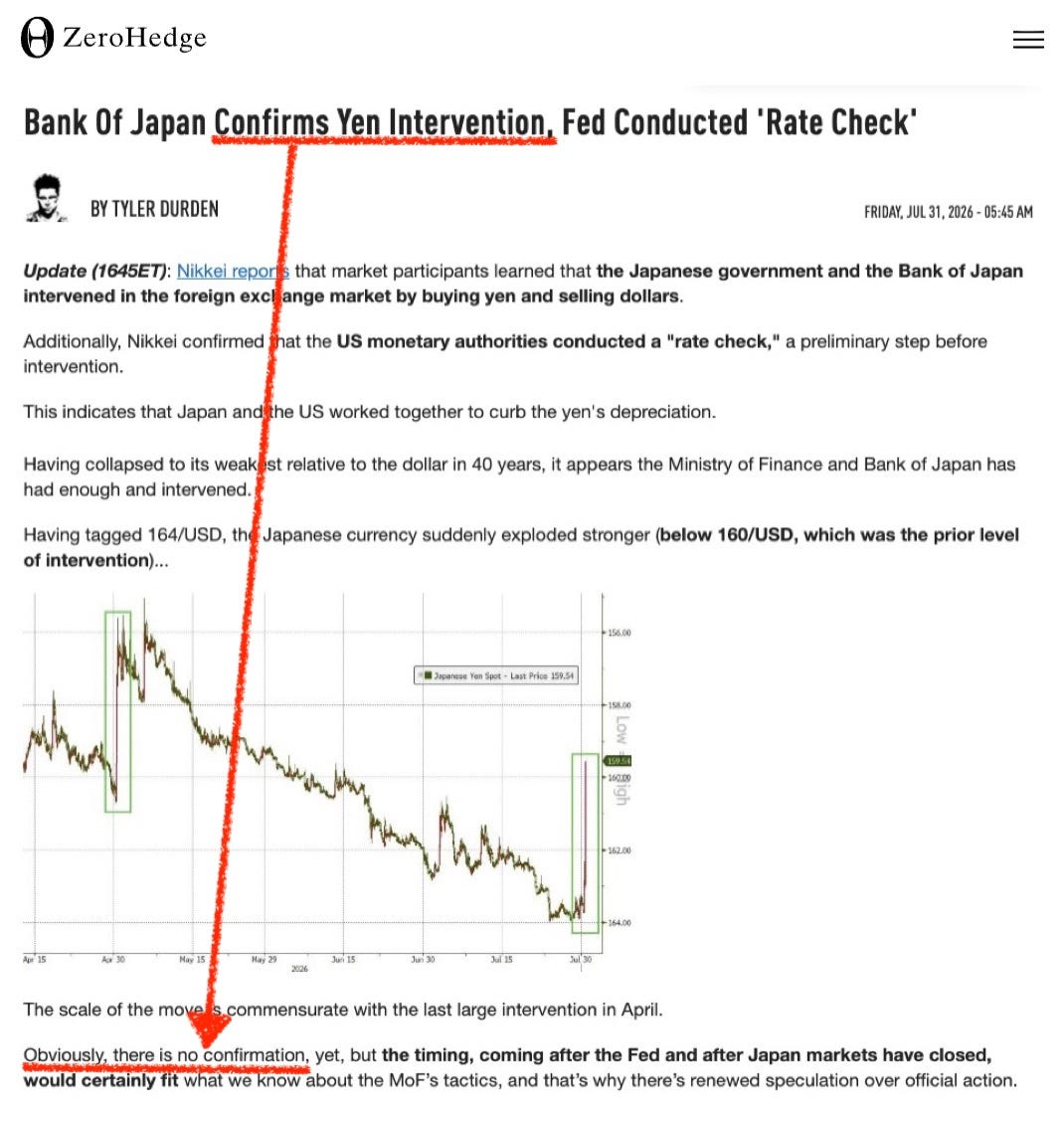
Yes, this is just the most egregious example of financial media playing fast and loose with the word “confirmation” or “confirmed” (not that ZeroEdge is by any means a real media outlet or any sort of source of credibility) - but as I also say in my interview with Real Vision, this practice of flashy bullshit grandiose headlines with the actual article content treated as the “fine print” has become so prevalent throughout the actual financial media ecosystem in their coverage of this JPY intervention saga, that they all might as well be ZeroHedge.
The sharp decline in reporting quality standards and the use of headline click-baiting, as well as the complete disregard of the seriousness that “confirmed/confirmation” carries when used, has become prevalent throughout the media landscape in the coverage of JPY government intervention since July 30th. Yes, to differing degrees, but by and large, the fact that this is occurring is just plain fact - and understanding this greatly matters in understanding what this Japan - U.S. joint coordination at is foundation actually is.
First, here is why this practice is happening in financial media’s coverage of JPY intervention as of late.
Yenteventions are unique in terms of how traditional financial media covers sudden market price action, because there aren’t really any other sharp macro market moves for which the media is expected to identify and tie down the specific source behind it. If some major data release sharply rallies ES futures, or a weird Fed Chair Warsh press conference hits UST yields +15bps, or a Trump Truth Social plunges crude futures -10%, none of those require identifying who the actual source of market moving is - all that is needed is identifying the catalyst, which is already clear.
Furthermore, it simply isn’t possible to identify the source behind any actual market move in real time - at the very least because that would require institutional trading desks to volunteer their first hand proprietary knowledge of what would be material non-public information, even if disseminated after the fact. We don’t know of Situational Awareness indiscriminately liquidating its levered long positions until days after Ken Griffin subsequently steps in, let alone in real-time, we just see a bloodbath in A.I. names. And we certainly aren’t expecting media outlets to identify the source of market movements in real time.
Yenteventions on the other hand also come out of nowhere - no specific catalyst present, and yet when a sharp move in USDJPY occurs, we want to immediately know the source - if this was MOF action otr not. . So when there is a sudden, sharp rally in JPY amidst a very jumpy yentervention-anticipating market, it sets up for private sector market manipulation, who is taking advantage of public sector market manipulation. These motives and incentive structures are not exclusive to market participants only - they apply to financial media as well.
When USDJPY suddenly plunges -3 big figures, you have to report on that - and in doing so, you of course have to mention yentervention as the possible culprit, or just declare it as the culprit. And everyone already knows the former - “…possible Japan market intervention…” such a headline won’t catch readers’ attention than one that says “EXCLUSIVE: JAPAN CONFIRMED TO INTERVENE IN MARKETS” or something of the sorts - with the contents of the article to then cite “…according to unnamed market participants…”
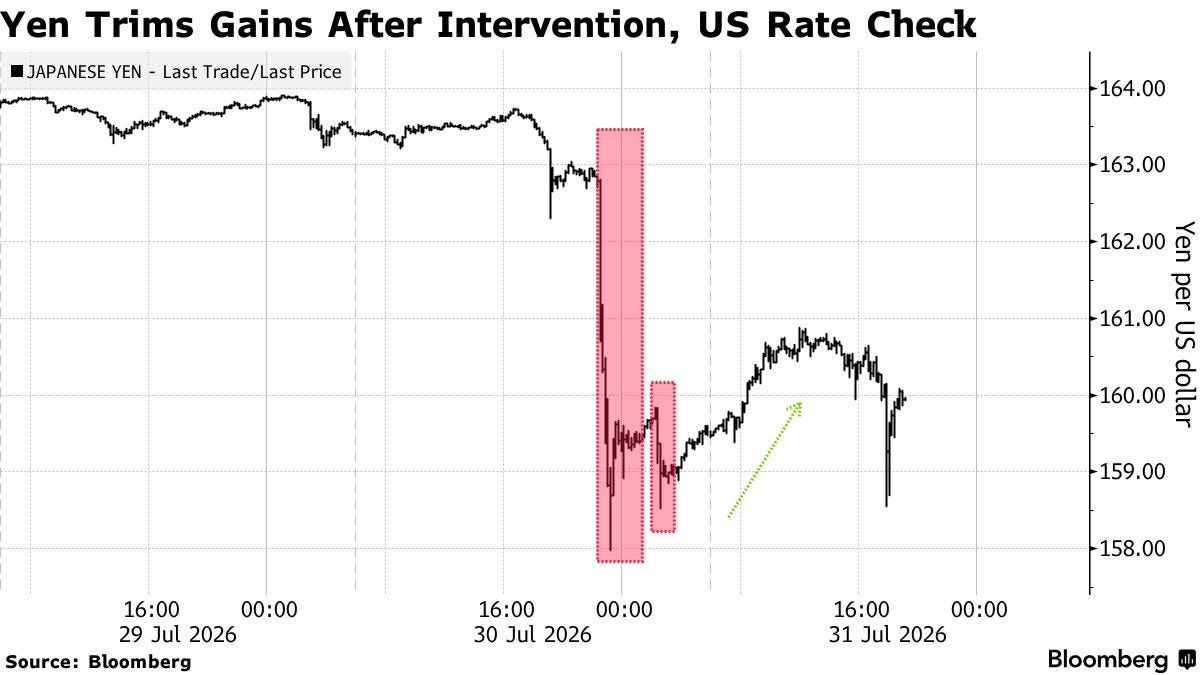
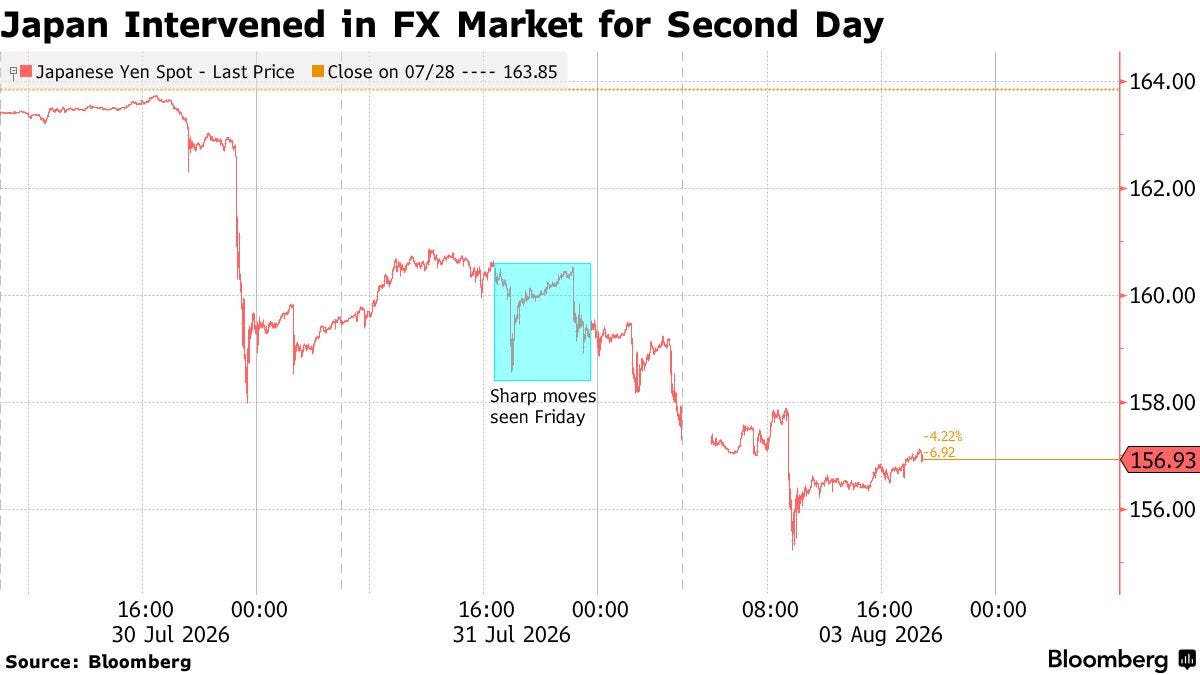
This is what fuels the “confirmed” media arms race on yentevention coverage. If you don’t “confirm” you are not part of the game - sourcing ethics be dammed.
And once those rules are no longer adhered to for a given topic, then that practice of “bullshit headline” + “contradictory article” persists - where the headline is treated as “may or may not be accurate” and the article content within being the “fine print” that nobody reads.
Take a look at Reuters for example - headline “US will do ‘whatever it takes’ to support Japan after yen intervention, Bessent says”
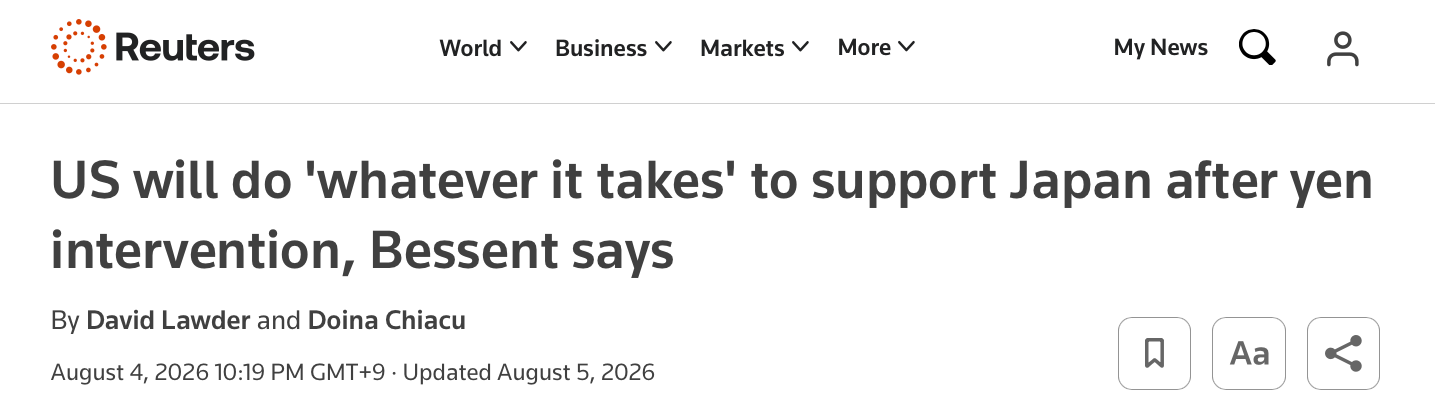
And even goes on to repeat this in the first line of the article.
“Whatever it takes” is a particularly significant phrase as we all know - it’s then-ECB Mario Draghi’s history making quote that he says in terms of rescuing the eurozone in the depths of its crisis. And Reuters knows this, and knows that readers know this term.
So for Bessent to refer to JPY as his “whatever it takes” moment, as implied (or stated outright) in the headline is huge. But is that really what Bessent said? No, of course not. Bessent said (on CNBC mind you, so Reuters quoting another outlet’s quote of Bessent) -
“We will do whatever it takes to support them in a way that helps the American economy, the American taxpayer.”
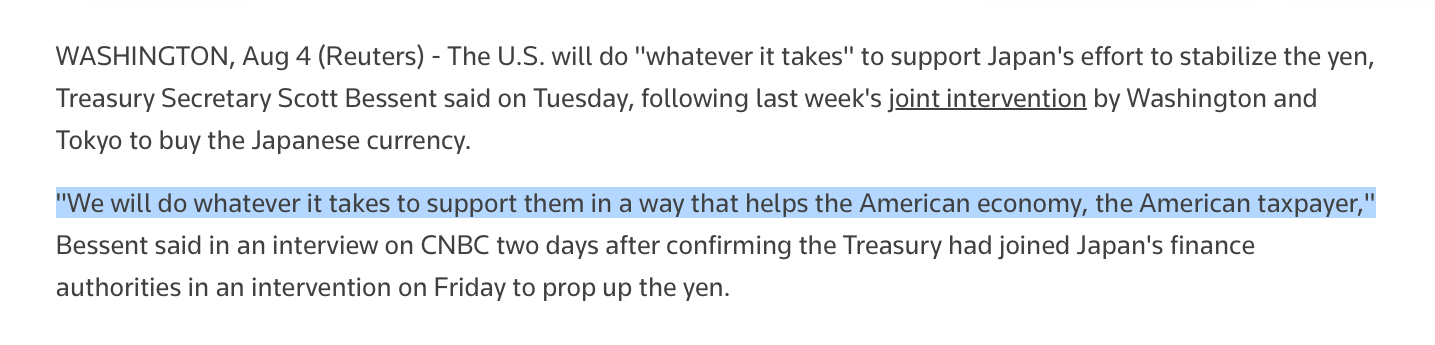
Bessent said that within the confines of what is best for America, the U.S. will do whatever it takes to support ‘them’ - the Japanese. Entirely different from “U.S. will do whatever it takes to support JPY” let alone in any sort of Mario Draghi context.
A total bullshit headline. This is really no different from that fraudulent ZeroHedge nonsense. But everybody’s doing it, and nobody cares.
Here is another interesting sentence they’ve slipped in:
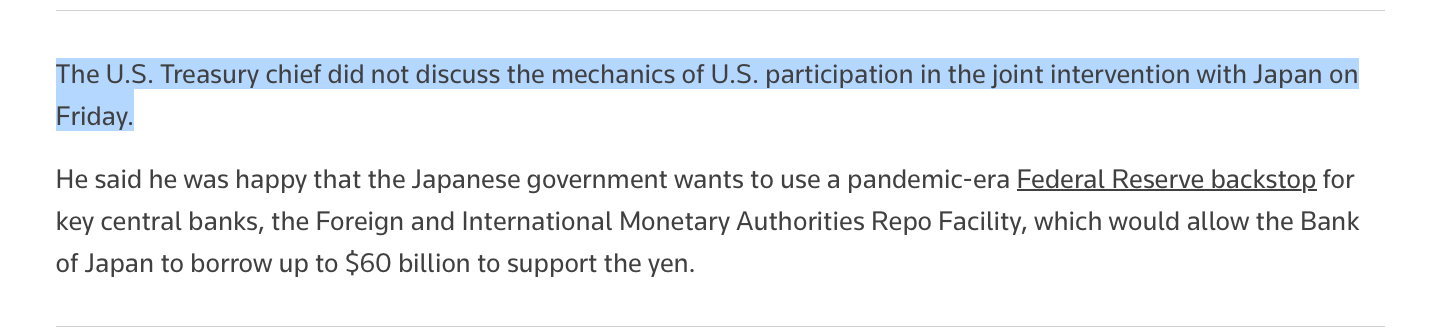
“The U.S. Treasury chief did not discuss the mechanics of U.S. participation in the joint intervention with Japan on Friday.”
Well well well. This is obviously true. But by adding this, Reuters is (subconsciously, accidentally, or otherwise) negating any notion of “US definitively acted directly in FX markets to buy JPY” that had been previously or subsequently printed - by them or by their peers.
We do not know what the mechanics of the actual joint yentervention are. Which means that the U.S. may have just as easily and likely not acted in markets as much as they have.
And finally, they quote directly from Bessent about what this FIMA facility structure is really about:
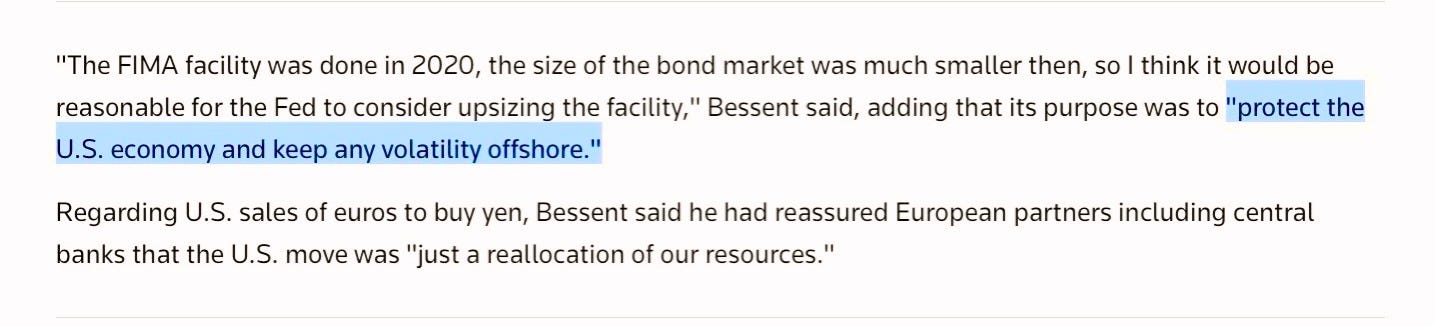
“…to protect the U.S. economy and keep any volatility offshore” …is apparently what the purpose of FIMA was/is. Does that sound like “whatever it takes to save JPY” in the Draghi sense? Or does that sound like “America first” currency policy.
Why am I pointing out misleading media headlines and burying conflicting facts and statements within those very articles to this extent?
Because the exaggerated omnipresent media coverage has not only created an overall image of far more US help and involvement in JPY support, but the massive pressure from this media narrative of ever-more US assistance alongside Japan’s actual market intervention activities had forced Bessent and Katayama to make a public joint statement in the first place - the very one that became this “major historic announcement.”
Major and historic, yes - but if it’s done at the twisting of official’s arms by a runaway media narrative, then it’s inherently hollow. And indeed, completely hollow it is.
And that’s why I am emphasizing this - we have to acknowledge what is actual reality, what is actually confirmed (despite it being reality or not), and how/why things developed the way they did, or developed at all.
So let’s now take a look at what has officially come out of the official sources only - Finance Minister Katayama and Treasury Secretary Bessent.
Here are the official joint statements themselves on joint coordination, released on Monday August 3rd at 8:00AM. You likely have seen these already - but take another look from the angle of statements that were made at gunpoint by an out of control media narrative that became impossible to ignore, much less counter.
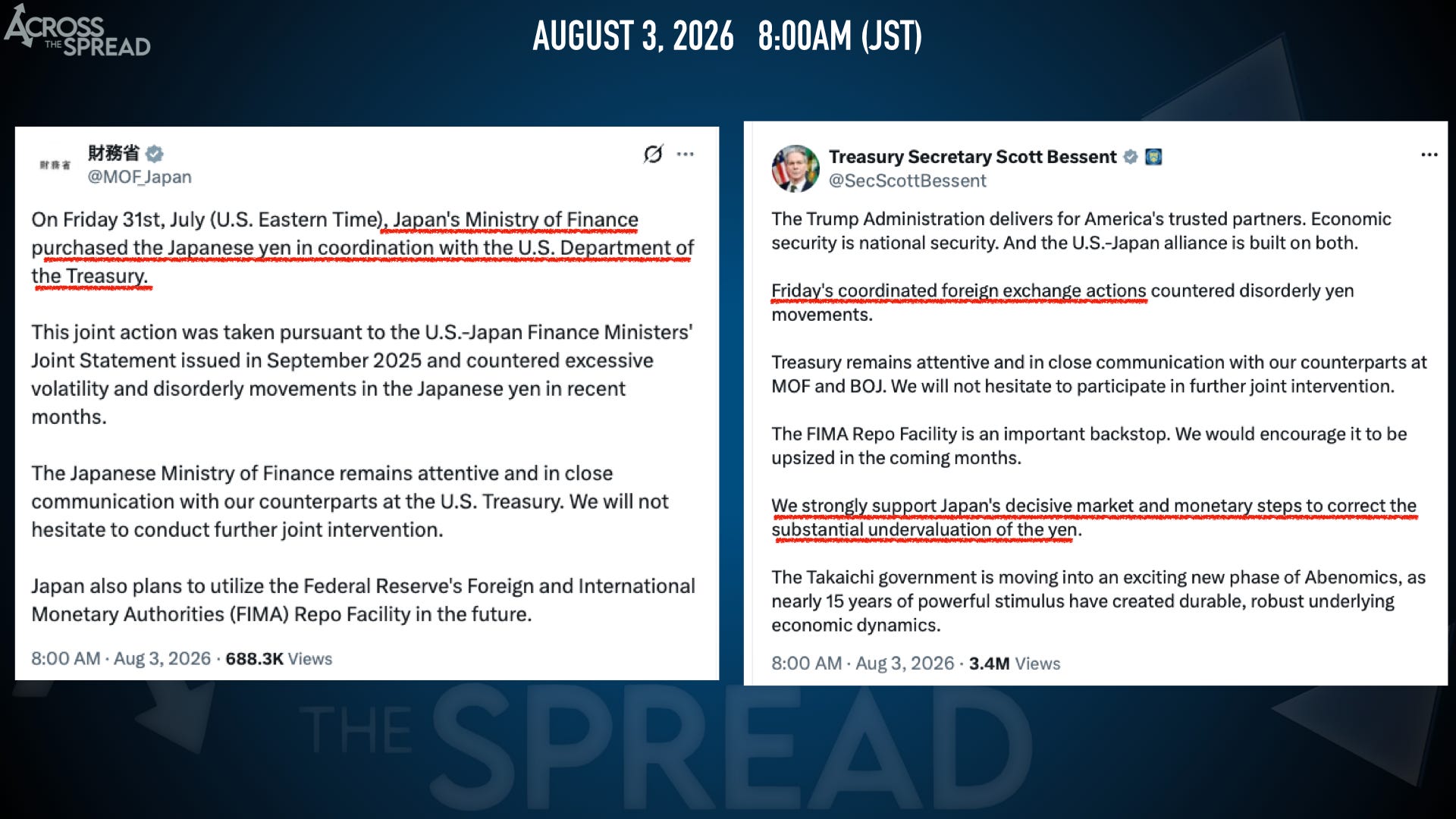
In both statements, I have underlined parts that are relevant to actual confirmation of market intervention activities taken. We can clearly see that both sides are confirming the Japan side to have bought JPY. Where is there anything similar that also definitively and explicitly confirms the U.S. side to have done the same? There isn’t anything of the sort. There is very careful and “clever” wording that plays on readers’ biases that look like the U.S. had also bought JPY - but look carefully - no such clear and explicit wording exists.
“Japan MOF purchased JPY in coordination with U.S.” does not say / mean “U.S. purchased JPY.” Neither does “Friday’s coordinated foreign exchange actions.”
In fact, Bessent’s “we strongly support Japan’s decisive market and monetary steps…” once again points to only one of the two sides undertaking market activity, while not confirming the other side to have done the same in balance.
“Joint coordination” in FX markets by U.S. and Japan does not mean equal or similar actions and activities. Joint coordination can mean anything - including just the announcing of “joint coordination” itself. We market participants are simply assuming “coordinated action in markets” to be something akin to say the U.S. and Israeli militaries’ joint coordination attacks against Iran - where both the U.S. and IDF forces have indeed engaged in firing weapons and intercepting incoming attacks - and even that isn’t a 1:1 equivalent contribution from both sides.
Now, let’s just assume that that the U.S. Treasury Department had indeed actually executed market intervention activity of buying JPY alongside Japan Ministry of Finance doing the same, based on runaway media assumptions. Let’s see what “joint coordination” looks like.
I point to this incredibly stupid Reuters piece that I’m sure everyone has seen by now:
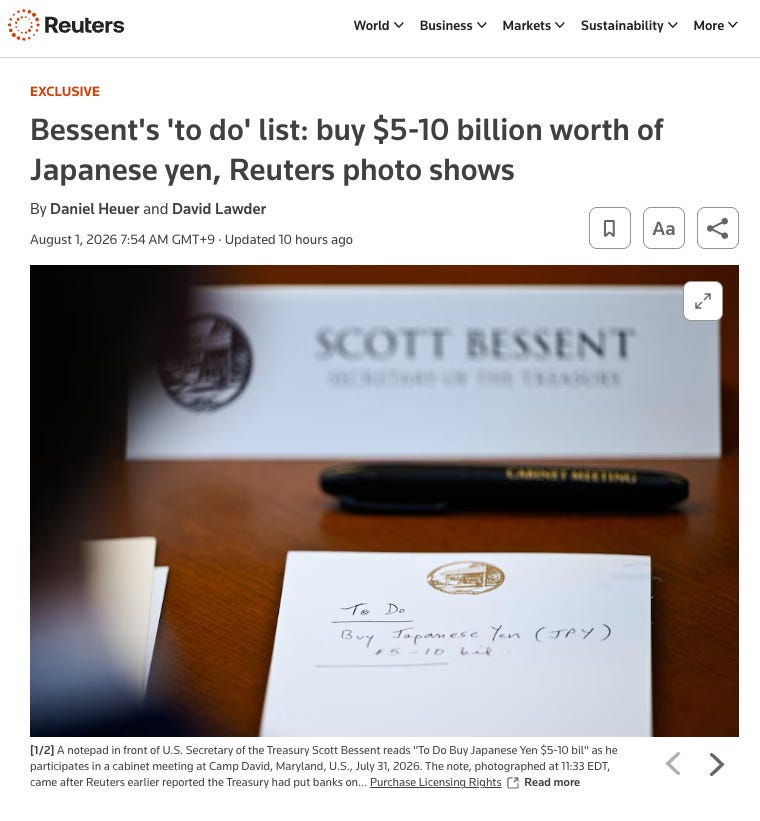
I will skip over how stupid this coverage by Reuters is, and how everyone ex-Reuters equally as stupidly took it and ran with it, and instead point out what this actually reveals.
As I discuss in my video with Ash - the overall read on this “To Do: Buy Japanese Yen (JPY) $5-10 bn” is also wrong.
Broad consensus read of this is Bessent showing his commitment to JPY support.
I completely disagree - it actually puts on display his reluctance to actually “buy Japanese Yen” - because this theatrical act occurring mid-trading day was orchestrated by Bessent who hoped for the press to rush this to print, and hopefully have markets front run it, and move markets for him, obtaining the same market result of JPY higher, without having Treasury spend a single penny themselves.
As a timely and very relevant moment - let me now explain this via the concept of rate checks, a term you’ve likely heard a ton about in this saga.
Rate checks the act of the government-directed market operations desks at BOJ or NY Fed calling up large institutional trading desks to “ask for prices” - which are obviously completely unnecessary for NY Fed or BOJ to do (they know where spot JPY is trading) - they are doing this “market price / size inquiry” so as to have markets front run the order, so as to not have to actually execute the order. Rate checks as we know it are NOT “precursors to yentervention” - they are the opposite.
Think of it this way - we’ve seen the “leak” of rate checks spilling out to the public before on many occasions, but they typically do not have an actual yentevention subsequently occur shortly thereafter. Conversely, we have seen plenty of actual yenteventions executed, without any publicized rate checks occurring prior to. Why? Because when rate checks are publicized, markets move without yentevention needed, and when yentevention is needed, they are max effective when overcrowded markets are taken by complete surprise.
So with that said - this is Bessent conducting a direct-to-public JPY rate check.
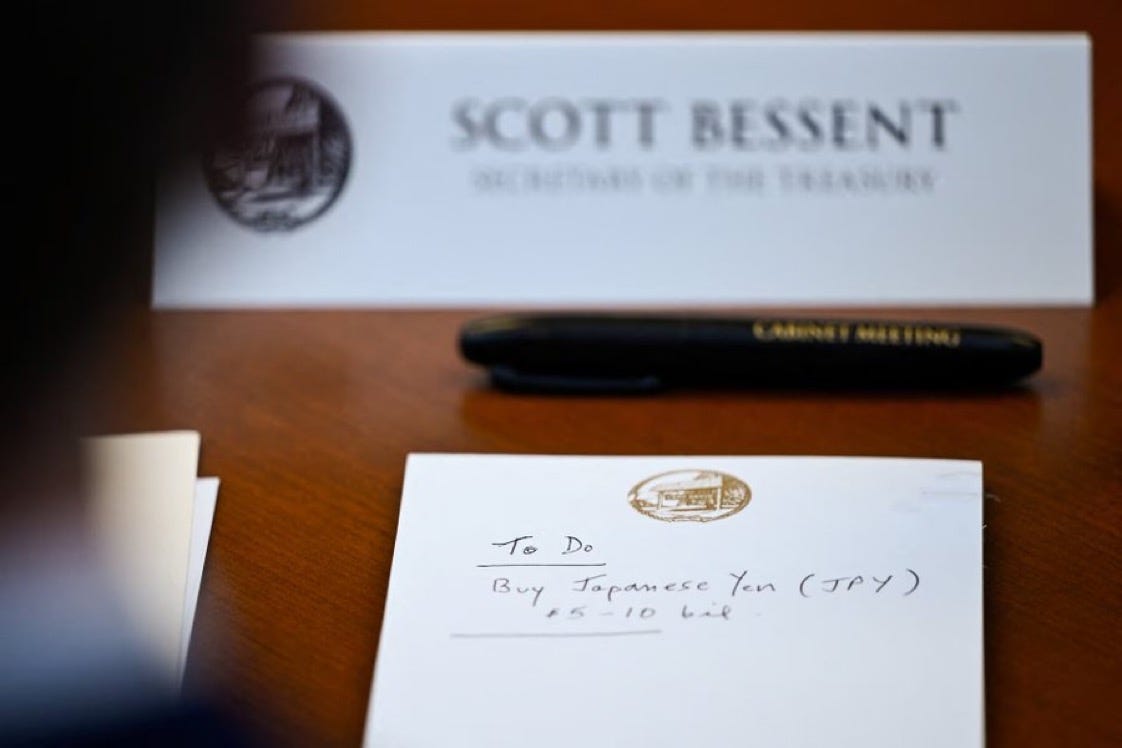
And as such, it shows Bessent’s preference for, or straight up attempt to orchestrate markets to move on their own, so that he doesn’t have to. Not his “commitment to buy Japanese Yen” - rather, his lack of commitment to do so.
There are more important misreads of what this shows- inadvertently by Bessent or otherwise.
Again- Bessent did this, knowing it would be publicized. And that’s precisely why, by design, he doesn’t write anything about USD selling on this memo, even though it should say so by FX trading terms that Bessent is also personally highly aware of. “Buy JPY, $5-10 billion USD worth” is what he essentially has written - that’s a bit of a convoluted way to phrase it. JPY is denominated in… JPY. So if he has “buying to do” - then it should say “Buy Japanese Yen (JPY) ¥800bn - ¥1.6 trillion” - or “Buy Japanese Yen (JPY) / Sell United States Dollars (USD) -$5-10 billion”
Buying “___trillion” of anything - JPY or otherwise, looks optically horrendous, though not as bad as “SELL 10 billion U.S. DOLLARS” does. Either way, both look bad - and so he purposely wrote it out as “buy Japanese yen” in USD amounts.
In other words, this reveals Bessent is highly sensitive about the optics of actively selling USD to the general public, if not to market participants. And this Reuters photo is yet another sign of Bessent’s reluctance to sell USD, or reluctance to be perceived as selling USD, that aligns with the EURJPY selling headlines that came later that day.
Perhaps the most important read, or misread from this stupid Reuters photo is the notional amount - why this isn’t front and center of discussion is beyond me.
“$5-10 billion” worth of yentervention is really nothing.
Estimates calculated by BOJ data vs money market broker estimates show that government related transactions (yentervention amounts) were ¥6 trillion for Thursday, and ¥5trillion for Friday, totaling to approximately ¥11 trillion in JPY buying, or around $71 billion or USD selling, for the two days combined.
These estimates for the notional amount of yenteventions over two days is in line with MOF’s officially confirmed amounts of yenteventions from the prior episode.
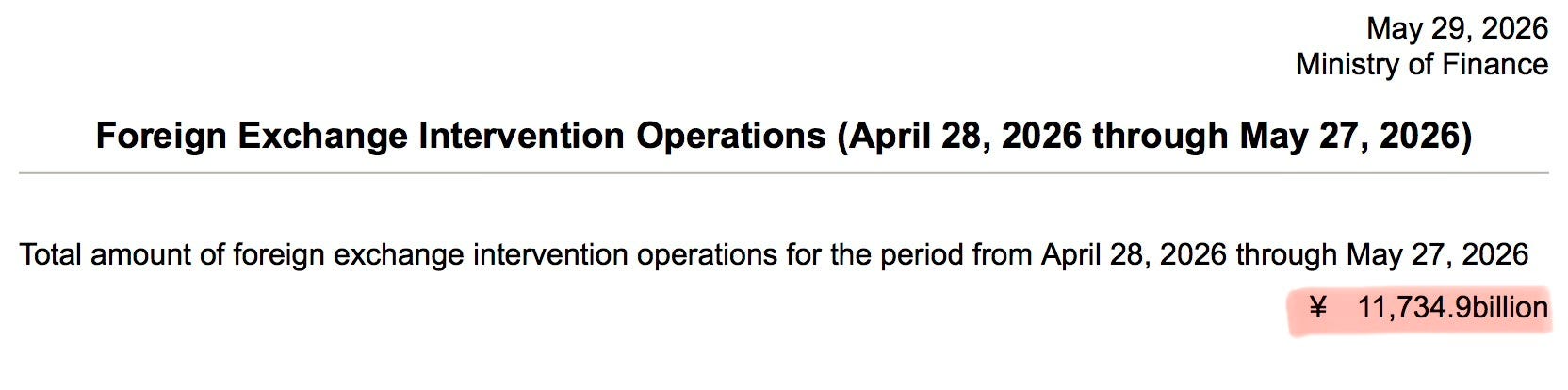
Official MOF data shows that Japan spent ¥11.7 trillion in yenterventions during Japan Golden Week from late April to early May - when markets should have been less liquid and thus easier to move price with less capital.
¥11.7 trillion equates to roughly $73 billion based on then-exchange rates, which aren’t too different from current exchange rates - given protection of / execution at ~160 level.
Now let’s go back to Bessent’s stupid memo. If Japan is spending $73 billion per double-tap yentervention, and U.S. is signaling “$5-10 billion” - then that means the “joint coordinated” cost split for Japan / US is 14:1 if U.S. spent $5 billion, and 7.3:1 if U.S. spent $10 billion. So let’s just take the mid:
Japan spent roughly $11 for every $1 the U.S. spent on supporting JPY.
And again, this is assuming the U.S. had actually taken direct market action, for which we only have Bessent’s stupidly revealing “To do” list to reference off of. Otherwise, in the absence of any firm data or official confirmation, the amount of notional contribution by the U.S. in any actual market intervention activity over the period is: zero.
So 11:1 at best, and nothing as of current. That’s what “Joint coordination” means in terms of market activity split.
FIMA facility is a COVID era facility that is rarely used, in which foreign governments can use their UST holdings as collateral to repo (pawn) them over to the US Fed, and receive USD over a short period, for which they pay interest on during. Essentially, FIMA allows for USD to be procured without having to liquidate UST holdings into the markets, and thereby push US yields (borrowing costs) higher.
And as you can see, US Treasury Dept and MOF have embraced this arrangement of MOF using FIMA facility going forward with yenterventions - no more having to sell USTs to yentervene, which is good for America’s bond markets and good for Japan not having to “run out of bullets.” Except only the former is true, the latter not so much.
Yes, by obtaining dollars via repo-ing their UST holdings rather than selling them into the market, the US avoids a potential price indiscriminate whale liquidator lurking around out there. But this is not “unlimited” capacity for Japan’s USD-blasting ammo by any means. Using FIMA, Japan’s amount of USD access is limited by the notional amount of USTs it holds in reserves. Which therefore makes it not so different from current constraints.
Now, Japan can of course always increase the amount of FIMA-facilitated USD supply by simply owning more USTs to then ship over to the Fed as further collateral. And that’s where things get interesting.
If it ever comes to a point where MOF is so heavily dependent on this use of FIMA in order to continuously slam USD down, then at some point, Japan’s purchasing and holding of USTs takes on a completely new motive. One that structurally creates demand for (especially long dated) USTs by Japan that hadn’t before existed. So, the more that the US can get Japan hooked on FIMA, not only does that prevent liquidation of USTs by the largest foreign holder of USTs (as Japan’s UST holdings are locked up at the Fed - can’t sell them), but it also may integrate UST demand by Japan via indirect force, making Japan an ever larger and growing foreign holder of USTs to help offset those who are de-dollarizing.
And if it comes to this outcome, or even just heads in that direction, then this would be quite a clever arrangement by Bessent thrust upon MOF.
Again, here’s what he said (in the article titled “whatever it takes to save JPY”
“…to protect the U.S. economy and keep any volatility offshore” …is apparently what the purpose of FIMA was/is. Does that sound like “whatever it takes to save JPY” in the Draghi sense? Or does that sound like “America first” currency policy.
Otherwise on FIMA - let me just break down the very obvious basics.
If the use of FIMA is all that came of this “joint coordination” statement, then by structure and definition, “joint coordination” simply means someting far closer to “more of the same existing framework of Japan unilaterally blasting USD in markets” than it does “US joining Japan on the front lines, committing boots on the ground to blast USD and buy JPY in markets.” FIMA is giving Japan license to continue acting unilaterally, and commands nothing of the US side to do within markets. Which is in lie with the reality thus far of: United States has not been officially confirmed to have acted directly in market intervention to strengthen JPY - and going forward, will continue not to do so. US market meddling hands are clean - just as Bessent wants them to be. Remember:
Furthermore on the use of FIMA reflecting Bessent’s clear avoidance of directly intervening in markets to sell USD and buy JPY - FIMA, again, was not created earlier this month, by America, for Japan. Its been around since 2020. So what did Japan and U.S. “jointly announce” then? The use of an existing facility? If this had already existed, then why in the hell wasn’t it used ever since Japan began yentervening unilaterally in 2022, some 4 years ago?
Because until now, yenterventions had been unilaterally done by Japan. And even though it was very obvious all along that Treasury was well aware, they said nothing - from Yellen to Bessent. Japan blasting tens of billions of USD per clip at the markets, regularly, and US says absolutely nothing? That’s pure complicity.
However, if they had authorized use of FIMA facility (or anything similar, including swap lines and the like), then that actually does require some part of the United States’ active participation - even if its just handling a repo facility, the U.S. can no longer pretend to act dumb and ignorant about what Japan is doing in FX markets, shredding up G7 protocols and the like. That’s what the US Treasury Dept had wanted to avoid - and continues to wish to avoid - direct market intervention activity, or anything within several steps from it.
But again, because Bessent and Katayama were forced to announce SOMETHING “joint coordinated” and a solution that addresses what market focus was directed towards (selling USTs to sell USD to buy JPY), that’s why FIMA, and why FIMA now.
So once agian, the “introduction” of FIMA as the centerpiece of this “joint coordination” is just another reflection of what the US had been avoiding all along, and how they are weaselling out of not doing any heavy lifting in direct market activity going forward.
Bank of Japan Governor Bessent
Bessent has been very clear for some time now, and publicly so: JPY is getting destroyed because BOJ policy rates and rate policy are ridiculously low and ridiculously slow.
He hasn’t forgotten that core principal. And now that Bessent has lent out the US Treasury as a symbolic co-signer of Japan’s forever war against JPY sellers, he needs to protect its credibility.
That means he has policy pressuring power over Japan fiscal and monetary policy that is clearly unprecedented.
In addition to the use of FIMA that may structurally create additional demand for long dated USTs that otherwise may not have existed, let alone been potentially sold off, but now force-held to maturity and held in custody of America, Bessent is taking back his leverage from the April-May MOF sidearm flash.
In response, Bessent is saying to Katayama and Ueda something along the lines of the following:
Alright, Katayama and Ueda, here’s the deal. FIMA is temporary. Every one of these stupid top-down non economic acts of market interventions are temporary. JPY is on autopilot downside because fundamentals have become completely detached - meaning, its not JPY that has detached from fundamentals, its Japan POLICY that has detached from fundamentals - and those need to be brought back into even the outskirts of where fundamentals are. That means:
BOJ - hike rates, in succession, at +50bp clips, shock-hike, whatever it is, do it starting the next Sept meeting (Oct latest, depending on if there truly are un-movable market conditions). I don’t care if NKY and TOPIX cliff dive. And given the fact that US mortgage rates are back to mutliyear highs from long end USTs terrified that you people at MOF are going to liquidate your holdings- that means I don’t give a single fuck about Japan’s “floating rate mortgages” going up to… fractions of what American mortages are.
And to a lesser extent - Takaichi policy needs to be far less indifferent in perception about JGB yields. Primary balance surplus - great. You did that by moving goal posts (and I truly mean it when I say “great” - good job). But you need to instill confidence in Japan beyond promising a projection for lower debt/GDP by growing the denominator in nominal terms. As of current trajectory, Japan is going to reach your 2030 nominal GDP target anyway, without Sanaenomics, strictly thanks to inflation. Inflation is also the reason you are boasting these record high tax revenues - because you are taxing rising wages, and you are taxing consumption. So if consumer prices rise by 5%, then your consumer tax revenue will automaticaly also rise by 5%. To hail that as some sort of fiscal windfall victory is going to crush your administration’s approvals - when regular peole hear about “record high tax revenues” what they hear is “record high taxes taken away” at a time when they are facing sharply higher costs of living - and that’s without them even making the direct connection that rising government tax income is at direct odds with government efforts to curb consumer price inflation.
Get your shit fiscal shit together.
And as Bessent conveys the above and more, he wouldn’t be wrong to do so.
Japan just bought a bit of time with a new sponsorship partner in what is otherwise more of the same yentervention measures - this US-Japan joint alliance is really no different than the pre-existing. Its Japan still battling alone. The fact that the US is NOT engaging in any market activity itself (or at best, at an 11:1 ratio) shows that the US itself understands what the bet is:
Time and credibility has been provided by America to Japan, so that Japan can fundamentally restructure its markets and economy away from a structurally depreciating JPY. If Japan isn’t able to do so, then the US can walk away (given they haven’t so far officially confirmed going long not 1 yen). And that complete absence of US involvement in direct market intervention says eveything you need to know of the level of confidence Japan markets veteran Bessent has in Japan’s ability to fundamentally restructure the markets and economy into one in which there is actually two-way demand in selling AND BUYING JPY.
Oh, and last point - regarding MOF’s Katayama recently saying GPIF should rebalance its $1.7 trillion portfolio “back to JGBs” - what that means is “at the expense of hundreds of billions of UST holdings.” Bessent will shut that down, if he hasn’t already done so. And he will once again just lean on the same argument - stop forcing capital this way or that way, and fundamentally make JPY and JPY assets attractive. And if you can’t, don’t you dare force GPIF to dump USTs just so Takaichi can cut food consumption taxes down without pissing off the social secuirty greedy elderly.
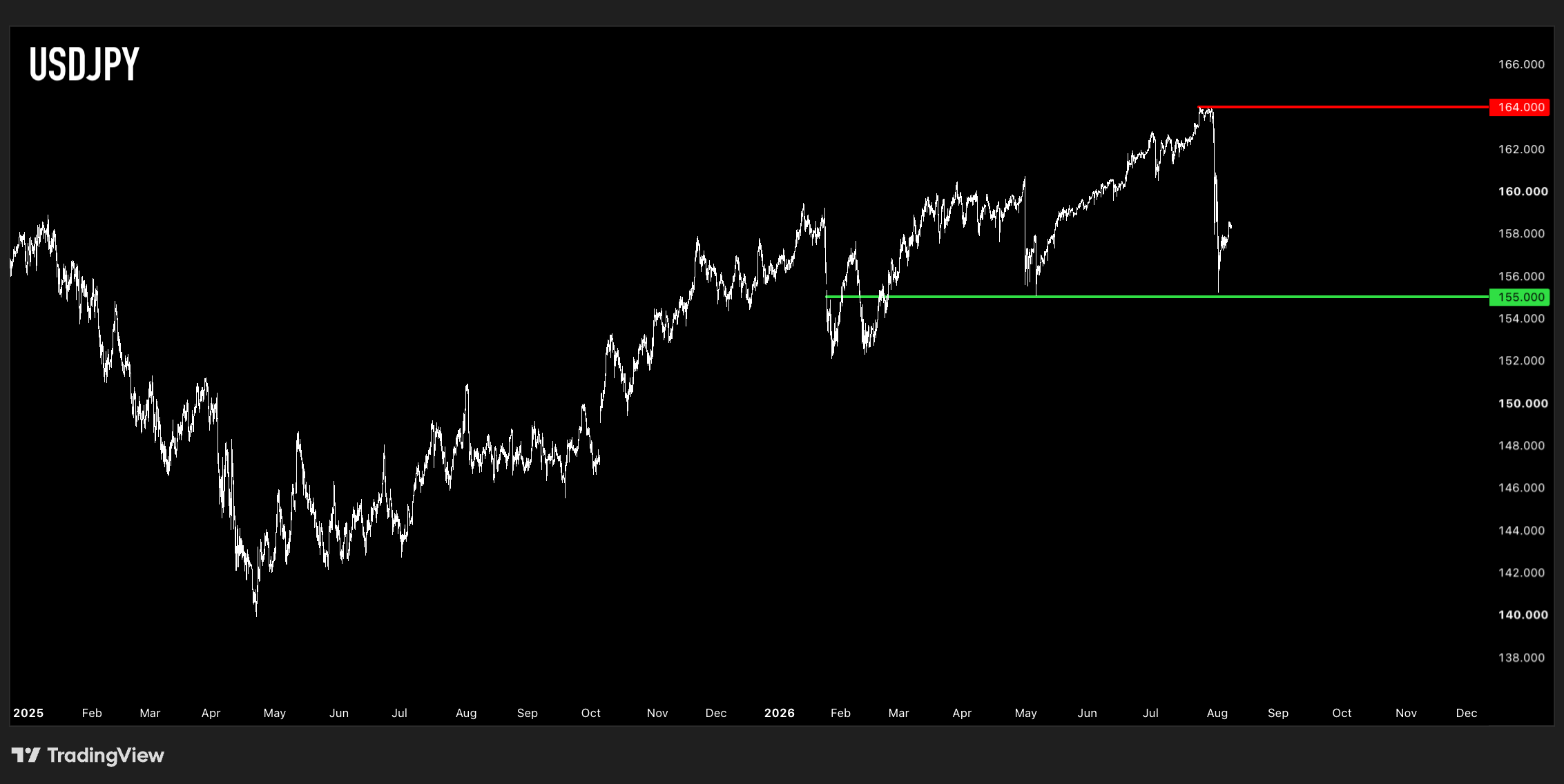
Immediate term: USDJPY 155 support, 164 resistance.
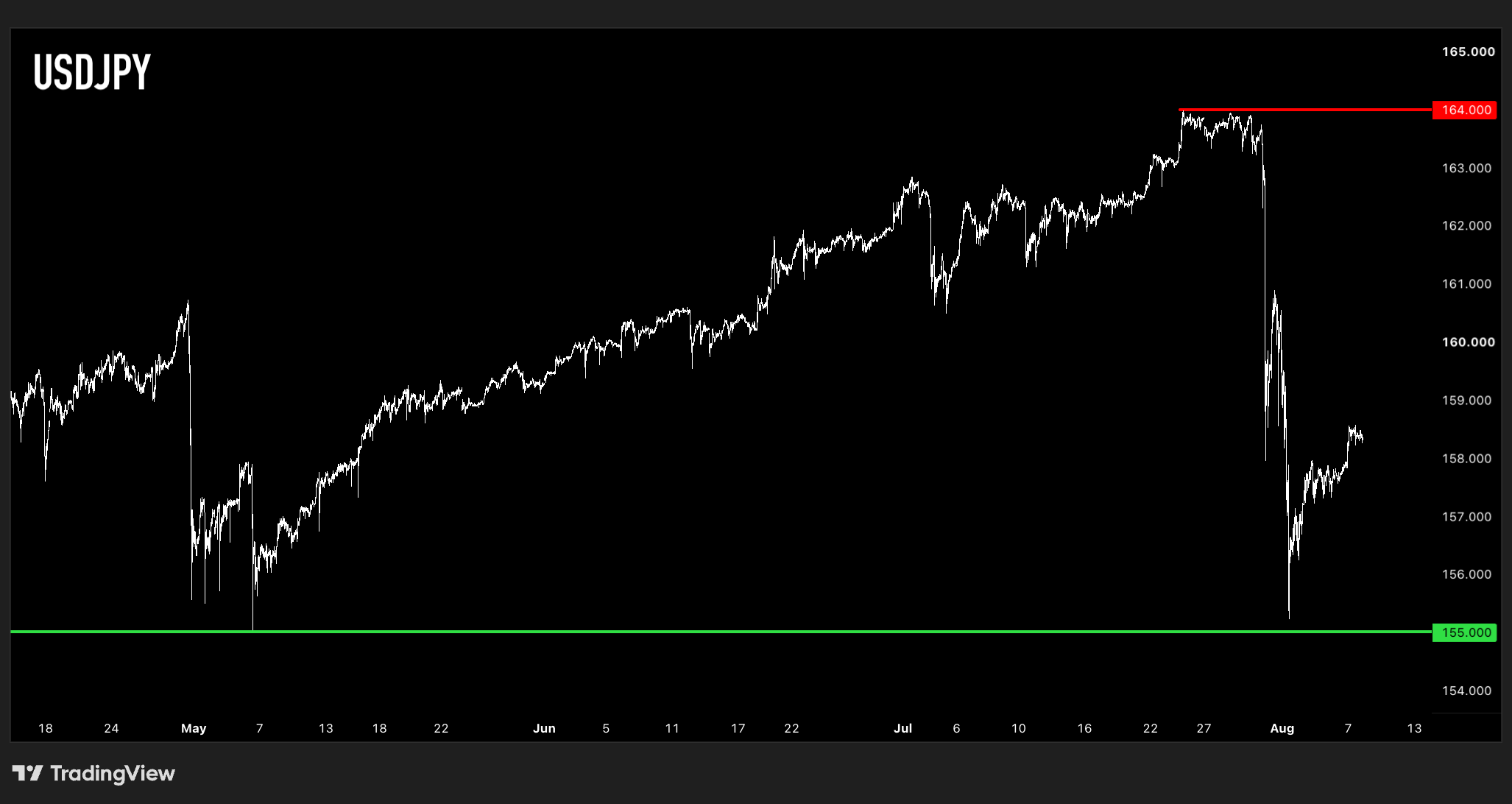
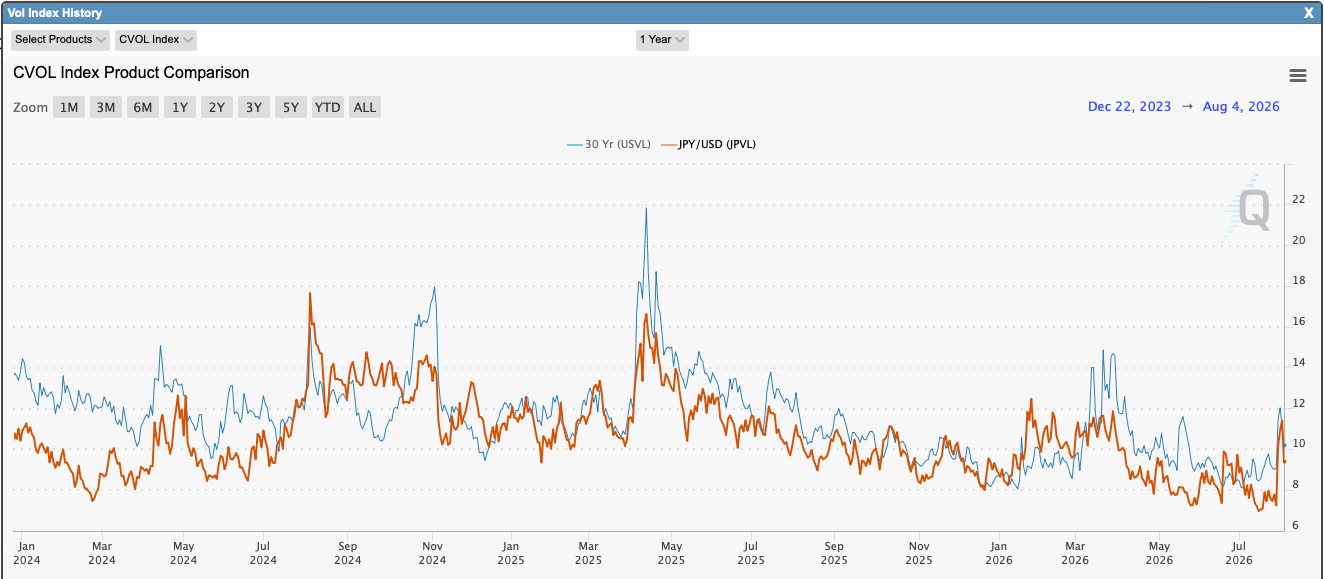
This likely to be rangebound obedient market will lower JPY realized vol, with the perceived additional credibility of the US for the time being. As these levels (particularly the upside ceiling) become market-enforced, self capping levels, that in turn will reduce the need to yentervene. As JPY realized vol comes down, while BOJ hikes still stall and Warsh’s Fed also stalls in rate policy changes, that combination will fuel the carry trade.
So this notion that “now that America is involved in strengthening JPY - shit will blow up” - no, I disagree.
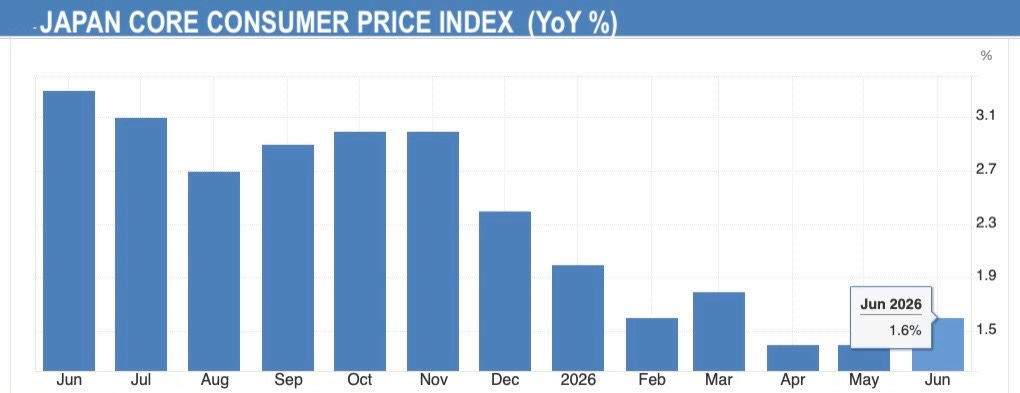
Japan
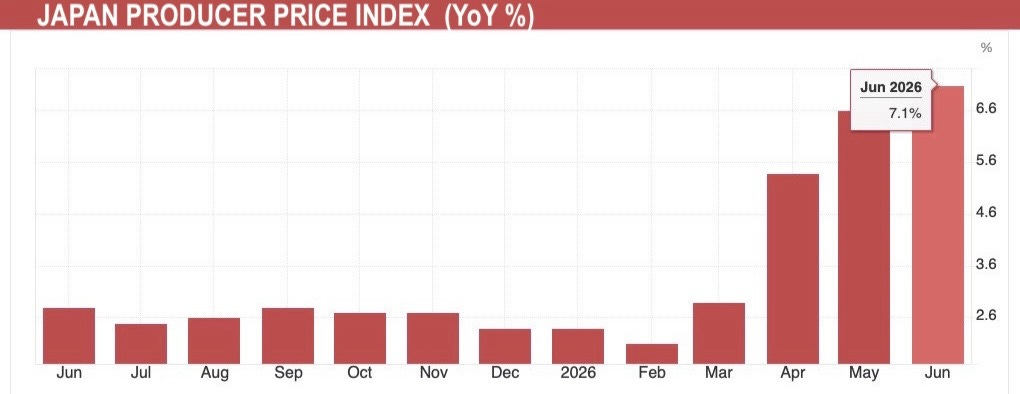
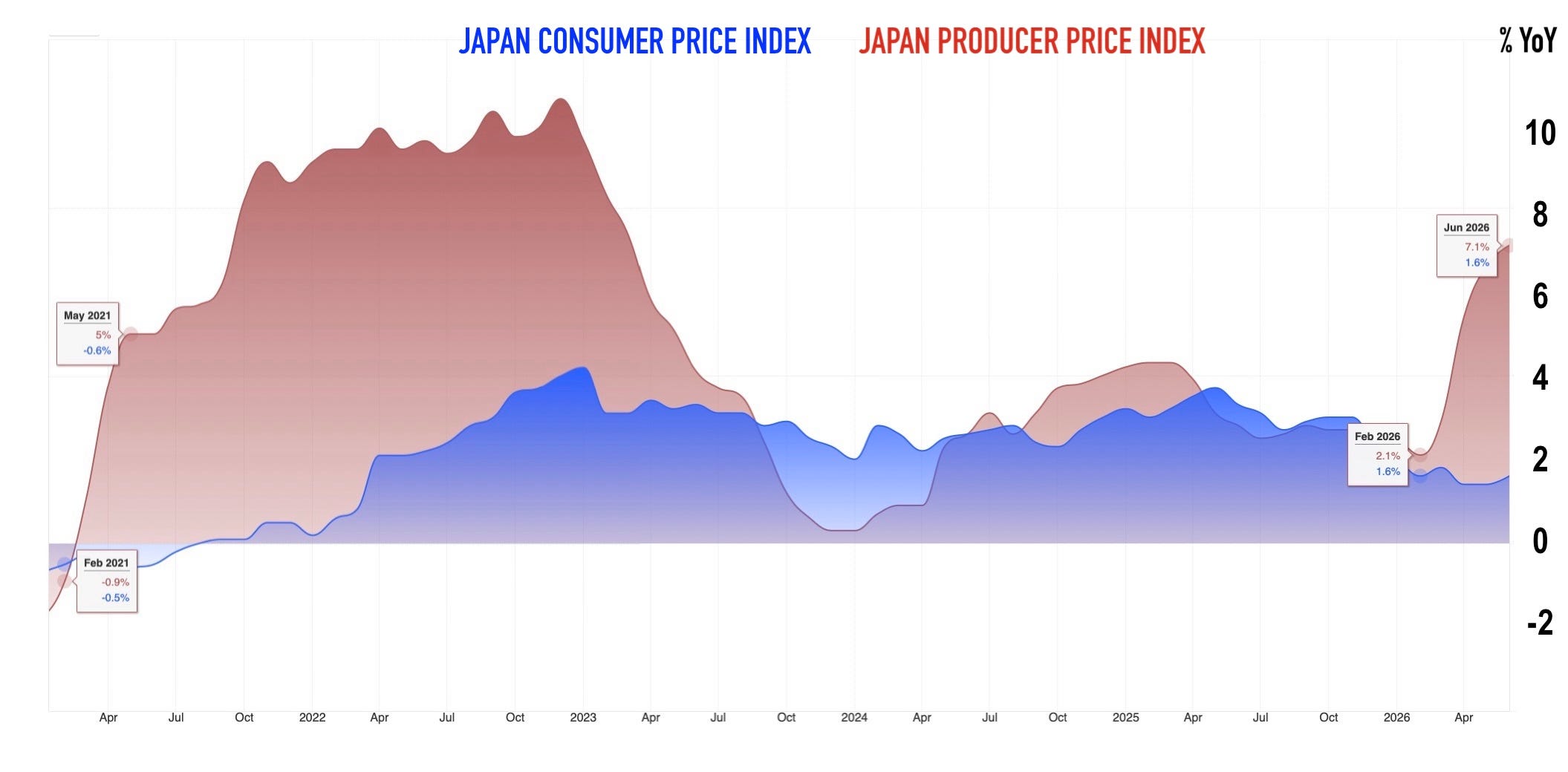
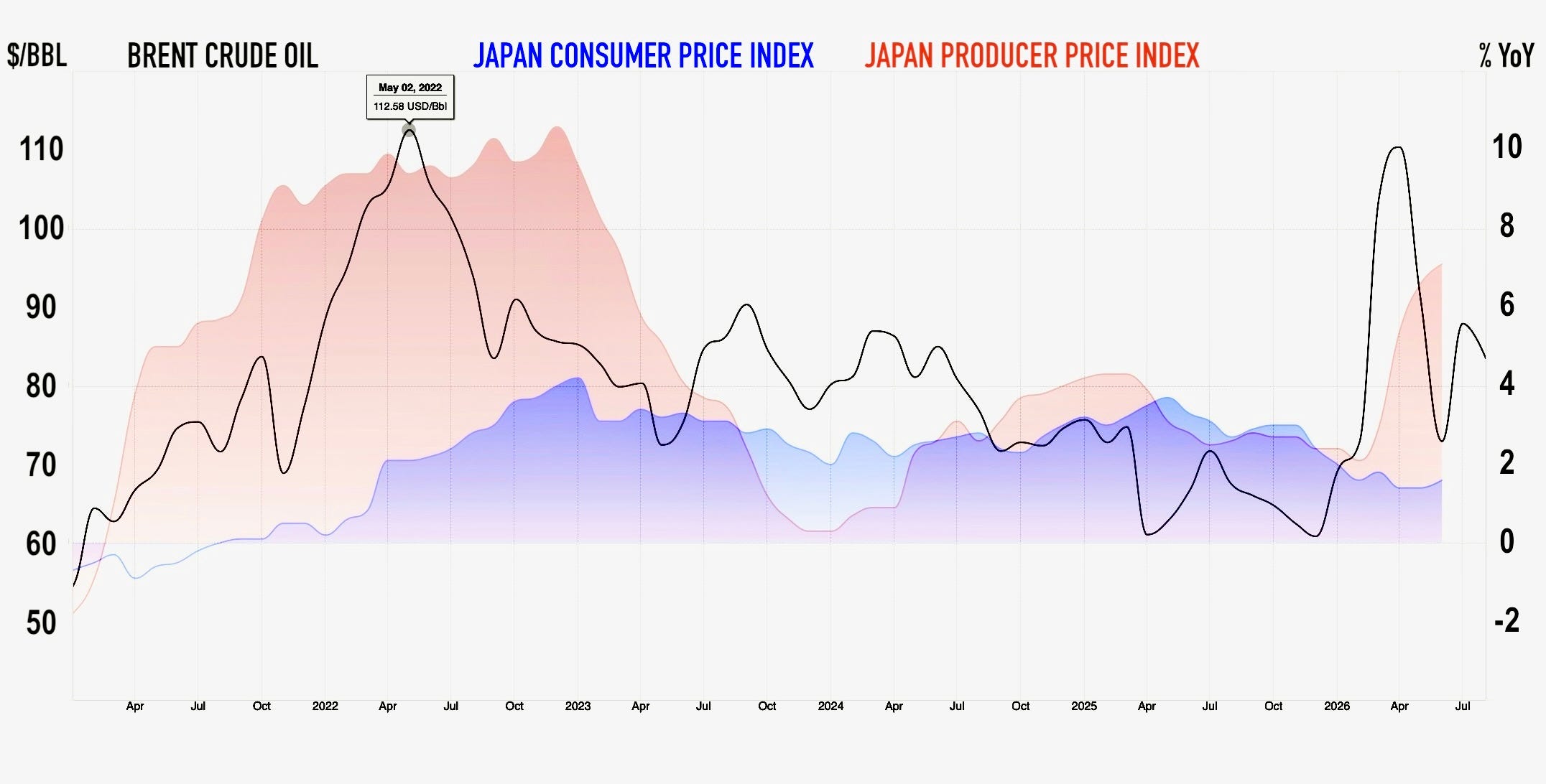
Ash Bennington sits down with Weston Nakamura, founder of Across the Spread, to unpack the extraordinary joint intervention by the United States and Japan to support the yen. Weston explains why the story is far beyond another Bank of Japan policy decision, why the weakness in the yen has become a concern for the wider global financial system, and how rising yields and capital repatriation could affect US Treasuries and other global assets.
Slide deck attachment:

Watch the full interview on Real Vision, available to subscribers of Real Vision and/or Across The Spread, HERE:
Comments
Nothing yet. Say the first thing.
Sign in to join the conversation.