
Starmer wants to reduce immigration, by creating additional restrictions on legal immigration, rather than attempting to tackle illegal border crossings.
The government wants to send asylum seekers to foreign countries after they have exhausted all avenues of appeal in the UK.
Development Minister confirms cuts to UK aid from 0.5% of gross national income to 0.3% are permanent.
There are talks of a UK-EU deal which would allow British travellers to use European passport e-gates.
Keir Starmer’s approval rating has fallen to an all-time low, with 69% of the country viewing him unfavourably.
Ofcom is setting new rules which would ban MPs from presenting a news programme.
The government have introduced their plans for big changes to the immigration rules, with the focus set on legal migrants.
The Prime Minister’s plans involve many changes to visas, including the care worker visa.
As part of his plans, the care worker visa would be removed, meaning that people would not be able to enter the UK to work in the care sector. However, those currently on a care worker visa may be able to have it extended.
This would mean that new care workers would have to already be living in the UK.
The skilled worker visa is also being changed, with new requirements for applicants to have a degree-level qualification, or a higher salary.
The current salary requirement for a skilled worker visa is £38,700, or the average rate for the profession, whichever is higher.
The government claims that these changes to the skilled worker visa will reduce the number of eligible occupations to around 180.
There will also be more restrictions on student visas. Once graduated, people in the UK on a student visa will need to leave the country within 18 months, down from the current requirement of 2 years.
In addition to these changes to visas, the government intends to set requirements for immigrants to speak English at a level roughly equivalent to a language A-Level, while the current requirement is more comparable to a GCSE.
This particular change has been mocked in some countries, such as Spain, where many Brits now live, despite a lot of them not speaking any Spanish.
These changes are currently only plans, so no changes have been made at this point.
Starmer’s immigration shakeup is just in the planning stage - subscribe to Westminster Weekly to keep up with its progress.
Prime Minister Keir Starmer is talking with 9 countries to create a system similar to the Tories’ Rwanda Plan.
Starmer’s plan is that foreign countries will act as “return hubs” where asylum seekers are sent after exhausting all avenues of appeal in the UK.
Albania currently has a similar deal with Italy, although has refused to do the same for the UK.
The government has created a shortlist of 9 other countries which could host these “return hubs”, including some Balkan nations, alongside others outside of Europe.
According to the government, these “return hubs” will be a “viable and cost-effective” method of deterring asylum seekers from coming to the UK.
A key difference between Starmer’s plan and the Rwanda Plan is that Starmer intends to fully comply with international law.
It also seems that the countries the government is keen on working with are, on the whole, safer than Rwanda.
Earlier this year, the Prime Minister announced that the UK would be reducing aid spending from 0.5% of gross national income to 0.3% in 2027.
This change is to fund increased defence spending.
The Development Minister, Jenny Chapman, has said this reduction is the “new normal”.
“I’m not making my choices, thinking, ‘Oh, we’ve got to get through the next 18 months, two years and then we’ll be back to where we were’. I’m making decisions thinking that this is the new normal and we have to make this work”
Jenny Chapman took over from the previous Development Minister, Anneliese Dodds, who resigned in protest at Starmer’s cut to the aid budget.
Ahead of a UK-EU summit in London tomorrow (19th May), there have been talks about allowing British travellers to use European e-gates, which are currently only for people from the EU or European Economic Area.
This would mean that Brits wouldn’t have to queue separately when arriving at European airports.
This is likely just one area that may form part of a larger deal, which should be announced next week.
Even just this one aspect could be good for Starmer, as it could help to reduce the queues faced by British travellers since Brexit, and would come just ahead of the summer holidays.
That might help to bring his approval ratings back up from the current all-time low, but more on that in a second.
We won’t know the full details of the deal until after next week’s summit. I’ll cover everything we know in next week’s edition of Westminster Weekly.
According to polling by YouGov, Prime Minister Keir Starmer’s approval rating has dropped to an all-time low of -46.
Approval ratings can be a little confusing, but what this means is that there is a gap of 46 percentage points between those who view Starmer favourably, and those who view him unfavourably.
YouGov’s latest polling shows 69% of the country have an unfavourable view of Starmer, while only 23% have a favourable view.
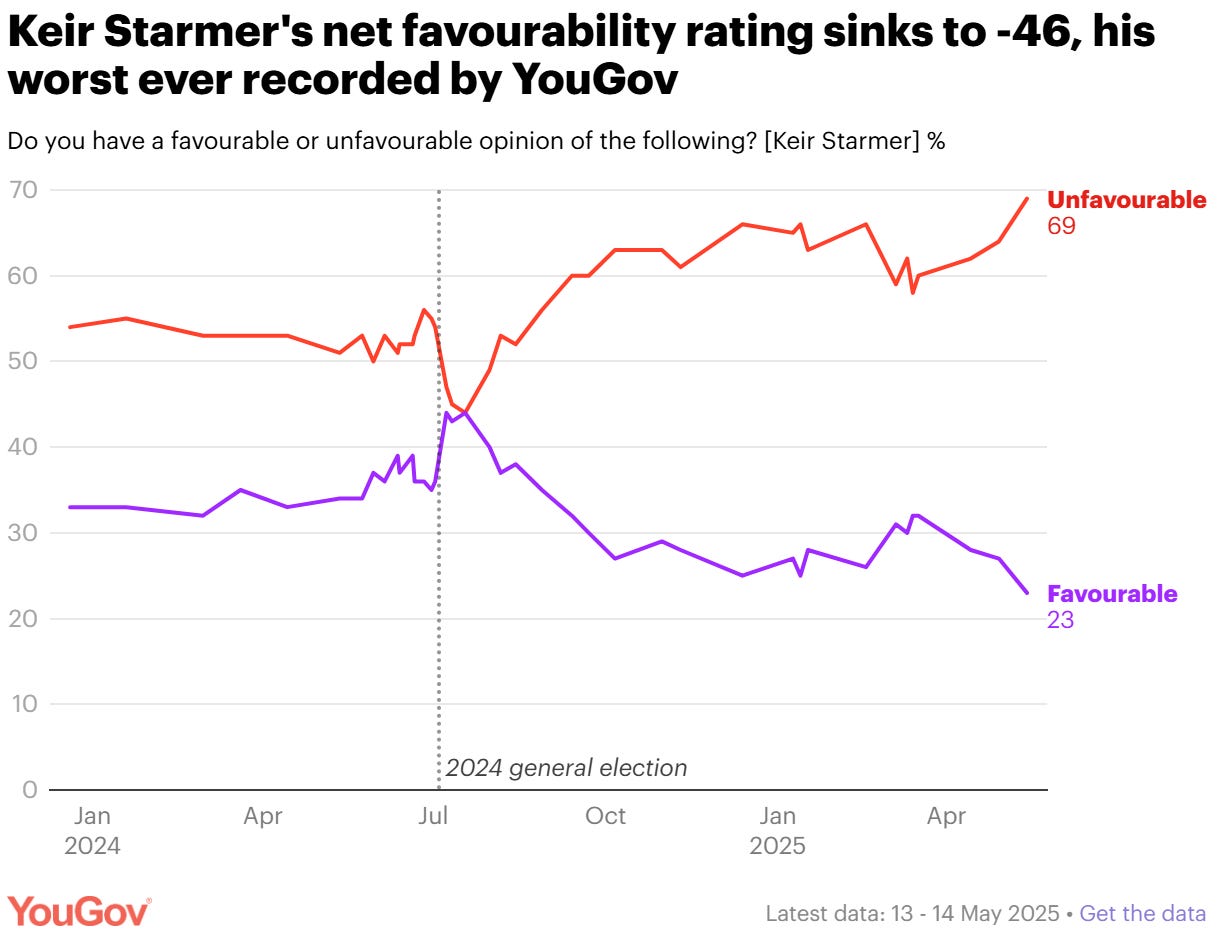
Even Labour voters aren’t happy - 50% of those who voted Labour last year view the Prime Minister unfavourably, up from just 33% last month.
What happens at tomorrow’s UK-EU summit could have a positive impact on Starmer’s approval ratings, but we’ll have to see what’s announced first.
Regulator Ofcom intends to tighten rules, which would prevent politicians from presenting the news on any programme.
This change applies to any MP - so politicians who are not currently an elected MP will still be able to present a news programme.
That’s everything for this week, but before you go, I’ve just got a quick question!
Thank you for reading Westminster Weekly! Subscribe for free to make sure you don’t miss any important developments.
Cover photo sourced from the Home Office.
No posts
Comments
Nothing yet. Say the first thing.
Sign in to join the conversation.