
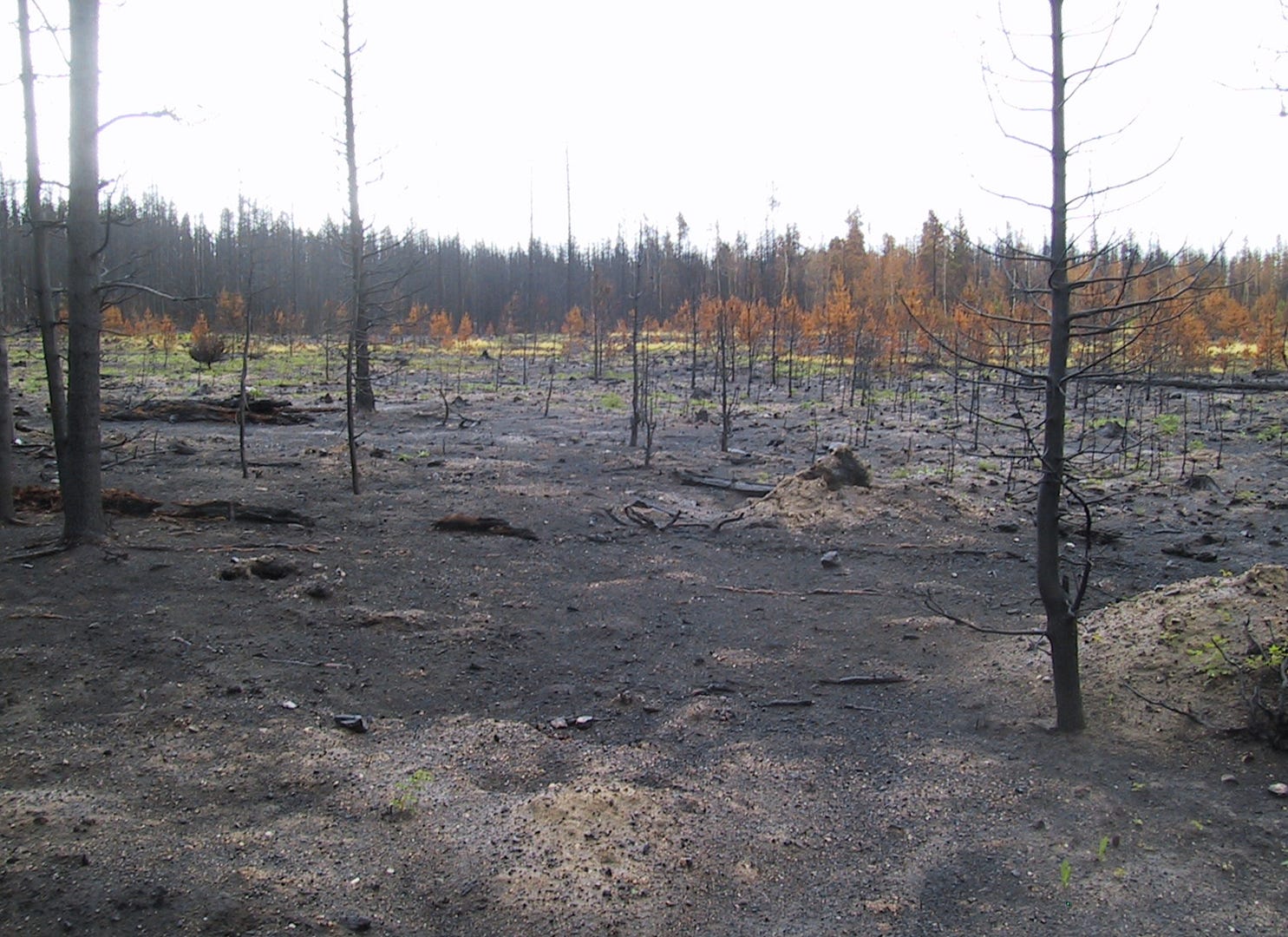
The West is burning. Eastern Oregon has massive grass fires, but not because it hasn’t been heavily grazed by cattle and sheep: It has. The Sierra Nevadas have seen massive blazes, but not because no one raked the forest. Fires swept through upscale neighborhoods and working-class suburbs on the outskirts of Los Angeles, but not because the governor didn’t magically divert the Sacramento River over a mountain range in time to put out the fires. We have fires throughout the conifers on our national forests, but not because they have never been logged: They have.
The crisis is real, for communities, for wildlife, for the land. There are greedy industries looking to capitalize on fears and tragedies and suffering to make bigger profits for themselves, cynically using false narratives to rebrand their exploitation of the land as some sort of fire risk abatement.
It’s a con game. And you’re the mark.
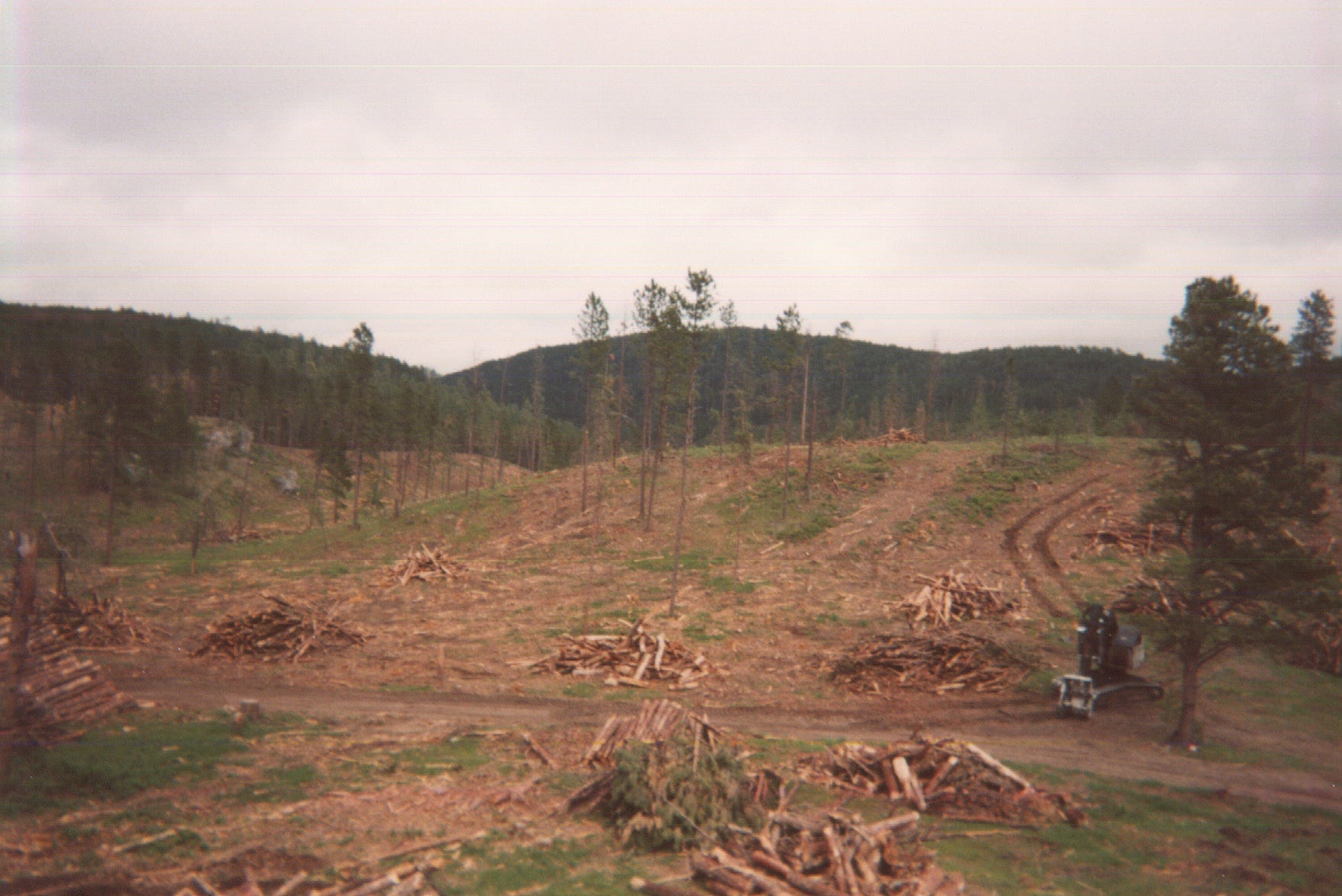
Years ago, I ran a forest-defense NGO in southeastern Wyoming that got its start advocating for reforms on the Rocky Mountain Region’s most heavily-clearcut National Forest, the Medicine Bow. It was a poster-child for forest fragmentation. The interior-forest wildlife, like pine martens and brown creepers and goshawks, were all but gone. The old-growth stands of trees had disappeared years ago. But that didn’t stop the logged-off forests and stump-filled clearcuts from burning in massive blazes: The 2012 Squirrel Creek Fire (11,000 acres), the Keystone Fire of 2017 (2,500 acres), the Ryan Fire (19,328 acres) and the Badger Creek Fire (21,310 acres) in 2018, and the 2020 Mullen Fire (176,878 acres), largest of all. I had friends who lost homes. I had a front-row seat to the public-relations circus that was — and is — state and federal fire policy.
Through all of this, there were heroes for science who tried to tell the truth about fire in western forests. Dominick Kulakowski, whose research showed that spruce-fir forests in the Rockies burned only every 300-700 years, and when left alone would cycle between spruce and fir for centuries, developing into multiple-canopy old-growth forests that were the predominant land cover in the Rocky Mountains. Dr. Chad Hanson of John Muir Project and former firefighter Tim Ingalsbee of FUSEE, environmental professionals who showed that you cannot log your way to a fire-free forest. Bill Baker, whose research burst the bubble that ponderosa pines were naturally found in sparse savannas that were cleared every 5 to 40 years by low-intensity ground fires (throughout history, the most ponderosa acreage burned was, and is, burned in stand-replacement fires, it turns out), and who established that sagebrush basins only burned every 100 to 240 years under natural conditions but take 50 to 120 years to recover from fire. Jack Cohen, who ran the Forest Service’s Intermountain Fire Lab and tested experimental fires that showed that wooden homes could withstand full-blown canopy fires as close as 40 meters (120 feet) without igniting, if they had Firewise construction features like metal roofs and soffit vents. Dick Hutto, whose scientific articles illustrated the ecological benefits of fire in natural forest systems, essential for fire-dependent bird species like woodpeckers (full disclosure: Hutto was my undergraduate advisor at the University of Montana). Dominick DellaSala, who researched the ecology of burns and discovered that salvage logging was the worst possible management of burned forest if you wanted the trees to come back into healthy ecosystems. But politicians and agency land-managers pandered to industry lobbyists instead, so we never got science-based fire policy that worked.
In the fire policy debate, you can’t blame the wildland firefighters who are out there, putting their lives on the line to stop big fires once they get started. The helitack crews, the smokejumpers, the interregional hotshots, the slurry bomber pilots, the local Forest fire crews and the pressed-into-service agency staff who have passed the step test. They’re doing their best, sometimes even engaging in acts of heroism, and with tragic frequency, giving their lives to protect humans and homes. They go where they’re ordered, do their best to put out big fires (next to impossible in the hot, humid, and windy conditions of Red Flag fire weather), and then get shuffled on to the next fire until they’re all used up. They are in harm’s way due to the counterproductive profiteering of resource-extraction industries, and the smarmy posturing of politicians who don’t have a clue about either fires or land stewardship.
It’s the politicians and the bureaucrats who deserve the biggest share of the blame. For them, fire is an opportunity to do crooked favors for their pet commercial interests. If they can give away the national forests and all the important wildlife habitat and recreation destinations they contain to the timber industry, so they can be turned into lifeless stumps, if they scrape fuel breaks from Hell to breakfast (that immediately fill with flammable weeds), then when the next big fire roars through unabated, they can say “We did our best.” And then, big fires become an act of God for which no one is held accountable. In bureaucratese, this is called a “CYA exercise.” Cover Your Ass. Escape accountability. Live to fight another election cycle, while your constituency burns down around you. They should know better.
There’s a practical reality. After noticing a pattern where some homes burned up during forest fires while others survived with minimal damage, forest professionals developed a series of Firewise principles for home construction and property maintenance. Metal roofs that wouldn’t catch fire. Screens on soffit vents so flying embers wouldn’t be sucked into the attic. Firewood stacks and combustible shrubs kept far from structures. “Defensible space” around the buildings so burning trees won’t fall onto the house. Residents and businesses in fire-prone landscapes who implement these Firewise principles can minimize the chance of losing a home or business when fire-dependent conifer forests inevitably burn.
But focusing on removing vegetation within 120 feet of structures in the Wildland-Urban Interface (WUI), defending the structures (and lives) on the acres that really matter, isn’t profitable in the system we’ve created. It isn’t conducive to industrial-scale logging that produces millions of board-feet of lumber to pad the timber industry’s profit line. In fact, it costs money. And many landowners in fire-prone areas can’t afford it. I live in the fire-prone Rogue Valley of Oregon, and a local wildland firefighter told me that there used to be federal grants to treat private lands to reduce flammable vegetation on private property, but the Trump administration pulled back the grant funding in the name of “anti-wokeness” because the wildland fire-prevention companies were Indigenous-owned.
That’s where state and federal fire policy comes in or — more often than not — doesn’t show up. The Forest Service has an annual budget of $2.14 billion a year, according to its FY2027 budget request. Over the past 6 years, the agency claims that an average of 123,246 WUI acres per year has been treated. There are 36.5 million acres of private inholdings inside our National Forests, plus another 8.55 million acres of National Forest lands that fall within the Wildland-Urban Interface, for a total of over 43 million acres of WUI inside National Forest boundaries. So less than 3% of the WUI is being treated every year, even as fire risk grows.
This year, the timber lobby got its F*x Our Forests Act (or FOFA) introduced in Congress, with bipartisan sponsorship. Parts of it got baked into the Farm Bill that’s currently stalled due to other legislative controversies. It authorizes “Categorical Exclusions” – code for loopholes allowing project approval without any environmental analysis – for logging projects totaling less than 10,000 acres, or livestock grazing that is packaged as “fuels reduction.” It requires legal challenges to be filed within 150 days of original publication in the Federal Register, forcing a rush to the courthouse with as little as a few days to put together the lawsuit, if there is to be any legal accountability. You can approve massive clearcuts in the backcountry. You can approve systematic overgrazing that will wipe out the forage base for elk and mule deer and eliminate sage grouse hiding cover. You can approve endless firelines crisscrossing our National Forests, which fill in with flammable weeds, and that won’t do anything to slow down extreme fire spread driven by wind, which burn the most structures and are increasing with climate change.
You know what the F*x Our Forests Act doesn’t do? The one thing that will actually save lives and property: Funding home hardening and flammable vegetation reduction within 120 feet of structures. Not one slim dime for WUI fuels reduction is included in this corporate-welfare boondoggle.
Some of the most egregious dishonesty in FOFA is the notion that heavy livestock grazing on public lands will reduce fire risk. If heavy grazing actually reduced fire risk, our Bureau of Land Management Lands – predominantly sagebrush steppes, grasslands, and deserts – would already be fireproof. This year, we’re seeing record fires in eastern Oregon and elsewhere across the West – on public lands that have been grazed to death for decades.
Livestock industry apologists are fond of pointing to a single scientific study from the USDA Agricultural Research Station in southeastern Oregon, which found that you can reduce flame length significantly by grazing off 80% of all of the edible plants that will grow from the beginning of the year to the bitter end (This leaves just 20 percent of edible forage for wildlife, but that’s another article).
There’s one small problem: Cheatgrass. Grazing at 80% forage utilization wipes out the native perennial bunchgrasses, which actually stay alive and have a measure of water content during the hottest, driest part of the fire season. And what do you get next year, once you graze the land down to bare dirt? Amber waves of cheatgrass, as far as the eye can see. Covering more than 100 millions acres of the West in impoverished wildlife habitats and flammable tinder, according to the latest calculations. It’s green for only 6 weeks in the spring, and dead, dry and ready to burn by the beginning of July. The livestock industry is 100% responsible for it, from destroying the native bunchgrass and biological soil crusts that resist it, to transporting the seeds in the fur of their stock not pastured on weed-free private lands, to suppressing the recovery of the native grasses so nothing but cheatgrass can ever survive. Cheatgrass is what’s fueling the Big Grass Fire on the Oregon-Idaho border right now, the flammable consequence of decades of catastrophic overgrazing in the Owyhee canyon country.
Fuel breaks are another con game. The Bureau of Land Management has ramped up efforts to put fuel breaks across the Sagebrush Sea. To help defend the sage grouse habitat, they claim. To halt the spread of fire. But this program has been going on for thirty years, with nothing measurable to show for it, according to the federal government’s own analysis. Theoretically, a fuel break might hold in limited circumstances if there are fire crews positioned all up and down it to defend it when the flame front advances, assuming there is no extreme fire weather of high winds and low humidity, or even changing wind directions. But the practical reality is that the major fires are driven by heavy winds and sailing embers. The fires jump concrete interstate highways six lanes wide. They jump rivers, filled with water, the most flame-proof substance in the known universe. One even jumped the Columbia River, half a mile wide. During extreme wind events, flying brands start new spot-fires miles ahead of the flame front. A hundred-foot-wide strip gashed into the sagebrush with a bulldozer? It’ll fill up with flammable weeds in the first growing season after it’s bladed. Unless it’s regularly maintained forever, which just doesn’t happen. Fuelbreaks cost a lot of money, create a lot of busywork, destroy a lot of habitat, and in extreme fire conditions, they’re only a symbolic gesture as a defense against the flames.
Increasingly, massive fires are becoming the new normal, and the biggest driver isn’t too much combustible vegetation. It’s the climate. After Exxon’s scientists discovered and accurately predicted the oil industry’s responsibility for changing the climate in the 1970s, Big Oil and their allies spent millions concocting fake science to “prove” that climate change wasn’t a real threat, or that fossil fuels, ruminant livestock, and deforestation weren’t responsible for it. But now, even the oil industry has had to publicly admit that climate change is real. We have record temperatures. Heat domes. Extended hurricane seasons with record wind speeds. Tornadoes popping up in places where tornadoes were rare as hens’ teeth in decades gone by.
The changing climate has had a massive effect in fire country. Fire seasons once went from late June to September, but now are expanding from May through October, and indeed, we’re now seeing major fires in January and March. Droughts are longer, deeper, and more frequent due to climate change, stressing vegetation and making it more combustible. Extreme wind events are getting more frequent (as the jet stream breaks down), and as summer rains grow scarcer – a dangerous combination. Summer temperatures are inching steadily upward, with new heat records being set on a weekly basis. Long stretches of hundred-degree days are becoming commonplace, even in regions where temperatures hitting the century mark used to be a rare event. Combine all these climate-driven factors together and you get extreme fire weather, when a small spark can go from a single acre to tens of thousands in a matter of a few short hours.
The good news is that renewable energy sources are more available than ever. Solar panels alone, sited on rooftops and parking-lot shared canopies and roofing irrigation canals to reduce evaporative loss, could supply the United States’ entire electricity demand without bulldozing a single acre of habitat or whacking a single eagle with a wind turbine blade. The bad news is that utility corporations have armies of lobbyists who often undermine distributed renewables, there are still massive releases of methane – the most potent greenhouse gas – from both cattle and leaking from natural gas wells and pipelines, and Big Oil is alive and well and in control of the White House. We’ve all got work to do to move climate solutions from promising technology to proven reality.
In order to get to sane fire policy, we first need to decouple our land management agencies from the parasitic industries that are degrading our lands and making dishonest claims about the efficacy of fuels reduction work. In 2002, I authored the Keep the Medicine Bow Wild Plan, a comprehensive, science-based forest management blueprint that, among other things, prescribed focusing vegetation treatments on the quarter-mile around every structure in the Forest. It garnered overwhelming public support in the local community. The Forest Service even evaluated it in detail as one of their Forest Plan alternatives. The concept has proven over the decades to be the best idea in fire mitigation today. But they ultimately rejected it in favor of more clearcutting, fuel breaks in the backcountry, and cattle and sheep grazing as usual wherever it had been authorized previously. When the Forest Service held their cooperating agency meetings, it was the timber industry and the livestock industry whose agenda dominated the comments of the county commissioners, and state politicians who had a seat at the table, while the public whose interests in healthy forests and abundant wildlife and quality recreation were relegated to the gallery. In the end, the Forest Service chose to log it, graze it, and then watch it burn.
Erik Molvar is a wildlife biologist and is Executive Director of Western Watersheds Project.
No posts
Comments
Nothing yet. Say the first thing.
Sign in to join the conversation.