
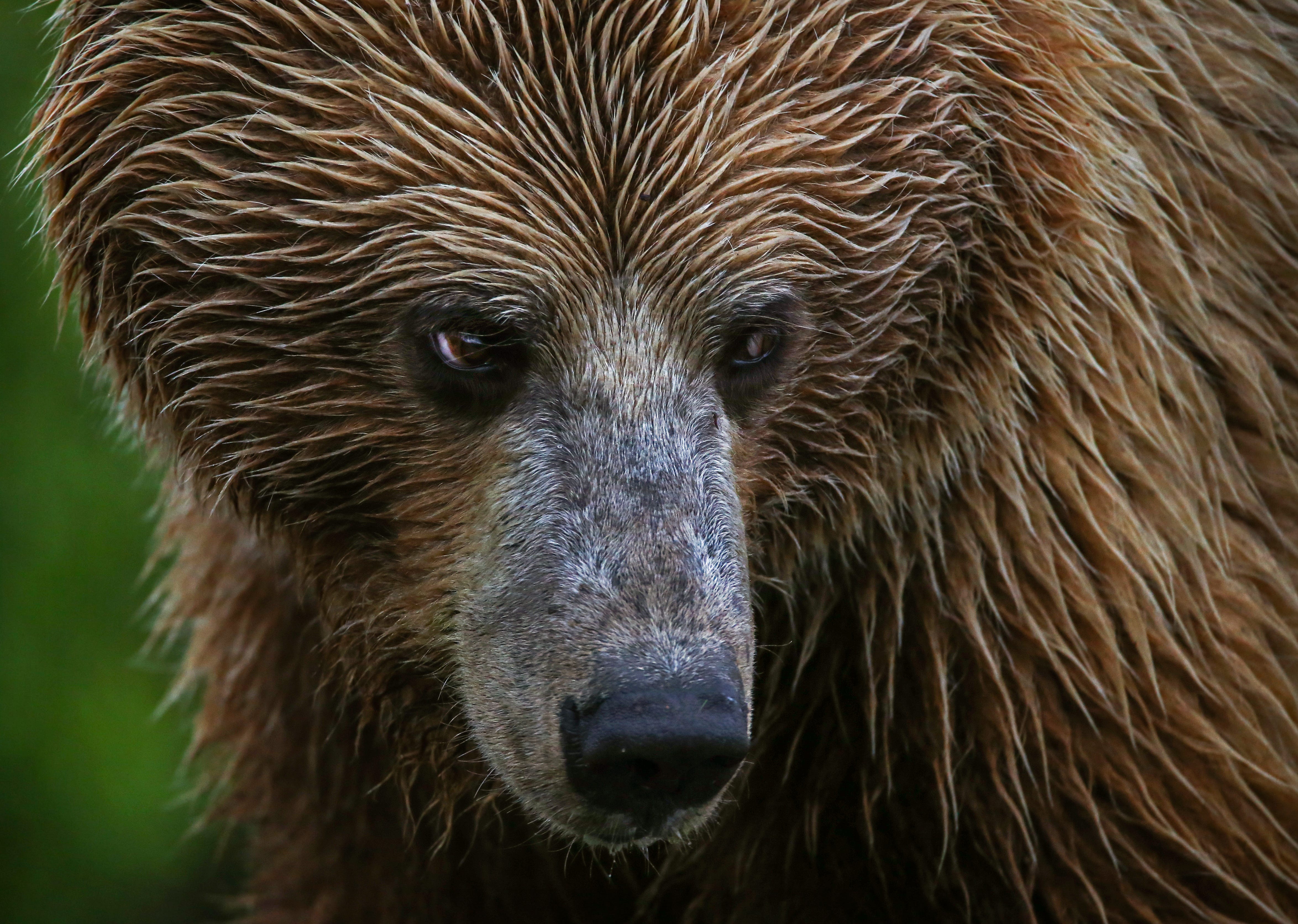
Here’s a test. I’m going to say a word and you’re going to try and remain calm, read the article, and think about the discussion in it, before you devolve into a fit of rage. Ok, ready? Grizzly.
The big thing putting grizzly bears in the news, outside of the Northern Rockies where we actually live with them, is the story about the guy who got killed by one in Glacier National Park back in May.
The latest piece of that story to make waves is that the Interagency Grizzly Bear Committee just published its comprehensive report on the incident.
The basic gist of that was that the dude was hiking back down a lesser-hiked trail all by himself after dark, through dense deadfall, when he surprised a mature boar. He deployed his bear spray, but the bear still made contact, knocking the hiker down a steep slope. When he began to climb back to the trail, the bear made contact again, this time fatally.
Thankfully, the bear won’t be killed since this is the first known conflict it’s had with humans, and since it left the area after the incident without eating the body.
This story has drawn breathless coverage across the full gamut of media, all across the world. And to me, that gives us the most significant takeaway here: grizzly attacks are so rare that each one is remarkable.
Glacier National Park, where the incident occurred, sees over three million visitors each year. And if you’ve ever been to a national park, you’ll know that at least 2.99 million of those visits come from the absolute stupidest humans on the planet. You couldn’t ring a louder dinner bell for any critter interested in killing and/or eating people if you tried. And yet, this was the first grizzly-related fatality in the park since 1998.
Now I’m bad at math, but that puts your odds of being killed by a grizz in that park at about one in 84 million. All other causes of death in that park result in two to seven deaths each year. So your odds of dying in Glacier by any means other than a grizzly attack are around one in 428,000 to one in 1.5 million.
Just to put those numbers in perspective, as an average American, your odds of being killed by a firearm in any given year are one in 7,400.
So all of us can stop worrying about bears killing tourists, and get back to texting while we drive, right?
Of course not.
Last week, the Department of the Interior announced a new plan to transfer management of grizzlies in the lower 48 from federal to state governments.
Secretary of the Interior / Tech Billionaire Doug Burgum made the announcement from a stage set up in Yellowstone National Park alongside Governor of Montana / Californian Tech Billionaire Greg Gianforte, Governor of Idaho / Cattle Rancher Brad Little, and Governor of Wyoming / Cattle Rancher Mark Gordon.
All of those guys have impressive track records of managing the public estate in favor of the public, definitely not using taxpayer dollars to subsidize ranching, and would certainly never commit wholesale murder of wild animals just to melt the brains of their illiterate voter bases, obviously.
“I think of this as a dress rehearsal for delisting,” remarked Christy Clark, director of Montana Fish, Wildlife and Parks.
The back story here is that the use of the Endangered Species Act to protect grizzly bears has been controversial ever since populations of them were listed as a threatened species in 1975.
Way back then fewer than 1,000 total grizzlies remained in the lower 48, largely in isolated populations anchored in Yellowstone and Glacier National Parks.
For those of you who don’t commute between the two every other week, like I do, it’s worth briefly explaining some geography. While both parks are located in the Northern Rockies, Yellowstone sits about 350 miles south of Glacier, separated not just by a bunch of lonely mountains, but by two interstate highways, multiple towns and cities, an awful lot of ranches and farms, and most of Montana’s humans.
Back when the bears were listed, scientists felt that restoring interconnectedness between the two isolated populations would be a reasonable goal for recovery, but was likely impossible. Since that time, Montana’s human population has grown from 748,000 to 1.1 million.
That didn’t stop scientists from formally establishing interbreeding between the two populations as the formal goal for species recovery in 1993.
That didn’t actually happen until earlier this year (in the faintest, most technical sense—scientists had to transplant bears to make it work). But that didn’t stop Republicans from trying to move grizzly bears off the ESA’s list of threatened species first in 2007, then in 2017. Both efforts resulted in lawsuits that paused any implementation, and the Biden administration put an end to that whole boondoggle.
Now, Burgum thinks he’s found a workaround. By keeping the bears listed, but by transferring management to some of the most regressive state governments in the country, he thinks he can have bears killed while avoiding getting tied up in years of messy lawsuits. Which of course it still will.
Want to help those lawsuits along? You have 21 more days to tell the government what you think of this nonsense, which will give the various animal advocacy orgs some of the material they need in court.
Speaking of animal advocacy, they’re no less guilty of going insane over this stuff than anyone else is.
A new petition in Montana filed the day after the IGBC report made it formal that the hiker in Glacier was killed despite using bear spray seeks to make it illegal to go hunting in this state without carrying bear spray on your person at all times.
“Their focus is on preventing individual animal deaths,” reports Natalie Krebs in Outdoor Life.
The efforts is proving controversial in both hunting and animal advocacy circles, which often overlap here in Montana. The problem is, of course, that if you’re sneaking around the woods carrying a rifle, you’d have to put that rifle down and pick up bear spray in order use it, wasting the kind of seconds that may represent the entire duration of a bear attack. And, according to actual science, that rifle is the far more effective tool.
“It’s one of those things that sounds good on paper,” hunting advocate Guy Eastman explained to Wyoming’s Cowboy State Daily. “But the actual logistics of implementing that, monitoring it and babysitting people to carry it—that’s a whole other issue.”
Even if you insist on believing the press release that declared bear spray more effective than a firearm, despite claiming to represent the studies that came to no such conclusion, you do need to at least acknowledge that hunters don’t kill all that many bears in self defense.
Of the 72 grizzly mortalities that were recorded in the Greater Yellowstone Ecosystem in 2025, 44 were management actions targeted at bears that had created conflicts with livestock or humans, while 15 were killed in self defense. There were zero human fatalities caused by the bears in the GYE last year.
And not only would focussing on decreasing conflicts between grizzlies and ranchers save more bears, there’s a proven method for achieving it that, unlike bear spray, has actual science to back it up.
Back in 2024, I reported on an ongoing study in Montana that’s found the simple presence of a Kangal—a giant Turkish livestock guardian breed; our dog Teddy is one—can reduce incidences of grizzlies entering ranches by 87.8 percent.
“Forcing ordinary folk to buy and use bear spray as required by law goes beyond what I think management and government should do,” wrote famed Yellowstone naturalist Doug Peacock in a Facebook post discussing the petition to mandate that hunters carry the spray. “I think education on bear behavior is what is needed.”
But that approach—simply educating people about how to stay safe in grizzly country, or helping ranchers acquire dogs—will of course never happen.
Hey, at least we’re talking about something other than wolves for a change.
Top photo: NPS
A journalist with more than two decades of experience working around the world, Wes Siler is here to cut through the outrage and disinformation to bring you the factual, insightful, actionable reporting you need to understand what’s going on. Upgrading to a paid subscription supports this reporting, and buys personal access to Wes, who will help you save money on gear, plan outdoor adventures, and prepare for real life, and who promises he’s less salty in real life than he sometimes comes across as on the Internet.
Comments
Nothing yet. Say the first thing.
Sign in to join the conversation.