
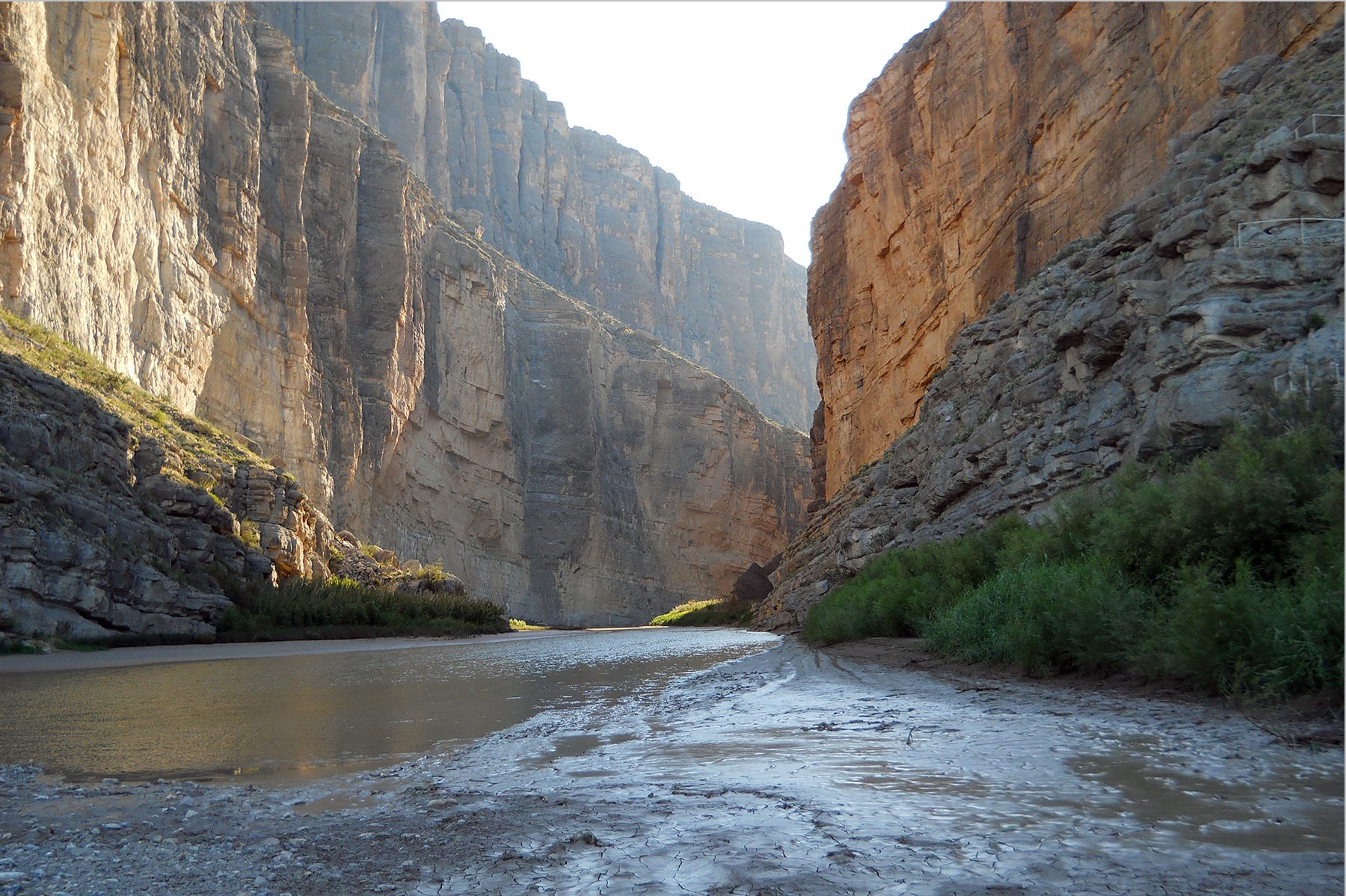
A person with insider knowledge has exclusively revealed to me details of the border “wall” being built in Big Bend National Park. There’s good news and bad here if you care about stuff like national parks and the responsible use of your money.
Plans for construction along Big Bend’s border with Mexico emerged in February, when former Secretary of Homeland Security Kristi Noem announced plans to waive 28 separate environmental and cultural protection laws in order to fast track the project.
Since that time, some limited plans for the project have been published, withdrawn and republished, often with conflicting details. Numerous outlets have speculated on what the project might entail. But we have not yet gotten authoritative information. That’s what I’ll lay out below.
But, it doesn’t look like the twists and turns in this story are yet over. While construction officially began on August 6, last night U.S. Customs and Border Protection Commissioner Rodney Scott announced he’s pausing the project temporarily.

CBP Commissioner Rodney Scott@CBPCommissioner
CBP is pausing all construction activity in Big Bend National Park while I visit and conduct a personal, on-the-ground evaluation. CBP is firmly committed to protecting America, and that includes our national treasures like Big Bend National Park (BBNP). We know the current and
4:53 PM · Aug 17, 2026 · 172K Views
221 Replies · 189 Reposts · 570 Likes
“CBP is pausing all construction activity in Big Bend National Park while I visit and conduct a personal, on-the-ground evaluation,” Scott stated on Twitter. “…over the next couple of days, I will join a small team to evaluate the terrain and listen to local leadership, community members and stakeholders to ensure that we secure our borders while simultaneously protecting BBNP for generations to come.”
Scott’s announcement appears to be in response to a letter Senator John Cornyn (R—Texas) wrote to the Department of Homeland Security on August 7, requesting the project be paused until stakeholders have a chance to review the final plans.
The project is drawing almost universal outcry from stakeholders in the region, no matter their political affiliation.
The project isn’t controversial just because it’s taking place in a national park. It’s controversial because it’s not necessary. Across the park’s entire 118-mile stretch of border with Mexico, the Customs and Border Patrol apprehended only 200 people in all of 2025, or 0.05 percent of total apprehensions along the entire United States-Mexico border.
And CBP itself acknowledges that number is actually decreasing. Across the entire 517-mile border sector in the wider Big Bend region, illegal crossings fell 74 percent between FY2023 and FY2025.
The reason why virtually no one tries to cross the border there is that the Big Bend area is very remote, especially on the Mexico side of the Rio Grande, where no roads cross the incredibly harsh Chihuahuan Desert all the way up to the river. That river then carves through a canyon that, in some places is 1,000-feet deep.
All of that represents a much more effective barrier than the 30-foot wall that’s been constructed in other segments of the border. Scott himself has referred to such an endeavor as “silly.”
Such a wall, along with its associated infrastructure, would also cause significant environmental harm to Big Bend’s intact ecosystems.
“A physical wall in the area would end up killing hundreds of mammals like deer, black bears, mountain lions, bobcats, and javelinas who just happen to find themselves in the United States when the wall goes up and lose access to a reliable source of drinking water,” explains Substack newsletter Our Public Lands and Waters.
Impacts to the park’s intact riparian habitat, and subsequent reductions in the area’s bird populations are another concern, as are any artificial light sources that may be installed. The park has the darkest measured skies in the entire lower 48, and its wider 15,000 square-mile region is a designated Dark Sky Reserve.
So what are they actually building? My source, who has asked to remain anonymous for fear of recrimination, explains that the $1.7 billion contract includes 232 miles of new road construction in the national park, along with infrared sensors. Those roads will run along the 118-mile long border the park shares with Mexico, and allow access to it.
That mileage will more than double the total mileage of paved roads inside the 1,252 square-mile park (an area larger than Rhode Island). It is not clear if any or all of them will be open to the public, or reserved strictly for CBP use.
Portions of that road intended for maintenance will be 12-feet wide and will be paved. Patrol roads will be paved 24-feet wide. The roads will feature occasional turnouts and similar features, that will extend its width in some areas.
Vehicle barriers are being added in areas where crossing the river could be conceivable.
No artificial light sources will be added at this time.
No physical “wall” will be built.
While construction of the road will still interrupt ecosystems that have otherwise remained undisturbed, these details reveal a project that is far from a worst case scenario. Yes, the construction itself will disturb plants and animals, and create a permanent scar through otherwise pristine areas of a national park. But, a simple two-lane paved road of the kind that is present elsewhere in Big Bend and most other national parks should not otherwise have an enormous impact on migrations, and even nightly animal movement patterns. The project is scheduled for completion sometime between August and December, 2028.
What about all those laws that got waived to get the project permitted? My source says that the contractor—a division of Kiewit, a massive construction conglomerate based in Omaha—is taking care to avoid any areas of particular value, employing two inspectors to walk ahead of the bulldozers to look out for any artifacts, nests, dens, or similar that may lie in their way.
To me, the problem with this project is found not in its footprint—again, still bad, but far from the damage that would have been caused by construction of an actual wall—but simply with the taxpayer money it’s wasting.
At $7.3 million per-mile, the money taxpayers are laying out for this project is far above the average cost of constructing a new, two-lane, paved road in a national park, which the Federal Lands Transportation Program pegs at $2 million/mile.
It’s also far higher than some other recent high profile examples of road construction in national parks. The first one of those to come to mind is the 5-mile road NPS built between the northern entrance to Yellowstone National Park in Gardiner, Montana and Mammoth Hot Springs, following the severe flooding in June, 2022 that wiped out the old access road. That was built along fresh, unimproved ground, up and over 1,000 feet of elevation, featuring numerous sharp curves protected by extensive guard rails. That project was completed in October that same year, and cost taxpayers $15 million. Just $3 million/mile.
Another way to look at it is in terms of cost-per-person. Spending $1.7 billion (the total cost being paid for construction, not the budget necessary to actually patrol, maintain, or operate the road once it’s built) in order to apprehend 200 people each year comes out to $8.5 million per-apprehension in the first year. Far higher than the $17,000 DHS says it spends on average to arrest, detain and deport an individual.
But perhaps the most relevant comparison is to the total cost the operation of the entire National Park Service has to taxpayers, which comes out to $3 billion annually.
While funding for the construction project was appropriated by last year’s One Big Beautiful Bill Act, and comes from cutting healthcare and food assistance to low-income Americans not from cuts to the park service, $1.7 billion would still be enough to re-hire every park ranger fired by the Trump administration to-date, then keep paying them for the next 28 years.
Top photo: NPS
A journalist with more than two decades of experience working around the world, Wes Siler is here to cut through the outrage and disinformation to bring you the factual, insightful, actionable reporting you need to understand what’s going on. Upgrading to a paid subscription supports this reporting, and buys personal access to Wes, who will help you save money on gear, plan outdoor adventures, and prepare for real life, and who promises he’s less salty in real life than he sometimes comes across as on the Internet.
National Park Service Maintenance Backlog Now Totals Over $35 Billion
·
Apr 22
Testifying in front of the House of Representatives on Monday, Secretary of the Interior Doug Burgum revealed that the maintenance backlog in national parks now totals over $35 billion. This is the first time we’ve gotten an estimate on the increase to the backlog caused by the Trump administration’s first year in office. The backlog stood at around $23 billion at the end of FY2024.
This Is Trump’s Plan To Sell National Parks
·
June 4, 2025
Late Friday night, the White House quietly released a 1,224 page appendix to its 2026 budget proposal. While budgets are written by Congress, not the President, it still provides a detailed look inside the executive branch’s plans and priorities. This one would effectively eliminate public lands funding provided by the Great American Outdoors Act, cut a further 5,518 full-time national park employees, reduce the budget for seasonal staff by half, and bring massive budget cuts to national monuments. What’s all this add up to? Obama’s Director of the National Park Service warns the Trump administration is preparing for a sale.
Here Comes The Greenwashing
·
Jun 11
A new, “Great American Outdoors Act 250” bill was just introduced in the House. It would reauthorize the expiring Legacy Restoration Fund at its current level—$1.9 billion annually—for the next five years. The problem is, the public lands maintenance backlog it’s intended to address is, according to recent testify by the interior secretary, expanding each year by at least ten times that amount.
Comments
Nothing yet. Say the first thing.
Sign in to join the conversation.