
The Hope is a small interactive ‘smart home’ touchscreen device, demonstrating an alternative approach to AI technologies that focuses on equitable and low-power use, supporting under-served communities, without tech companies and without indulging in the myth of ‘intelligence’. In short, it’s a form of AI that could serve social good, responsible deployment, and the rejection of the logics of algorithmic capitalism and exploitation that dominate the field today.
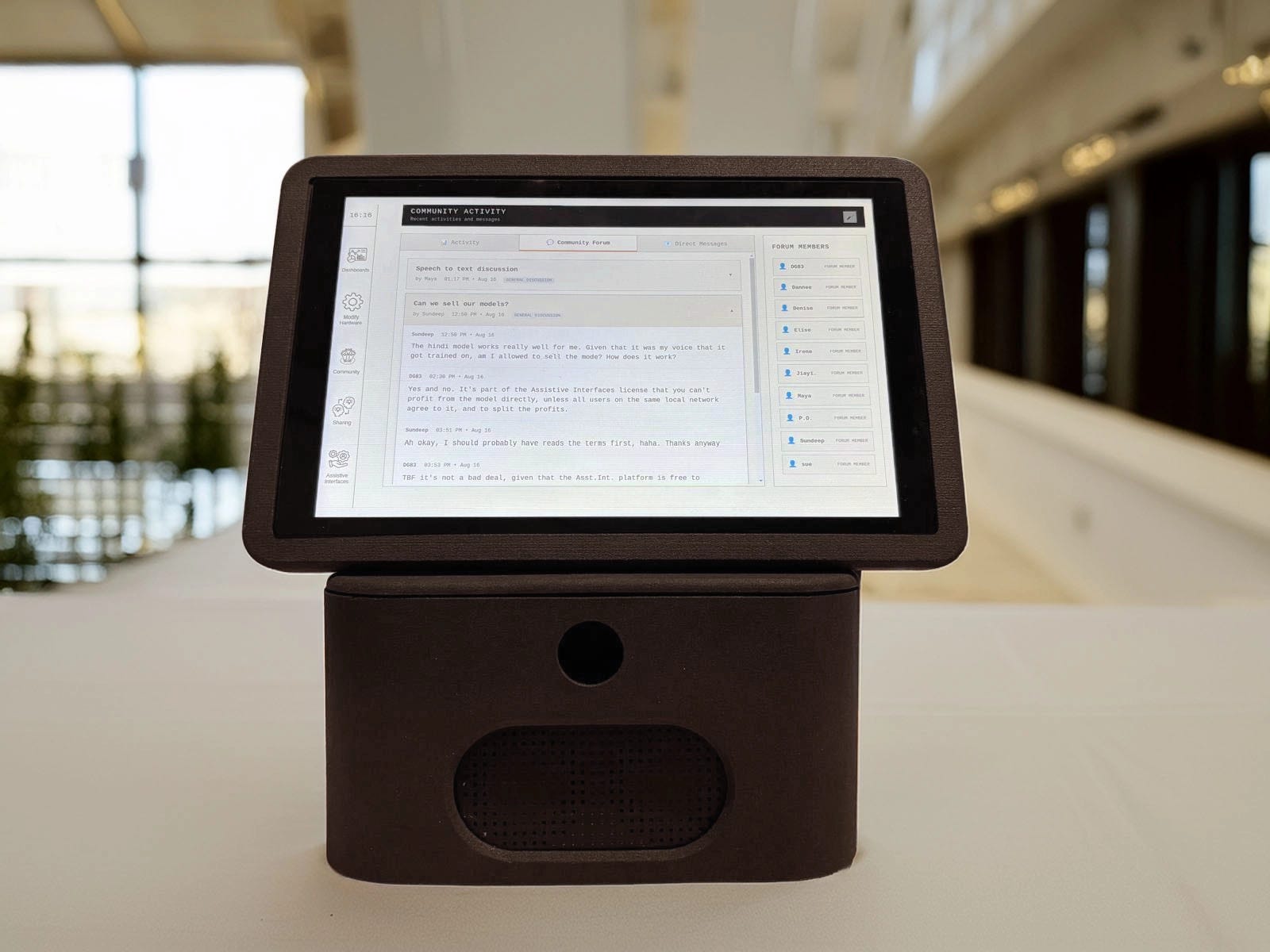
Here’s the wall text description from its exhibition at Edinburgh Festival 2025:
“The Hope is a speculative consumer device that proposes a new form of decentralised, non-exploitative, and low-carbon AI.
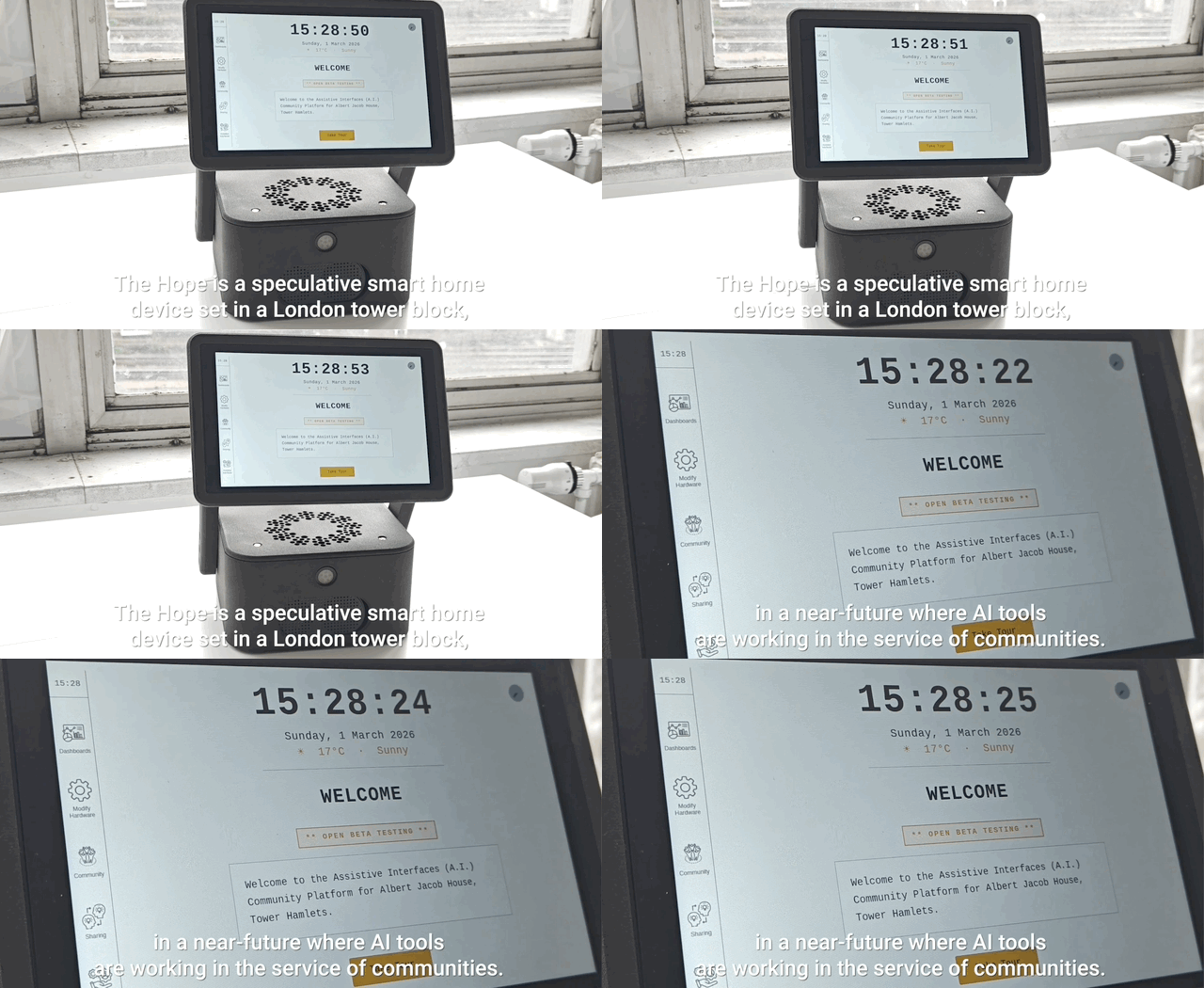
The device is set in a social housing tower block in London, whose residents have started to slowly adopt this low-cost, repairable, open-source device in their homes. It is an interactive ‘smart home’ hub that has been thoughtfully designed to assist the residents in their lives, with all the expected functions of a modern device: voice control, playing music, controlling connected devices, etc. However, the device has been designed to reject the extractive and exploitative practices of the modern tech sector, with everything running securely and privately on-device, using no AI data centers in its operation, on entirely open-source software, and with all functions emphasising low-power computing, carbon literacy, and responsible design.
Across the tower block the devices are linked together in a private mesh network, a decentralised digital community space that allows the residents to talk securely with each other and share data and files. They can also collaborate and share computing power to train new personalised LLMs and AI speech models that align with the residents’ own distinct dialects, languages, and everyday needs, completely autonomously from tech companies; a form of community-based AI sovereignty that rejects the cultural colonialism of the Global North’s tech sector.
Audiences interacting with The Hope can explore the fully-featured device through its custom OS, touch screen, and voice interface. They can interact with the simulated residents via the device’s community forum and direct message services, where the many characters share their thoughts about life with the tool, ask questions of each other, and have lively discussions. Through this, The Hope demonstrates how we already have the capacity to make a progressive form of AI for us and our communities, and that a better world is possible.”
This work was born out of what I feel is a mounting cultural need to articulate a different form of AI tools away from exploitive and extractive norms of the field today. Regular readers of this substack will be aware of my critiques of corporate generative AI tools, of the industry behind them, and how some artists and arts organisations engagements with these conditions enhance the power of these companies and their influence. In spite of this, I and many others in critical technology studies hold a fundamental position: that no technology is entirely good, entirely bad, or ever ‘neutral’, and that a technology’s moral or ethical dimension is not an immutable material feature, but is always defined by the intentions of the humans who design it and use it. I have always believed that there are no exceptions to this, which means that even generative AI must have a use-case or a form that is not exploitative and necrocapitalistic, even if that involves a complete re-think of its current state, how it is produced, and what it’s used for. This is where the name The Hope comes from; a desire to propose a better, achievable alternative to the systems we have around us today.
To make a ‘hopeful’ use of AI, the first thing I needed to do was address the term ‘AI’ itself. ‘Artificial Intelligence’ is such a poisonous phrase, fundamentally misrepresenting what these technologies are and do. It’s a term that’s filled with all the science fiction promises and expectations that are so eagerly exploited by the tech industry. Given this, I don’t think any speculative ethical use of these tools would use the term. Within the narrative of the work that plays out through interactions with The Hope, the technology behind it is instead referred to as an ‘Assistive Interface’ (or ‘AI’ for short). Instead of promising automation, it promises ‘assistance’ of labour, and instead of ‘intelligence’, it promises an interface, a tool, something used by us in our lives, and implies nothing more.
As part of its ‘hopeful’ and propositional nature, The Hope does not use Large Language Models or any traditional generative AI. I wanted this work to expand perception of the field of AI tools past mainstream LLMs and genAI, and to demonstrate a broader application of the underlying technologies. For example, the system has a ‘general query’ function, where the operator can ask general knowledge questions (an increasingly standard use case for chatbots), via the voice interface. Instead of using an LLM, whose response may or may not have any relationship to reality, the system uses a BERT encoder, which is a long-established form of Natural Language Understanding (NLU) system for parsing the intent of any request (i.e., estimating what the asker wants from their query). Once intent has been parsed (e.g. “How old is the Tower of Pisa?”), the answer is pulled from a locally-hosted version of Wikipedia, using the excellent wikipedia-api python wrapper. This returns the relevant part of the Wikipedia entry, which is then spoken via the system’s text to speech system. In effect, rather than querying a large language model, this interface queries Wikipedia and returns information directly from there; information which has been authored, edited, and maintained by countless human editors.
This function is an example of how the use cases of AI do not have to be bound to logics of exploitation and the myth of ‘machine intelligence’, and can offer us new ways of accessing the resources we already have around us, and have far more trust in than a probabilistic text generator masquerading as a beyond-human intelligence.
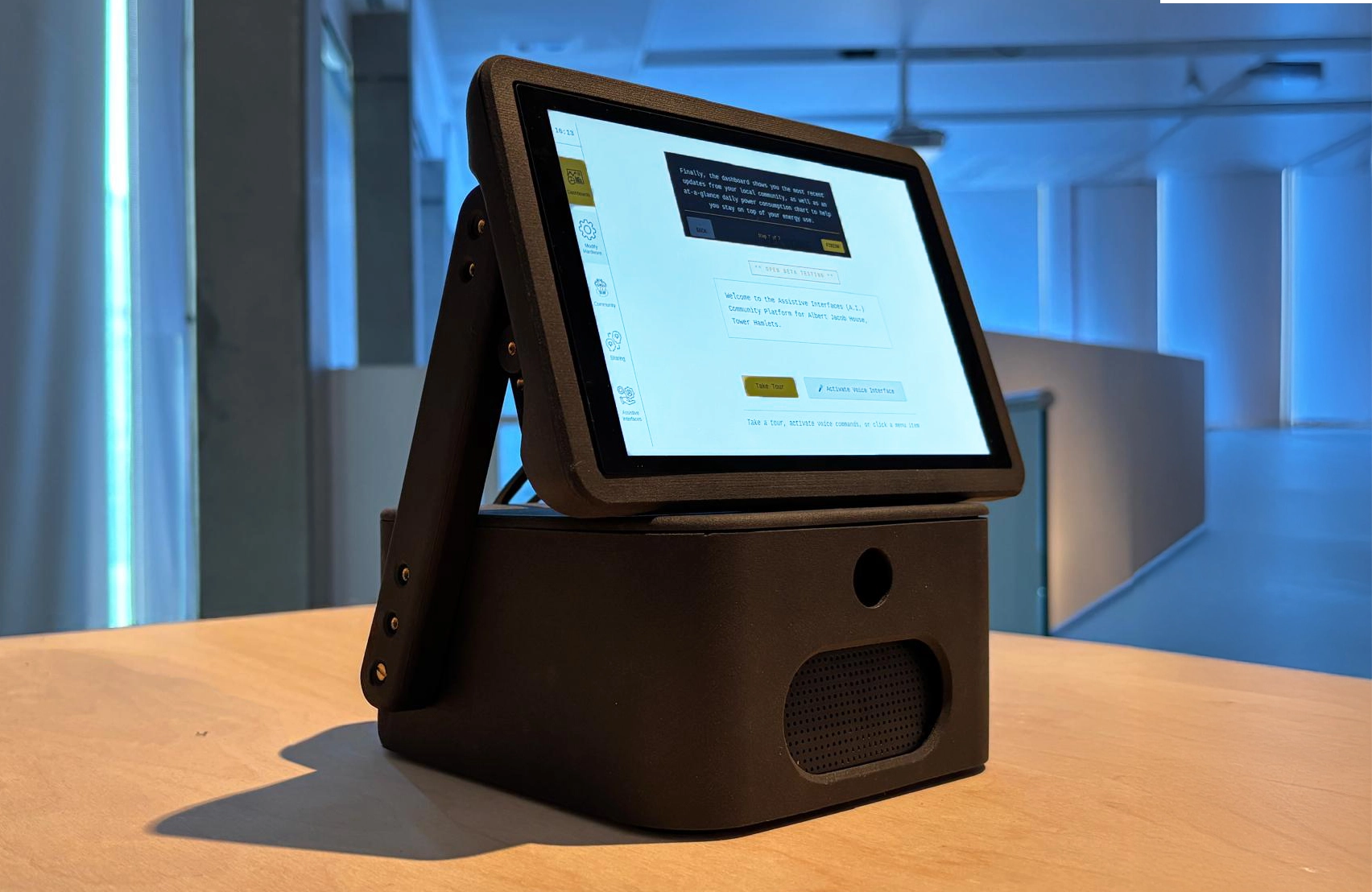
The device is a built around an 8” touch screen interface connected to a small mini-PC – these can be bought used for around £250, and have a pretty tiny form factor for the amount of compute power they have. The microphone is a Røde mini-shotgun mic (great for when you expect voice input to come from the direction the screen faces), and the speaker is the smallest formfactor USB speaker I could find, to keep the overall footprint of the device within the usual size of these kinds of ‘smart home’ devices. The design philosophy behind the 3D printed chassis centers on being modular, adaptable, and repairable, in contrast to the dominant extractive design trends of contemporary consumer electronics. It has exposed and accessible screws, components, and cables for easy repair and replacement, and is 3D printed from recycled nylon filament for a reduced carbon cost. One of the options on the device interface is the capacity to view and edit the print files for the device, allowing the owner to make decisions such as increasing the chassis size of the screen component to allow for larger, more accessible screens.
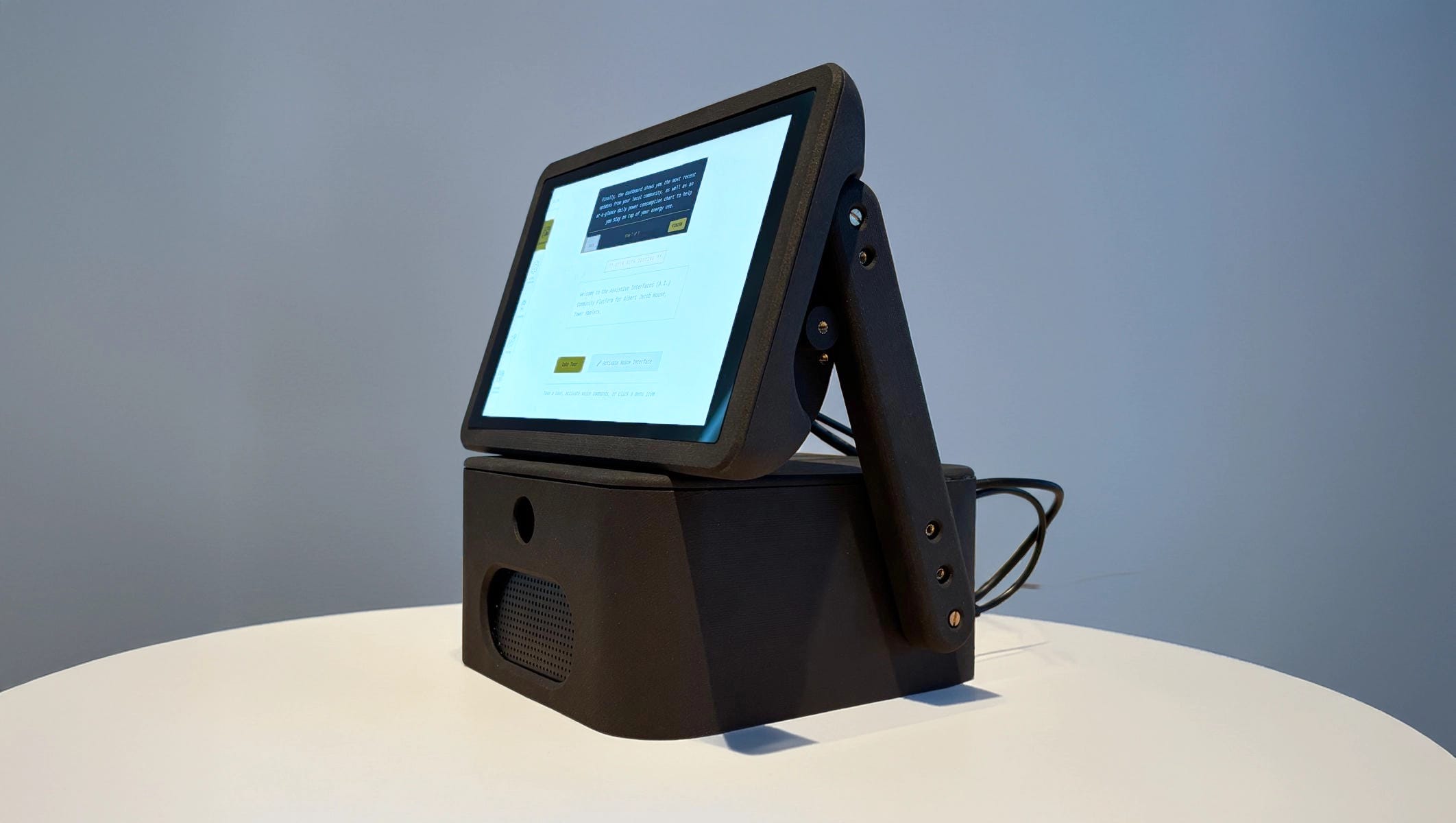
Running on the PC is a custom voice-to-voice interface (the pipeline is faster-whisper > distil-BERT > piper-tts), and a custom designed operating system and user interface written in python. Everything is locally-hosted, with all computational processes happening on-device, and there are no data center calls involved in the operation of The Hope. Unlike the other two works in this series, this device isn’t necessarily ‘voice first’: voice is just one of the interfaces offered (the other being the touch screen), and the device is designed to give the owner as much control over the mode of interaction to broaden accessibility as much as possible.
The interface uses the common visual language of apps and touchscreen navigation controls for an intuitive experience. A menu of apps on the left hand side of the screen shows the different features and functions the audience can explore, which are viewed in a main window on the screen. This was all written from scratch in python, and is designed to feel like a typical operating system, though one that works under very different logics than ‘normal’ consumer tech. For example, every function and app has a corresponding impact on the amount of power that the system is consuming. When any of those features are used, or their settings are changed, the system shows the corresponding impact on energy use, encouraging an attitude to computation that centers around responsible energy use in balance with performance.
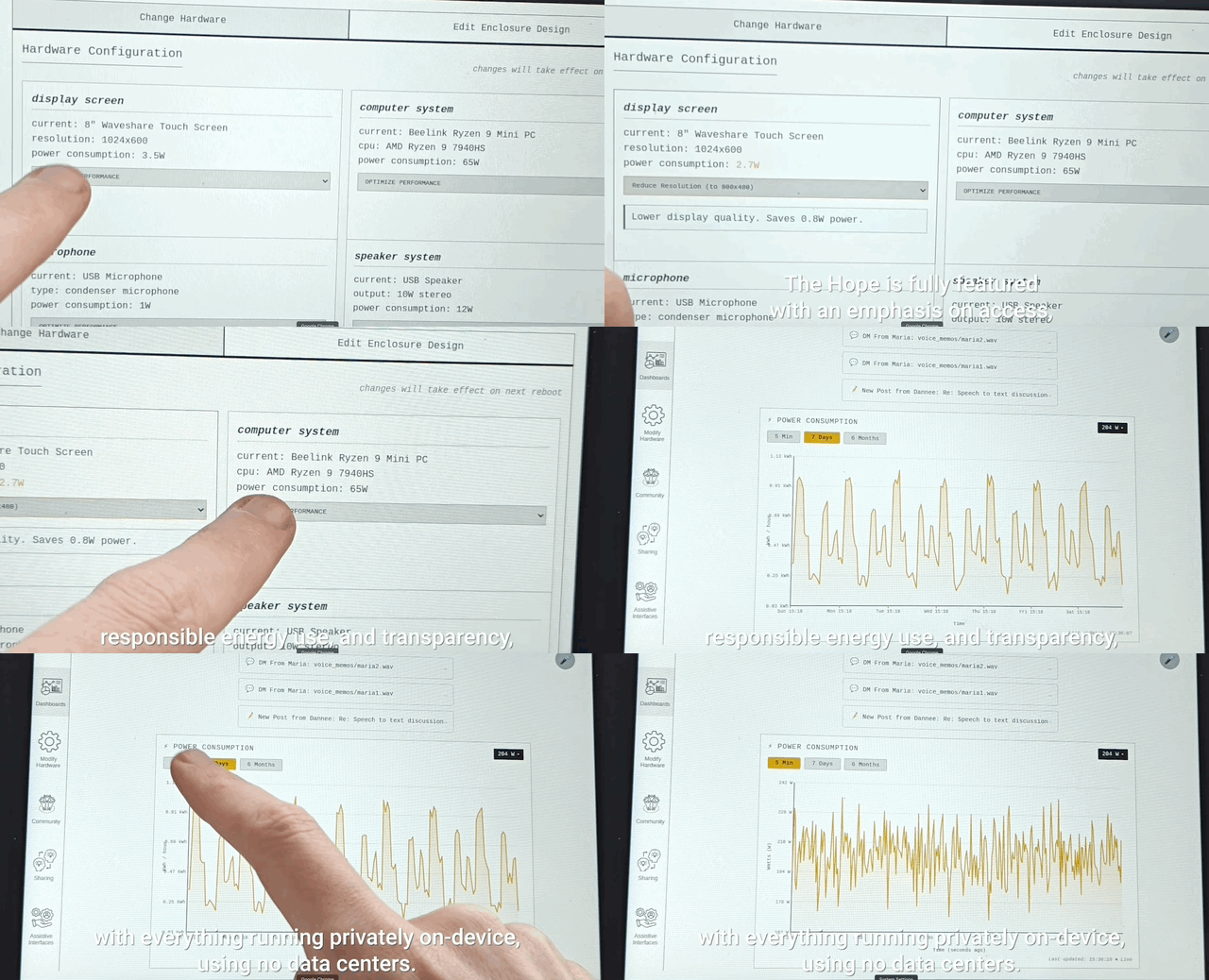
Audiences can freely explore the operating system on the device, browsing its functions and testing out its features. There is a simulated world on the device, with all the other residents of the tower block talking to each other, and to the audience, through the community forum and direct messaging system. These appear as ‘live’ messages and updates on the display, fleshing out the world of the device and showing how people are using it, discussing it, the parts of it they like, the ones they want to have improved….a healthy, communicative space. Obviously, none of the conversations across any of the 20+ different characters were written using generative AI, and each one has a name, a personality, and an investment in the ‘Assitive Interfaces’ platform and what happens on it.
As with the other works in this series, there is no linear narrative at play, and audiences are free to explore the device and be led by whichever features they are most interested by. The device is designed to feel as ‘real’ as possible, so there are a lot of features to experiment with: controlling the smart devices, exploring the voice interface, starting new distributed computing projects, and altering system settings like the system speech and voice languages (current languages include English, German, Hindi, and Brazilian Portuguese).
I’ve found the best approach in works like this is to add as much depth as possible to the world, so that anyone who really spends time with the device feels rewarded for that with extra ‘easter eggs’, little secrets, etc. The best case scenario as the author of such a work is that you put in so much that nobody gets to all of it, meaing that some of your hard work never actually finds an audience. It’s a fair price to pay, if you can give eben the most dedicated audience member the impression that the world is as full and detailed as reality is.
Open source software, 3D printing, voice interfaces, distributed computing, mesh networks, Wikipedia….these are all technologies and tools we have already, and have had for years. All that The Hope does is assemble them together in a single formation. My goal with this is to demonstrate that everyday computation can look very different, and more empowering than what we have now. Data sovereignty, safe and private online spaces for community discussion, and a sense of genuine ownership over the products in our homes are all things that would improve the lives of many.
For me, The Hope is also an attempt at materialising what a postcapitalist form of digital technology may look like; something that we can imagine being produced, and used, in a functional future after capitalism. This is not a perfect attempt, as all products under capitalism are stained with exploitation that is almost impossible to erase. But I’ve been thinking more and more about how being able to articulate something that would be such a vast transformation of the world and its logics should really start with these small vignettes; little isolated views that perhaps we can, over time, piece together to start to see a bigger picture that presents itself, and can be pursued. This is going to be a core concern of my speculative projects, moving forwards.
===
So, this closes these three posts on The Harbinger, The Horizon, and The Hope. Producing all three of them took up the majority of my time last year, so I’m glad to have this space to talk about these works at depth. Thanks for joining me in it.
Updates:
To see The Hope in action, the video documentation of it can be found here:
Comments
Nothing yet. Say the first thing.
Sign in to join the conversation.