
0:00
-1:26
“When the water shortages hit, it forced the shutdown of the data centers that the AI systems were run on. It was such an energy-intensive industry that the average-sized data center used as much water in a day as an average-sized town, all just to keep the huge server stacks cool. You might have expected that they’d be shut down sooner, before the great water crisis really took hold, and before the water conflicts. But there was still a lot of faith left that somehow AI was going to solve the water crisis, and the rest of the climate emergency, despite its huge energy cost and the fact that the AI companies had been working with the fossil fuel industry for years. But though the companies did eventually shut the data centers down, they didn’t do it all at once, and the order of events said a lot about the state of the world at that point.”
Excerpt from ‘The Slow Death of A.I. in the Age of Permacrisis’ from the collection Newly Forgotten Technologies: Stories From AI-Free Futures.
Image: landing page for the CCC wesbite, designed by Mariana Marangoni
The founding of the CCC is driven by the era of ‘Post-Abundance’ that we have entered, with the breaking down of supply chains, energy price rises, global conflicts, and climate effects all impacting resource availability and cost. Computation is one of the key sites for this impact, via supply chain disruptions that have repeatedly decreased component availability against a background of increased demand and higher price per compute. As well as a site of impact, computation is itself one of the drivers for these crises when the energy use of AI training and cloud computing now dwarves the kWh usage of multiple countries combined and is increasing, semiconductor production is widely seen as an emerging trigger of major conflicts and the next technological arms race, and computational e-waste is blighting landscapes throughout the Global South causing long-term impact on communities and landscapes.
As creative practitioners and researchers, we have an opportunity and responsibility in this moment to articulate the complexity of what is happening and what is to come, and to demonstrate through our practices how change can and should happen. From its beginnings as a novelty, digital arts is now a mainstream field and a set of practices that permeates many forms of traditional and emerging art and design. At this time, when many digital practitioners are embracing computationally consumptive tools such as generative AI, there is a risk that digital art will become history’s most consumptive art practice at the absolute worst point in history for this to happen. In response to these conditions, the CCC was founded to articulate what ideas like de-growth communism could means in a digital arts context, and how we re-think ‘progress’ aside from consumptive computational and technological advances.
The practices we are developing focus on carbon and technological literacy around computational systems and their uses, promoting uses of them in arts and design practice that modify, hack, or employ these tools in ways that reduce consumption, minimise waste, and engage with their hidden functionalities to propose mindful and critically reflexive engagements with them. This practice does not simply argue for an abandonment of computational tools in our practice, as there is no manufactured art material that can be said to be free of the original sin of extractive capitalism. It also does not abandon technology, because the CCC members have all chosen to be digital practitioners. The provocations, potentials, and affordances of digital technologies are what inform our creativity and define our practices. We don’t want to abandon this conflict, we want to stay with the trouble.
We want to foster practices that acknowledge the climate crisis as a hyperobject that intersects with many forms of disempowerment and injustice around the world, allowing for a wide range of social, racial, and economic justices to be understood in relation to the climatic. This facilitates an interdisciplinary approach to the research of the CCC, tying it into other critical projects adjacent to climate and technology, such as decolonialism, critical technology studies, critical race studies, and algorithmic justice.
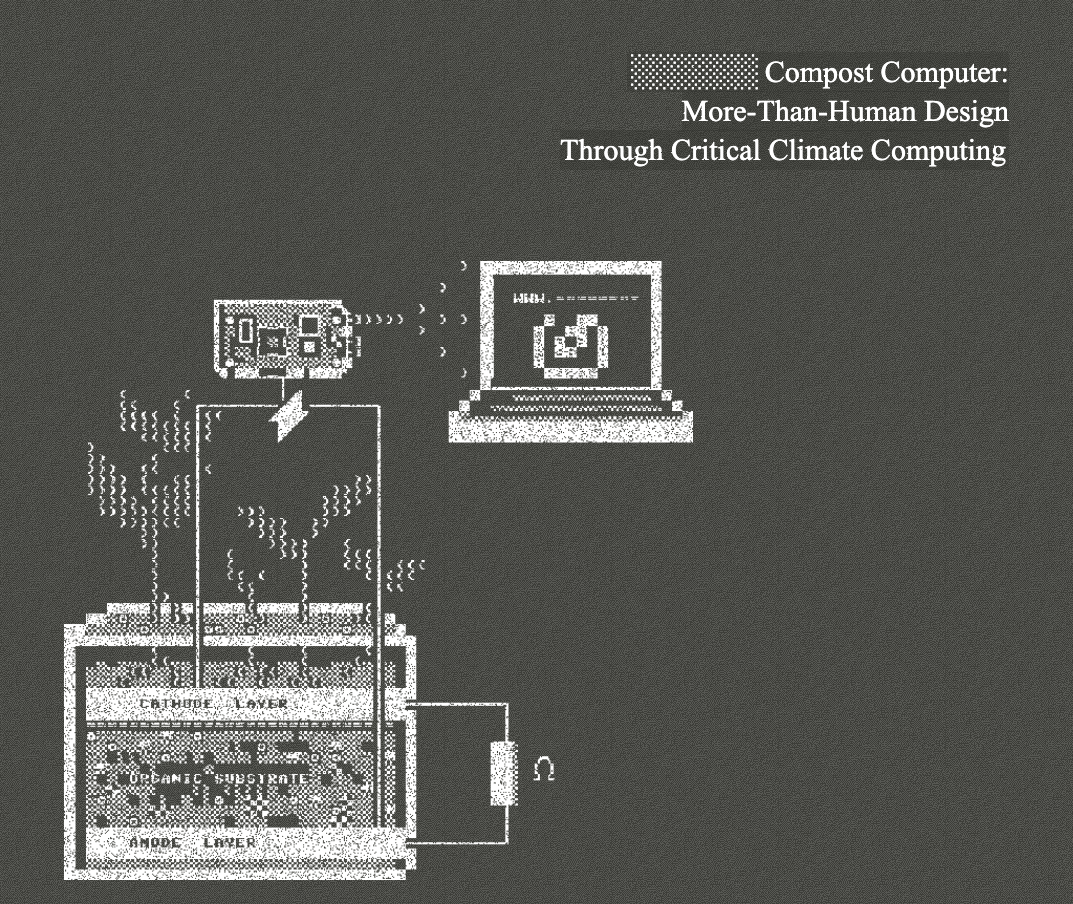
Image: a representation of the Compost Computer project, by Mariana Marangoni.
Our first public project has just launched, funded through the UKRI, AHRC, and the Design Museum’s Future Observatory program, and it’s titled ‘Compost Computer: More-Than-Human Design Through Critical Climate Computing’. In collaboration with Manchester-based urban growing collectives MUD and Sow the City and the long-running arts and culture festival FutureEverything, we’re building a biomatter-powered low-cost webserver, fueled by the latent electrical energy of the compost produced by MUD. On this webserver we’ll be hosting a reimagined version of FutureEverything’s website, whose design will be steered by some of the new research being developed in CCC member Mariana Marangoni’s PhD, in collaboration with the CCC’s Shinji Toya. This design will focus on low-carbon approaches to webdesign, reducing computational load, bypassing data center architectures, and experimenting with new graphical formats and protocols to create a form of web design minimalism informed by the climate crisis and the changes it demands.
The guides for how to develop the server hardware as well as the website itself will be made freely available to all when the website launches in September 2025. In the meantime, we have more projects in development with the Critical Climate Computing group (including public events in London and elsewhere) as it grows and evolves.
Comments
Nothing yet. Say the first thing.
Sign in to join the conversation.