
Every household has a shadow budget. Not just the money in the account, but the invisible ledger of who worries, who remembers, who pays, who delays, who asks, who sacrifices, who leads, and who quietly absorbs consequences when plans fail.
Modern life pushes large social failures down into small groups. Housing, childcare, medical debt, elder care, unreliable work, loneliness, and scarcity are not merely abstract political concepts. In reality they manifest as household arguments, text threads, overdraft fees, resentment, burnout, and human beings trying to be generous and loving without going under.
VZNA (pronounced ‘viz-nah’) version 1 is a working prototype for small groups that want to coordinate shared money and shared burdens more consciously. It lets a household, family, crew, or small community divide money into visible vessels, propose changes, react with consent or concern, and gradually form a shared picture of what the group thinks should happen next.
The interface is a Discord group chat. The back end ledger is a Google Sheets file populated daily by a secure third party plugin. VZNA itself connects the two, performs the math, records in the ledger and reports in the chat, where it stays and listens for the human feedback that group decisions are made of.

We humans get along fine without a budget of any kind, much less a democratic one, as long as the group remains small, highly aligned, and without an excess of stressors. But when times get tough, or when another level comes into reach, these informal systems can break down, collapsing under the weight of built up resentment.
Not all of what we identify as personal, interpersonal or even political conflict is really structural failure, but the results of our experiments indicate that much of it may indeed be. When we follow a certain set of rules for long enough we begin to take them for granted and stop seeing how they guide our behavior.
VZNA is not built on the fantasy that everyone will agree. It assumes people will disagree. So it intentionally gamifies disagreement, making it visible, collaborative, and mutually respectful.
Any member can propose that money be moved or made available for a particular thing, and anyone else can respond to a proposal using the following emoji:
👍 Consent means “I can live with this / I support this.”
👎 Dissent means “I have concerns.”
✊ Blocking means “I think this crosses a serious line for the group.”
✋ Unblocking means “I think the concern has been answered enough to move forward.”
A block is not a tantrum or a personal veto. It is a flare. It says, ‘slow down, something here may damage trust.’
This technology is not trying to replace love, trust, judgment, or conversation. It is trying to give those things a better economic foundation on which we to build.
VZNA uses a variation on the ‘envelope’ method of budgeting, where certain ‘vessels’ are maintained by the group. Each vessel is represented by an emoji.
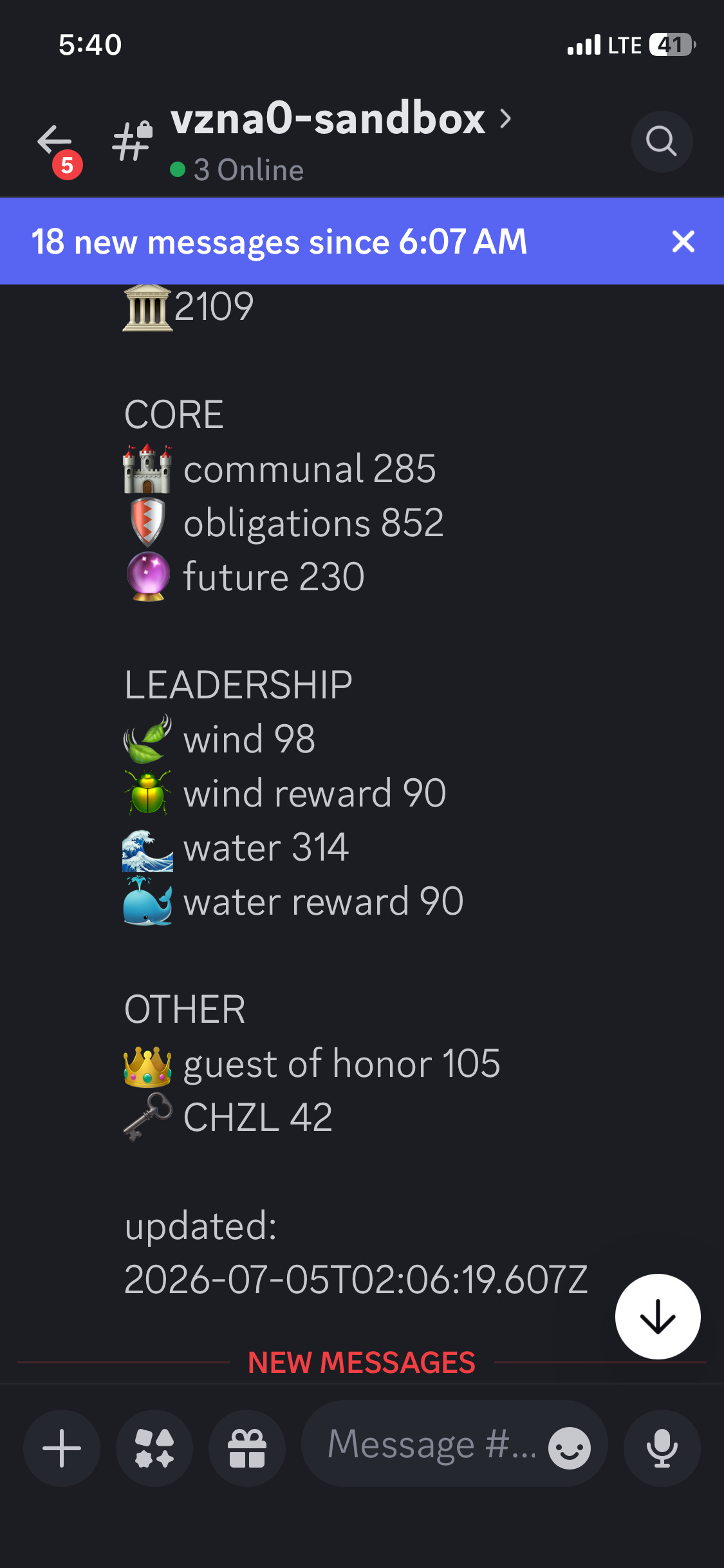
A vessel is a place where money has a purpose. Rent, food, future needs, dependent care, leader work, rewards, community projects, or whatever the group needs to see clearly.
VZNA v1 uses emojis because they make the system easier to read quickly, but the deeper point is not the emoji. The deeper point is that shared purposes become visible.
VZNA maintains a daily, collectively editable report of vessel balances called the ‘melior.’
The melior is the group’s current best shared allocation. It is not one person’s budget. It is not a majority’s domination. It is closer to an average of everyone’s perspective about where shared resources should go.
The mean averages numbers. The melior averages human priorities under real constraints.
Instead of one person silently moving money around, changes can be proposed in the shared channel: move this much here, fund this need, support this leader, cover this obligation.
VZNA turns hidden financial decisions into visible social objects.
VZNA also assumes that leadership is real work. Someone notices problems, checks timing, explains the plan, carries emotional weight, and helps the group move. That work should not be invisible.
At the same time, VZNA does not assume leaders should be trusted blindly. Leadership rewards and leadership working funds remain visible to the group.
Some people belong to the moral life of a group without being able to participate fully in its budgeting process: children, dependent elders, people who need care. VZNA v1 includes a dependent-care vessel called Guest of Honor to keep those responsibilities visible.
VZNA v1 also includes a suggested donation vessel for CHZL, the tech collective building and maintaining the system. People can ignore it, fund it, or use it as an invitation to participate in the wider project.
VZNA is not a bank. It is not a cryptocurrency. It is not a command economy. It is not a replacement for friendship, marriage, parenting, politics, unions, or mutual aid. It is not a promise that better software fixes broken trust.
It is a protocol for making shared burdens visible enough that people can talk about them before they become explosions.
Imagine four adults sharing a household. Rent is due, groceries are rising, one person has been doing most of the childcare, another has been coordinating repairs, and everyone vaguely agrees that they should save for emergencies. Without a system, these pressures become scattered conversations and private resentments.
In VZNA, the group can see vessels for obligations, communal needs, future needs, dependent care, and leadership. Someone can propose funding obligations first. Someone else can dissent because groceries are too low. Another person can block a leader reward if they think the group is rewarding coordination while ignoring care. The point is not that the software decides who is right. The point is that the burden becomes visible enough for the group to respond.
VZNA starts with households and small groups because that is where consequences are easiest to see. If a system cannot help five people coordinate rent, care, food, savings, and leadership, it has no business pretending it can fix a city, a union, or a country.
The ambition may be larger, but the test has to begin where reality talks back quickly.
Right now, VZNA v1 is testing whether small groups can use a shared allocation protocol to reduce confusion, surface disagreement earlier, reward real coordination, and make burdens less lonely.
VZNA v1 is not the whole answer. It is a tool for one layer of the problem: the layer where money, care, obligation, leadership, and trust meet in ordinary life.
We are building it because the burdens are already shared. The question is whether they can become visible, governable, and lighter.
No posts
Comments
Nothing yet. Say the first thing.
Sign in to join the conversation.