
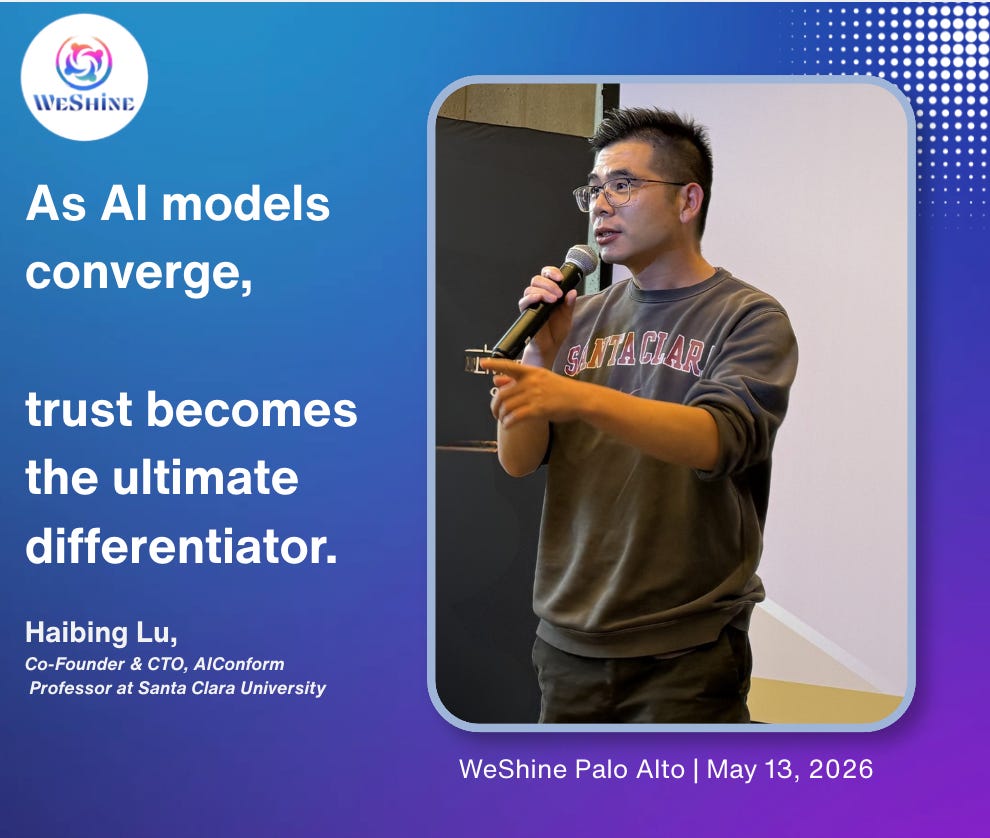
At WeShine’s May 13 event in Palo Alto, we were honored to welcome Haibing Lu, Co-Founder & CTO of AIConform and Professor at Santa Clara University, as a keynote speaker.
Haibing works at the intersection of AI research, enterprise adoption, and regulatory compliance. Through his work at AIConform, he helps organizations build reliable, scalable, and trustworthy AI systems while navigating an increasingly complex regulatory landscape. His keynote addressed one of the most debated questions in AI today:
A few months ago, Haibing publicly stated that Claude had established a meaningful lead over ChatGPT. Since then, the landscape has shifted again. OpenAI’s latest releases have pushed ChatGPT back to the top of many rankings, while Google continues to improve Gemini and introduce new capabilities.
Yet for Haibing, the more interesting observation was not which model occupies the top position. It was how quickly those positions change.
Every few months, a new release reshuffles the leaderboard, making it increasingly difficult for any single provider to maintain a lasting advantage.
“The difference is minimal. Going forward, chatbots will become commodities.”
His point was not that model quality no longer matters. Rather, as foundation models continue to improve, the performance gap between leading systems is becoming increasingly narrow. Leadership positions may change several times within a year, making it difficult for any single provider to maintain a lasting advantage based on model performance alone.
This shift has important implications for founders, investors, and enterprises.
For the past two years, much of the AI conversation has focused on models themselves. Which model is smarter? Which model is faster? Which model is leading the benchmarks?
But as capabilities converge, the competitive landscape may begin to look very different.
According to Haibing, long-term differentiation is increasingly moving beyond the model and toward the ecosystem built around it. The companies that succeed will not necessarily be those with the highest benchmark scores, but those that can integrate AI into products, workflows, and business operations in ways that create measurable value.
Several themes emerged throughout the discussion:
Foundation models are becoming increasingly interchangeable for many use cases.
Workflow integration matters more than benchmark leadership.
Enterprise trust is becoming a major competitive advantage.
Compliance and governance are evolving into product requirements rather than optional features.
Customer adoption ultimately matters more than technical superiority.
“What really matters is the ecosystem. How the model can be integrated into workflows. How it can win the trust of clients.”
One of the most compelling parts of the discussion focused on enterprise adoption.
Consumer AI and enterprise AI often operate under different rules. Individual users may prioritize convenience and performance, but enterprises must also consider security, governance, compliance, and operational risk.
This becomes particularly important in highly regulated industries such as healthcare, financial services, insurance, and legal services. In these environments, organizations are not simply evaluating model capabilities. They are evaluating whether a solution can be trusted.
As Haibing noted, trust increasingly influences purchasing decisions. The model itself may be powerful, but enterprise customers also need confidence that their data is protected, their systems remain compliant, and potential risks are properly managed.
In this sense, trust is no longer merely a brand attribute. It is becoming part of the product.
Haibing also discussed the growing importance of AI governance and regulation, an area where he has significant experience through both academia and industry.
The challenge facing many startups is straightforward. Regulations continue to evolve around the world, while technology advances much faster than policymakers can respond. Founders want to focus on building products and acquiring customers, yet they must also navigate a growing set of compliance requirements.
The reality is that many enterprise customers now expect vendors to demonstrate responsible AI practices, risk management processes, and governance frameworks before large-scale adoption can occur.
For that reason, compliance is increasingly moving from the legal department into the product roadmap.
Companies that address these concerns early may find themselves better positioned as enterprise adoption accelerates. In other words, compliance is increasingly moving from a legal consideration to a business capability.
Perhaps the most important insight from the evening was that technology alone does not create value. Adoption does.
The most powerful model does not automatically become the most successful business. Customers rarely purchase AI because a benchmark score improved by a few percentage points. They adopt solutions because those solutions help them solve problems, improve efficiency, reduce risk, or generate measurable business outcomes.
As AI continues moving from experimentation into production environments, adoption may become the metric that matters most.
The companies that earn trust, integrate seamlessly into existing workflows, and deliver consistent value are likely to build stronger and more durable businesses than those relying solely on technical leadership.
The competition among foundation models will continue. New releases will reshape rankings, new capabilities will emerge, and debates over model quality are unlikely to disappear.
However, Haibing encouraged the audience to focus on a broader picture.
As AI matures, the next generation of winners may not be defined by model performance alone. They may be defined by their ability to build trusted ecosystems, navigate compliance requirements, integrate into enterprise workflows, and drive real-world adoption.
In other words, the future of AI may not be decided by who builds the best model.
In other words, the future of AI may not be decided by who builds the best model. It may be decided by who builds the strongest ecosystem around it.
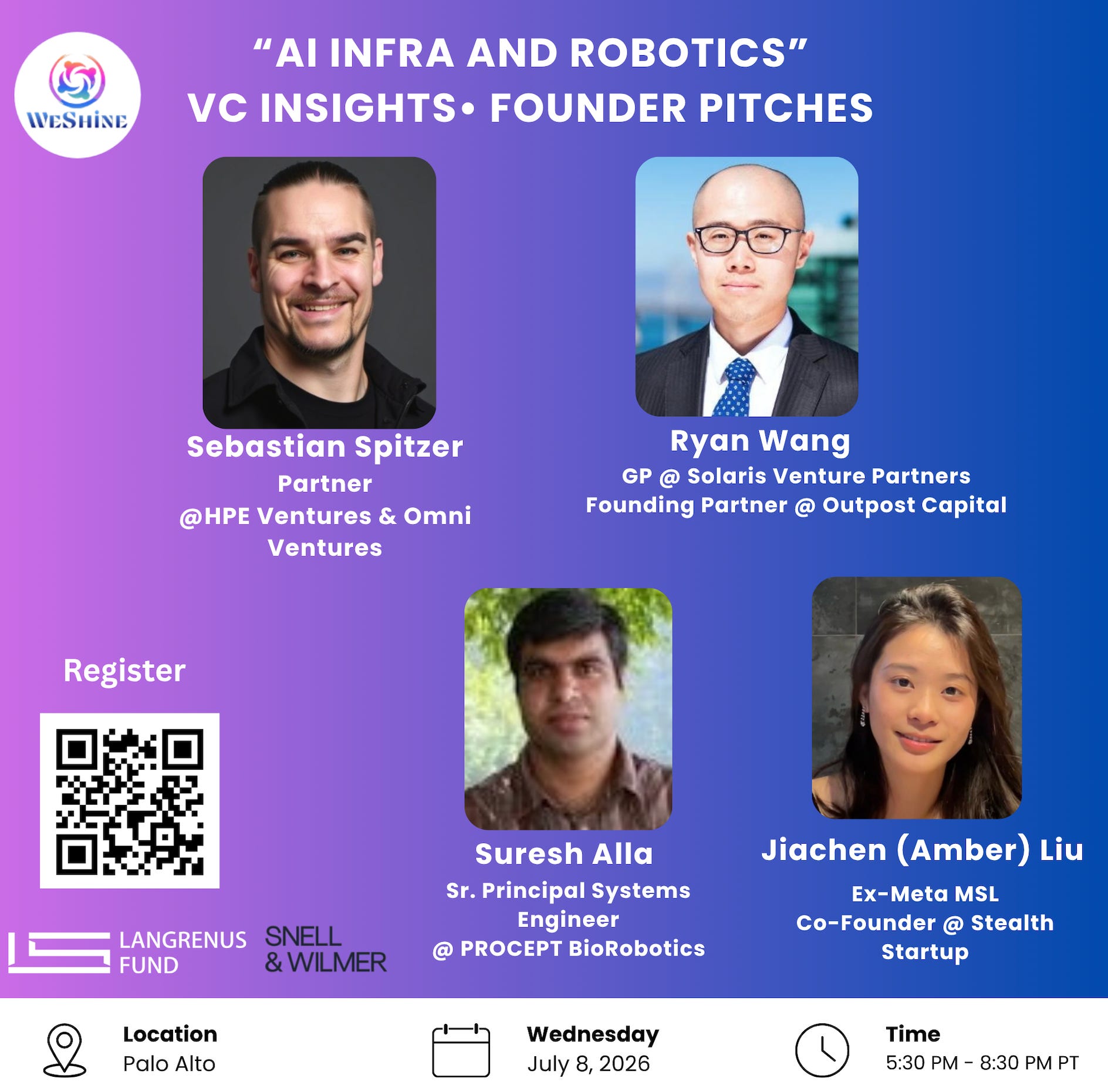
Haibing’s discussion highlighted a broader shift taking place across the AI industry. As foundation models become increasingly capable and accessible, attention is moving beyond model performance toward infrastructure, trust, governance, enterprise adoption, and real-world applications.
These themes will continue at our upcoming WeShine event in Palo Alto, where investors, founders, scientists, engineers, and technology leaders will explore the future of AI infrastructure, robotics, and emerging technologies.
📅 July 8, 2026
🕠 5:30 PM – 8:30 PM
📍 5 Palo Alto Square, Palo Alto
Sebastian Spitzer Venture Partner, HPE & Omni Ventures
Startup Advisor, Operator, and Investor
Ryan Wang General Partner, Solaris Venture Partners
Topic: Global Mindset in Venture
Venture insights on AI, robotics, and frontier technologies
Panel discussion featuring investors, founders, legal experts, and industry leaders
Startup pitch showcase with live investor feedback
Networking with entrepreneurs, VCs, scientists, and technology professionals
Panelists include leaders from Solaris Venture Partners, Omni Ventures, PROCEPT BioRobotics, Snell & Wilmer, and emerging AI startups.
Selected startups will have the opportunity to present directly to investors and receive feedback from experienced investors and industry experts.
📩 Pitch Deck Submission Deadline: July 3
🎟 Event Registration:
https://luma.com/ifupn00h
📩 Pitch Application:
https://forms.gle/YhtzhjAN34KQQ6hr6
Follow WeShine on LinkedIn for real-time updates, founder resources, and community announcements.
We shine together ✨
— The WeShine Team
Located in Silicon Valley, WeShine is a nonprofit driving innovation and supporting entrepreneurs. We connect founders, technologists, investors, and industry experts to turn ideas into impactful realities. Through online seminars, meetups, incubation programs, talent initiatives, and global startup events, we provide the resources and networks entrepreneurs need to grow. Join us and be part of a community where visions shine brighter.
No posts
Comments
Nothing yet. Say the first thing.
Sign in to join the conversation.