
Yesterday I preached at St. Martin’s Episcopal Church in Houston, Texas. My text was John 3:1-17. Sometimes I find the lectionary’s artificial cutoffs strange (the passage actually continues through verse 21), but in this case it made me think harder and, I hope, more fruitfully about an effective way to conclude.
Here is what I preached:
+In the Name of the Father, the Son, and the Holy Spirit, Amen.
One great Christian preacher has famously said that the church season of Advent “begins in the dark and moves toward the light.” We might say the same thing about the season of Lent.
As I was working on this sermon a couple of mornings ago, I took my dog out. While I waited for him to do his business, there was no trace of sunrise yet, and patches of snow still covered much of my backyard. Although you’re obviously closer to it here in Houston than I am in Michigan, spring has not yet fully sprung. We are still in the time of dark mornings and early sunsets, waiting for more light.
And that is where our Gospel reading this morning begins: in the dark. “There was a Pharisee named Nicodemus, a leader of the Jews. He came to Jesus by night.” This is the start of one of the vivid conversational scenes for which the Gospel of John is famous.
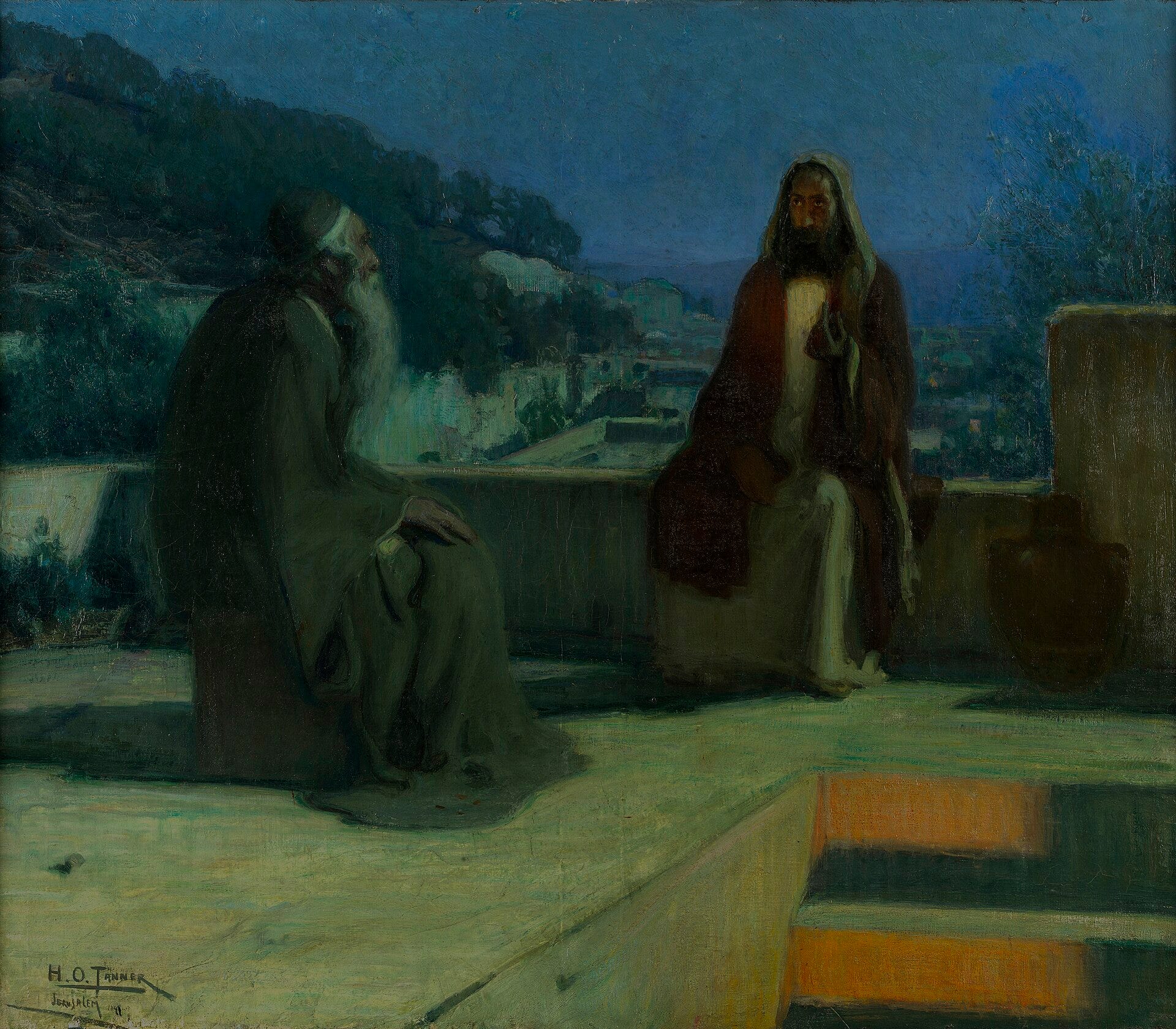
Just before Nicodemus appears, the narrator tells us: “When [Jesus] was in Jerusalem during the Passover festival, many believed in his name because they saw the signs that he was doing. But Jesus on his part would not entrust himself to them.” There is an excited buzz around Jesus — he is performing miracles, like changing water into wine at a wedding feast — but, to Jesus, the hubbub is not the same thing as genuine faith. People may say they believe in him, but not all supposed “belief” is authentic trust. As one scholar has paraphrased it, “Many believed in his name when they saw the signs that he did; but Jesus did not believe in them.”
So Nicodemus, having heard the excited rumors, comes to Jesus at night, probably out of fear of being seen visiting Jesus in broad daylight. (As the narrator says later in this Gospel, “[M]any, even of the authorities, believed in [Jesus]. But because of the Pharisees they did not confess it, for fear that they would be put out of the synagogue.”) Nicodemus comes to Jesus in the dark with an instinct to believe, but he is hesitant. He starts with an encouraging affirmation when he says: “Rabbi, we know that you are a teacher who has come from God, for no one can do these signs that you do unless God is with that person.” But even this affirmation reflects his lack of understanding. St. Thomas Aquinas comments: “He says what is true, but he does not affirm enough.”
In response, Jesus probes. Testing Nicodemus’ desire to understand rightly, he says, “Very truly, I tell you, no one can see the kingdom of God without being born from above.”
Here we have an instance of Jesus saying something cryptic which is then misunderstood, which becomes a trope in the Gospel of John. Jesus uses a word that can be translated into English in several different ways. He talks about being “born from above,” and that phrase “from above” could also be understood as “born again” or “born anew,” which is how Nicodemus interprets it, quite literally: “How can anyone be born after having grown old? Can one enter a second time into the mother’s womb and be born?”
This is one of those places where we see the artistry of this Gospel narrator. He has staged a conversation between Jesus and Nicodemus that turns on an ironic confusion. We might think of a play like Oscar Wilde’s The Importance of Being Earnest in which a character named Jack wants to marry a woman named Gwendolen. He has been pretending that his name is Ernest. In one scene, Gwendolen says to him, “[M]y ideal has always been to love some one of the name of Ernest. There is something in that name that inspires absolute confidence. The moment [I first heard you were] called Ernest, I knew I was destined to love you.” The joke is that the audience hears the word as the character quality (“earnest”), not the proper name (“Ernest”), and wonders: Is this character “Ernest” actually earnest, sincere, genuine? That’s the kind of thing the Gospel of John is doing with its audience. Jesus says, “You must be born from above,” but what Nicodemus hears is, “You must be born a second time.” He has misunderstood what Jesus means. He is still groping around in the dark, ignorant of what Jesus wants him to know.
In other words, Nicodemus is like you and me — maybe especially during this season of Lent. We too are still in the dark. Since we’re here in church this morning, we probably have some inkling of who Jesus is, and hopefully we also want to love and trust him. Maybe we made a commitment on Ash Wednesday to fast from something so that we can try to come closer to Jesus in some way. But a lot of us are also unsure about him. What does he want from us? Who can we trust him to be for us? And what might he do if we disappoint him or fail to measure up in some way? Not long ago, I was talking with a lifelong Episcopalian about Jesus, and she told me, “I love God, and I trust Mary, but I’ve never known quite what to do with Jesus.” She was Nicodemus when she said that. I am Nicodemus. And you are too. Who really is Jesus to us? Is he good? Is he trustworthy?
One of my regular practices each year during Lent is to read a book about the life of Jesus. This year I’m reading Romano Guardini’s classic The Lord. I’d like to share with you a brief portion of it:
Often, naively, we imagine [spiritual] illumination… as a fixed thing, as though [we] had only to behold, once, in order to know without wavering forever after; as though once gripped by the Spirit, [we] stood fast for all time. In reality… life is shaken by all storms and saddled with all weaknesses. At times the Spirit hoists [us] far above the heights of human accomplishment or being… At other times, the Spirit drops [us], and back [we plunge] headlong into darkness.
Guardini is writing here about John the Baptist languishing in prison with doubts about whether Jesus, whom he had baptized, really is the Messiah. But he might just as well have been writing about Nicodemus — or about us. We waver, we falter, we misunderstand. We too are in darkness.
So Jesus presses on. In spite of Nicodemus’ confusion, he says:
Very truly, I tell you, no one can enter the kingdom of God without being born of water and Spirit. What is born of the flesh is flesh, and what is born of the Spirit is spirit. Do not be astonished that I said to you, “You must be born from above.” The wind blows where it chooses, and you hear the sound of it, but you do not know where it comes from or where it goes. So it is with everyone who is born of the Spirit.
In other words, says Jesus, “No, you don’t have to figure out a way to make yourself a fetus again so you can literally be reborn. Your mother’s water has already broken once. What you need is a rebirth from above, from the womb of God’s Spirit. God’s Spirit is a heavenly wind that gives you insight and awareness you couldn’t otherwise have. That’s what you really need.”
And it’s here that Jesus comes to the heart of what he wants Nicodemus to grasp. “When you have spiritual rebirth,” he says in effect, “you will come to truly understand me.”
To truly understand Jesus is to see the ultimate reason why he appeared: “[J]ust as Moses lifted up the serpent in the wilderness, so must the Son of Man be lifted up, that whoever believes in him may have eternal life.”
You may remember that in the Old Testament, when the Israelites in the wilderness were being attacked by venomous snakes, God told Moses to sculpt a bronze serpent and hoist it up on a pole so that any poisoned Israelites who looked toward that sculpture could be healed. In the same way, Jesus says, he is about to be hoisted up on a pole — the cross — so that any sinner who looks toward him can be forgiven and saved.
And then he says, in some of the most justly famous words in the whole Bible,
For God so loved the world that he gave his only Son, so that everyone who believes in him may not perish but may have eternal life. Indeed, God did not send the Son into the world to condemn the world but in order that the world might be saved through him.
This is what Nicodemus most needs to understand. Which means it is what you and I most need to understand.
The secret clue to who Jesus is and why he came is the cross. God loved the world — and that term, “the world,” in John’s Gospel means the whole human family which has actively rejected and rebelled against God — God loved this hostile, wayward world in such a way that he willingly gave his Son Jesus up to death so that anyone and everyone in the world who trusts him is reconciled to God — forgiven, redeemed, restored, given hope, made new, reborn.
We are a week-and-a-half into Lent now, friends. It may be that you are tempted to experience God, in the words of Nancy Mairs, as “the God of the Gotcha.” God is waiting to find fault with you, to catch you breaking one of your Lenten promises. But Jesus says otherwise to Nicodemus. God is not out to condemn us. God is out to save us. And the cross of Christ, the ultimate clue to who he is and why he came and to the character of the Father who sent him, is the proof. In the words of another apostle, “God proves his love for us in that while we still were sinners Christ died for us.”
So as we with Nicodemus come to Jesus in the dark, let’s pay attention to this ray of dawning light: Jesus was lifted up on the cross so that we can be born from above, brought by God’s Spirit to realize that God’s intention toward us is love — proven, unbreakable, triumphant love.
As Jesus says later in this Gospel, “I am the light of the world.” And as the Gospel writer himself declares, “The light shines in the darkness, and the darkness did not overtake it.”
Amen.
No posts
Comments
Nothing yet. Say the first thing.
Sign in to join the conversation.