
The past few weeks have been hectic. In mid-May, I left my cabin in the woods to return my seasonal job with the Appalachian Trail Conservancy. I prepared the Monson A.T. Visitor Center for its opening May 30, while in my off hours I worked on my final paper for an online course I was completing. On the final weekend of the month, I opened the center to the public and guided my first mindful nature walk of the season, for a local women’s retreat group.
This is all work I love, but to get it done, I cut back farther than I should on my sleep. And there have been some unwelcome surprises along the way.
Just as I was moving back to town, I discovered that carpenter ants had moved in to my cabin. Not content with carving homes in the trunks of aging firs, they had taken up residence in my walls and begun to reproduce, sending out winged emissaries that alerted me to their presence. Dealing with a carpenter ant infestation is not a job for amateurs. Get it wrong, and your home may suffer major structural damage. I was fortunate to find a professional technician able to make the trip to my cabin “way out in the williwags.” But effective carpenter ant treatment is not cheap.
At the same time, I learned that my sixteen-year-old Subaru required unexpected repairs – though I suppose no repair is really unexpected for a vehicle that age. It was another hit to my carefully planned budget.
These are very small problems compared to what many people in the world are facing now, and compared to more serious health and family issues I myself have faced in the past. And yet, I think we all know how an accumulation of minor stressors can take a toll on our well-being. What I’m most grateful for, at times like these, are moments of natural grace that reconnect me to a deeper, more fundamental reality.
My usual days off are Tuesday and Wednesday. I often head back to my cabin. A couple of weeks ago, I used Tuesday to tackle some long-delayed outdoor chores. Usually, I’m a firm believer in the saying that “a bad day in the woods is better than a good day anywhere else.” But on this particular day, the black flies were out in force. The females saw me as the blood meal that would enable them to lay eggs, giving rise to even more flies. I try to remind myself that these annoying critters are part of the ecosystem, and that they are vital food for the birds that I love. But that doesn’t help much when they’re getting into my hair, my eyes, and my ears, seeking every available patch of exposed skin and opening in my clothing.
By the time I finished my chores, it was close to sunset, but the clouds were so thick that I thought there would be little color. I was smeared with blood and squashed black flies, so I decided a bath was my first priority. I had pumped water earlier in the day to fill the pails and pots in my cabin. I heated a pot of water on my propane stove. I lathered up with Dr. Bronner’s biodegradable soap and, just outside my porch door, emptied the pot over my head to rinse myself. The water was almost but not quite too hot. It felt wonderful.
Then I headed down to the lake for a quick dip – and I was surprised by unanticipated wonders. The gray clouds hanging low in the west were tinged with pink. Streaks of lavender, apricot, and gold glowed in a gap above the horizon. I stood with my legs submerged in the still-cold water, transfixed by light and sound.
A male Swainson’s thrush sang in the woods on the point just ahead, his melody spiraling upward. Like his cousin the hermit thrush, his voice was flutelike, rich with internal harmony. To my ears, the Swainson’s sounds a bit raspier than the hermit, less ethereal, more earthy, but nonetheless beautiful in his own way.
A loon’s eldritch wail drifted toward me over the water, passed me, then echoed off the shoreline trees behind. In my wetland, spring peepers were starting their whooping nocturnal chorus.
I would have lingered longer, but I realized my legs were starting to go numb. I screwed up my courage and dunked my head under the water. It was cold enough that, on the second dunk, my scalp muscles started to spasm. I headed back to the warmth of my cabin, feeling cleansed in a way a conventional shower could never match.
My days off tend to be busier than I’d like. The next day, I had a midmorning Zoom meeting. But I had a bit of time outdoors beforehand. I wanted to eat breakfast outside, but what to do about the black flies? I put on my rubber boots and carried a folding chair and small table down to the lake, past the treeline and into the shallow water just beyond. There, a light breeze deterred flying pests.
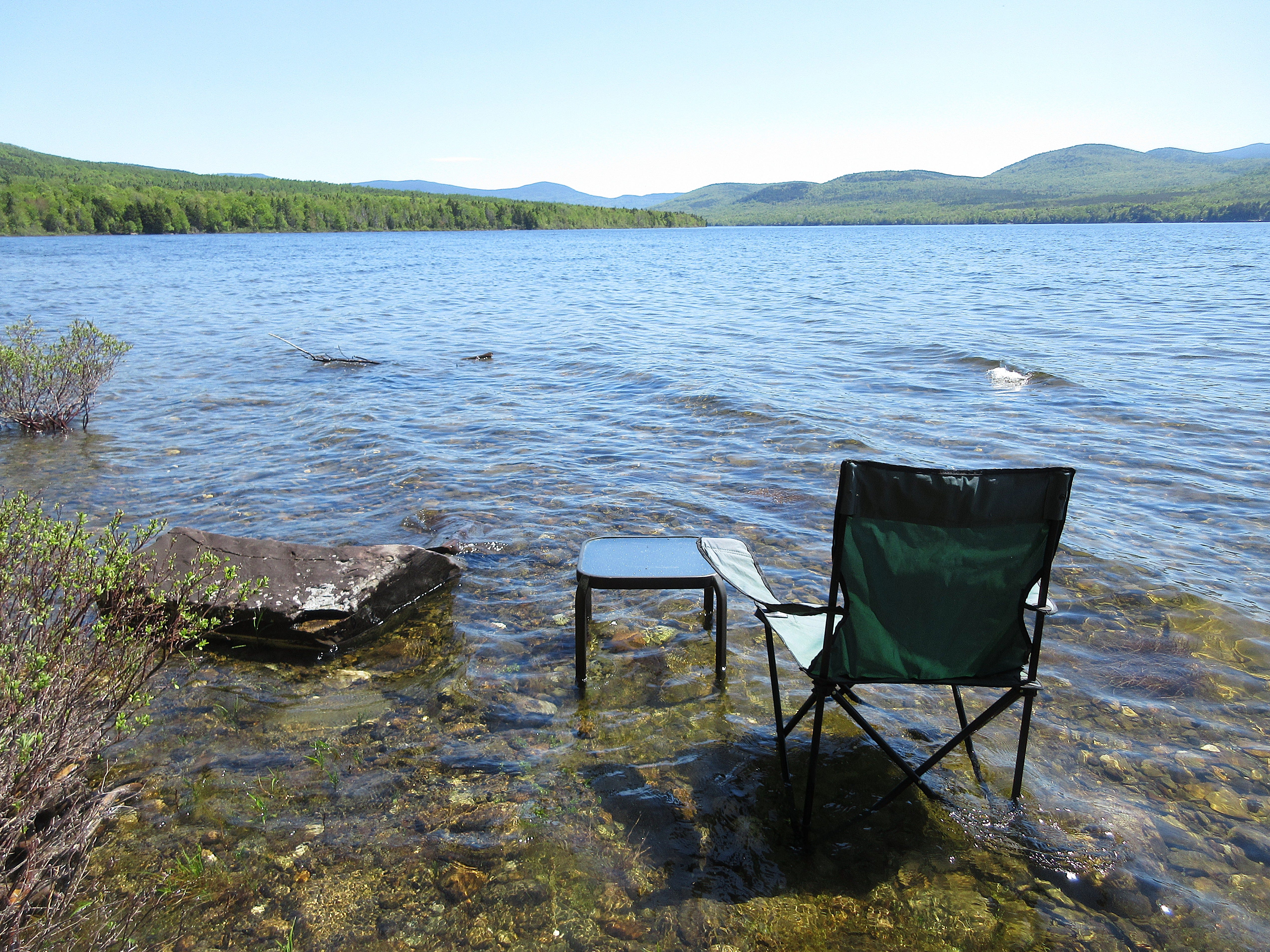
What a spot to dine! My surroundings offered nourishment that went far beyond the bacon and eggs on my plate. Water lapped and sloshed and splashed against the shore. Waves of golden light rippled across the bottom of the lake; blue sky reflected off its surface.
The leaves of trees growing along the shore and up the mountain slopes were multiple shades of luminous green. The foliage of red maples was still a bit rusty, adding a touch of variety to spring’s palette, foreshadowing fall colors. A stripe of yellow pollen at waterline on a rock showed the intensity of the trees’ reproductive efforts.
On my skin, the cool touch of the breeze balanced the warmth of the sun. As I sat there basking, three ring-billed gulls flew by, uttering harsh cries.
My world seemed made of air and light and water: alive, kinetic, vibrant. I breathed out carbon dioxide; the trees on the shore took it in, then with water and the sun’s bright energy, transformed it into fresh oxygen for me to breathe. With each inhale and exhale, I affirmed my interconnection with the forest around me.
This week, my time at my cabin was shorter, but I found my moment of grace on Wednesday evening. About 9:45 PM, I walked a path edged with bunchberry – a dwarf dogwood – its creamy white flowers standing out in the twilight. It led me to a small cove along the edge of my wetland. The last fading embers of sunset, a dull smoky orange, smoldered just above the northwestern horizon.
Higher in the darkening sky hung a waxing crescent moon, with the outline of the full moon faintly visible: in the words of old-time sailors, immortalized by Coleridge, “the new moon with the old moon in her arms.” Earthshine – sunlight reflected off the Earth – was illuminating the darker part of the lunar disk that the sun’s rays couldn’t reach directly. Next to the moon, Venus shone like a brilliant diamond. The moon and Venus cast slender lines of silver light onto the water by my feet. Jupiter glowed more softly, a bit lower in the sky and farther north.
The spring peepers were silent, perhaps done with mating for the year. Their eggs were no doubt incubating nearby. But I heard other frog voices: slow trills voiced by gray treefrogs and the green frog’s distinctive twangs.
I carried away a sense of Earth as an ark, cradling my life and the lives of my fellow creatures in a vast cosmos.
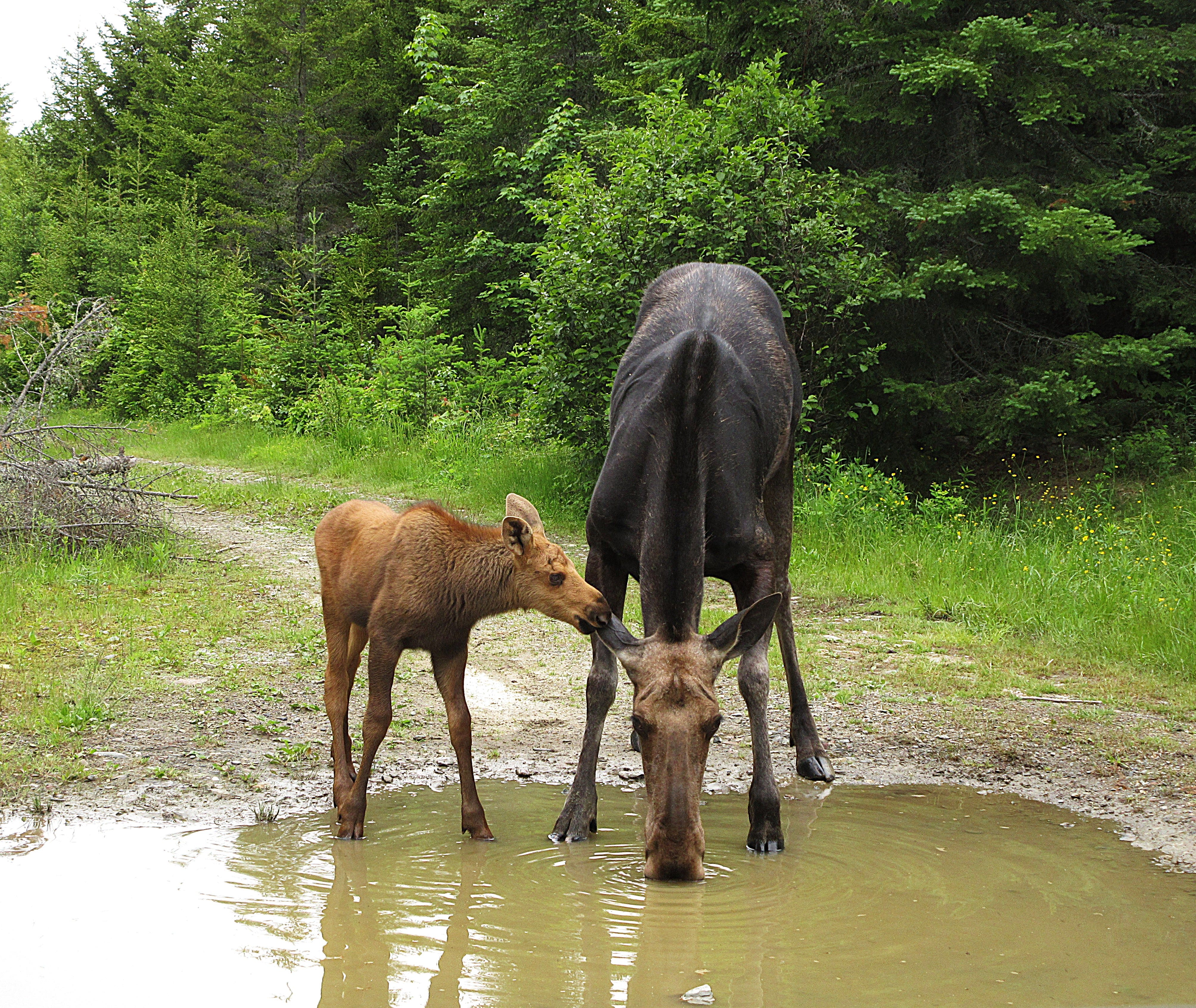
Early Thursday, I drove back to my work in Monson. As I rounded a bend in the road, I came upon a cow moose and her calf, just a few weeks old. I paused to watch as Mom drank from a roadside puddle. It looked as though the calf might want to follow her example, but didn’t quite know how to coordinate its body to do so. The calf stayed close to Mom, gently nuzzling her ear in a way that suggested a deep bond between them. I felt privileged to share this intimate moment in their lives, an unlooked-for gift during my morning commute.
Our human world is often hectic and chaotic. These quiet moments of connection with nature remind me of my place in a web of life that extends far beyond my own species. They rest my soul and renew my strength for the onward journey. They are a lifeline, as essential to my spirit as oxygen, water, and food to my body.
I’m blessed to live in a region with an abundance of wild woods and waters. But urban and suburban greenspaces also provide ample opportunities for natural connection. The three major Eastern cities where I’ve studied or worked – Washington, DC, New York City, and Boston – all offer meaningful access to nature via public transportation.
I trace the roots of my own bond with the natural world to a small, nameless creek near my childhood home in a suburban Maryland subdivision, just seven miles from the Washington, DC border. Thoreau’s famed cabin on Walden Pond was about a half-hour’s walk from the center of Concord, Massachusetts, and only twenty miles from Boston.
Wherever you may live, I encourage you to take a walk on the wild side, in search of your own moments of grace.
Come join me at the twentieth annual Thoreau-Wabanaki Festival! On the morning of July 22, I’ll partner with Professor Charles Stang, Director of the Center for the Study of World Religions at Harvard Divinity School, in a session on the Spiritual Essence of the North Woods. I’ll lead a mindful walk at Lily Bay State Park, followed by a presentation on Thoreau and Transcendentalism by Professor Stang. For more information, go to https://thoreauwabanaki.org/2026-schedule-of-events/.
No posts
Comments
Nothing yet. Say the first thing.
Sign in to join the conversation.