
You’re at a family gathering. As usual, small chattering groups have formed, scattered around the house.
You walk past a few of them. You hear “ChatGPT” come up a few times — not to your surprise. These days, it feels like everyone and their mother is talking about ChatGPT.
Then, someone mentions “Claude”, which makes your eyebrows lift a little in delight — good to know there are people who’ve gone a bit beyond the surface. You stop to join that group.
The topic moves from vibe-coding related complaints to “but it’s still amazing what it can do, you know?” to someone declaring, “And it all started with that legendary All You Need is Attention paper. Such geniuses to have figured that out.”
Many in the group — including yourself — nod in recognition, with some chuckles sprinkled in. A brief moment of appreciative silence follows.
Then your uncle clears his throat. “I’m still new to this stuff. What is this attention that we need?”
Someone laughs, “Oh, no, it’s not the attention we need. It’s about the tokens paying attention to each other. That’s how the magic happens!”
“I don’t understand what you just said.”
“That’s the best way I can explain it. But don’t feel bad, many people can’t get it.”
“Can someone dumb it down for me? Or describe the process?” Your uncle looks around the circle for an answer, starting from his left, moving from one person to the next… until it stops at you.
You regret both standing beside him and nodding earlier.
It’s not that you don’t know what attention is — you do! But the words just aren’t coming to you. So you say the most glaring words that showed up, “Well, attention is— you know, a kind of technique that makes the tokens look at each other… so that the LLM can predict the next token.”
Your uncle is silent for a bit. Maybe your explanation hit home for him—
“Nope. Still don’t get it,” he says. “And it sounds like none of you do.”
Note: The above is entirely imaginary, and not based on real people or events. Really.
Unfortunately, your imaginary uncle’s conclusion might apply even to people working in AI companies.
I didn’t know this until a brave soul, Sofía, bared it all in her article “I work in AI and I’m scared”.
When I started at Freepik as a copywriter three years ago, I didn’t know the first thing about machine learning. I still don’t, to be honest. I can explain how a diffusion model works to a certain degree, but that’s about it. I don’t understand the technical architecture behind Veo 3. I couldn’t tell you what a transformer is beyond the general concept (even though I’ve REALLY tried).
And for the longest time, that terrified me – because how could I credibly lead strategy for an AI company when I didn’t understand the fundamental technology driving everything we built?
And then…
Here’s the thing nobody says out loud: everybody’s faking it
I’ve sat in meetings where someone asks “wait... what’s an LLM?” like they just arrived late to a party where everyone’s already three drinks deep. Instead of anyone admitting they Googled it that second -just to double check their suspicions-, someone will say “it’s large language model, like claude”, then everyone nods and moves on.
Firstly, good news (or bad?) to Sofía — not everyone is faking it.
There are people who actually do know the LLM architecture well. One only needs to browse AI discussions on Discord servers (e.g., Machine Learning Street Talk) to see that.
And it’s not impossible for non-technical people to learn what goes on under the hood of LLMs. It just becomes unnecessarily hard when you start by diving straight into jargon-and-math-heavy papers.
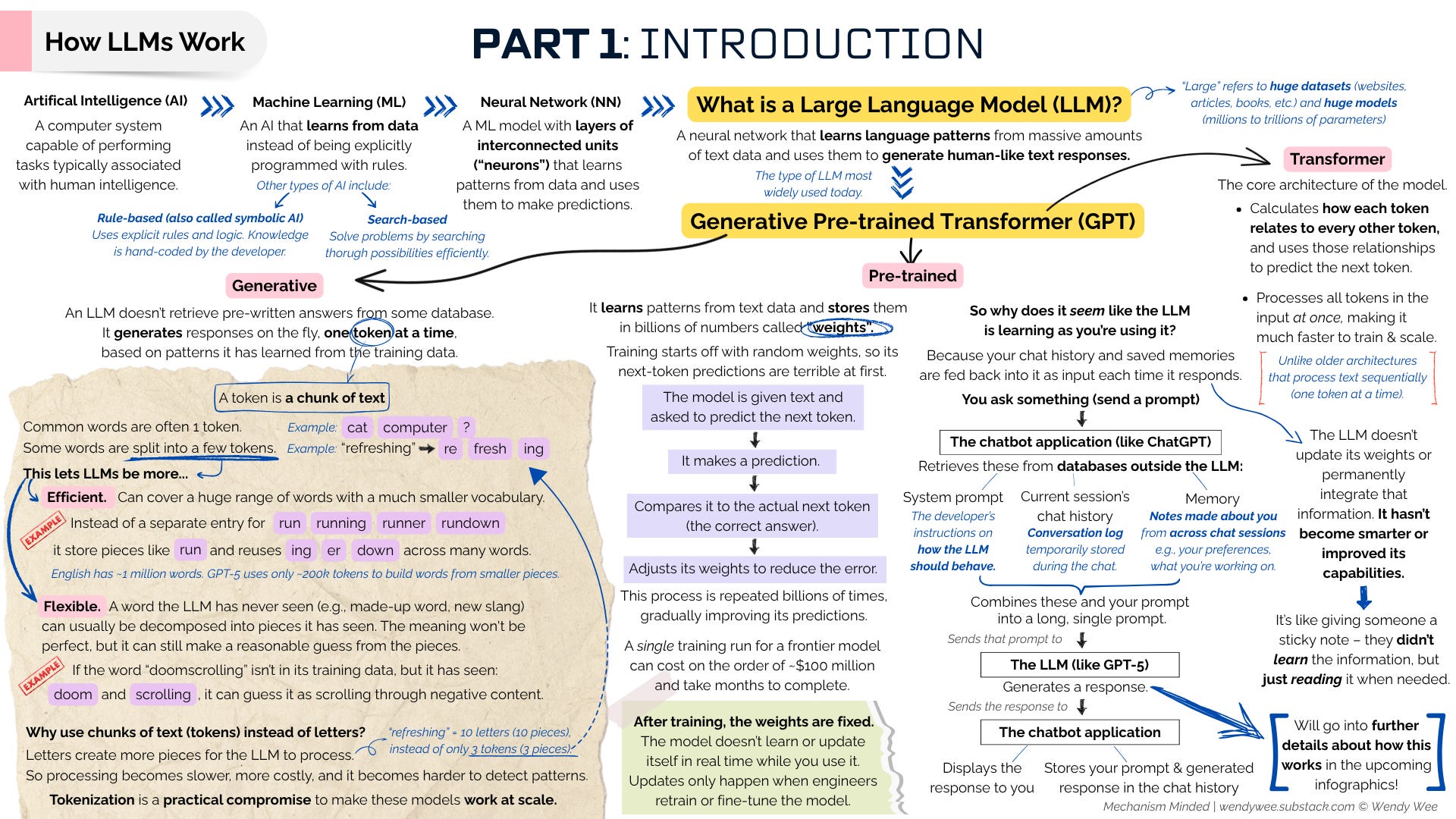
So here’s an attempt to make things a bit more intuitive — a four-part infographic series covering the basic mechanics of how LLMs work. Each part will be released weekly.
How LLMs work
Part 1: Introduction
Part 2: Entering the LLM space
Part 3: Transformer in action
Part 4: Generating the response
This week, we’ll start with some general basics, such as what “tokens” and “GPT” even are.
We’ll also be busting the misconception that LLMs are learning and becoming smarter while you’re chatting with them “because they’re AI” and “isn’t that what AIs do — always learning and improving?”
Next week, we’ll explore the high-dimensional space of an LLM — and what happens when the tokens enter it!
Comments
Nothing yet. Say the first thing.
Sign in to join the conversation.