
Hello, I’m Wendy Pratt; author and poet. I wrote a memoir, The Ghost Lake, about my experience of living on an ancient extinct glacial lake called Paleolake Flixton in North Yorkshire, and how I found my place in a long line of lake ancestry going back to the palaeolithic. I also wrote a poetry collection, Blackbird Singing at Dusk, a kind of sister project to the memoir.
I want to offer a gentle content warning. This post is about the experience of writing poetry about loss, specifically a poem I wrote about losing my dad. In this post I talk about death in a hospital setting.
My dad was a strange and wonderful person. He could be very giving, sometimes he could be quite controlling, he was quite shy and he was also the life and soul of the party. He liked exploring and travel and doing things his own way, no matter what. He is missed.
The poem I’m about to share with you is about the strange limbo land that is an Intensive Care Unit, and how the strangeness of the ward enhanced the strangeness of death.
I want to talk to you about writing poetry about death, or grief. This is the sort of poetry I am probably best known for. I have written quite a lot of poetry about the death of my daughter, in 2010.
I sometimes think that there’s a bit of a taboo around discussing the nuts and bolts of a poem if it’s about death, and I suspect that this is because there is a bit of a taboo about talking about the nuts and bolts of death itself. But while a poem about trauma, grief or death often starts as an emotional explosion; an act of translation; trying to understand, or compartmentalise something intense and painful, if you are a poet and you want your poetry to go further, then there still has to be a thought process behind what happens to it next. It still needs to be crafted and edited.
My dad died in the intensive care unit in Castle Hill, four years ago today. I had never been in an intensive care unit before my dad went into one, and it was not at all like I expected it to be. I have strange, detached memories of the time; they are very sensory memories - the musicality of the machines around us; much more than on a normal ward, the machines were constantly, quietly beeping, slightly different notes in different rhythms so that occasionally they would fall together and beep all at the same time and then move apart, like some sort of celestial star pattern, something unnoticeable until it aligned.
I remember the structure of the ward - a central desk and all the bays like the rays of a child’s drawing of a sun. Each bed contained someone who was really poorly. Sometimes there were family gathered, talking quietly, sometimes people were waking up from long sleeps, sometimes people were thrashing about, doing stuff in their deep, poorly people sleeps. We were there to see the poorliest of the poorly. My dad, having gone through chemo for stomach cancer, had faced an operation with a high mortality rate, and he had been the unlucky statistic, there were complications, several more major operations in quick succession, and finally no hope of saving him. He was in an induced coma. We gathered there at his bed to switch his life support off. It seemed to take a long time for him to die. About twenty minutes. I was holding his hand through the sheet, rubbing my fingers over the top of it, and I had to stop myself from rubbing his hand too vigorously like a sort of stimming gesture.
I remember the tenderness of my brother who had been taking mum into the ITU to see him before this point, how, used to the scene by now, he had not flinched like me, had gone straight up to my dad’s sleeping form, even with the strange movements that the intubation caused in his body, the jerk of breath coming and going in him, even with all that strangeness, my brother had gently stroked my dad’s head and told him what was happening.
Between the decision and the action of switching his life support off there was a room, painted the blue of deep cool water, into which we poured as a family, to stand and stare at each other in shock, and drink tea, and eat biscuits and have a final wee before the sitting with him as he passed into death.
It’s possible that I will write more poems about the experience of the Intensive Care Unit. It was a particularly strange experience. There was an element of beauty to it, the strange liminal space between life and death in which the nurses nursed, moved between the beds preparing people to go back to the land of the living, or leave for the land of the dead. It felt like being weightless, between planets and that was what I wanted to capture in the poem I wrote about the day.
Here’s the poem:
My Dad on the Dark Side of the Moon
When I think of my dad at the end
I am thinking of the way we accompanied him
to the hospital as if accompanying him
to a religious ceremony
the way all jewellery was removed
all hair how he carried no mobile phone
how he slipped into a place of being entirely alone
and how we quietly recognised this
as something people have done for thousands of years
and how it is necessary when you are a warrior
or an astronaut to go places and face fears on your own
I am thinking of him carrying his Bag for Life
across the car park and how we didn’t hug
and how we barely said goodbye and how
he passed from one moment into the next
and how I imagined him drifting into the dark side
of the moon and how we four left with gravity
and density tapped the landline
and said
Ground control to Major Tom
because we are a family that jokes
through our trauma and how those jokes
didn’t protect us from the pain
I am thinking of the way
the surgeon opened him like a letter
I’m thinking about the surgeon’s soft hands
to which my father would have joked
Never done a hard day’s work in his life
and how hard the work that the surgeon did was
how he tried to reel my dad back from the black emptiness
my dad’s skin shimmering gold in the light
from an enormous sun as he spun and spun away from us
how the surgeon pulled on those frictionless space ropes
how they could not get the traction
needed to return him to us
I wanted to tell you about what I was trying to do with it, how I wanted it to work within the context of the collection it sits in (Blackbird Singing at Dusk.)
Writing the Poem
To start with I wrote down exactly what I had observed, what I am still observing in the notes that my brain took at the time - the images and sounds that replay when I let myself think about this loss: the dimmed room, the musical machines, the feeling of liminality. But I wanted to catch on something else too, how my family reacted; how during the days before his death, when we were going back and forth from Hull relaying information to our big extended family, how my autocorrect kept changing ‘deteriorated’ to ‘defrosted’ and how funny that was. How we were still able to just do ordinary things outside of the liminal death room, how the washing still got done, the dog still got walked and how we thought long and hard about whether to cancel plans - theatre, social events - perhaps because we were in survival mode, and survival mode is one of a strange semi normality within the emerging trauma. I often think about him marching away across the car park with his Bag for Life, the last time I ever saw him alive, and the last picture of him my phone, which is actually a picture of his infected foot that I took to show my nurse friend.
We really are a family that makes jokes about trauma, because we don’t like discomfort. Though I have also become the person who writes poems about ICU being outer space.
I doubted myself about the use of white space
I doubted the voice and whether it was too stylised
I doubted myself about the lack of punctuation
I doubted myself about mixing metaphors
I questioned whether the poem was too obvious, too ‘on the nose’
I questioned myself about who would see it, how they would respond to it
I questioned myself about whether I was romanticising a traumatic event that didn’t just include me.
Doubting yourself about writing is so normal, every writer does it. I always think that if you can justify your intentions, and do it honestly, then you are able to edit and move the poem forward authentically.
Heres how I answered my own doubts
The White Space
My intention for the white space, especially for the big ‘tear’ in the middle, was to enhance the feeling of a gap opening up between ourselves and my dad. We are slowly being left in one place, while he is drifting away on another. There’s a helplessness to that. My doubts were around whether it was too obvious a choice - the meaning too obvious, not subtle enough. I wondered if it was clumsy. When I feel for the poem, feel for its rightness, I look at the poem and it feels like tearing open and that’s exactly right. The problem is that I need the reader to understand that intention. This was stumbling block for me because it was such an intense experience, ICU, and not that many people have lived it. Their reference points for this specific experience are missing. But they are likely to have lost someone they love, we all will, and that feeling of drifting away is something people will recognise. It felt like a good enough way of expressing that feeling, without explaining it in the poem. Though I do still wonder if I could have done this in a more subtle way.
The Voice
This voice is not my voice - it is a stylised voice, dead pan, slightly robotic. It is a kind of ‘observer’ voice. Slightly mechanical, distanced from the emotion of what is happening. I wanted it to reflect something almost scientific, which ICU definitely was, quite space aged. I also wanted the voice to capture the strangeness of normal moments, to link, through the voice, the humour and the trauma and level those those experiences through the observer voice. It allows for the imagery to become more intense because of that, which means the emotional side of the poem pops.
The observer voice works well when observing rituals, death, grief. I wanted the poem to be in conversation with other poems in the collection, and because the collection touches on the ritual acts, especially around grief and death rituals - of ancient people that have come before me, I wanted to connect this experience to that, to express in this poem how it did feel like someone going into a place of ritual; the ritual of removal, the rooms where we had to let him face this terrible thing alone.
Punctuation
I decided on no punctuation. The white space does the work of punctuation. I wanted to create a sense of constant unstoppable motion, as if we are observing a river flowing by, or a comet, or indeed the eternal movement of an astronaut whose line has snapped. The poem is disjointed by the tear, but also flowing around and through it because there are few stopping places.
Mixed Metaphors
I thought long and hard about the surgeon’s knife and the envelope. That image went in and came out many times because it is a simile that takes us away both from the actual experience, and the metaphorical space experience. Does it work? I’m still unsure, but whenever I read it is feels like a genuine reaction to the experience, so it stayed. Perhaps it breaks the poem up. I wanted there to be something about my dad in the ward not just being a biological being, but something that contained what it was to be human. If I was to re write this poem, or further edit it, this would be the place I would work on.
Who writes the experience?
This is another strange one. I didn’t want to hurt my family by writing graphic poems about the loss of my dad. But, this is also my story to tell, and this is my medium of exploring that experience. I went ahead with it. But when it was published in Blackbird I warned them not to open the collection randomly incase the first thing they saw was dead dad poems.
Human beings have a responsibility to look out for each other, but we, as writers, have a responsibility to authentically report back on the world, it’s what we are for. Our job is to connect to people and share the experience of being human.
The Romanticisation of Trauma
This is a big one. I worry about this a lot. But what I am actually worrying about is whether other people see that in me, whether they are judging me. It’s very difficult to stand your ground if you think you’re being judged for the topics you write about, but I think that judgement often comes from people who find it difficult themselves to deal with discomfort, and what’s more uncomfortable in a society obsessed with living forever than death itself? I write in the way that is right for me, in the way that I view the world and that is so often with metaphor and simile (this is often a neurodivergent way of working out the world, by the way) and I can only ever be myself. I will stand my ground here.
I hop this is helpful. Writing about trauma and death is difficult. I hereby give you permission to be true to yourself, carry the experiences you have had forward, connect your experience of being human with others.
Until next time
x
Monthly Dawn and Dusk Chorus zoom write along groups
Quarterly zoom writing workshops
Subscriber only essays of behind the scenes of the writing world
Access to my entire archive of subscriber only posts
Discounts on some external writing courses
Occasional month-long online courses
Occasional one to one writing surgeries
Supporting me to write my new book
A subscription is £6 per month or £50 per year when done through the Substack website, rather than the app. You can unsubscribe at any time.
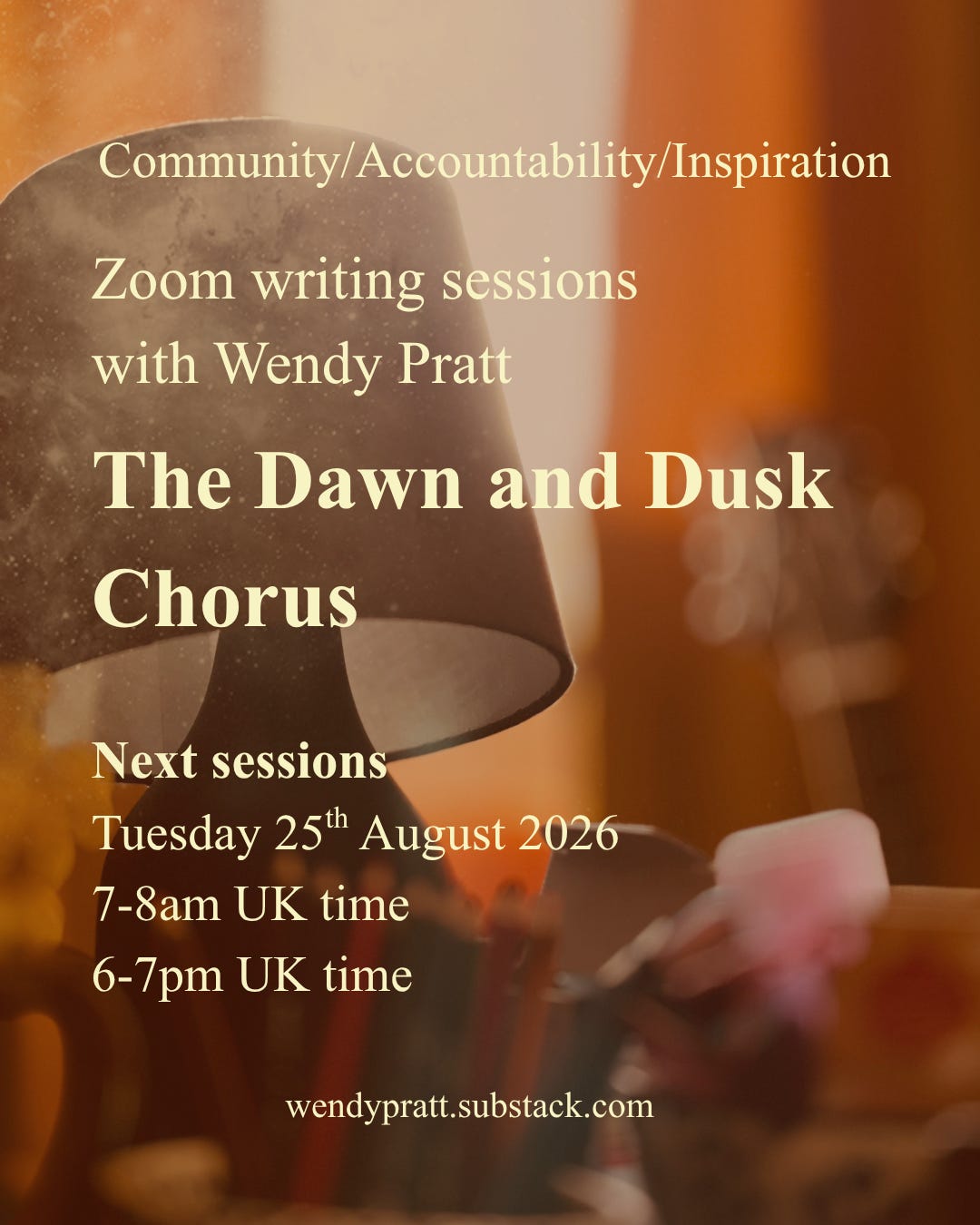
The next Dawn and Dusk Chorus sessions are on Tuesday 25th August 2025
7-8am and 6-7pm UK time.
Comments
Nothing yet. Say the first thing.
Sign in to join the conversation.