
Hello, I’m Wendy Pratt; author and poet. I wrote a memoir, The Ghost Lake, about my experience of living on an ancient extinct glacial lake called Paleolake Flixton in North Yorkshire, and how I found my place in a long line of lake ancestry going back to the palaeolithic. I also wrote a poetry collection, Blackbird Singing at Dusk, a kind of sister project to the memoir.
This post contains the poem and prose extracts we looked at in this month’s Dawn and Dusk Chorus zoom writing sessions, and the writing prompts. Usually I paywall these posts as the sessions are a perk of paid membership to Notes from the Margin, but to give you a taste of what we do in the sessions, this one is unpaywalled.
Monthly Dawn and Dusk Chorus zoom write along groups
Quarterly zoom writing workshops
Subscriber only essays of behind the scenes of the writing world
Access to my entire archive of subscriber only posts
Discounts on some external writing courses
Occasional month-long online courses
Occasional one to one writing surgeries
Supporting me to write my new book
A subscription is £6 per month or £50 per year when done through the Substack website, rather than the app. You can unsubscribe at any time.
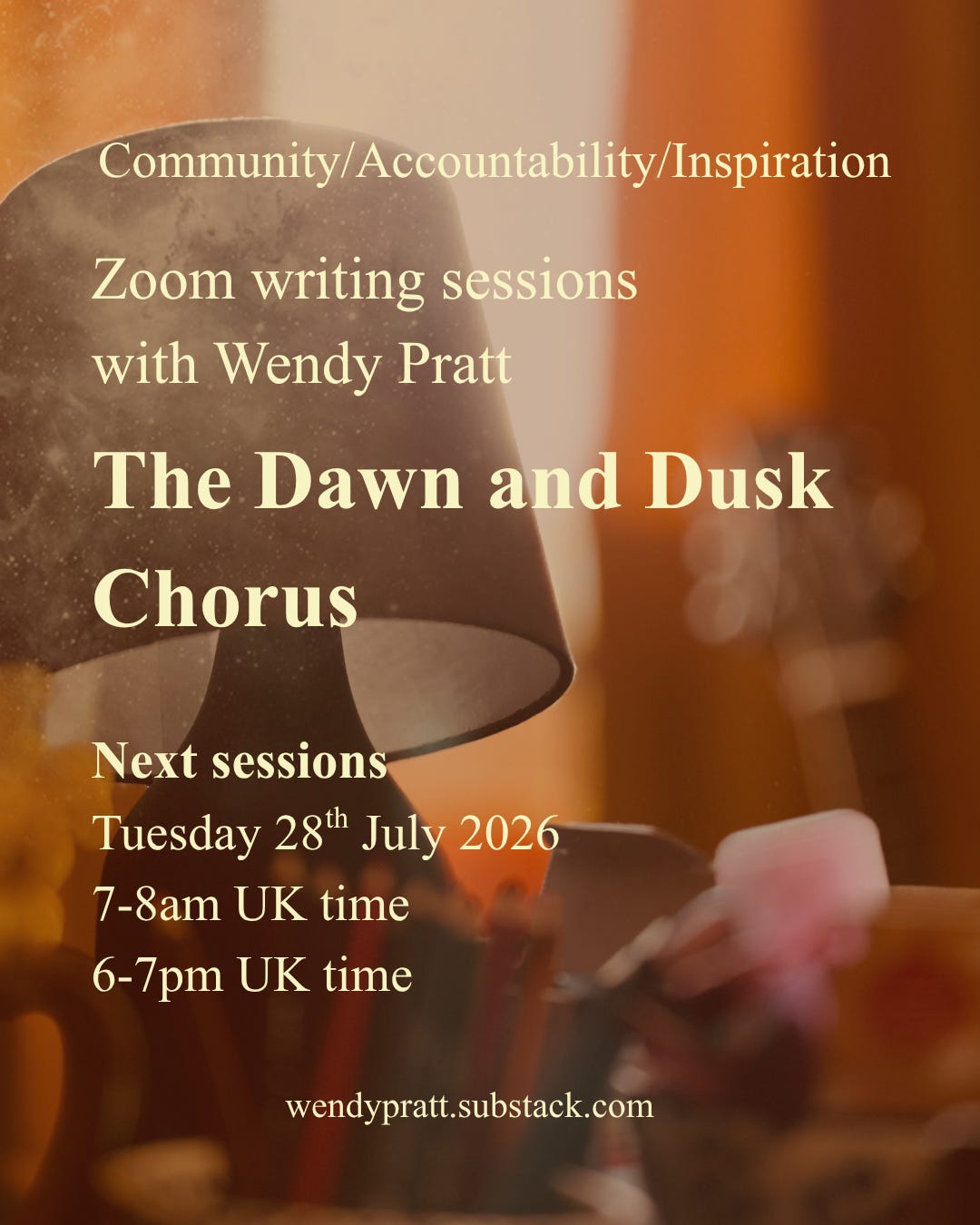
The next Dawn and Dusk Chorus sessions are on Tuesday 28th July
7-8am and 6-7pm UK time
My next live workshop is also in July on Wednesday 15th 7-8.30pm UK Time
We’ll be looking at how to put the surprise into poetry - how to jolt the reader out of a passive experience.
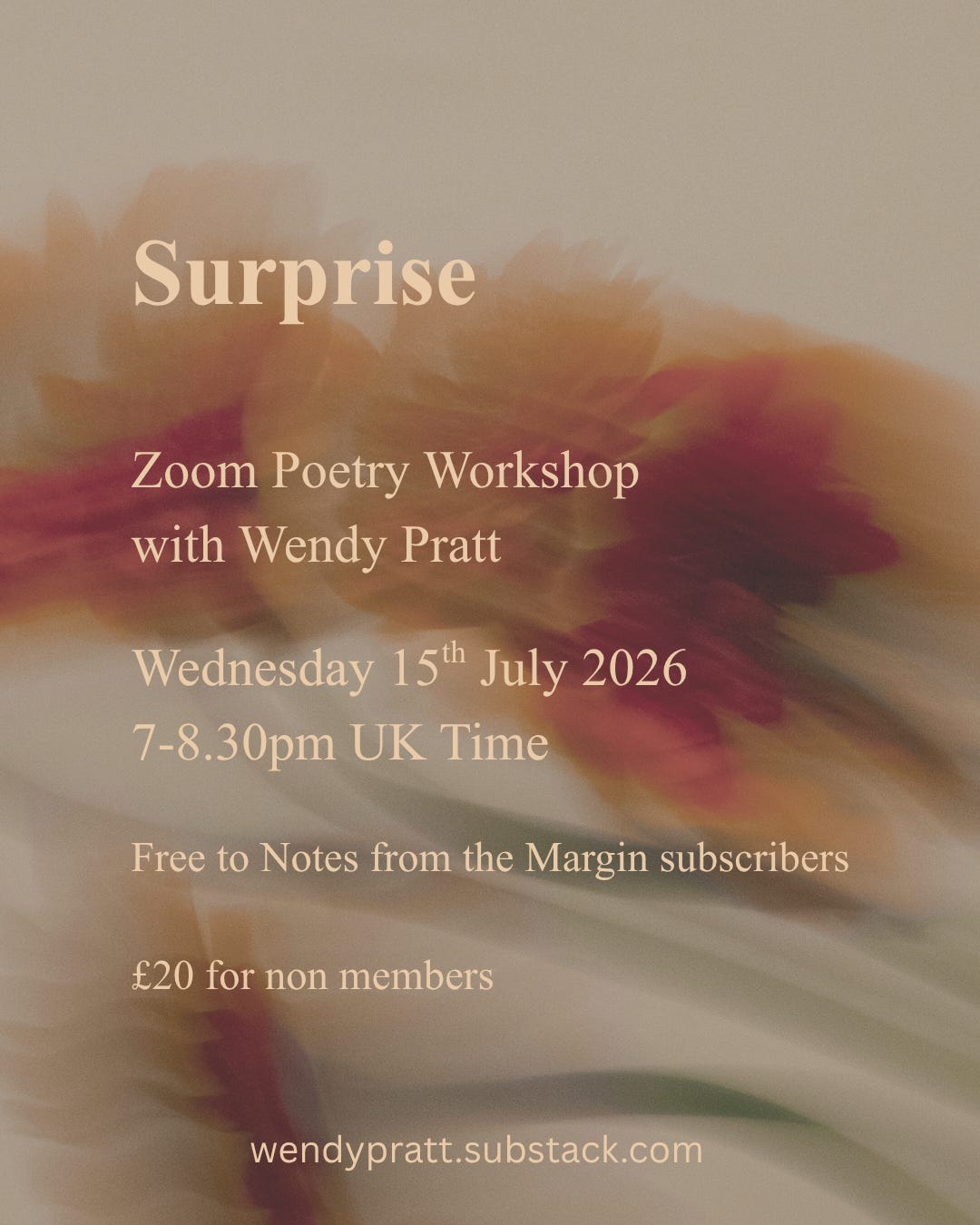
This workshop is completely free to paid subscribers of Notes from the Margin, but I’m also offering a payment version - £20 - for non members. Here’s the link to the eventbrite page. If you’re a paid subscriber to Notes from the Margin you don’t have to book, you’ll automatically receive the zoom link just before the event.
Thanks for reading Notes From the Margin with Wendy Pratt! This post is public so feel free to share it.
Thanks to everyone who came along to the sessions this month. We were quite near the solstice so no wonder we fell towards those still, calm moments in the writing hour. It was, as ever, a warm and nourishing hour, prioritising creativity at the beginning and end of the day, and as ever, I came away feeling better for the time spent in creativity. Thank you!
We started the morning session looking at this poem by Tess Taylor:
Text within this block will maintain its original spacing when published
Tess Taylor
Solstice
How again today our patron star
whose ancient vista is the long view
turns its wide brightness now and here:
Below, we loll outdoors, sing & make fire.
We build no henge
but after our swim, linger
by the pond. Dapples flicker
pine trunks by the water.
Buzz & hum & wing & song combine.
Light builds a monument to its passing.
Frogs content themselves in bullish chirps,
hoopskirt blossoms
on thimbleberries fall, peeper toads
hop, lazy—
            Apex. The throaty world sings ripen.
Our grove slips past the sun’s long kiss.
We dress.
We head home in other starlight.
Our earthly time is sweetening from this.
I love that slow flow down, it’s lazy, it’s settled, content. This line ‘we build no henge’ really speaks to me. I wrote a solstice poem of my own a few years ago, about how the witnessing of the solstice somehow makes the most ordinary things sacred, how you need no designated space or ritual to observe the thing that people have been observing for thousands of years, that you just need to turn up and face the sun. This is the poem:
Text within this block will maintain its original spacing when published
Wendy Pratt
Miracle of the Solstice
And of the paddleboarders
floating on the rippled sea
and of the snail in the wet dew
and of surprise in the sun’s heat.
Miracle of the warmed carpet
in a shaft of sunlight
and of the house
with the sleeping husband
and of the burble of coffee
and of the hum of the fridge.
Miracle of the fat pigeons in the road
and of the sun rising golden
and ancient
and of the hush of the sea
and the seagulls in the surf
and of the man who stopped walking
to watch the rind
of gold rise over Filey brigg
and of the little salmon boat
and the tanker far out
and of the sun’s beam illuminating
the campsite on the hillside
as if the campsite was a neolithic tomb
and the sleeping holidaymakers
precious offerings.
I found the Tess Taylor poem on the website poets.org, where I also found this quote from her:
Beauty is complicated, but sometimes joy feels pretty simple: lying in the pine needles by Upper Goose Pond, the pleasure of swimming and then drying off again.
Tess Taylor
As soon as I saw those words it was like a little bell ringing inside me: yes, yes, this is joy, this uncomplicated moment of contentment. I don’t know about you but I’ve been missing that a bit of late.
I always say, in the writing sessions, that these prompts are entirely optional. The sessions are for you to do whatever moves your creativity forward, but the writers seemed to really respond to this one. It was nice to share those small moments of joy:
Beauty is complicated but joy is simple. Use this as your first line, or your title and go from there.
Find your small summer joy, maybe even your solstice joy. Try to be specific: a single moment you have experienced: the simple joy of coffee and a sunny morning, or dewy grass under your feet or the way cloud shadows move over your eyelids as you lounge in the garden.
In the evening we moved onto prose and a favourite writer of mine, Nicola Chester . I absolutely love her book On Gallows Down and I know she has another one out now, which I’ve not read yet (but it’s on my list!) called Ghosts of the Farm. Here’s the extract from On Gallows Down that we looked at:
From my bedroom, I have seen lightning strike the gibbet, meteors arc above it. The crisp black silhouette of the down against a clear sky masquerades as the ridge of the old threshing barn/schoolroom roof, as the poet Edward Thomas might have seen it, recorded in his poem ‘The Barn and the Down’, when ‘the great down in the west’ looked like a barn stored to its rafters ‘with black of night.’ Always atmospheric, at times the place has a wild, gathering and lonely air of tumult.
Next to our house was a cluster of very old stone cottages, angled with clear views to Gallows Down. One, uninhabited for decades, was grown over with brambles and volunteer ash trees, its tall chimney pots leaning away from each other like a V sign to the newer, bigger, more comfortable and sanitary houses. Opposite was a 1950s house, contemporary with ours, with the pantry of an earlier house remaining as a workshop. Scratched and painted into its old brickwork was the date 1676. Both houses belonged to Mr Painting, another old, recurring name in the village. Several wild and unkempt cottages were owned and lived in by the lone men of the Painting family. Fiercely intelligent, guarded, sometimes eccentric or reclusive, they were respected and ‘known’ locally. Each morning our elderly Mr Painting opened his curtains, stretched a sleeve of his jumper over the heel of his hand and rubbed a circle in the grime and condensation on the window to check the gibbet was still standing on the hill.
Nicola Chester
I love the way that one point in the landscape becomes a focus for the village, and for time passing. Subconsciously, consciously, the gallows are the focal point, beneath which life and all its intricacies, nature and the richness of it, the pain of it all, moves and revolves.
What landmark do you look towards daily? It doesn’t have to be anything as dramatic as a gibbet on a down, it could just as easily be the lamppost facing your kitchen window, or the drainpipe on next door’s roof, or the spire of the church in the village or a tree, or a rock, or a plant in your garden. What events, what seasons have you seen pass over that landmark, what events has that landmark seen pass over you? Write a poem, or a piece of prose, that maps a community using that landmark as the focus, or write from a personal perspective, how has your life moved around this fixed point?
Happy writing folks, I hope I see you at the next sessions.
Until next time
x
In case you missed it, here’s week four of the Museum Pieces course:
Museum Pieces Week Four
·
Jun 25

Hello, I’m Wendy Pratt; author and poet. I wrote a memoir, The Ghost Lake, about my experience of living on an ancient extinct glacial lake called Paleolake Flixton in North Yorkshire, and how I found my place in a long line of lake ancestry going back to the palaeolithic. I also wrote a poetry collection,
Comments
Nothing yet. Say the first thing.
Sign in to join the conversation.