
By, Wendy Day
The music industry loves to talk about superfans like they’re one type of person with one behavior pattern and one strategy to unlock them. Buid a superfan app, drop some vinyl variants, add a premium tier. Done. That’s not how it works. And if you’re a hip hop artist, the gap between what you think your youngest superfans want, and what they actually do, could be costing you the most important relationships you’ll ever build in this business.
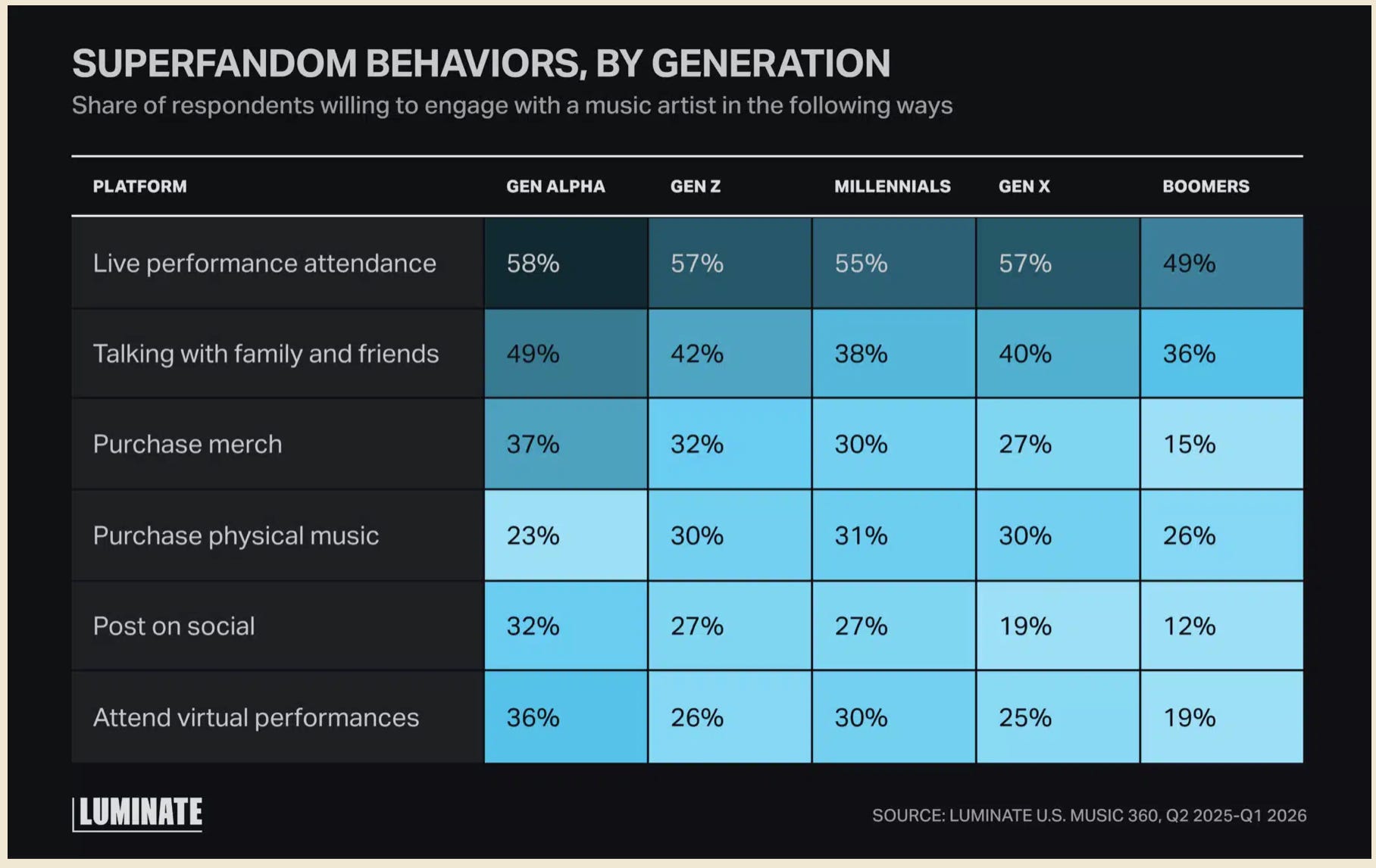
Luminate recently released data that breaks down superfan behavior by generation. The numbers are worth paying attention to, not because they’re shocking, but because they put hard percentages on something most artists are ignoring. Here’s the part that matters for you right now: Gen Alpha and Gen Z are your most active superfan generations. And the way they show up for artists they love has almost nothing to do with spending money.
First, let’s get clear on who we’re talking about. Gen Alpha accounts for 31% of superfans, Gen Z for 24%, and Millennials for 25%, making these three groups the core of the superfan population according to Luminate’s U.S. Music 360 data. In hip hop specifically, that Gen Alpha number should stop you cold. These are kids born after 2010. Some of them are barely teenagers. They are growing up inside of early 21st century hip hop culture the way older generations grew up inside rock or Golden Era hip hop and R&B. It is their native language. And they are already deeply, obsessively attached to artists they love. The question is whether you’re building with them or just broadcasting at them.
What the data actually shows about how they engage. Live performance attendance is the one thing that cuts across all generations, with Gen Alpha at 58% and Gen Z at 57% willing to show up to concerts. But the gaps start opening up fast when you move to other activities. Purchasing merch drops from 37% for Gen Alpha to 32% for Gen Z, and social posting sits at 32% for Gen Alpha and 27% for Gen Z.
Those numbers are relevant, but they’re not where the real story is. The generational divide widens significantly when you look at less financially motivated fan activities, with younger fans far more likely to engage with each other as a community than older ones. That’s the thing most artists completely miss. Gen Alpha and Gen Z superfans are not primarily transactional. They are communal. They are building something together around your music, and most artists have no idea it’s even happening.
Think about what that actually looks like in practice. Fan edits. Stitch videos. Coordinated TikTok moments. Fan accounts that have more followers than some mid-level artists. Group chats where they debate your lyrics like it’s scripture. They are creating culture around your culture, and they’re doing it whether you acknowledge them or not. The artists who figure out how to step into that space, not to control it but to feed it, are the ones who end up with fanbases that can weather anything.
Here’s where hip hop is leaving the most on the table. Pop artists, especially those with K-pop influence in their strategy, have spent years building infrastructure around exactly this kind of communal fan behavior. Fan kits. Fandom names with real identity attached to them. Tiered engagement that makes a 16-year-old feel like a genuine stakeholder in the artist’s story. Hip hop has largely treated that playbook like it’s for somebody else. It’s not.
Younger superfans are significantly more likely to identify as part of an official fandom, with Gen Z at 22% and Gen Alpha at 21%, compared to just 10% of Gen X and 4% of Boomers. That means your youngest fans want to belong to something. They want a name for what they are. They want the group identity. They want to feel like being your fan is part of who they are, not just something they do on a Friday night.
Dressing up to express fandom is another area where the data is clear. Gen Z comes in at 20% and Gen Alpha at 18% for dressing up to engage in fandom, numbers that dwarf Gen X at 8% and Boomers at 3%. Hip hop has always had deep connections to fashion and personal expression. The audience is already primed for this. The artist infrastructure to support it is mostly not there yet.
Virtual performances tell a similar story, with Gen Alpha at 36% and Gen Z at 26% willing to attend them, compared to 19% for Boomers. If you’re a hip hop artist and you haven’t thought seriously about how virtual performance fits into your strategy for younger fans, you are behind.
Here’s what you can actually do with this. Stop running one strategy and hoping it reaches everybody. Your 14-year-old Gen Alpha superfan and your 45-year-old Gen X superfan are both real, both valuable, and they want completely different things from you. This article is about the younger fans.
Give your youngest fans a name and make it mean something. Not just a hashtag. A real identity with history and inside language and something to be proud of. Drake has the 6, Beyoncé has the Beyhive, Kendrick has built an entire mythology around his audience’s intelligence. What do your fans call themselves, and what does that mean to them?
Build spaces where they can find each other. That could be Discord, Grouped, Mighty, or even a fan forum linked from your website. It could be intentional use of your comment sections to spark conversation rather than just drop content. The point is that you create the conditions for community, then you let them do what they already want to do.
Show up in virtual spaces like they matter, because they do. Create a livestream on Instagram one day and on TikTok another day. Pop up for a surprise appearance in a fan space. Offer a virtual listening session before a release. These things cost you almost nothing and they land enormous with a generation that grew up treating digital presence as real presence.
Take fashion seriously as a fan engagement tool. Your merch shouldn’t just be a logo on a shirt. It should be something a Gen Z fan would actually want to wear to school because it signals something about who they are. If your merch line doesn’t pass that test, it’s not working hard enough.
Let them create. Stop treating fan edits, and remixes and covers like a legal liability and start treating them like the marketing they actually are. A 17-year-old who spends three hours editing your video for free and posts it to 40,000 followers is doing work for you. Acknowledge it, then repost it. Make them feel seen.
The long game is the whole game.
Here is the truth that most artists don’t sit with long enough. The Gen Z fan who is 19 years old right now, streaming your music on a shared account, buying one shirt a year when they can scrape together enough money, and going to shows when someone else pays, is not a low-value fan. That person is a decade away from having real disposable income, a career, a platform of their own, and a deep nostalgic loyalty to the artists who felt like theirs when they were very young.
You either build that relationship now or you don’t. There is no catching up later. The artist who was there when they were 19 gets something no amount of marketing spend can buy. The artist who ignored them until they had money gets nothing but a transaction. Hip hop built itself on loyalty where the idea that this music is for us, by us, and the relationship between an artist and their tribe is sacred. That’s not just culture. That’s strategy. And your youngest superfans are ready to give you everything if you give them something real to hold onto.
The data just confirmed what the culture already knew. The question is what you do with it.
No posts
Comments
Nothing yet. Say the first thing.
Sign in to join the conversation.