
Maoist China made ideological conformity an administrative requirement. The parallels are becoming impossible to ignore.
Urgent: Glass Empires needs you. Subscribe today and save 30%.
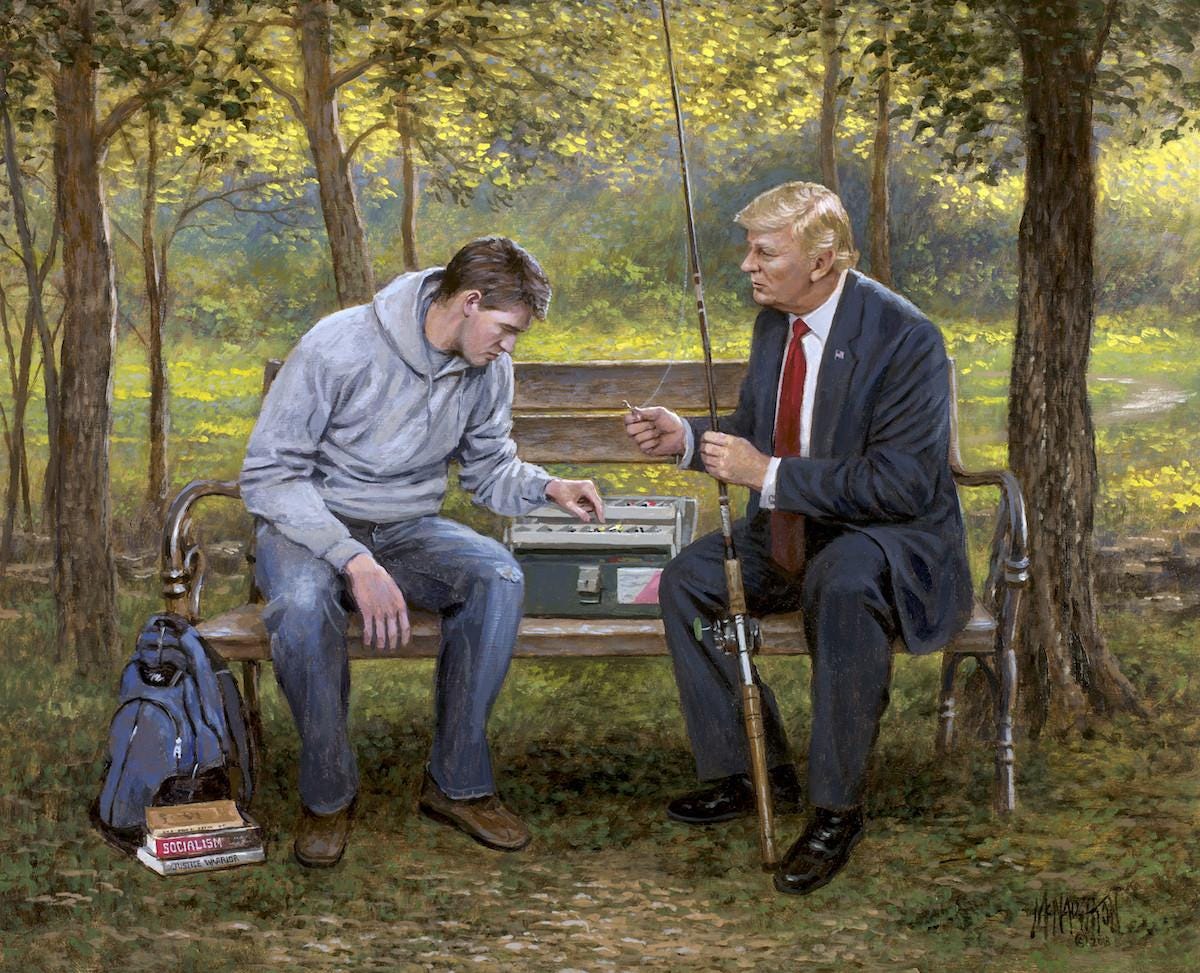
Art credit: Jon McNaughton, Teach a Man to Fish, 2018. McNaughton places Donald Trump in the role of ideological instructor while books labeled “Socialism” and “Justice Warrior” lie discarded. The message is explicit partisan propaganda: the leader supplies the correct worldview, the citizen receives instruction, and opposing ideas belong in the discard pile.
The Trump Administration is building a centralized party-state system to enforce ideological conformity.
The educational campaign has advanced into a more coercive institutional phase. On August 3, Education Secretary Linda McMahon issued a national directive to university presidents and governing boards. McMahon demanded public statements by year-end describing how institutions would implement White House-backed reforms. The directive addressed admissions, campus speech, faculty culture, research governance, and universities’ obligations toward American national interests.
On August 6, the Justice Department challenged Duke Law School’s admissions practices, while the Education Department investigated two California universities. The inquiries concerned allegations involving campus antisemitism and pro-Palestinian protests.
By the end of July 2026, federal officials had already applied the administration’s campaign to public schools. They opened or expanded school or education-agency investigations across California, Washington, Minnesota, and Colorado. The disputes involved parental authority, gender-related policies, student records, instructional materials, and federally protected opt-out rights. Violations of statutes invoked by the Education Department can ultimately jeopardize national education funding.
Grant preferences give those officials another means of advancing the government’s chosen educational framework. Together, these federal pressures can influence what institutions teach, permit, reward, and suppress, without establishing a single national curriculum.
China’s Maoist Re-Education System
Twentieth-century communist governments used re-education to identify and suppress beliefs they deemed ideologically dangerous. During the Maoist period, Mao and senior Party leaders intensified that practice against bourgeois and counterrevolutionary thought. They treated ideological deviation as a threat to Communist rule requiring organized correction. Political study, compulsory labor, criticism, and self-criticism became instruments for enforcing Maoist orthodoxy.
To explain the psychological operation of that system, psychiatrist Robert Jay Lifton examined Chinese Communist re-education through thought reform and ideological totalism. His 1961 study examined people who underwent Chinese Communist programs intended to reconstruct political belief and identity. Lifton argued sustained ideological control could alter judgment and an individual’s relationship with political authority.
During the Cultural Revolution, however, Mao and senior Party leaders incorporated re-education directly into political governance. Chinese Communist authorities imposed compulsory ideological instruction on suspect populations and enforced discipline through compulsory labor and relocation. Party-state class and political labels cost many intellectuals and professionals employment, personal freedom, professional standing, or institutional positions. Party leaders transferred authority toward Maoist cadres and revolutionary organizations committed to Maoist doctrine.
“educate and remould”— Chinese Communist formulation, 1966
Mao Zedong launched the Cultural Revolution in 1966, arguing that class conflict persisted under socialism. He accused Communist Party members of following a “capitalist road” and preserving bourgeois political values. Central and local Party authorities imposed compulsory ideological correction on personal conduct, political loyalty, and belief. Under Mao’s leadership, ideological reliability became necessary for party-state authority and advancement.
“the phenomenon of our schools being dominated by bourgeois intellectuals must be completely changed.”— Chinese Communist Party, 1966
Authorities imposed forms of re-education on different populations. During the Cultural Revolution’s early years, Red Guards persecuted teachers, intellectuals, professionals, and accused political opponents. Party cadres later entered May Seventh Cadre Schools for compulsory manual labor and intensive political instruction. Cadre-school administrators and Party authorities maintained control while temporarily removing many from administrative positions.
Meanwhile, in 1968, Mao and senior Party leaders expanded the nationwide Up to the Mountains and Down to the Countryside Movement. About 17 million urban youths were compelled to relocate to villages, state farms, and frontier regions. Mao ordered prolonged rural labor under poor and lower-middle peasants as political education. Party authorities also removed youths from cities after severe Red Guard factional conflict.
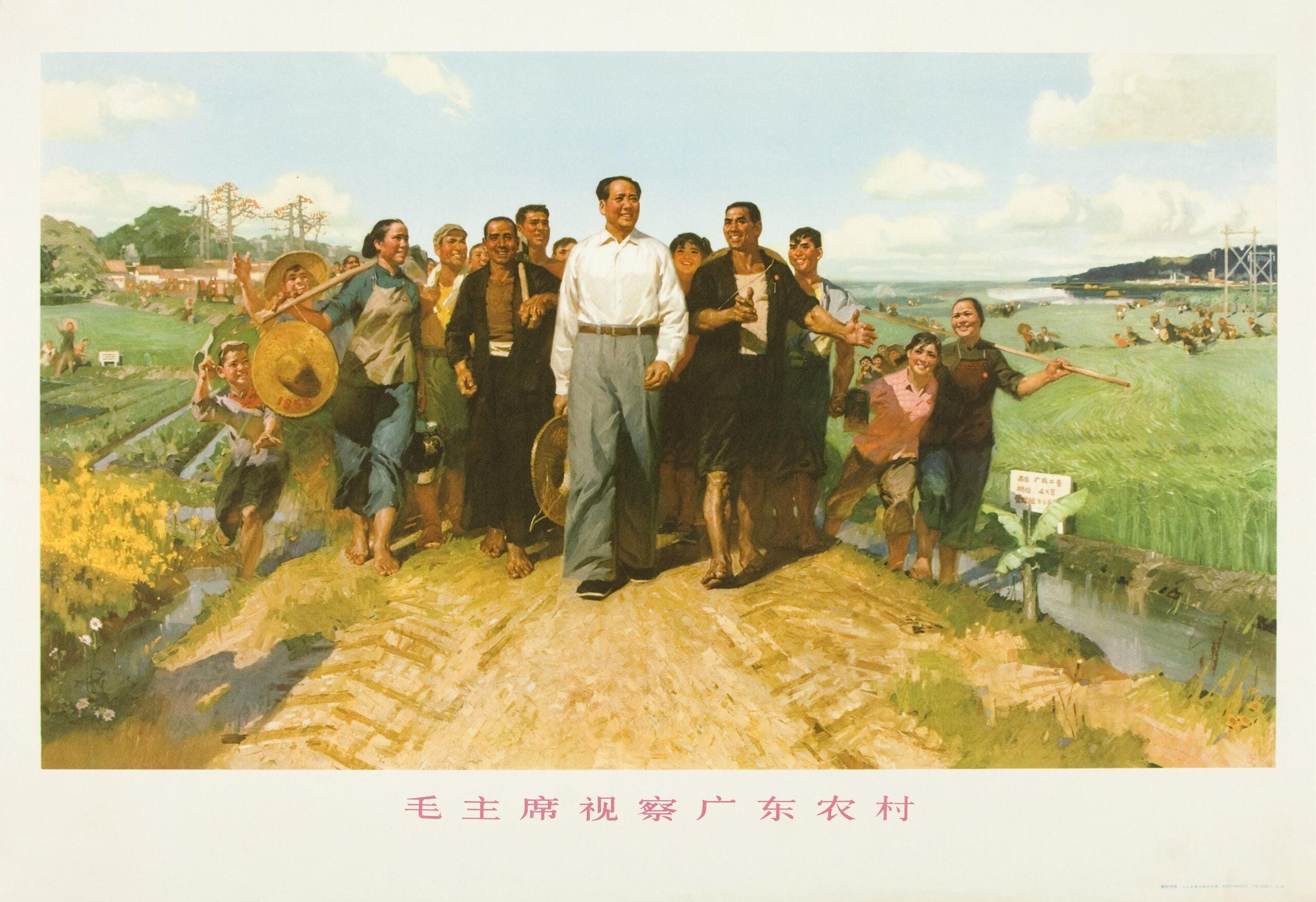
Art credit: Chen Yanning, Chairman Mao Inspects the Guangdong Countryside, 1972. Oil on canvas. Chen casts Mao as an idealized leader among rural workers, placing him prominently at the composition’s illuminated center. Based on Mao’s 1958 inspection of a Guangdong agricultural cooperative, the painting presents political authority as intimate, benevolent, and instructive.
“It is absolutely necessary for educated young people to go to the countryside to be re-educated.”— Mao Zedong, December 22, 1968
Taken together, these policies made ideological conformity an administrative requirement enforced through party-state coercion. Political reliability governed education, employment, professional status, and access to authority. The system disrupted families, weakened institutions, and produced enduring distrust of Cultural Revolution campaigns after 1976. Party leaders formally repudiated the Cultural Revolution in 1981, implicitly acknowledging the political damage their system had produced.
The historical record provides a basis for examining government language about education with particular scrutiny. On January 29, 2025, President Donald Trump defined patriotic formation as a federal educational objective.
“instill a patriotic admiration for our incredible Nation.” — President Donald Trump, January 29, 2025
Since the start of his second term, President Donald Trump has pursued a national project extending beyond conventional regulatory change. His administration increasingly prescribes preferred understandings of American history and patriotism. Government policy also promotes designated norms governing religion, gender, family life, citizenship, and acceptable public conduct. Federal officials use schools, museums, agencies, grant programs, and public spaces as principal channels for implementing those policies.
Trump announced the educational premise years before returning to office. On September 17, 2020, he attacked critical race theory, the 1619 Project, and competing interpretations of American history. Trump demanded government-supported patriotic education as a replacement for the disfavored historical frameworks.
“Teaching this horrible doctrine to our children is a form of child abuse in the truest sense of those words.” — President Donald Trump, September 17, 2020
Trump’s “horrible doctrine” referred to critical race theory and related interpretations of American racial history. After returning to office, Trump converted his demand for patriotic education into national policy.
Executive Order 14190 defines “patriotic education,” restores the 1776 Commission, and directs government resources toward qualifying instruction. In September 2025, Education Secretary Linda McMahon made patriotic education a discretionary-grant priority. The Education Department also formed the America 250 Civics Education Coalition with private organizations.
Federal involvement in education expanded again during 2026. Through the History Rocks! program, federal officials provided sponsored civics programming to students across all fifty states. By August 5, 2026, the Education Department reported reaching nearly 20,000 K–12 students. The federal government therefore acquired greater influence over historical instruction, without assuming formal control of state curricula.
Trump sharply intensified federal efforts to control national historical interpretation during July 2026. The White House Domestic Policy Council accused Smithsonian leadership of ideological activism. Smithsonian officials publicly rejected the council’s characterization as inaccurate. Congress then held hearings scrutinizing the National Museum of American History’s scholarship and exhibitions.
On July 24, Trump ordered federal warning signs outside the museum that challenged exhibits inside. The directive authorized pressure through funding, contracts, regulations, and control of federal property.
Federal religious policy constitutes another explicit element of Trump’s prescribed civic order. Trump established the White House Faith Office on February 7, 2025. By January 2026, he described religious restoration across schools, government, medicine, employment, and military institutions. His administration also established the Religious Liberty Commission to recommend further changes affecting religion and public institutions.
The Trump administration is converting religious preference from protected private belief into a criterion for public legitimacy. Federal policy increasingly privileges administration-approved faith commitments while subordinating institutional autonomy to executive moral judgment. Trump’s July 24, 2025, homelessness order applies the same logic beyond religion by expanding civil commitment, institutional treatment, and street enforcement. By tying federal grants to approved local policies, the administration turns public funding into an instrument for disciplining dissenting institutions and enforcing a federally preferred social order.
The next stage of re-education will not require a national curriculum or federal statute. Federal agencies are already imposing ideological requirements through funding, investigations, regulatory authority, and institutional directives without new congressional authorization. The pattern increasingly resembles Cultural Revolution re-education, where political conformity spread through schools, workplaces, and government institutions before becoming an entrenched system of ideological control.
Every article published requires hours of research and rigorous analysis. Currently, I publish articles without charge so readers can assess value before subscribing, but free content is not generating enough paid subscriptions to support the continuation of this work. Please consider paid support via my limited coupon for annual subscriptions.
Readers who cannot commit to a paid membership can support Glass Empires through a one-time or recurring tip on Buy Me a Coffee (BMAC) or Venmo. Contributions help cover the extensive research costs behind each daily investigation. BMAC also includes free guides for everyone.
BMAC Free Guides & Contribution
Sources
Trump White House Archive, Remarks by President Trump at the White House Conference on American History, September 17, 2020.
https://trumpwhitehouse.archives.gov/briefings-statements/remarks-president-trump-white-house-conference-american-history/White House, Ending Radical Indoctrination in K–12 Schooling, January 29, 2025.
https://www.whitehouse.gov/presidential-actions/2025/01/ending-radical-indoctrination-in-k-12-schooling/U.S. Department of Education, National Call to Action to University Presidents and Governing Boards, August 3, 2026.
Reuters, US Scrutinizes More Schools Over Admissions Practices, Diversity and Pro-Palestinian Protests, August 6, 2026.
https://www.reuters.com/legal/government/us-scrutinizes-more-schools-over-admissions-practices-diversity-pro-palestinian-2026-08-06/U.S. Department of Education, Demands Clarity on California and Washington Plans to Revise “Transgender” Policies, July 2026.
https://www.ed.gov/about/news/press-release/us-department-of-education-demands-clarity-california-and-washington-plans-revise-transgender-policiesWhite House, Restoring Trust in the Smithsonian Institution, July 24, 2026.
https://www.whitehouse.gov/presidential-actions/2026/07/restoring-trust-in-the-smithsonian-institution/White House, Religious Freedom Day, 2026, January 16, 2026.
https://www.whitehouse.gov/presidential-actions/2026/01/religious-freedom-day-2026/White House, Ending Crime and Disorder on America’s Streets, July 24, 2025.
https://www.whitehouse.gov/presidential-actions/2025/07/ending-crime-and-disorder-on-americas-streets/U.S. Department of Education, U.S. Department of Education Releases Secretary McMahon’s Patriotic Education Supplemental Priority, September 17, 2025.
https://www.ed.gov/about/news/press-release/us-department-of-education-releases-secretary-mcmahons-patriotic-education-supplemental-priorityU.S. Department of Education, U.S. Department of Education Concludes 50-State History Rocks! Tour to Commemorate America’s 250th Birthday, June 17, 2026.
https://www.ed.gov/about/news/press-release/us-department-of-education-concludes-50-state-history-rocks-tour-commemorate-americas-250th-birthdayRobert Jay Lifton, Thought Reform and the Psychology of Totalism: A Study of “Brainwashing” in China. Originally published 1961. University of North Carolina Press edition.
https://uncpress.org/9780807842539/thought-reform-and-the-psychology-of-totalism/Andrew G. Walder, China Under Mao: A Revolution Derailed. Harvard University Press.
https://www.hup.harvard.edu/books/9780674975491Emily Honig and Xiaojian Zhao, Across the Great Divide: The Sent-Down Youth Movement in Mao’s China, 1968–1980. Cambridge University Press, 2019.
https://www.cambridge.org/core/books/across-the-great-divide/D2FC585583E8B5952D7F4D3D31677431Chinese Communist Party, Decision of the Central Committee of the Chinese Communist Party Concerning the Great Proletarian Cultural Revolution, August 8, 1966.
https://www.marxists.org/subject/china/peking-review/1966/PR1966-33g.htm“Long Live the Great Proletarian Cultural Revolution,” Peking Review, June 17, 1966.
https://www.marxists.org/subject/china/peking-review/1966/PR1966-25f.htmMao Zedong, Directives Regarding the Cultural Revolution, including the December 22, 1968 directive on re-educating urban youth.
https://www.marxists.org/reference/archive/mao/selected-works/volume-9/mswv9_84.htmChinese Communist Party, Resolution on Certain Questions in the History of Our Party Since the Founding of the People’s Republic of China, June 27, 1981.
https://www.marxists.org/subject/china/documents/cpc/history/01.htm
Publication Disclaimer
This publication provides journalism, political analysis, historical interpretation, and protected opinion. Nothing published here advocates, solicits, encourages, instructs, or assists unlawful conduct. W. A. Lawrence and this Substack reject violence, criminal activity, and threats against any person or institution. Readers remain solely responsible for their conduct and compliance with applicable law.
Comments
Nothing yet. Say the first thing.
Sign in to join the conversation.