
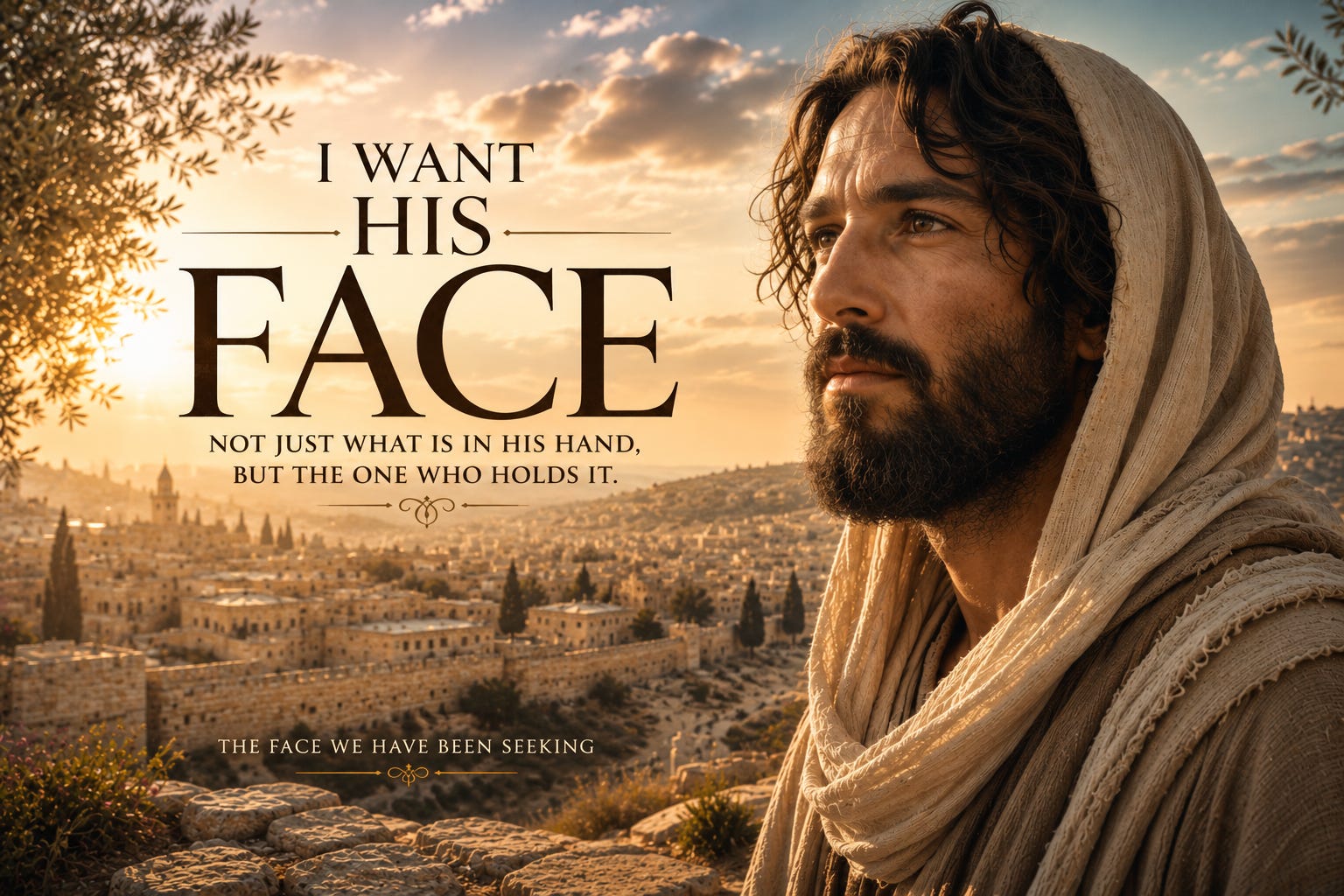
There is a peculiar kind of tragedy in receiving everything you asked for and discovering that you are still hungry.
Human beings are remarkably talented at misdiagnosing their deepest appetites. We assume another achievement will quiet us, another possession will settle us, another relationship will complete us, another victory will finally allow the restless machinery within us to stop. Yet satisfaction has a curious habit of retreating just as we approach it. The thing once considered indispensable becomes ordinary shortly after it is possessed, and the soul begins searching again.
The same danger exists in our relationship with God. We can become so consumed with what we need Him to do that we scarcely notice how little we have desired Him. Our prayers become crowded with requests for healing, provision, protection, opportunity, breakthrough, restoration, favor, and victory. None of these desires are illegitimate; all of them are good. The Scriptures invite us to ask, seek, knock, believe, and bring our petitions before our Lord. The problem begins when we become more interested in what is in God’s hand than in the God whose hand provides it.
Perhaps this explains why one of the most important words in the biblical vocabulary of divine presence is not a word that originally means atmosphere, power, sensation, or even glory.
It means face.
The Face
The Hebrew word is פָּנִים, pānîm.
It appears throughout the Hebrew Scriptures with the ordinary meaning of "face," but its semantic reach naturally extends to the idea of someone’s personal presence. To stand before someone’s face is to stand before that person. To flee from the face is to flee from the person’s presence. To seek the face is to seek the person himself.
This matters because English can make the “presence of God” sound strangely abstract. We speak of entering His Presence, feeling His Presence, carrying His Presence, or longing for His Presence. Eventually, the word can become detached from the Person it was intended to describe.
Hebrew resists that abstraction. In fact, the Hebrew language gives Presence a face, and the first time humanity discovers what it means to lose the face of God, we are standing in a garden.
Genesis 3 tells us that Adam and Eve heard קוֹל יְהוָה אֱלֹהִים, qôl YHWH ʾĕlōhîm, the sound or voice of the LORD God, moving through Eden. Their response was immediate. They hid themselves מִפְּנֵי יְהוָה, mippĕnê YHWH, literally, from the face of YHWH.
Something enormous has happened. Humanity was created for communion with God, but sin has transformed the face once associated with fellowship into the face from which humanity runs. The sound of God approaching no longer produces delight; it produces fear. Adam retreats into the trees, attempting the impossible task that every generation after him will repeat in one form or another: constructing a life in God’s world while hiding from God’s face. The story of redemption begins there, and much of the rest of Scripture can be read as the long journey home.
The Hand and the Face
There is an important difference between someone’s hand and someone’s face. The hand tells me something about what a person can do; the face tells me who the person is. A hand can give without revealing very much about the giver. It can place money into your hands, open a door before you, lift something too heavy for you, defend you against danger, or pull you from a place where you have fallen. We may be profoundly grateful for the hand while knowing surprisingly little about the person to whom it belongs.
The face is different. Identity lives there. Recognition lives there.
Affection becomes visible there. So does sorrow. So does pleasure. So does disappointment. Long before a child possesses the vocabulary to describe relationship, that child learns to search a room for a particular face.
This explains the importance of the spiritual maturation of a son or daughter of God.
We begin by discovering His hand. He provides and protects, heals and makes whole, opens doors and makes ways, answers prayers and keeps promises. He carries us through circumstances we could not have survived alone, and through those experiences we learn that our Heavenly Father’s hand is good. Eventually, however, love asks a deeper question: Do I want what is in His hand more than I want His face?
There is nothing wrong with the child who runs toward his father because his dad has brought him something. But there comes a day when the child becomes a man, time does its inexorable work, and he discovers that he would gladly surrender every gift his father ever carried through the door for one more afternoon sitting across the table from him.
Maturity has taught him the difference between a present and a presence. This is why spiritual maturity must eventually teach us the same thing.
I Don’t Want Canaan Without You
Moses understood this distinction with extraordinary clarity.
Exodus 33 occurs in the shadow of catastrophe. Israel has constructed the golden calf. Covenant has been violated as quickly as it has been established. Judgment has entered the camp, and Moses finds himself standing between a holy God and a people who seem determined to destroy themselves.
Yet Canaan remains. The land still exists. The promise has not disappeared. Milk and honey still await them. The destination Israel has spent generations dreaming about remains geographically available.
Then Moses says something that reveals what he values more than the destination.
God tells him: “My presence shall go with thee, and I will give thee rest.”
The Hebrew behind “presence” is startlingly personal: פָּנַי יֵלֵכוּ, pānay yēlēkû. “My face will go.”
Moses responds: “If thy presence go not with me, carry us not up hence.”
Consider what he has just said. Moses would rather remain in the wilderness with God than enter the Promised Land without Him. He refuses to confuse God’s promise with God. Canaan may be the inheritance, but Canaan is not the treasure. God is.
This is one of the most severe tests of spiritual maturity in Scripture. If God gave us the thing we have been praying for, but intimacy with Him was not part of the bargain, would we still call it blessing?
We have become accustomed to measuring divine favor by outcomes. The door opened. The business grew. The opportunity arrived. The ministry expanded. The prayer was answered. The diagnosis changed. The resources appeared. We understandably celebrate these things.
Moses introduces another measurement. Did His face go with us? A Promised Land without the Presence of God is just another wilderness, while a wilderness with God becomes holy ground. The determining factor is not geography; it is Him.
The One Thing
David understood this. He possessed nearly everything human beings normally spend their lives pursuing. He had authority, wealth, influence, military victories, national prominence, artistic genius, and a name that would outlive him by millennia.
Yet when David compressed the hunger of his life into a single desire, none of those things appeared.
Psalm 27:4 records, “One thing have I desired of the LORD, that will I seek after.” Something is clarifying about those words. Most of us live with a thousand competing desires shouting simultaneously, but David reduces the entire interior life to one governing affection: “That I may dwell in the house of the LORD all the days of my life, to behold the beauty of the LORD.”
Only a few verses later, the language becomes even more intimate: “When thou saidst, Seek ye my face; my heart said unto thee, Thy face, LORD, will I seek.” There is pānîm again. David does not say, “Thy throne will I seek,” nor does he ask first for God’s power or blessing. His desire terminates upon the Person Himself: “Thy face, LORD, will I seek.”
Psalm 16 carries the thought further: “In thy presence is fulness of joy.” The Hebrew expression אֶת־פָּנֶיךָ, ʾet pāneykā carries the thought of being with Your face, while שֹׂבַע, śōbaʿ belongs to the vocabulary of satisfaction and satiation. David has discovered where human hunger reaches its answer. With the face of God there is not merely joy, but the satiation of joy, the strange and wonderful discovery that God does not merely satisfy the appetite. He reveals that He was the appetite beneath all the other appetites.
The Crisis of a Successful Church
This should trouble us.
It is possible to build a remarkably successful religious life around the things that surround God while slowly losing our fascination with God Himself.
We can love preaching and lose wonder at the One being preached. We can love worship and become inattentive to the One being worshipped. We can love theology and cease trembling before the One theology attempts to describe. We can love church, ministry, conferences, movements, platforms, causes, influence, and even revival as ideas, while quietly allowing Jesus Christ to become one subject among many.
The danger is especially acute in an age obsessed with consumer preferences. Churches understandably study how people think, what captures attention, what makes families return, which music communicates effectively, what environments feel welcoming, and what programs meet genuine needs. Wisdom has a place in administration.
But there is a question that must stand above every other question: What does He desire?
Jesus Christ did not create the Church to become preoccupied with itself; it belongs to Him.
Paul says all things were created by Him and for Him, “that in all things He might have the preeminence.” — Colossians 1:18
Preeminence permits no rival center.
The Church does not need another innovation first; we need a rededication.
Not, “Lord, give us more” but “Lord, make us Yours again.” Restore our attention to You. Restore our affection to You. Restore our wonder at You. Deliver us from the peculiar tragedy of possessing an entire vocabulary about Christianity while becoming less captivated by King Jesus.
Church must become all about Him again.
The Impossible Command
But now the biblical story creates a problem.
God commands His people to seek His face. David longs to behold His face. Yet in the very chapter where God promises Moses, “My face will go,” Moses asks: “Shew me thy glory.”
God answers with a sobering boundary: “Thou canst not see my face: for there shall no man see me, and live.”
And suddenly the entire biblical longing becomes almost unbearable. God commands humanity to seek His face, while simultaneously declaring that His face cannot be seen. He invites us to desire Him, yet He dwells beyond the boundaries of human comprehension. He calls us to come near while reminding us that proximity does not diminish His transcendence. We are welcomed into genuine communion with the eternal God, yet the One who draws us near remains the One whom creation itself cannot contain.
The tension is not accidental. It protects one of Scripture’s most important truths: God may genuinely reveal Himself without becoming reducible to the revelation. The Creator can enter relationship with creation without becoming another object within creation. Nearness does not make Him manageable, and revelation does not exhaust the mystery of His being. We may truly know God without ever reaching the end of what there is to know about Him.
Israel learned this at Sinai. Deuteronomy reminds them that they heard קוֹל דְּבָרִים, qôl dĕbārîm, the voice of words, but saw no form. God gave them His Voice without giving them an image they could control. He would be known, but He would not be domesticated. He would dwell among them, but no building could contain Him. He would reveal His glory, but no idol could reproduce Him. He would invite humanity to seek His face while reminding them that His face remained beyond mortal sight.
And so the question traveled through the centuries: How does humanity behold the invisible God?
Then a child was born.
The Image of the Invisible
John opens his Gospel by reaching behind Bethlehem, behind Abraham, behind Eden, into the mystery of eternity itself: “In the beginning was the Word.”
Then, fourteen verses later: “And the Word was made flesh, and dwelt among us, and we beheld his glory.”
The word translated “dwelt” is ἐσκήνωσεν, (eskēnōsen). It carries the imagery of dwelling, pitching one’s tent, or tabernacling among us, and John knows precisely what he is doing with the language. The God whose glory dwelt in the Tabernacle has entered human history in the flesh. What Israel once approached through sacred space, sacrifice, priesthood, and covenant has now entered the ordinary geography of human existence. The Presence has moved into the neighborhood.
Paul approaches the mystery from another direction. Colossians 1:15 calls Jesus Christ εἰκὼν τοῦ θεοῦ τοῦ ἀοράτου, eikōn tou theou tou aoratou, “the image of the invisible God.” The phrase contains a deliberate and magnificent paradox: the image of the invisible. If God is invisible, how can He possess an image humanity can behold? If God is Spirit, how does He enter the material world? If heaven and the heaven of heavens cannot contain Him, how can He be encountered in human flesh? These are not peripheral questions. They reach directly into the mystery that has been developing since humanity first fled from the face of God in Eden.
Paul does not answer those questions by constructing a philosophical system. He gives us a name: Jesus Christ. God did not cease being eternal to enter time, nor did He surrender His transcendence to come near. The eternal Spirit did not become less than God to make Himself known. Rather, the invisible God made Himself visible in the man Christ Jesus. The One no man had seen was made known; the Voice that thundered from Sinai entered human vocabulary; the Glory that filled the Tabernacle walked among fishermen. The One whose face Moses could not behold gave humanity a face through which His identity could be known. And His name is Jesus.
Philip Asked the Question for All of Us
Perhaps no disciple articulates humanity’s ancient hunger more plainly than Philip. In John 14, he says, “Lord, shew us the Father, and it sufficeth us.” There is that ancient hunger for satisfaction again. Philip has seen miracles, heard teachings no rabbi had ever spoken, watched blind eyes open, and witnessed impossible things become ordinary in the hands of Jesus. Yet beneath everything he has witnessed remains the question humanity has been asking since Eden: Show me God. If I can see Him, it will be enough.
Jesus’ answer is astonishing: “Have I been so long time with you, and yet hast thou not known me, Philip?” We should pay careful attention to the direction of His response. Philip asks to see the Father, but Jesus answers by asking Philip how, after all this time, he has failed to know Him. Then comes the declaration that resolves the question: “He that hath seen me hath seen the Father.” Philip asks for another revelation, while Jesus directs him back to the revelation standing directly in front of him. The invisible God has made Himself known.
Hebrews presses the revelation further, describing Jesus as ἀπαύγασμα τῆς δόξης, apaugasma tēs doxēs, the radiance of His glory, and χαρακτὴρ τῆς ὑποστάσεως αὐτοῦ, charaktēr tēs hypostaseōs autou, the exact imprint of His reality.
The Greek χαρακτήρ, charaktēr, denoted the impression produced by engraving or stamping, so the emphasis is not upon vague resemblance. Jesus does not simply remind us of God, as though He were an unusually accurate reflection of someone standing at a distance. God has expressed Himself in Christ Jesus. This is why Paul can say without hesitation, “In him dwelleth all the fulness of the Godhead bodily.” Not a portion or an installment, nor a diluted expression of Deity accommodated to human observation, but all the fullness.
As believers, therefore, our pursuit of God’s Presence must eventually arrive somewhere far more substantial than atmosphere, sensation, emotion, or experience. It must arrive at Jesus.
The Face We Have Been Seeking
Then Paul writes one sentence that gathers the long biblical search into a breathtaking conclusion. In 2 Corinthians 4:6, he declares, “For God, who commanded the light to shine out of darkness, hath shined in our hearts.” Paul deliberately returns us to creation. The God who once commanded light to penetrate primordial darkness has performed another act of illumination, but this time the darkness lies within the human heart. The question is no longer whether light can overcome darkness, for Genesis has already answered that. The question is what this new light has been given to reveal.
Paul answers with one of the most consequential statements in the New Testament: “The light of the knowledge of the glory of God in the face of Jesus Christ.” There it is. The face. The thread that has been running quietly through the biblical story suddenly comes into full view. Adam fled from the face of God in Eden; Moses refused to travel anywhere the face of God would not accompany him; David made seeking God’s face the governing desire of his life; and the Psalmist discovered fullness of joy before that face. Yet the tension remained because Moses, who desired to see God’s glory, was told that no man could see His face and live. Now Paul makes the staggering declaration that the knowledge of the very glory Moses longed to behold has been revealed “in the face of Jesus Christ.”
This is where the long search reaches its answer. The face humanity has been seeking is revealed in Jesus Christ. If we want to know what God is like, we must look at Jesus. Watch Him touch the leper everyone else was afraid to touch, receive those respectable society had rejected, confront the proud while stooping toward the broken, weep beside the grave of a friend, forgive sinners without redefining sin, gather children into His arms, kneel before His disciples to wash their feet, stand silent before false accusation, and finally stretch His hands upon a cross. These are not disconnected episodes from the life of an unusually compassionate religious teacher. They are windows through which the character of the invisible God becomes visible.
If we want to understand divine mercy, we look at Jesus. If we want to comprehend divine holiness, compassion, righteousness, patience, or God’s disposition toward broken humanity, we look at Jesus. This is why Jesus can never be reduced to one religious figure among many, nor can Christianity be reduced to admiration for His ethical teachings. Jesus is God manifest in flesh. The God humanity could not discover by climbing upward entered history and made Himself known by coming down.
This radically changes what we mean when we speak about wanting the Presence of God. If by “Presence” we mean only an atmosphere that moves us emotionally, a sensation that overwhelms us during worship, or an experience that temporarily interrupts the ordinary rhythms of life, then we have stopped far short of the New Testament revelation. To desire His Presence is ultimately to desire Him, and the God whose Presence we seek has made Himself known in Jesus Christ of Nazareth. Therefore, when we say, “I want His Presence,” we must mean something more than, “I want to feel something.” We are saying, “I want Jesus.”
What If He Gave You Nothing Else?
We can now return to the question we were not prepared to answer at the beginning. What if God gave you nothing else? Suppose every prayer you prayed this morning had already been answered, every mountain had been moved, every necessary door had opened, every enemy had been defeated, every financial need had been supplied, every sickness had been healed, and every crisis requiring divine intervention had been resolved. If nothing remained to request from His hand, would you still seek His face?
That question reaches into places religious activity can easily conceal. Would prayer still matter if there were nothing left to request? Would worship remain precious if there were nothing left to receive? Would we still long to enter His Presence simply because He is there? The question is not intended to diminish petition, because Jesus Himself taught His disciples to ask the Father for daily bread. Rather, it asks whether petition has matured into relationship, whether gratitude for what God provides has deepened into affection for who God is, and whether we have discovered that the greatest gift God can give His children is ultimately Himself.
A petitioner comes because there is something to request, and a servant comes because there is an assignment to fulfill. A customer approaches because there is a benefit to be acquired. A son or daughter, however, eventually learns another reason for coming home: the Father is there. There comes a maturity in love when presence becomes more valuable than presents, when conversation becomes more precious than provision, and when sitting near someone we love becomes its own reward. Perhaps this is precisely the maturity the Spirit desires to restore to the Church. We should continue to believe God for miracles, ask Him to heal, trust Him to provide, and stand upon every promise He has spoken. Still, beneath all of those petitions there must live a deeper and more enduring affection: If You never place another thing in my hand, Your face will still be enough.
Until We See His Face
This is the rededication the Church needs most. Not another promise to become busier for God, but a return to the place where Jesus possesses the preeminence again. We have already heard Paul’s insistence that Jesus must hold first place in all things; now that truth must become more than theology we affirm. It must become the order by which we live. Jesus belongs at the center, the unrivaled object around which everything else in our Christian life takes its proper order.
This is why the Presence of God can never remain an experience we enjoy without becoming the Presence that governs us. Isaiah entered the throne room, saw the Lord high and lifted up, and immediately saw himself differently. Genuine encounter has always carried this consequence. The nearer we come to Him, the less interested we become in preserving those parts of ourselves that cannot live comfortably before His face. Our ambitions, appetites, relationships, resources, habits, schedules, and even our churches must eventually answer the same question: Does Jesus have the preeminence here? Rededication is not trying harder to impress God. It is restoring Him to the center and allowing everything else to find its proper place around Him.
This is what the Church must become again: a people utterly captivated by Jesus. We should pursue excellence, reach people, serve communities, build ministries, teach truth, care for families, and carry the Gospel into every place God gives us influence. But none of these things can become the reason for the Church. He is the reason. We gather because of Him, worship because of Him, preach because of Him, serve because of Him, and surrender our lives because we have discovered that no gift from His hand can compare with the treasure of His face.
And this is where the biblical story finally takes us. Genesis opens with humanity hiding from the face of God. Moses longs for that face but cannot behold it. David spends his life seeking it. The Psalmist discovers that fullness of joy is found with it. Paul announces that the knowledge of God’s glory has been revealed “in the face of Jesus Christ.” Then, almost at the end of the final chapter of Scripture, Revelation 22:4 gives redeemed humanity the promise toward which the entire story has been moving:
“And they shall see his face.”
Eternity reveals what life was always supposed to be about. We were created for His face. Sin taught us to hide from it. Religion can tempt us to settle for His hand. Redemption teaches us to seek His face again, and eternity will finally satisfy the ancient hunger when the sons and daughters of God stand before the One for whom they were created and discover that He was never merely the giver of the treasure.
He was the Treasure all along.
Comments
Nothing yet. Say the first thing.
Sign in to join the conversation.