
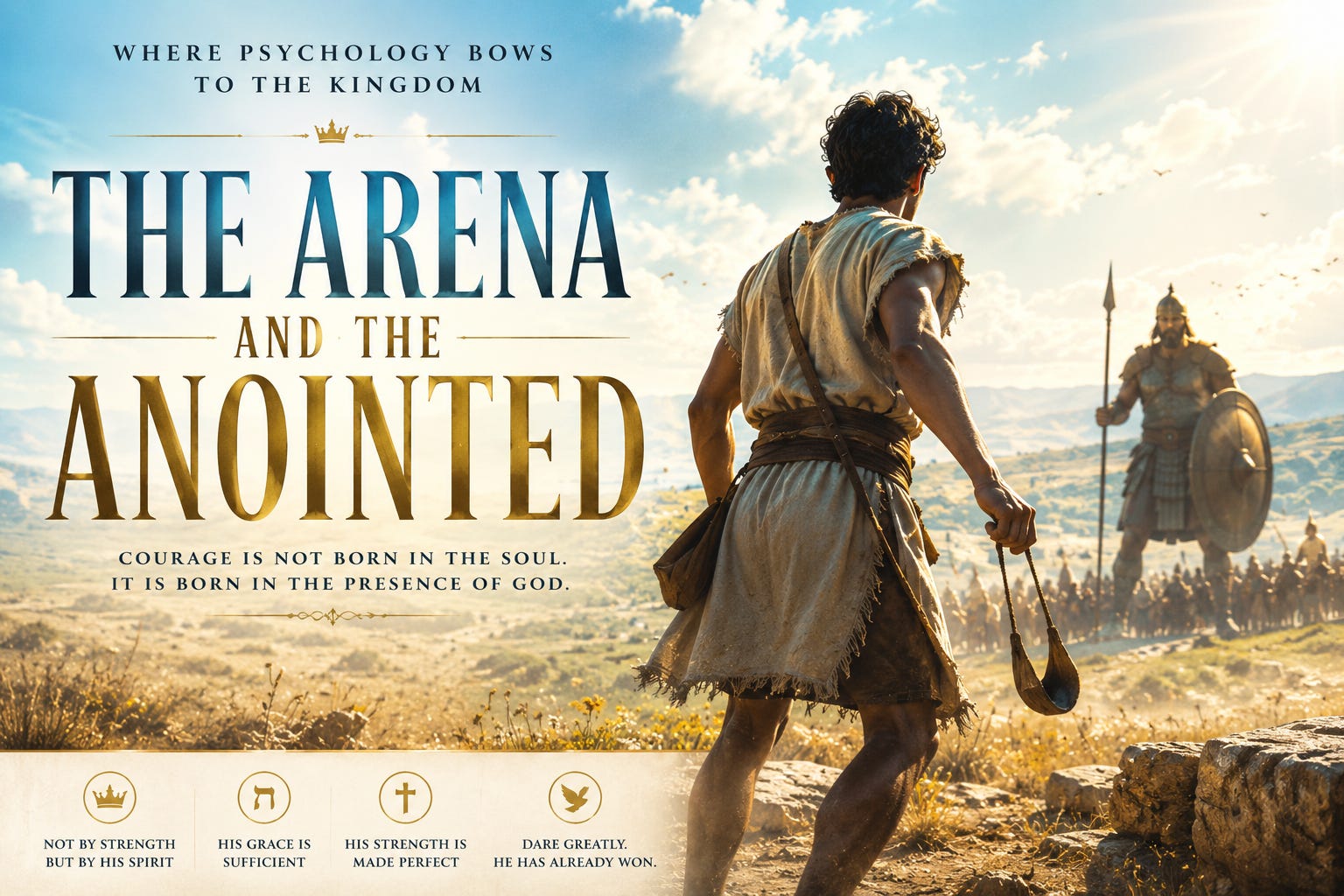
“My grace is sufficient for thee: for My strength is made perfect in weakness.”
— 2 Corinthians 12:9
The modern world has become captivated by the study of courage. Universities devote entire disciplines to understanding resilience. Psychologists seek to explain why some individuals embrace uncertainty while others retreat into the safety of predictability. Leadership experts write volumes describing calculated risk, vulnerability, and perseverance. Historians chronicle the lives of extraordinary men and women who stepped into moments that forever altered civilizations. Theodore Roosevelt immortalized “the man in the arena,” and more than a century later, Dr. Brené Brown helped an entire generation recover the language of vulnerability, arguing persuasively that courage is born wherever men and women are willing to risk failure, criticism, and rejection for something greater than themselves. Their observations have served many people well, for common grace often permits humanity to discover fragments of truth through careful observation. Yet observation is not revelation, and description is not origin. The Kingdom of God does not begin by asking what courage looks like. It begins by revealing where courage comes from. Before psychologists measured it, before philosophers debated it, before presidents celebrated it, Heaven had already declared its source.
The first arena in human history was not a battlefield strewn with weapons nor a coliseum surrounded by spectators. The first arena was a garden, and the conflict that unfolded there established the pattern for every arena mankind would ever encounter thereafter. Adam stood beneath the trees of Eden surrounded by abundance, fellowship, innocence, and the uninterrupted presence of God. Yet into that sanctuary entered another voice, subtle in its approach but catastrophic in its consequence. The serpent did not begin by attacking Adam’s strength. He questioned God’s Word. The battle was never fundamentally about fruit. It was about authority. It was about whether man would order his life beneath the revealed Word of God or elevate another voice above it. Every arena that has appeared throughout redemptive history is but another manifestation of that original confrontation. Every temptation, every calling, every act of obedience, every opportunity to compromise, every summons to sacrifice, and every divine assignment ultimately asks the identical question first whispered beneath Eden’s branches: Whose voice will govern your obedience?
It is precisely at this point that theology begins where psychology necessarily ends. Psychology possesses remarkable abilities to observe behavior, identify emotional patterns, measure physiological responses, and explain many of the mechanisms through which fear influences human decision-making. Such observations deserve appreciation, for truth discovered through honest inquiry remains truth. Yet psychology cannot answer why courage possesses eternal significance. It cannot explain why sacrifice is honorable, why righteousness should be preferred over convenience, or why obedience carries everlasting consequence. Those questions belong not to anthropology but to theology. They belong not to the study of humanity but to the revelation of the Creator. Scripture consistently presents courage, not as confidence in human capacity, but as confidence in the immutable character of God. The believer acts courageously, not because he possesses unusual strength, but because he has become persuaded that the One who has spoken cannot lie, cannot fail, cannot abandon His covenant, and cannot be overcome.
This distinction appears repeatedly throughout Scripture, where the language itself carries theological depth that is often obscured by translation. When Joshua stood upon the eastern banks of the Jordan River following the death of Moses, he faced an assignment that would have overwhelmed any ordinary leader. Before him stood fortified cities, experienced armies, and responsibilities that no man would naturally desire. Yet the Lord did not instruct Joshua to cultivate greater self-confidence. He commanded him, “Be strong and of a good courage.” The Hebrew verb translated as “be courageous” is אָמַץ (’amats). This word means to become firm, to strengthen oneself, to seize hold of one’s resolve, and to remain immovable despite overwhelming resistance. The command was never psychological. It was covenantal. Joshua’s confidence was not to arise from his own abilities but from the certainty that God would remain faithful to every promise He had previously spoken. Biblical courage has never been emotional optimism; it is theological conviction. It is the settled persuasion that the promises of God establish reality long before circumstances appear to confirm them.
This principle explains why the Kingdom of God continually calls ordinary men and women into assignments that exceed every measurable qualification they possess. Noah was commanded to construct a vessel for a judgment no generation had ever witnessed. Abraham departed from Ur possessing neither a map nor an itinerary, sustained only by the promise that God would reveal the destination in His appointed time. Moses confronted Pharaoh carrying nothing more impressive than a shepherd’s staff, while Gideon watched the Lord intentionally reduce his army until victory could no longer be attributed to military superiority. Esther approached a king whose laws authorized her execution. Daniel opened his windows toward Jerusalem, knowing the lions awaited him. In every generation, God deliberately called His servants beyond the boundaries of self-sufficiency because divine power is most clearly revealed where human adequacy has reached its absolute limit. Heaven has never required perfect circumstances before issuing divine assignments. It has only required obedient hearts willing to believe that God’s presence outweighs every visible obstacle standing before them.
The Apostle Paul understood this mystery more profoundly than perhaps any other servant of Jesus. Modern readers often admire Paul’s theology while overlooking the remarkable arenas through which that theology was forged. His apostleship was not cultivated within the comfort of academic reflection but within prisons, shipwrecks, beatings, betrayals, sleepless nights, hunger, cold, persecution, and relentless opposition. When Paul catalogs these experiences in his second letter to the Corinthians, he is not attempting to inspire admiration for his endurance. He is establishing the theological foundation upon which his understanding of grace rests. It is within this same epistle that Paul unveils the mystery of his thorn in the flesh, describing how he pleaded three separate times for its removal, only to receive an answer that forever transformed Christian understanding of weakness. The Lord responded, “My grace is sufficient for thee: for my strength is made perfect in weakness.” The Greek verb τελειόω (teleioō), translated as “made perfect,” signifies bringing something to its intended completion, maturity, and fullest expression. God’s power was not compensating for Paul’s weakness. His weakness became the very theater in which God’s divine strength reached its highest manifestation. Paul therefore concluded that he would gladly boast in his infirmities because every limitation he possessed became another opportunity for Jesus to reveal His inexhaustible sufficiency.
Long before Paul articulated this mystery, Isaiah had already prepared Israel to understand it. The prophet declared, “He giveth power to the faint; and to them that have no might He increaseth strength.” The Hebrew word יָעֵף (ya’ef), translated “faint,” describes one who has become exhausted, depleted, and emptied of every remaining resource. The Lord does not despise such weakness because it exposes the illusion of self-sufficiency that so often competes with faith. Human pride continually attempts to convince us that our greatest asset is our strength. Scripture consistently declares the opposite. Our greatest strength is discovering the limits of our own ability, for it is only when the reservoirs of self-reliance have been exhausted that the rivers of God’s sufficiency begin to flow unhindered. The arena was never created for man to display his strength. It was ordained for God to display His own.
If ever there was a man who understood that truth, it was David. The Valley of Elah was not transformed because a shepherd entered it. It was transformed because one man interpreted the battlefield through covenant while everyone else interpreted it through fear. Israel saw a giant. David saw an uncircumcised Philistine. Israel measured military superiority. David measured the faithfulness of God. Everyone else allowed the facts to define reality. David allowed the promises of God to define the facts. Faith never denies what stands before it; faith refuses to grant circumstance the final authority. The arena belongs to those who see through the eyes of covenant rather than the calculations of men.
Yet even David’s courage pointed beyond itself. Another Shepherd would one day walk into a far greater arena. In Gethsemane, the Second Adam succeeded where the first had failed. At Calvary, the Son of God entered the greatest conflict in history, not with a sling, but with a cross. There, sin exhausted its fury, death spent its sting, and hell unleashed every weapon at its disposal, only to discover that obedient love is stronger than the grave. Jesus Christ did not show us how to enter the arena, only. He entered it first, conquered every enemy that stood against us, and now calls His Church to walk in the victory He secured.
David did not enter the valley because he wore Saul’s armor. He entered because the anointing he had received in secret was greater than the armor he refused in public.
Somewhere before every believer stands an arena; it may be a conversation you have delayed, a calling you have resisted, a sacrifice you have feared, or an act of obedience that has waited far too long. Whatever form it takes, the question remains unchanged from Eden until this very hour: Whose voice will govern your obedience? Dare greatly, not because you trust your own strength, but because you trust the God whose strength is made perfect in weakness. The arena has never been the place where heroes prove themselves. It has always been the place where God reveals Himself.
To Learn More About Wendell Hutchins II

Comments
Nothing yet. Say the first thing.
Sign in to join the conversation.