
I’m quite the fraud when it comes to my green fingers. They are sage, not pastoral green. Sure, I adore plants with my eyes and my nose. And communing with them looks like gathering them up from the ground. I take clippings home to brew nettle into tea, turn cleavers into detox tonics, ramp up the flavour in dishes with foraged wild garlic. It’s as natural to me as transforming clay into cakes, masks, and peculiar concoctions in the middle of my school’s playground. Yet, rarely will you find me kneeling on the ground. Shovelling, seeding, pruning, planting. I receive so much from the land, but I have neglected to give nearly as much back.
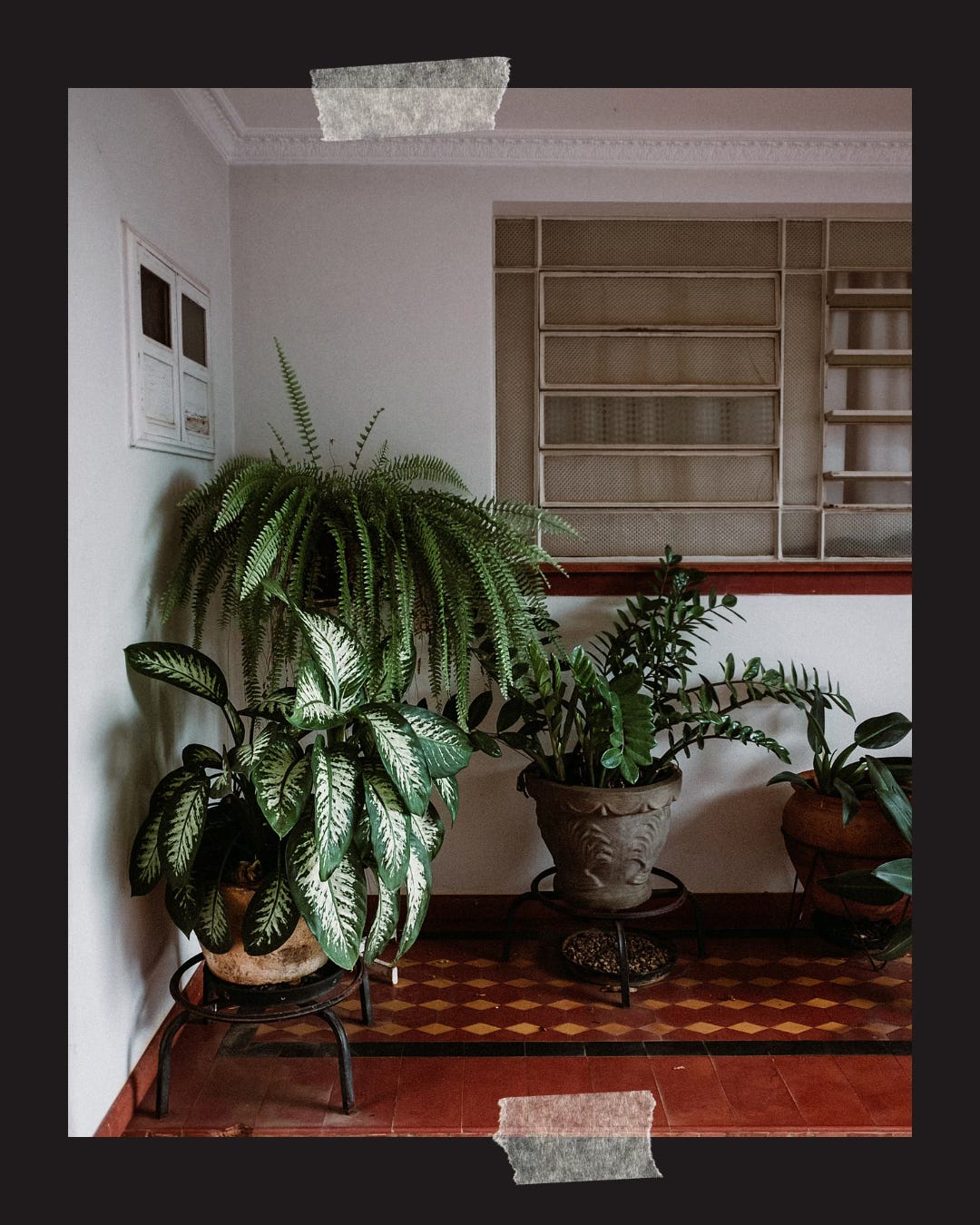
So far my attempts to be a steward of the soil have been limited to caring for a few houseplants I have gathered over the years.
Text within this block will maintain its original spacing when published
Twelve years ago I purchased a dragon tree from Homebase. It’s the one with long, sturdy grassy leaves magnetised by the sun, native to subtropical, dry forests and high-mountain habitats—Cape Verde, Morocco, the Canary Islands—yet makes the perfect indoor plant for me in the UK. They aren’t needy; indirect light, water, and a bit of plant food in their growing season are enough to keep them alive. It’s still alive today.
Have I been a good plant mama to it?
Maybe as good as a half-present father who only shows up in a crisis.
For much of its time with me, its leaves have slumped toward the ground. In a good year, five or six leaves at the top of the plant would stand tall. Whenever I’m in B&Q, Homebase, or passing any garden centre, and spot dragon trees, all their leaves stand up tall, even when displayed in some dark corner at the back of the store.
It must be my soil, right?
I blamed the winters. That’s when 70% of its leaves shed or hang on by their hooks. My ceiling light is a poor substitute. When spring arrives, and I naturally become more attentive, new leaves fill the tree. Although many still droop towards the ground, instead of rising high, saluting the sky.
This year, I stopped, I stared at my dragon tree and thought: Wow you have persevered despite my half-arsed attempt at caring for you.
Right then I used my plant identifier app Picture This to diagnose it. It basically said what I already knew. It needs attention—a wiser plant mama! The brown tips on the leaves were a sign that it’s been underwatered. A result of my listless winters. And rapid drooping of leaves (this happens on occasion) is also down to underwatering, or root rot.
Only God knows how the roots are doing. They haven’t seen the light since the tree was first potted. With that said, I have noticed some creamy tails poking through the drain holes. Given its age, it’s probably outgrown its fourteen-diameter plastic container.
So I googled Natural fertiliser for house plants. I kept forgetting to pick up Baby Bio on my shopping runs and I needed to act fast. I knew I must have something nutrient-dense in my house. The answer was obvious when I think about it now. The sea is the source of many minerals, and tucked away in my kitchen cupboard, I always have kombu for my dashi broths. Kombu is a brown mineral-rich seaweed. Kombu makes me feel alive, and well. Kombu it is!
Straightaway I soaked the kombu knots in filtered water overnight. The next morning I watered from the root, and I kid you not—my dragon tree did not delay its spike back up to the sun. Okay, fine, some leaves were still drooping, but overall it came alive as daisies do at dawn. It must have been malnourished. I was only doing the bare minimum.
Now I've got in the habit of misting my dragon tree to mimic the humidity of summers in Madeira. And, when the midday sun blazes on it, I shift it back into the shadow.
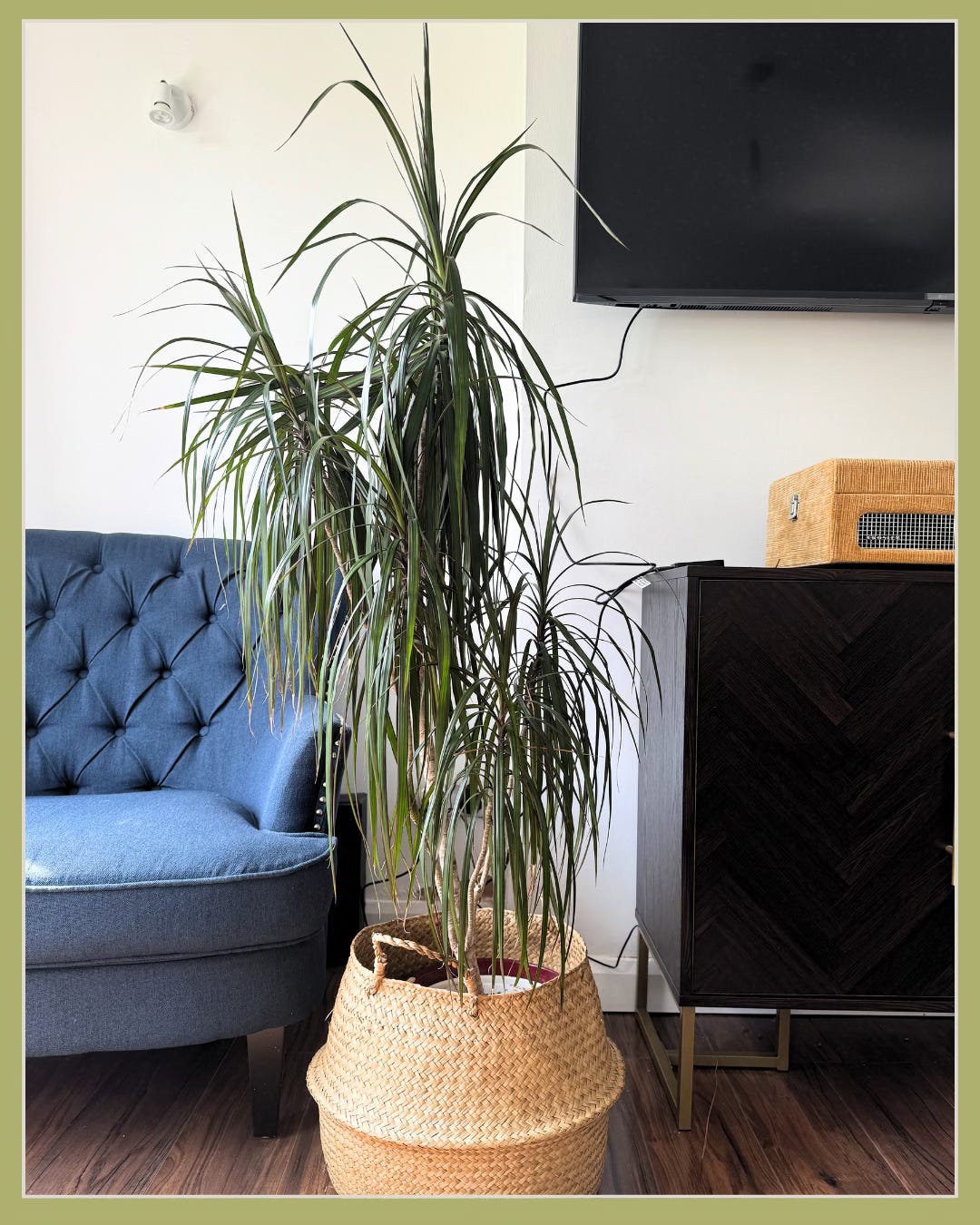
My dragon tree isn’t rotting, and never has (I’ve seen a rotting one; it looks tragic). But for sure, it’s due a repotting. It can reach new heights once rehoused to a larger pot. I find new homes tend to wake us from a slumber we didn’t know we were in. So I’m not entirely clear on why I capped my dragon tree at the height it came to me. I pray someday you’ll rise towards the sun, and stay that way. But I know—there’s so much more I could do for my dear plant existing far from its native home, in the cold, dry Midlands air. I could also propagate to birth sister stems and cousin leaves to bulk out my twelve-year-old tree!
Why is it so hard for me to make room for you to grow? To thrive?
I once repotted a rubber plant, and within a week it lost all its leaves. Perhaps the new soil was empty of all it needed. Maybe I over watered it. Now I think of it, this is what led me to the dragon tree. Going into B&Q, searching for the right soil (with the help of Google), new pots, carrying this load onto a bus, laying down a deconstructed bin liner, searching for sharp scissors to cut the plastic pot, blending the new soil with the old, holding the plant upright while scooping the soil into the pot…watering, was me trying to keep my rubber plant alive.
I also once repotted my global green (a hanging plant), and it became so much fuller, greener and longer, trailing from my ceiling to the laminated floor. It lived long in the corner of my bright bedroom. I’d like to believe it’s still thriving in the new home it went to after leaving it on my flat’s front lawn before I moved.
But hey — only God knows what will happen once I repot my dragon tree.

Dragon Tree (Dracaena marginata)
The Dragon Tree is native to subtropical forests and high-mountain habitats — Cape Verde, the Canary Islands, Morocco — which tells you most of what you need to know about its needs. It wants bright, indirect light, warmth, and occasional misting to offset dry indoor air. It is not a thirsty plant; allow the top inch of soil to dry between waterings, and in winter pull back significantly. Brown leaf tips usually signal underwatering; soft yellowing leaves suggest too much. Feed once a month through spring and summer — a kombu soak (brown seaweed steeped in filtered water overnight) works beautifully as a natural, mineral-rich alternative to proprietary fertiliser. If roots are pushing through the drainage holes, it’s time to repot into a larger container — fresh, well-draining soil makes a quiet but significant difference. One last thing: they are slow growers, and they are survivors. With a little more than the bare minimum, they will show you exactly what they are capable of.

Claiming Your Spot
·
Apr 26
I guided my bike down a bushy, stingy, squeezed path leading to a dead end alive with tangled thorns wrapped around a colony of leaves rising above my head. I had missed my chance to climb the glacier of green spanning well over one hundred yards. I spun my bike around to search for a way onto the clearing. Now off the narrow path, onto the green glitte…
Comments
Nothing yet. Say the first thing.
Sign in to join the conversation.