
“To render the United States independent on foreign nations, for military and other essential supplies.”
— Alexander Hamilton, Report on the Subject of Manufactures, 1791
We have become very good at forgetting where things come from. Perhaps that is because the workshops, furnaces, mines, refineries, and machine shops have gradually disappeared from the daily lives of many people in the West. In their place are air-conditioned offices, financial terminals, cloud platforms, software companies, and screens displaying the astonishing valuations of semiconductor and AI firms.
For years, some of the most sought-after workers in Western economies have been programmers. Their code sits at the top of an enormous industrial structure most of us rarely see.
Imagine that structure as a ladder. Understanding that ladder helps explain much of the technological struggle now unfolding between the world’s major powers.
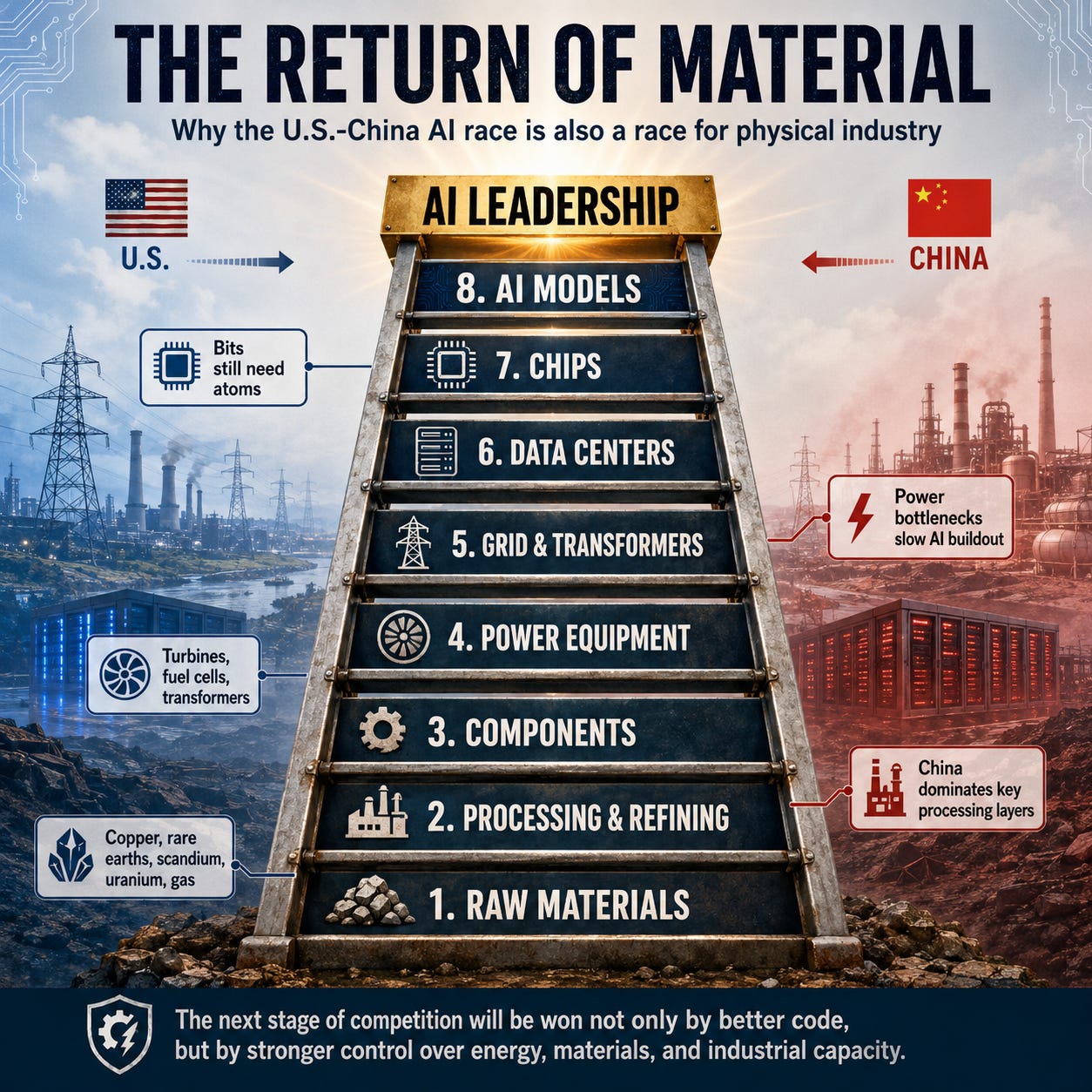
AI systems, social networks, software platforms, delivery apps, search engines, and streaming services occupy the upper rungs. At that level, the world appears almost weightless. We type a command, upload a photograph, request a song, ask a model a question, and something happens. But before anyone can type anything, there must be hardware. Screens. Keyboards. Power connections. Telecommunications equipment. Antennas. Memory. Motherboards. Processors. Go down another rung and the physical world becomes even more obvious. Copper. Aluminum. Silicon. Lithium. Cobalt. Nickel. Rare-earth elements.
And that is still only the beginning.
Take semiconductors, perhaps the most celebrated advanced industry in the world. A semiconductor fabrication plant does not begin with a processor. It begins with extraordinarily reliable electricity, ultrapure water, silicon wafers, industrial gases, specialty chemicals, copper, aluminum, precision machinery, vacuum systems, optics, lithography equipment, and a vast ecosystem of specialized suppliers.
Each of those suppliers, in turn, rests on mining, refining, heavy industry, transportation, engineering, and energy. The supposedly weightless digital economy is remarkably heavy. An advanced chip may depend on raw materials extracted in Africa or South America; energy and industrial inputs from North America and the Middle East; chemicals and silicon wafers from Japan; lithography systems from the Netherlands; optics from Germany; design software and manufacturing equipment from the United States; advanced fabrication in Taiwan and South Korea; and packaging and testing facilities across Asia.
We like to call a chip American, Taiwanese, Korean, or Israeli. That describes an important part of the story, but not the whole system that makes the chip possible. The product at the top may have a nationality. The ladder beneath it usually does not.
And that leads to a basic rule of technological power: you cannot dominate the top of the ladder while remaining indifferent to everything underneath it.
The semiconductor contest is therefore not merely a race to build fabs. It is a struggle over the entire industrial structure beneath them, from mines and electricity to chemicals, machine tools, logistics, and finally the algorithm written by a programmer thousands of miles away.
Semiconductors are only one example. Western consumers live extremely comfortable lives while spending remarkably little time thinking about the industrial systems that make those lives possible. That arrangement worked particularly well during the high era of globalization, when efficiency became the overriding economic objective.
Now imagine a country that wants technological and military power because its geography leaves it little choice. It may have brilliant scientists. Exceptional software engineers. World-class universities. Entrepreneurs capable of imagining entirely new systems. But how does an idea become a machine if the lower rungs of the ladder no longer exist at home?
This is where conventional economic accounting can become misleading. We tend to evaluate an industry by immediate profitability, shareholder returns, employment, or contribution to GDP. Those things matter. But they do not capture everything manufacturing produces. A factory does not merely produce objects. It produces competence.
When a country builds machines, semiconductors, steel, medical equipment, energy systems, aircraft, and defense technology, it is simultaneously developing engineers, technicians, plant managers, suppliers, production processes, repair capabilities, institutional knowledge, and the ability to solve thousands of small physical problems that never appear in a corporate presentation. Manufacturing is one of the ways a nation practices being capable.
A country can keep corporate headquarters, finance, marketing, software, and industrial design at home while moving most production overseas. Initially, the arrangement may be cheaper and more efficient. Twenty years later, however, it may discover that it exported something more valuable than factory jobs. It exported the people who know how to build.
It lost suppliers. Tooling knowledge. Production experience. The ability to troubleshoot. The tacit knowledge accumulated by workers and engineers. And perhaps most importantly, the ability to expand production quickly when a crisis arrives.
Factories are not simply buildings containing machines.
They are repositories of experience.
This is one reason China’s economic strategy deserves to be understood on its own terms rather than through Western accounting alone.
Beijing does not necessarily view manufacturing, energy, critical minerals, batteries, telecommunications, semiconductors, and AI as unrelated sectors competing for capital.
They reinforce one another.
Factories create production knowledge. Production knowledge lowers the barrier to entering adjacent industries. Dense supplier networks make experimentation faster. Infrastructure makes expansion easier. Scale reduces costs. The result can then be used to acquire still more scale.
This helps explain why Chinese companies can move astonishingly quickly across industries that outsiders may regard as separate. Industrial capacity eventually becomes geopolitical capacity. The distinction matters because a country can have a larger GDP than another while possessing a very different kind of economy.
One may generate enormous value through finance, professional services, software, advertising, entertainment, and digital platforms. Another may dominate steel, chemicals, batteries, machine tools, shipbuilding, industrial components, refining, and manufacturing. Both forms of economic activity create wealth. They do not necessarily create the same kind of power. Ask a simple question.
In a severe crisis, which can a country survive without for longer: social media platforms or functioning water systems? Viral videos or electricity? Another financial derivative or the logistics network that delivers transformers, fuel, food, medicines, and replacement parts?
GDP aggregates value. Geopolitics asks what that value can actually do.
One of the clearest signs of this transition is the return of export controls, sanctions, industrial policy, tariffs, and strategic restrictions. These are all symptoms of a global economy being reorganized around security.
In July, the European Union tightened restrictions on entities involved in supporting Russia’s military-industrial system, including companies based in China. Beijing responded almost immediately by restricting exports of dual-use goods to 14 European entities. The important point is not the diplomatic dispute itself. It is why such retaliation has teeth.
China possesses leverage in parts of the lower ladder: materials, components, processing capacity, industrial inputs, and supply chains that foreign manufacturers cannot always replace quickly. A sanction imposed on a company at the top can be answered by interrupting something it needs from below. That is what economic interdependence looks like once globalization becomes geopolitical competition. The same principle is visible in AI.
Chinese companies have released increasingly capable models at extraordinarily low prices, often with weights that developers can download and run independently. This is technological competition, of course. But it can also become economic warfare through abundance.
If advanced intelligence becomes extremely cheap, competitors whose business models depend on charging substantial premiums for access to models face a difficult problem. Lower prices compress margins. Open or inexpensive models reduce switching costs. Customers begin asking why intelligence that cost a fortune yesterday should remain expensive tomorrow. The strategic objective does not have to be destroying a competitor. Sometimes it is enough to commoditize the thing that competitor expected to monetize. Again, the ladder matters.
AI appears to be software. But cheap AI at enormous scale ultimately depends on data centers, chips, transformers, power generation, cooling systems, electrical equipment, fiber networks, and capital-intensive physical infrastructure. The cloud still touches the ground.
That brings us to another emerging conflict.
Across parts of the United States and Europe, communities and governments are pushing back against the construction of large data centers. Residents worry about electricity prices, water consumption, land use, noise, tax incentives, and pressure on local grids. Many of those objections are perfectly legitimate. But governments should understand what is at stake when they make these decisions.

A hyperscale data center is not merely another commercial real-estate development. In an economy increasingly organized around computing power, it is part of national infrastructure. The societies that want AI without power plants, transmission lines, data centers, mines, industrial facilities, and water infrastructure are trying to occupy the top rung after sawing off the ladder beneath themselves. There is no digital economy floating independently above the physical one. There never was.
This framework also changes how we should interpret the confrontation between the United States and Iran. The nuclear program, ballistic missiles, Iranian military capabilities, Israel, and the regional balance are obviously central to Washington’s calculations. But look farther down the ladder. There is the Strait of Hormuz.
A substantial share of the petroleum consumed by Asian economies moves through this narrow maritime passage. China, in particular, has built an enormous industrial system whose continued operation depends on vast quantities of imported energy. Suddenly a conflict that appears on television as missiles, aircraft, nuclear facilities, and diplomacy is also about something much more primitive. The movement of fuel through a narrow stretch of water. That is the bottom of the ladder exerting pressure on the top.
Whoever can influence the security, cost, or reliability of those energy flows possesses leverage extending far beyond the Persian Gulf. Decisions made around Hormuz can affect factories in Asia, shipping markets, insurance costs, energy prices, industrial competitiveness, and ultimately the strategic calculations of governments far removed from Iran. This is why great-power competition cannot be understood by following weapons systems and AI benchmarks alone. The battlefield stretches all the way down.
Manufacturing capacity is itself a source of strength.
That may be one of the most important distinctions in the emerging world order. Because the contest for technological supremacy will not be decided only by whoever writes the best algorithm. It will also be decided by whoever can build the machines, refine the materials, generate the electricity, train the workers, move the cargo, maintain the infrastructure, and keep the entire ladder standing.
Thank you for reading WeissWord. If this argument gave you a different way to think about the technology race, please like the article and share it with someone who might enjoy it.
No posts
Comments
Nothing yet. Say the first thing.
Sign in to join the conversation.