
“Do you never worry?” “Would it help?”
—Rudolf Abel, Bridge of Spies
Saudi Arabia has been locked in a long strategic rivalry with Shiite Iran. For decades, that rivalry has been overshadowed by the possibility that Riyadh, which provided financial support to Pakistan during the development of its nuclear program, might receive assistance or a nuclear security umbrella from Islamabad if Iran ever broke through to a bomb. That ambiguity gave Saudi Arabia a strategic insurance policy. It also signaled to Tehran that an Iranian nuclear breakout could trigger a regional chain reaction.
Since the middle of the twentieth century, various countries have sought nuclear weapons while continuing to develop missile systems capable of carrying nuclear warheads over long distances. Despite the danger of mass destruction, that trend has not stopped. Secret nuclear programs are not always discovered in time. Libya’s program and the reactor built in Syria demonstrated how far governments can advance sensitive infrastructure away from public view, and how much sustained intelligence work may be required to uncover it. It is reasonable to assume that intelligence agencies are still working today to identify programs and capabilities that have not yet been exposed.
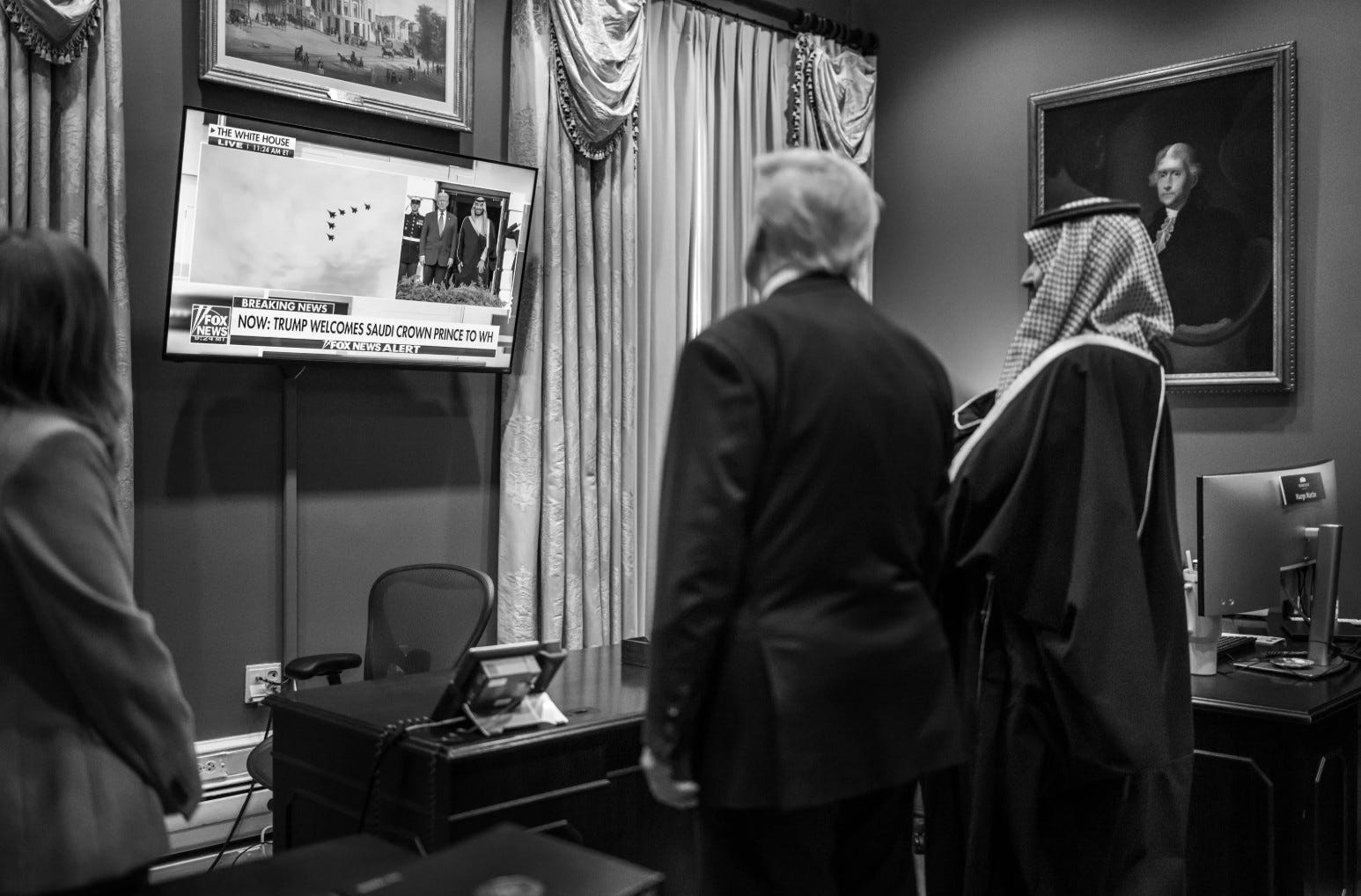
If we look east from Israel, we find a region in which Russia, China, North Korea, India, and Pakistan already possess nuclear weapons. For that reason, Iran’s nuclear question may not necessarily disappear even if a more moderate, Western-friendly government eventually comes to power in Tehran. The desire for nuclear capability does not stem only from the nature of the Islamic regime. It is also rooted in deeper considerations of national security, regional status, and strategic independence.
Iran sought to establish a broad nuclear program and gain control over sensitive parts of the fuel cycle even under the shah. There is no conclusive evidence, however, that the shah made a final decision to develop a nuclear bomb. After the 1979 revolution, and especially following the Iran-Iraq War, the American military presence in the region, Israel’s widely reported nuclear capability, and the experience of North Korea strengthened the belief in Tehran that nuclear capability could provide deterrence and help guarantee the survival of the regime.
Through investments of billions of dollars, and at the cost of sanctions, isolation, and serious economic damage, Iran succeeded in building advanced enrichment infrastructure, accumulating a significant stockpile of enriched uranium, and gaining technical experience that has brought it close to nuclear-threshold status. The lesson Iran’s leaders may draw from North Korea is clear. A country with nuclear weapons pays a heavy price, but it also enjoys a degree of protection from outside attempts to overthrow its government.
Iran’s progress is not taking place in a vacuum. It affects Saudi Arabia first and foremost, as Iran’s principal regional rival. From Riyadh’s perspective, a nuclear Iran would not merely be another country possessing weapons of mass destruction. It would be a hostile Shiite power able to operate across the region under the protection of a nuclear umbrella. Such a capability could give Tehran greater freedom of action through its forces and allies, while weakening Saudi Arabia’s position as the leader of the Arab and Sunni worlds.
This is why the Saudi nuclear program is not simply an electricity project. Saudi Arabia does have genuine civilian reasons to build reactors. Rising demand for electricity, water desalination, industrial development, and the desire to free up oil now burned for domestic power generation so that it can be exported more efficiently all support the case for nuclear energy. But the program also has strategic value. Building reactors, training engineers, and acquiring knowledge of the nuclear fuel cycle would bring the kingdom closer to an independent nuclear capability, even if it does not currently decide to produce a weapon.
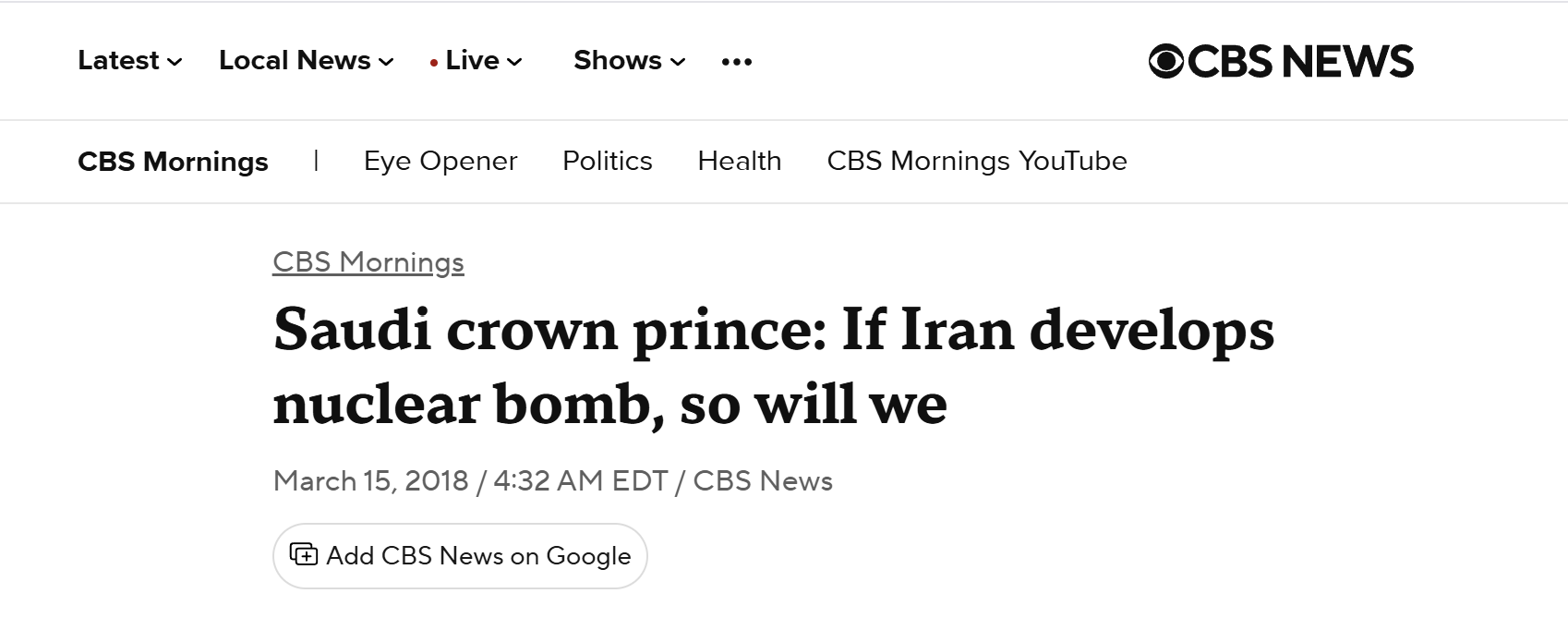
Crown Prince Mohammed bin Salman has made clear in the past that Saudi Arabia does not want nuclear weapons, but that if Iran acquires a bomb, the kingdom will seek an equivalent capability. That is why Riyadh does not want to rely solely on an American promise to supply fuel for its reactors. It wants to preserve its own knowledge, infrastructure, and room for maneuver: an insurance policy in case Iran crosses the threshold, or in case American protection is no longer seen as sufficiently reliable. Saudi officials have repeatedly warned that an Iranian nuclear weapon would force the countries of the region to reconsider how they guarantee their security.
This is the deeper significance of the nuclear agreement with the United States. Saudi Arabia does not need to decide today that it wants a bomb. It only needs to build a civilian program that, under extreme circumstances in the future, could shorten the path toward one. The difference between a civilian energy program and a threshold capability will be determined less by the type of reactor than by who controls uranium enrichment, who supplies the fuel, what happens to the spent fuel, and how extensive and lasting international supervision will be. Saudi Arabia needs nuclear power to generate electricity, but it also needs the nuclear option so that it is not left without an answer to Iran.
Saudi Arabia has real alternatives to American technology, above all China. Beijing has already demonstrated in Pakistan that it can build a broad civilian nuclear program. Four reactors operate at the Chashma site, two large Hualong One reactors operate in Karachi, and another reactor, Chashma-5, is under construction. According to data from the International Atomic Energy Agency, Pakistan has six operating power reactors and one more under construction.
China is a genuine alternative to the United States for Saudi Arabia, not merely a rhetorical threat for use in negotiations. Beijing has proven experience building power reactors in Pakistan, and it can offer Riyadh a broad package that includes planning, construction, financing, fuel supply, workforce training, and the transfer of engineering knowledge. Unlike the United States, China is likely to impose fewer political conditions on matters such as Saudi relations with Israel, human rights, or the alignment of Saudi foreign policy with Western interests.
From Riyadh’s perspective, the Chinese advantage is not limited to the price of a reactor. Cooperation with China could become part of a larger program to develop local industry, mine uranium, train engineers, and build a more independent nuclear supply chain. China may also offer long-term government financing and a faster pace of construction than is common in Western projects. If Washington insists on conditions that Saudi Arabia sees as too restrictive, Riyadh can turn to China and obtain most of the components needed to establish a civilian nuclear program.
The Saudi price would be greater dependence on Beijing, American concern over Chinese access to strategic infrastructure, and deeper tension in relations with the United States. But that price is precisely what makes the Chinese alternative credible. It may not be Saudi Arabia’s preferred option, but it is certainly an option the kingdom can pursue.
The nuclear agreement between Washington and Riyadh is not merely an energy deal. It reflects American recognition that, in a multipolar world, Saudi Arabia has alternatives, and that the United States, despite its power, no longer has a veto over the kingdom’s choices. From Washington’s perspective, the question is not whether Saudi Arabia will develop a nuclear program, but who will shape it.
The decision to move forward with Riyadh is therefore not necessarily a move against Israel. It is an American attempt to remain in the room, set the rules, and prevent China or Russia from taking control of strategic infrastructure that will remain with Saudi Arabia for decades. Israel’s alternative is to negotiate the issue with Washington rather than with Beijing.
Some in Israel are quick to interpret every rapprochement between Washington and Riyadh as evidence that Israel’s standing is eroding. The broader picture points to a more complicated reality. At the same time that the United States is advancing civilian nuclear cooperation with Saudi Arabia, it is deepening Israel’s integration into its defense research, development, procurement, and production systems.
Washington is not replacing Jerusalem with Riyadh, nor is it giving Saudi Arabia priority over Israel. It is pursuing two separate tracks according to its own interests. With Israel, it seeks to strengthen a deep defense and technology partnership. With Saudi Arabia, it seeks to prevent China or Russia from taking control of strategic infrastructure that will influence the Middle East for decades.
Instead of treating every American move in the region as a sign of abandonment, it makes more sense to understand it as the policy of a great power trying to preserve influence over several centers of power at the same time. The agreement with Riyadh is not evidence that Israel has lost its place. It is evidence that the United States is not willing to lose Saudi Arabia as well.
At the same time, the U.S. House of Representatives approved defense legislation pointing in the opposite direction: not away from Israel, but toward a deeper and more institutionalized defense and technology partnership with it. Section 219 proposes appointing a senior official in the Department of Defense whose role would be to coordinate cooperation with Israel in research, development, testing, evaluation, technology integration, and industrial collaboration.
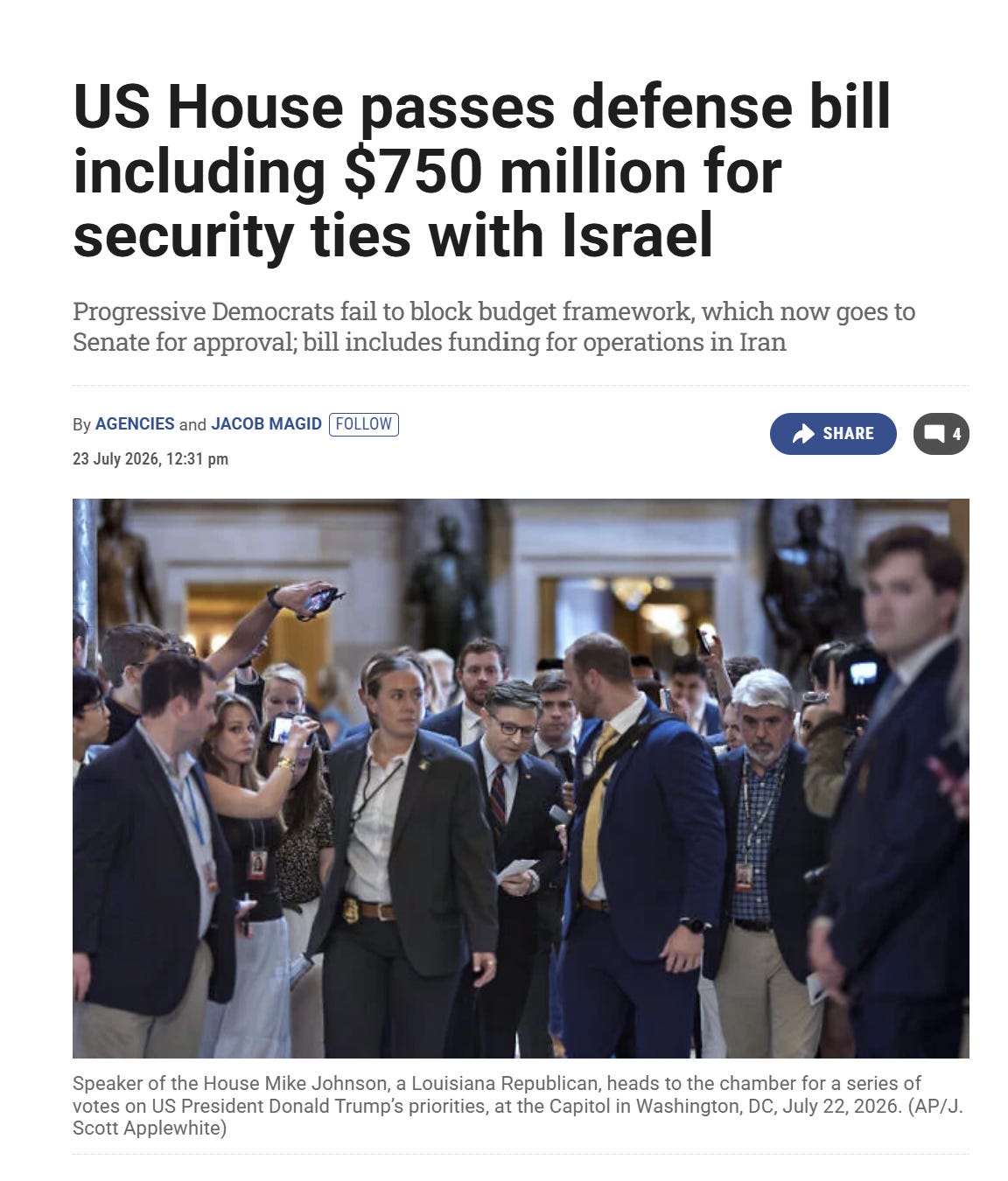
The proposal does not stop at joint research. It seeks to create frameworks for joint ventures, licensing agreements, and co-production in the United States with Israeli industry. It also calls for coordination with central parts of the American defense establishment, including the Missile Defense Agency, DARPA, the Defense Innovation Unit, the military services, and Space Command, in order to avoid duplication and make Israeli technologies part of the American system itself.
It also proposes joint exercises and mechanisms for sharing information, so that technologies developed together do not remain in the laboratory but are ready for operational use.
Alongside Section 219, the legislation includes an extension of the authority concerning the American emergency stockpile held in Israel, continued cooperation against underground threats, and an extension of the research and development program against unmanned systems through the end of 2029.
This is not a formal defense alliance, nor is it an automatic American commitment to go to war on Israel’s behalf. But the cumulative meaning is clear: Israel is seen not only as a recipient of aid, but as a technological and industrial partner whose systems and innovations may be integrated into Pentagon programs.
Israel’s challenge is not to prevent the United States from acting according to its own interests, but to make sure Israeli interests are included within them. Panic is not a strategy, and a sense of abandonment is not a substitute for understanding reality. In a multipolar world, influence is preserved through intelligent participation in shaping agreements, not by denying that the other side has alternatives.
The American struggle over Hormuz is not only against Iran. It is also against China.
I want you to connect the dots.
The Houthis did not act against Saudi Arabia after October 2023.
Not when Iran was attacked in June 2025.
Not when Iran was attacked again in February 2026.
What changed? The rapprochement between the United States and Saudi Arabia, and the announcement of the nuclear agreement. China needs the Strait of Hormuz to remain open. Saudi Arabia is one of its largest oil suppliers. Not Iran.
China has invested heavily in its relationship with Riyadh. Between 2005 and June 2024, Chinese projects in Saudi Arabia totaled approximately $53.9 billion, with more than $31 billion invested since the launch of Vision 2030 in 2016.
Since 2021, China has become the largest source of investment commitments for new factories, facilities, and infrastructure in Saudi Arabia, reaching approximately $21.6 billion by the end of 2024. By comparison, the United States ranked second with about $12.5 billion.
The deeper China moves into Saudi infrastructure, energy, industry, and technology, the greater Riyadh’s bargaining power becomes in its dealings with Washington. The United States understands very well that if it leaves an empty space, someone else is ready to fill it. The construction of nuclear energy facilities by the United States rather than China would be seen in Beijing as a serious blow to its interests.
The timing raises a question. Just as the United States and Saudi Arabia are deepening their cooperation, the Houthis are once again threatening Riyadh. The move may be intended first and foremost to serve Iran’s interests by demonstrating that every Saudi move toward the United States carries a price.
From China’s perspective, the picture is more complicated. Beijing does not want to destabilize Saudi Arabia, which is a central economic and energy partner. But it also does not want to see Riyadh move deeply back into the American camp. The Houthis are supported by Iran, which in turn is supported by China. The friends of friends are acting against Riyadh because Riyadh is moving closer to their direct rival. That does not necessarily mean that China is directing the Houthis. But the strategic alignment is difficult to ignore.
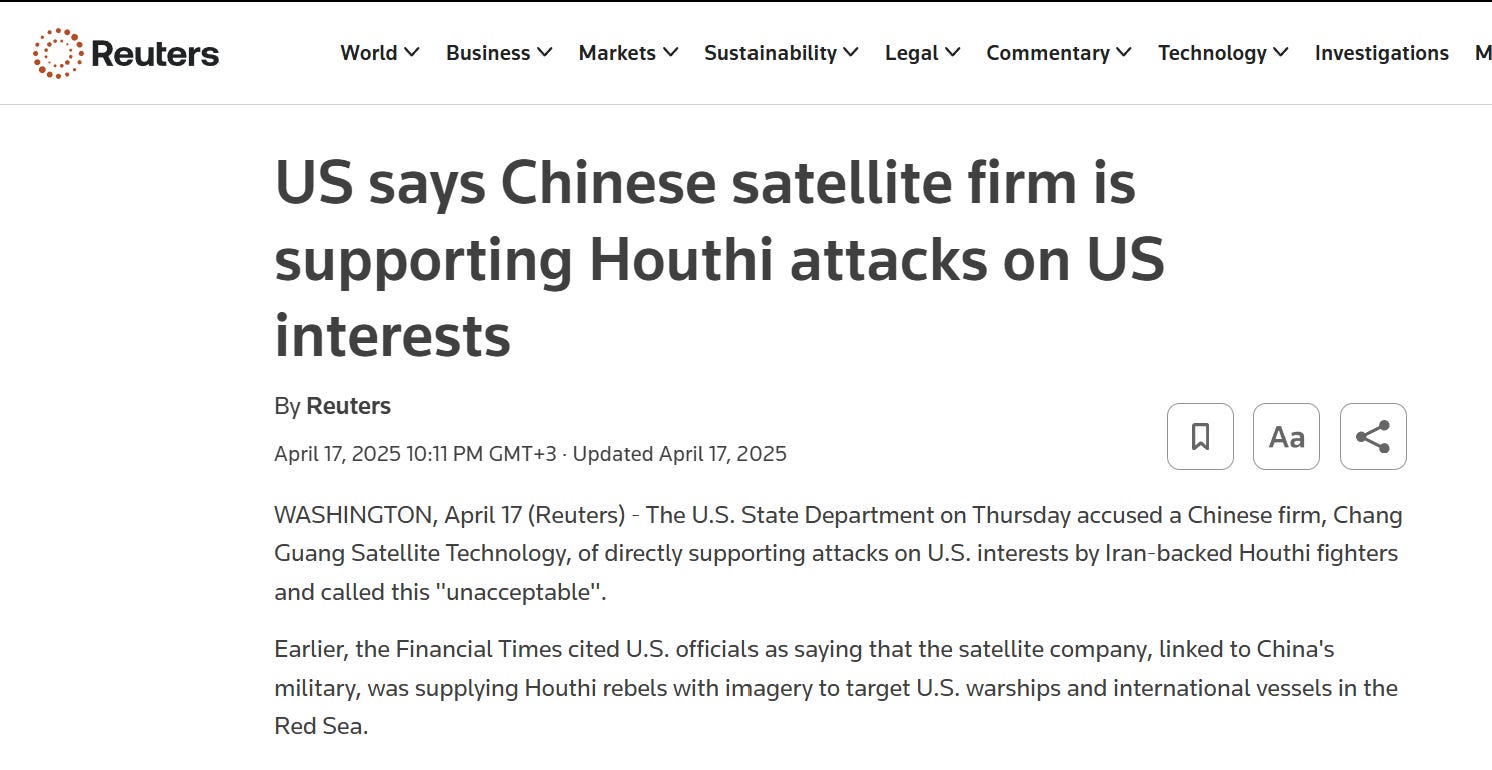
In 2025, the U.S. State Department accused Chang Guang Satellite Technology of providing the Houthis with satellite imagery that helped them monitor maritime activity in the Bab el-Mandeb Strait and direct attacks against commercial vessels and American ships. According to an analysis by the Hudson Institute, the company continued its activity even after Washington raised the matter with Beijing.
What we are seeing today in Ukraine resembles, to some extent, what is beginning to happen in the Middle East.
Instead of defeating the enemy in a direct confrontation, the goal is to turn its strategic rear into the battlefield.
Ukraine cannot conquer Russia, so it attacks oil refineries, weapons factories, warehouses, ports, and logistical infrastructure. Its goal is not only to cause physical damage, but to undermine the sense of security, increase the cost of the war, and force Moscow to defend thousands of miles of territory behind the front. The Houthi threat to Saudi Arabia follows a similar logic. It is not necessarily an attempt to destroy the Saudi economy. It is an attempt to impose costs.
It is enough for shipping companies to change routes, insurance companies to raise premiums, and investors to price in a higher level of risk. In a world where infrastructure, ports, and supply chains have become legitimate targets, the threat itself can sometimes be almost as valuable as the attack.
The nature of war is changing
Power is no longer measured only by the number of tanks or aircraft a country possesses. It is also measured by the ability to turn an opponent’s economic rear into an active front. That is exactly what Ukraine is trying to do inside Russia, and what the Houthis are trying to do against shipping and the Saudi economy.
Thank you for reading. If you enjoyed the article, please like it and share it with others.
No posts
Comments
Nothing yet. Say the first thing.
Sign in to join the conversation.