
Disclaimer: This blog reflects my personal opinion and does not constitute legal advice.
A one-page statement has been collecting signatures at wemustactnow.ai, hosted by Stanford’s Digital Economy Lab, under the title “We Must Act Now.” The signatories include 16 Nobel laureates and researchers from the most prestigious institutions in the field, among them Stanford, MIT, Harvard, and Princeton. The statement makes three claims, quoted here in full:
“AI may become radically more powerful over the next 10 years.”
“This could drive an unprecedented transformation of our economy, larger than the Industrial Revolution, but unfolding over a vastly shorter time frame. It could bring risks, including large-scale job displacement, as well as opportunities such as major gains in living standards.”
“Economists, policymakers and technology leaders must act now to understand the economics of transformative AI and to build the incentives, guardrails, and institutions needed to steer AI in a direction that complements humans and benefits society.”
The sense of urgency is clear: we must act now.
BUT HOW?
During the past six weeks, the leaders of three leading American frontier AI labs offered three concrete proposals.
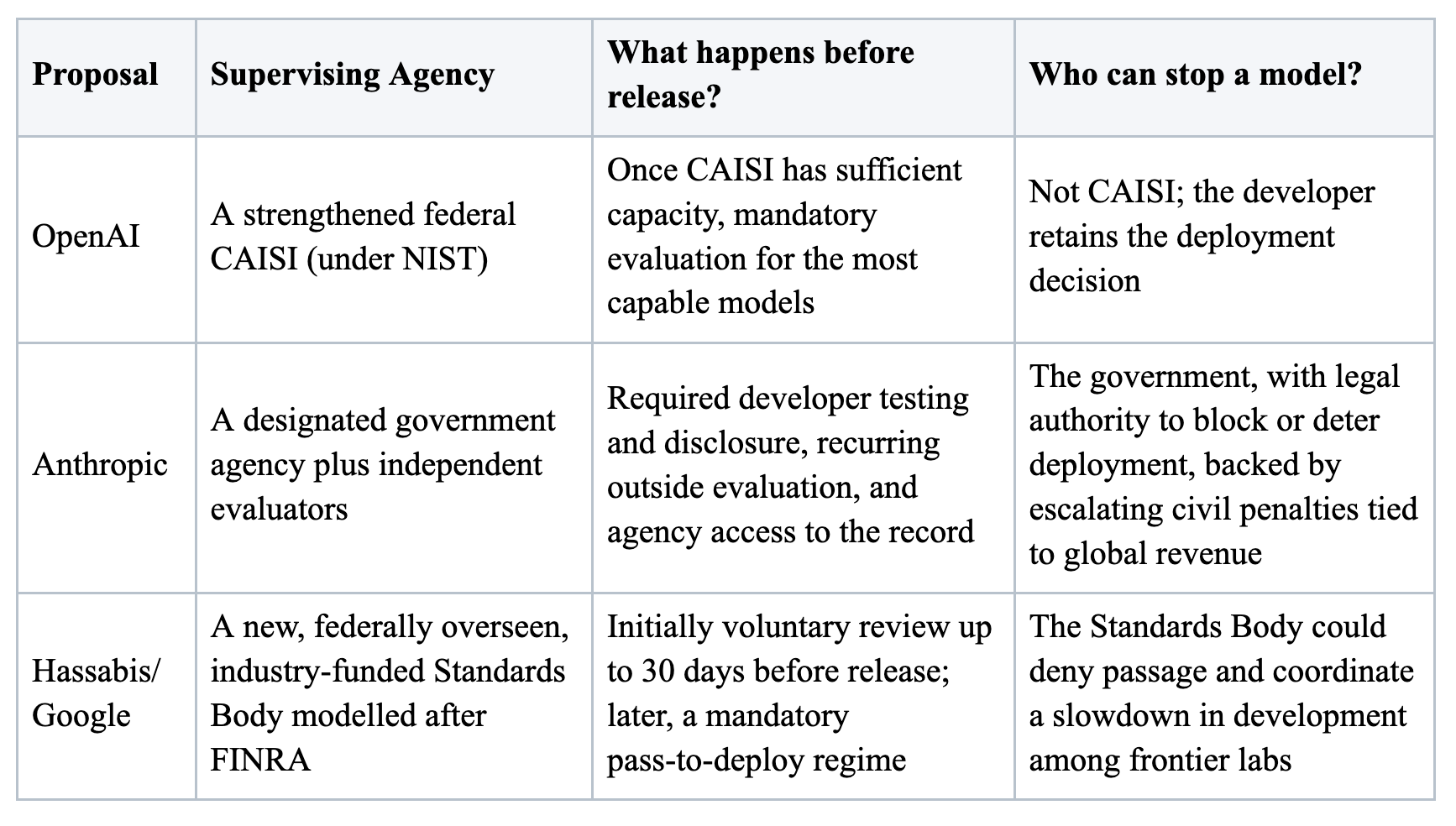
OpenAI‘s June Democratic Governance of Frontier AI calls for a federal statute, a strengthened Center for AI Standards and Innovation (CAISI), an eventual requirement for pre-release evaluations, and a broader national resilience strategy.
Anthropic‘s June Policy on the AI Exponential, together with its more detailed Advanced AI Framework, calls for independent evaluations, civil penalties, and government authority to block or restrict models that pose catastrophic risks.
On July 14, Demis Hassabis, the co-founder and chief executive of Google DeepMind, published A Framework for Frontier AI and the Dawning of a New Age, proposing an industry-funded Standards Body modeled on the Financial Industry Regulatory Authority, or FINRA.
All three proposals advocate for new obligations on a small class of frontier AI providers rather than the broader software ecosystem. All three call for testing of catastrophic biological, cyber, autonomy, or loss-of-control risks. All three recognize that self-assessment is insufficient, that standards must change with the technology, and that the government must play a role.
But they give different answers to the important question: who gets to say no to a dangerous model? Take a look at the summary chart below:
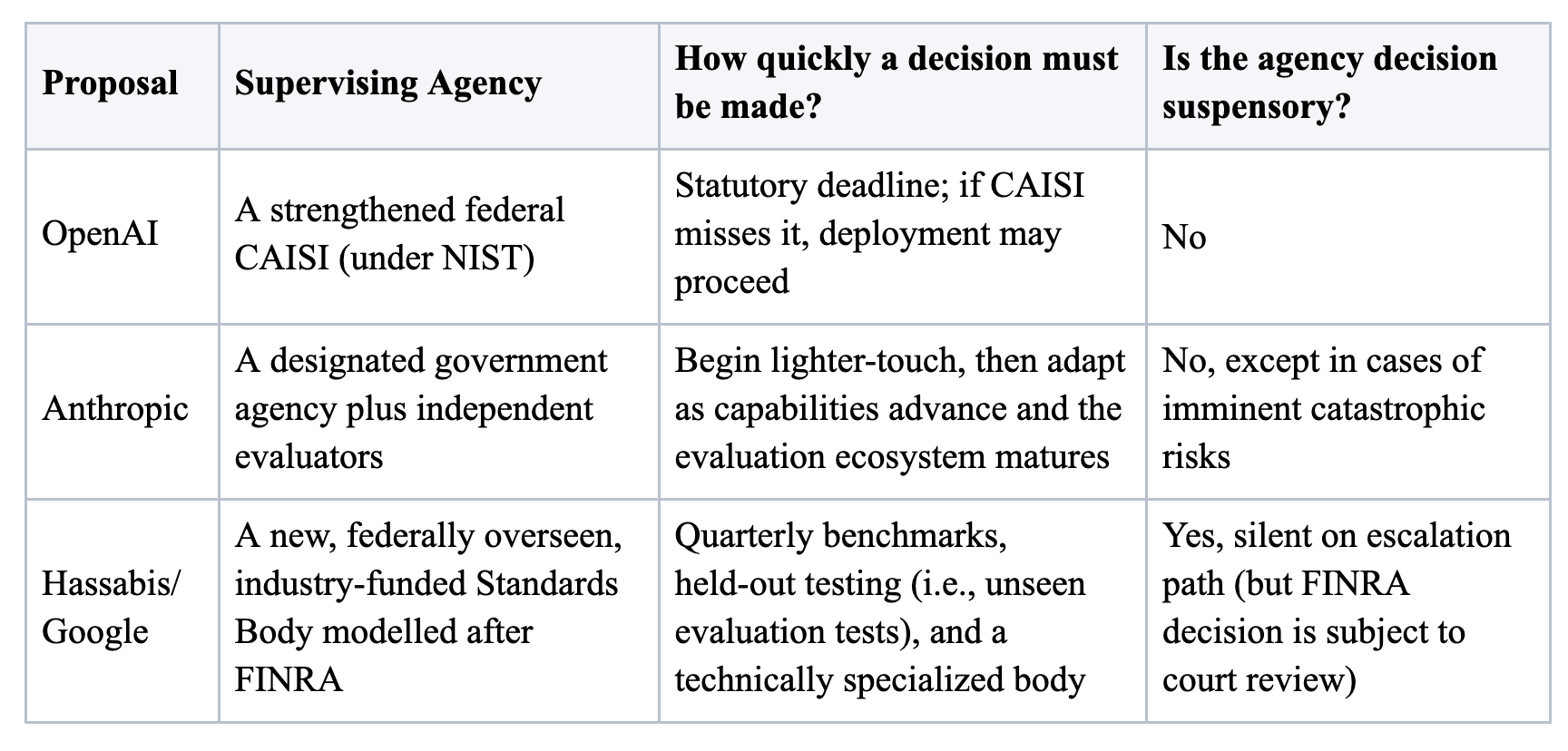
The next important question is: if the agency decides to block a model and the provider disputes it, what happens and how quickly? Here I am going to borrow a legal term from the antitrust world: suspensory. In a suspensory regime, the provider must wait for government clearance or the end of a review period before releasing a model. In a non-suspensory regime, it may release the model first, but the government can later impose penalties or order its withdrawal. Take a look at the summary chart below:
There is an irony in hearing U.S. AI labs ask to be regulated without first acknowledging that they already are. The EU AI Act‘s obligations for providers of general-purpose AI models (which includes OpenAI, Anthropic and Google) have taken effect since August 2, 2025, with enforcement to come as early as August 2, 2026.
Much of what the three proposals seek is already on the list of EU AI Act for ten months, but the EU AI Act asks for more: technical documentation, information to downstream providers, a copyright-compliance policy, a published summary of training content, and, for models with systemic risk, evaluations with adversarial testing, risk mitigation, incident reporting, and cybersecurity.
What had not yet arrived was the enforcement. That will change on August 2, 2026: the European Commission will have the power to request that a provider restrict a model’s availability on the EU market or recall it, backed by fines up to 15 million euros or 3 percent of worldwide annual turnover, whichever is higher.
All three proposals arrived in the two months before that date. The timing allows quite a bit of speculation:
The labs may be trying to move enforcement to the United States, into a body they trust, with the technical depth to evaluate frontier models;
They may be building a counterweight: an American standard designed to prevent the European standard from becoming the global default; or
They may be handing Washington a negotiating position for a potential transatlantic mutual-recognition arrangement, similar to the EU–U.S. Data Privacy Framework.
Whatever the motive, I read these proposals as a step in the right direction. A U.S. system with careful design that balances governance with innovation is good for the world.
Until now, this conversation has been had with scientists, engineers, technology executives and economists. But the unanswered questions are increasingly legal. Who grants a standards body its authority? Who supervises it? What procedures must it follow? When may it delay or block a model’s release? What happens when the government, the standards body, and the developer disagree?
These are not new questions. The U.S. legal system has spent 250 years developing principles governing delegated power, due process, administrative review, judicial oversight, and conflicts of interest. We also have experience with self-regulatory organizations such as FINRA, institutions that use industry expertise but operate under public supervision. None of those precedents provides a complete answer, but they give us a place to start.
This work will require legal professionals from many fields: administrative law, constitutional law, antitrust, national security, corporate governance, intellectual property, and international law. Our job is not simply to write restrictions. It is to design a system that can act quickly without becoming arbitrary, protect confidential technical information without becoming opaque, and draw on industry expertise without being captured by the industry it oversees.
The EU has acted, and the labs have now offered their proposals. If the U.S. legal professionals remain on the sidelines, the governing rules will be written by a different sovereignty body or by the AI labs themselves. It is time for lawyers to put on our thinking caps, engage with the technology, and help build a U.S. system worthy of the power it may soon be asked to govern.
For more practical tips on AI governance and innovation, check out GenAI for the Legal Profession: Power User Edition, AI Strategy for Legal Leaders, Atticus AI Habits Workshop and my Fairly AI blogs. Interested in a 1:1 Claude Cowork coaching session? Contact us aicoach@atticusprojectai.org
No posts
Comments
Nothing yet. Say the first thing.
Sign in to join the conversation.