
Disclaimer: This blog reflects my personal opinion and does not constitute legal advice.
Rising token costs have pushed many U.S. and European organizations to increase their reliance on state-of-the-art open-weight models such as DeepSeek and Qwen. On June 16, 2026, another powerful Chinese open-weight model dropped: GLM-5.2.
In my prior blog, I explained the DeepSeek dilemma when DeepSeek first came out in early 2025: the benefits and risks of using DeepSeek. Compared to DeepSeek, GLM-5.2 may be an order of magnitude higher in both benefits and risks.
The benefits of GLM-5.2 are hard to ignore:
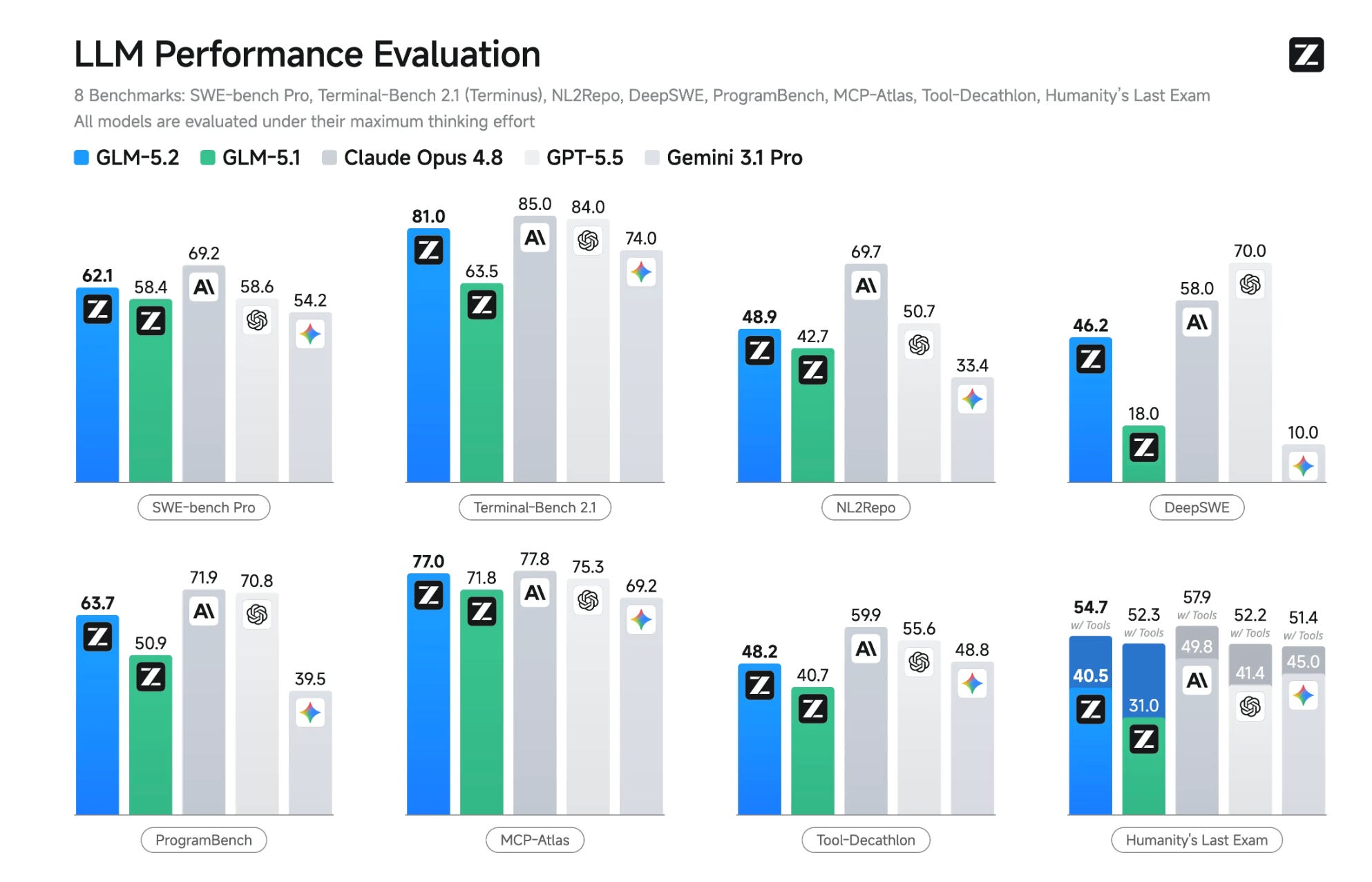
Powerful: GLM-5.2 is a coding and agentic-workflow model with results rivaling state-of-the-art proprietary models. It beats Gemini 3.1-Pro in almost all publicly available reasoning, coding, and agentic benchmarks, rivals Claude Opus 4.8 and ChatGPT 5.5, and supports a 1-million-token context window. See the results published by its provider, Z.ai, and copied below.
Open and Cost-Effective: The model is available under an MIT license, one of the least restrictive open-source licenses. Deploying this model on an organization’s own compute infrastructure avoids the overhead of token-based pricing, offering a lower and more predictable cost structure without sacrificing too much performance.
Easily Accessible: An organization can (1) access GLM-5.2 through its provider Z.ai’s hosted API, which is compatible with common tools such as the OpenAI SDK, vLLM, and Docker; or (2) download the model from Hugging Face and run it on its own AI infrastructure. AI platforms such as Amazon Bedrock and Microsoft Foundry already host a prior version of GLM (GLM-5), and may start offering GLM-5.2 after testing the model for security and compliance.
You may recall that when DeepSeek first came out in January 2025, regulators in Italy, Taiwan, Australia, and South Korea took immediate action, banning its use based on privacy and national-security concerns. Many U.S. federal agencies, as well as state and local governments, followed suit by restricting DeepSeek from being installed on government devices and, in some cases, from being used in government supply chains.
For GLM-5.2, regulators have remained quiet to date. But that silence should not be mistaken for acquiescence. To understand the risk, we need to look more closely at who Z.ai is and why that relationship warrants scrutiny.
The publisher of GLM-5.2 is listed as Z.ai.
However, in the terms of use for GLM-5.2, the party providing the services is listed as “Jingsheng Hengxing Technology Pte. Ltd.“ Let’s call it “Jingsheng”.
Jingsheng, according to a document from the Hong Kong Stock Exchange, is “a company incorporated under the laws of Singapore with limited liability on November 23, 2023, and an indirect wholly owned subsidiary of our Company”.
“Company” is defined as “Knowledge Atlas Technology Joint Stock Company Limited (北京智譜華章科技股份有限公司), a limited liability company established under the laws of the PRC”.
北京智譜華章, when spelled out in Pinyin, is “Beijing Zhipu Huazhang”.
In January 2025, the U.S. Bureau of Industry and Security (BIS) added Beijing Zhipu Huazhang Technology Co., Ltd. and several related Zhipu entities to the so-called “Entity List” due to their military ties. Under the BIS rule, “A license is required for all items subject to the EAR, with a license review policy of a presumption of denial.”
In addition, the EAR has separate military end-use and military end-user rules for China. These rules restrict exports, reexports, and transfers of certain items subject to the EAR when there is knowledge that the item is intended for a military end use or military end user in China.
In short, the provider of GLM, Z.ai, is a subsidiary of Beijing Zhipu Huazhang, a company subject to the U.S. EAR.
The Export Administration Regulations (EAR) are the U.S. government rules that govern the export and re-export of “items“ that could have dual-use applications (i.e., military and civilian uses). The definition of an “item” under these rules is broad. It covers not only physical products but also software, source code, and even the technical documentation required to build, operate, or repair those items.
In short, these rules prohibit the transfer of technology made in the U.S., located in the U.S. or containing significant U.S. technology to organizations on the “Entity List” or when there is knowledge that the technology is intended for military end use or a military end user in China.
Because the EAR restricts the export of U.S. technology, and GLM-5.2 itself is Chinese technology, the question for a U.S. company should not be framed as: “Can we use GLM-5.2?”
The better question is: “Are we sending U.S. technology to Z.ai, Zhipu Huazhang, or any of their affiliates by using GLM-5.2?”
As mentioned above, an organization can:
Access GLM-5.2 through Z.ai’s hosted API;
Download it from Hugging Face; or
Access it through a U.S. AI platform that hosts GLM-5.2 on U.S.-based infrastructure.
Options 2 and 3 are the lower-risk paths from an EAR compliance perspective. Under these options, an organization is not sending technology, such as prompts, source code, customer data, product specifications, or confidential technical information, to Z.ai, Zhipu Huazhang, or their affiliated entities.
However, EAR compliance is only one part of the compliance analysis. The organization still needs standard security, privacy, customer-contract, and data-governance review.
Using Z.ai’s hosted API is different. If prompts include source code, technical specifications, vulnerability reports, architecture diagrams, customer logs, government data, or controlled technical information, the organization may be creating an export-control issue under the EAR.
For defense, DOD-facing, government, critical-infrastructure, or export-controlled customer environments, organizations should be even more cautious. They should avoid using Z.ai hosted services, Alibaba Cloud, or Alibaba-controlled infrastructure without getting approvals from their organization’s legal and compliance teams.
GLM-5.2 may be powerful, open, and cost-effective, but open weights do not eliminate compliance obligations.
For many organizations, downloading the model and running it in a controlled internal or approved cloud environment is likely the more manageable path, assuming appropriate security, privacy, open-source, export-control, and customer-contract review.
Using Z.ai’s hosted API is a different risk category. U.S. organizations should not send source code, technical specifications, vulnerability reports, architecture diagrams, customer logs, government data, export-controlled information, or confidential customer information through the API without specific legal approval.
For more practical tips on AI governance and innovation, check out GenAI for the Legal Profession: Power User Edition, AI Strategy for Legal Leaders, Atticus AI Habits Workshop and my Fairly AI blogs.
No posts
Comments
Nothing yet. Say the first thing.
Sign in to join the conversation.