
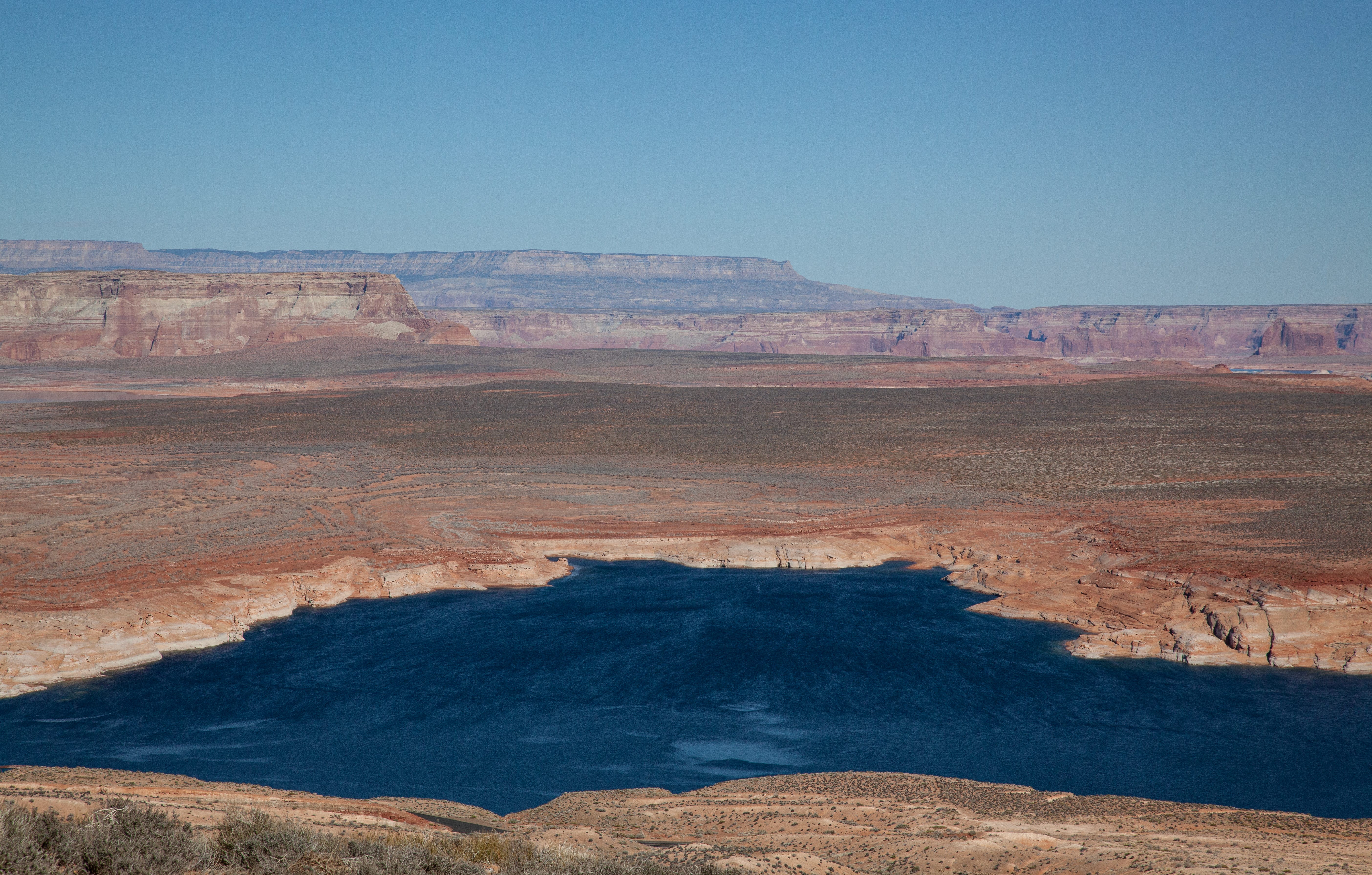
I took this photograph in February 2015, on a trip through northern Arizona with Tera while writing an article for Sojourns Magazine.
We were in Page, moving between Antelope Canyon, Horseshoe Bend, and the enormous landscapes that make that part of Arizona feel almost otherworldly. Along the way, we stopped here.
Water in the desert has a different presence.
Maybe that’s because the land around it makes the contrast impossible to ignore. Rock, dust, distance, heat — and then suddenly this deep blue body of water sitting in the middle of all of it, carrying that sense of an oasis that desert water so often does.
Living in Arizona changes the way you think about water.
You notice when the creeks run.
You notice when they don’t.
You watch the monsoon clouds gather and hope they actually bring rain, and you feel the disappointment when they don’t.
You learn quickly that water is not simply something we can ever take for granted.
Because water is life.
And that is true far beyond the deserts of Arizona.
Scientists searching other worlds look for water because liquid water is one of the strongest clues that a place might be capable of supporting life. Water itself exists throughout our solar system, but Earth is extraordinary because stable liquid water covers most of its surface and has persisted here long enough for life to flourish.
We live on a planet where water falls from the sky.
It moves through rivers.
It collects underground.
It fills our cells.
Every forest, every animal, every crop, every city, every human being who has ever lived has depended on it.
And somehow we have managed to treat it as though it were an unlimited resource.
That’s the part I can’t get over.
The Colorado River is under enormous pressure right now. Arizona is being forced to confront increasingly difficult questions about how much water exists, who gets to use it, and what happens when demand continues growing faster than the system can sustain. State water officials have said plainly that future Colorado River reductions could seriously affect Arizona’s supply.
And at the same time, we keep building more. More subdivisions. More industry. More warehouses. More data centers.
The growth of artificial intelligence is accelerating that last category dramatically. Large data centers can consume millions of gallons of water a day, depending on how they are cooled, while also requiring enormous amounts of electricity. Federal energy researchers are already working on ways to reduce data-center water use because water-intensive cooling creates an obvious problem in places where water is already scarce.
Human ingenuity is one of the extraordinary things about us. But when ingenuity becomes extraction without responsibility, it stops looking like progress.
We can build remarkable things and still destroy the systems that make those things possible.
That isn’t progress.
It’s extraction.
I thought about that again while remembering a moment involving Elon Musk several years ago. In 2021, while Tesla was building its factory near Berlin, Musk was asked about concerns that the plant could strain the local water supply.
He laughed.
Then he laughed again.
He pointed around him and said there was water everywhere, then asked whether the area looked like a desert, and called the concern ridiculous.
The people raising those concerns were not being ridiculous.
The factory was being built in a protected drinking-water area, while residents were warning about the strain it could place on groundwater. After sustained opposition, Tesla reduced its planned water use.
But what has stayed with me is not the engineering argument.
It was the laughter.
Someone asked a serious question about water — one of the fundamental requirements for human survival — and one of the wealthiest people on Earth treated the concern as absurd.
That attitude is bigger than Musk.
It’s the belief that the natural world exists primarily as an input.
Water becomes something industry consumes.
Forests become timber.
Mountains become minerals.
Land becomes real estate.
And if someone asks what happens when we take too much, they are treated as an obstacle to progress.
But nature doesn’t negotiate with balance sheets.
We live within physical limits whether corporations acknowledge them or not. We can drain aquifers, divert rivers, consume more and more, and tell ourselves that growth will somehow solve the consequences later.
But water is not something we can invent our way around.
It’s one of the conditions that makes life possible in the first place.
A civilization can survive just fine without artificial intelligence.
It can’t survive without water.
That shouldn’t be controversial.
And yet here we are.
We’re living through a changing climate that’s already intensifying drought, heat, wildfire, and pressure on water systems around the world. In Arizona, groundwater depletion has become severe enough that land itself is sinking in parts of the state.
At some point, growth has to answer to reality.
The question can’t always be whether we can build something. It also has to be whether we should.
Whether the resources exist. Whether the people who already live there will still have what they need. Whether the ecosystems around us can survive what we’re asking of them. Whether future generations will look back and wonder how we could have understood so much and protected so little.
Water is not an inconvenience standing between corporations and profit.
It’s not an obstacle to technological progress.
It’s not theirs to exhaust.
It belongs to the living world that depends on it.
Which includes us.
When I look at this photograph, I don’t just see water in the desert.
I see something we are extraordinarily fortunate to have.
I see one of the things we search for across the universe because we understand what its presence can mean.
Life.
We can’t keep allowing corporations to exhaust the natural world simply because extracting from it is profitable.
Water is life.
And we should all start treating it that way.
Comments
Nothing yet. Say the first thing.
Sign in to join the conversation.