
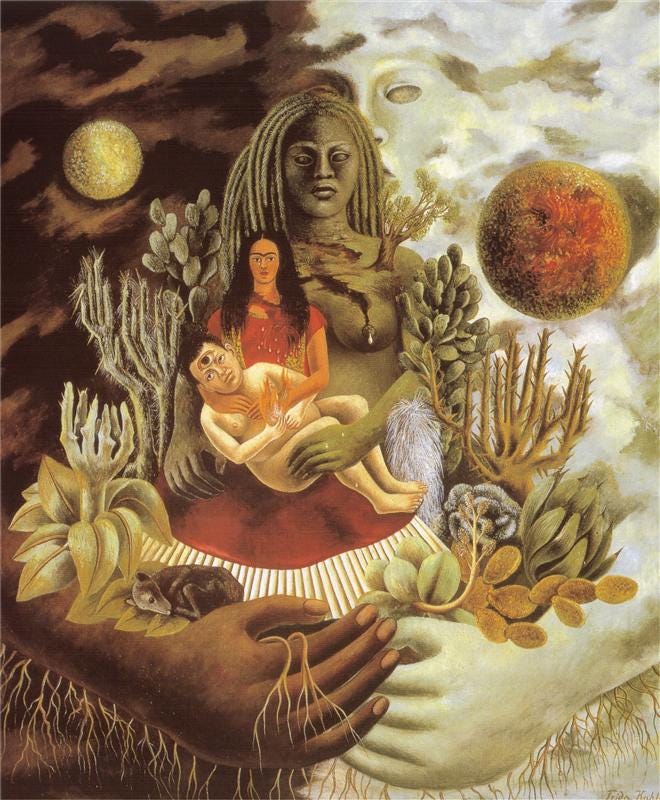
Frida Kahlo, The Love Embrace of the Universe, the Earth (Mexico), Myself, Diego and Señor Xólotl, 1949For by the grace given me I say to every one of you: Do not think of yourself more highly than you ought, but rather think of yourself with sober judgment, in accordance with the faith God has distributed to each of you. For just as each of us has one body with many members, and these members do not all have the same function, so in Christ we, though many, form one body, and each member belongs to all the others. We have different gifts, according to the grace given to each of us. If your gift is prophesying, then prophesy in accordance with your faith; if it is serving, then serve; if it is teaching, then teach; if it is to encourage, then give encouragement; if it is giving, then give generously; if it is to lead, do it diligently; if it is to show mercy, do it cheerfully.
- Romans 12:3-8
Subscribe to receive new posts.

In this passage from Romans, we find a creative description of nonduality: just as each of us has a physical body that benefits by cooperative interactions among separate yet interconnected members (i.e., brain, lungs, skin, heart, etc.), we humans collectively interconnect with each other and can grow in the capacity to see all creation as one body in Christ, a gloriously diversified unity. As our bodies share the life-giving gifts of blood and oxygen, so spiritually we can share Christ’s gifts of love and kindness with one another, freely given and then freely shared in the oneness of Christ. The apostle Paul affirms this oneness in 1 Corinthians 12:12: “The body is one, although it has many parts; and all the parts of the body, though many, are still one body. And so it is with Christ.” This is the ultimate reality yet to be realized in the experience of most of humanity.
Rev. Dr. Jacqui Lewis explains how our oneness is understood in the African concept of ubuntu. The term “comes from the Zulu phrase Umuntu ngumuntu ngabantu, which literally means that a person is a person through other people.” In other words, we are so connected that “what hurts you hurts me. What heals you heals me. What causes you joy causes me to rejoice, and what makes you sad also causes me to weep” (the CAC’s Daily Meditations for February 7, 2022).
Ubuntu speaks to the “delicate network of interdependence with our fellow human beings and with the rest of God’s creation” (Desmond Tutu, God Has a Dream, p. 25). Both ubuntu and St. Paul describe these webs of interconnectedness: we all live and move and breathe and have our being in the Divine.
Richard Rohr puts it this way: “The entire physical world around us, all of creation, is both the hiding place and the revelation place for God … offering grace to any who look deeply.” Even so, we often struggle to love the world and all its inhabitants just as they are. How can we expand the capacity of our hearts and minds? Rohr points out that St. Bonaventure suggests that we “start by loving the very humblest and simplest things and then move up from there. … Don’t start by trying to love God, or even people; love rocks and elements first, move to trees, then animals, and then humans” (The Universal Christ: How a Forgotten Reality Can Change Everything We See, Hope For, and Believe).
Love is a practice, one that is fostered by intention and the silent work of the Spirit through our commitment to contemplative practices.
Meditations
“One of the classic statements of the Church Fathers was that ‘God become human in order that the human family might become God.’ Jesus reveals this Oneness explicitly in his teaching and especially in his last discourse at the Last Supper where he speaks of oneness with God and with each other. He prays for his followers to be one with the same oneness that he has with the Father and the Father with him. Jesus’ Priestly Prayer [John 17] is [a very strong call] to oneness with God. Paul develops this insight in his reflections on the Mystical Body of Christ. Through Baptism and grace each human being is invited to become a new creature in Christ as a cell in his Mystical Body.
“Everything we do in ordinary life cannot be separated from this Oneness. It dwells in us as our deepest self. Little by little, we are meant to develop consciousness of the divine Self by which we were created. …
“The same God is in others as in us. All humans basically are equal and, if they consent, are inserted into the Mystical Body of Christ to serve each other and to build-up the Body of Christ in every possible way.”
- Thomas Keating, That We May Be One: Christian Nonduality
+
It is by grace that you are saved through faith, not by anything of your own, but by a pure gift from God, and not by anything you have achieved. Nobody can claim the credit. You are God’s work of art.
- Ephesians 2:8–10
+
“Life is short, let us just love each other.”
- Daisy Lin, “Drawing from the Wellspring Within”, Tricycle Magazine
+
All religions, all this singing:
One Song.
The differences are just
Illusion and vanity.
The Sun’s light looks
A little different on this wall than
It does on that wall,
And a lot different on this other one,
But it’s still one light.
We have borrowed these clothes,
These time and place personalities
From a light,
And when we praise,
We’re pouring them back in.
- Jelaluddin Rumi in One Song: A New Illuminated Rumi by Michael Green, translated by Coleman Barks
To Practice
Practice The Indwelling One. Meditate on the Hebrew, “Adonai Hu ha-Elohim” (1 Kings 18:39) or an English equivalent, “The One indwells in all.” We are called to remember that everyone and everything that exists is an expression of the One Life we share.
Practice being Nobody Special. In his book, Legacy of the Heart, author Wayne Muller describes how we can check in with ourselves throughout the day to see how often we feel different, separate, and apart from others. He suggests that we also examine our feelings during those times and then imagine that we might be experiencing something ordinary – that we are the same as everyone else. If we feel resistance to giving up the idea that we are special, Muller takes us through a series of questions to find out what possibilities await us if we let go of that resistance.
Practice voluntary displacement: in his book Just This, Richard Rohr recommends “otherness” to free us from our “unquestioned assumptions, tribalism, and self-referential worldviews” that keep us “xenophobic, ethnocentric, nationalistic, and competitive with other world religions.” He encourages us to leave our comfort zones and visit other neighborhoods, churches, synagogues, or mosques to learn and appreciate the diversity of the Mystical Body and what it might mean to truly love our neighbors.
Practice the Welcoming Prayer in the ordinary moments of your day, sinking into and relaxing into the sensations of your body as the challenges of the day unfold, embracing your experience and each moment as it is. Note the effects of this practice.
You may listen to the audio recording of today’s reflection here (about 14 minutes long).
Please share your reflections and comments below. Post prayer requests here. By clicking on the Subscribe link, you can receive email notifications when someone posts a prayer request.
You may be interested in the articles by fellow practitioners in latest issue of the CO NEWS newsletter, now available here.
There are three live Word of the Week prayer groups meeting weekly to support your journey. Each prayer group has a slightly different reflection excerpt, therefore some participants attend more than one. You can use this time zone converter to assist in calculating the prayer groups in your local time.
Tuesday, 9:00-10:00 AM Eastern (New York) Time (UTC/GMT offset -5 hours)
Wednesday, 6:00-7:00 PM Eastern (New York) Time (UTC/GMT offset -5 hours)
For these two groups, use this link to join OR click-on “join meeting,” and enter meeting ID 445 909 4698. When prompted for a passcode, use COL.
Thursday, 8:00-9:00 AM Eastern (New York) Time (UTC/GMT offset -5 hours). This groups meets on Meditation Chapel in the Wisdom Chapel. Use this link to join the group. Be sure to register with Meditation Chapel here if you are not already.
Additional opportunities to support your silent prayer practice and spiritual journey are offered in The Meditation Chapel, a Zoom-enabled, worldwide meditation community. All groups are free and open to all. Read more about groups on The Meditation Chapel here.
No posts
Comments
Nothing yet. Say the first thing.
Sign in to join the conversation.