
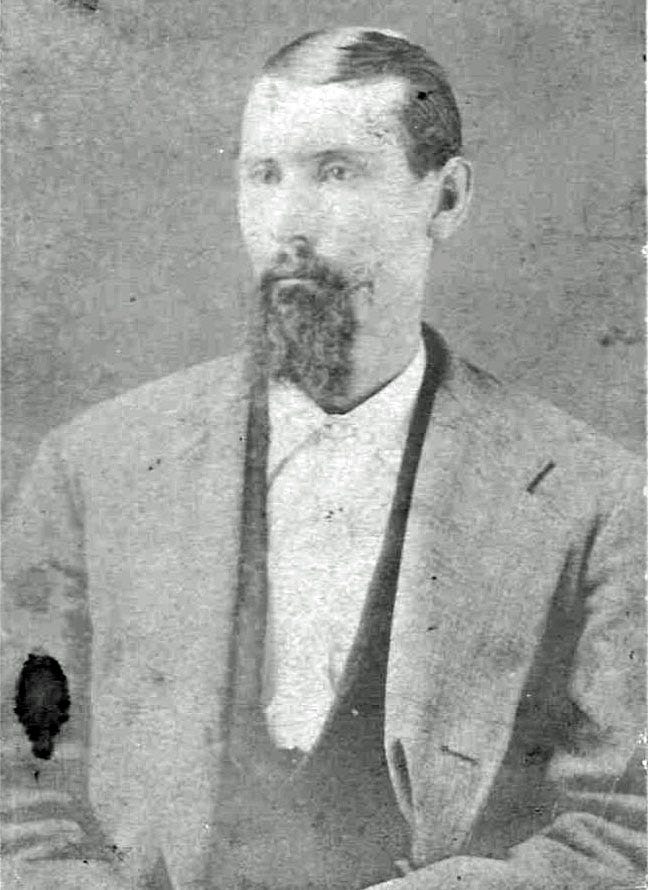
Samuel Walker Brown has been one of my genealogical road blocks since I first learned that he was my ancestor in 2015 after a DNA test revealed that he was part of an unknown branch of my family tree. He is my 4th great grandfather, and I descend from his daughter Betty Brown who was born in 1863 and married Aaron Columbus Davis in Alleghany County, NC, in 1883.
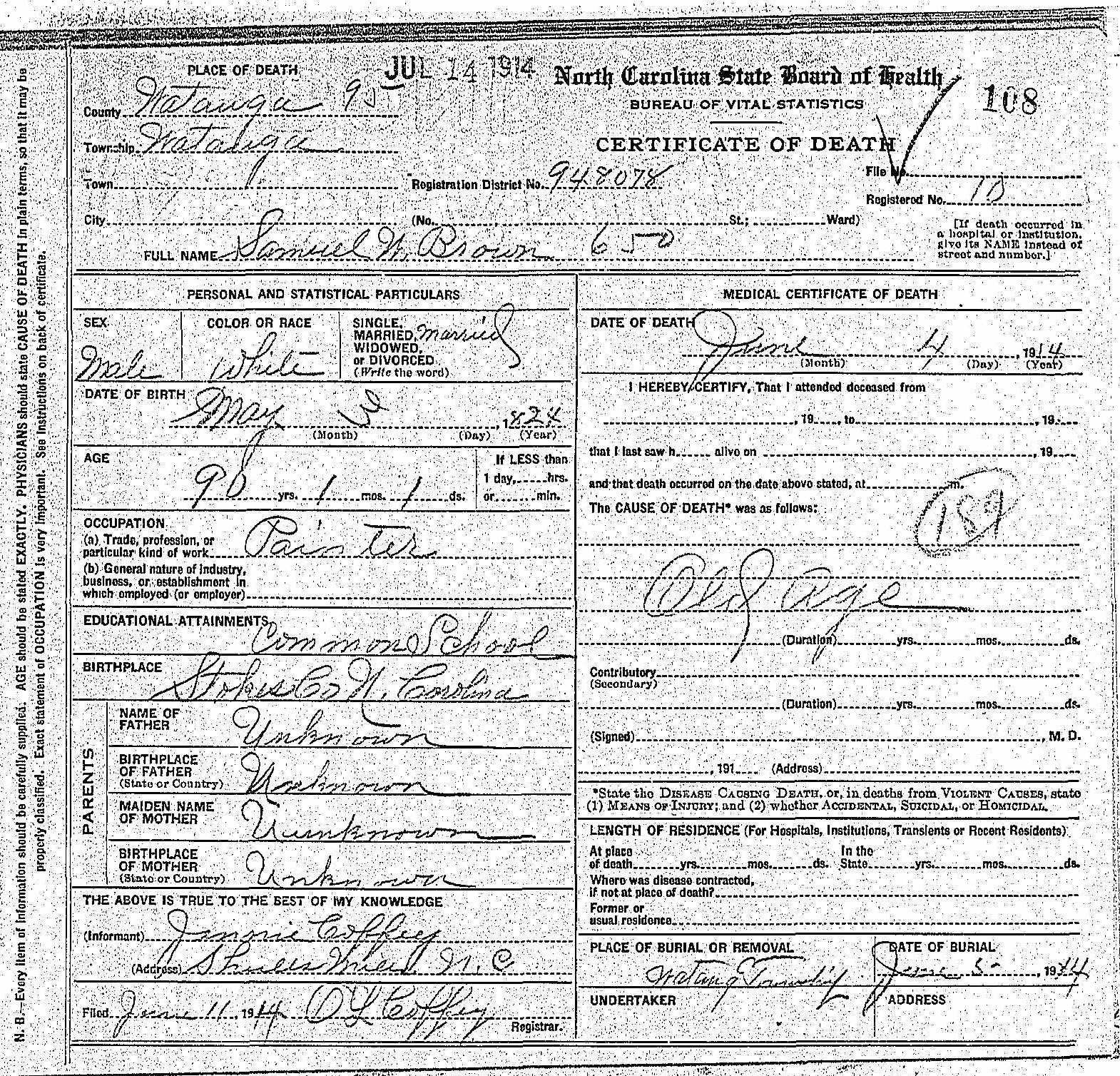
Samuel Walker Brown was born in Stokes County sometime between 1824 and 1834 according to census records and his Watauga County death certificates. That’s right, he had more than one death certificate – three, in fact! North Carolina introduced official county death certificates in 1913, so Samuel’s death in 1914 occurred just as the new system was being implemented.
The first death certificate says he was born on May 3, 1824, in Stokes County and died on June 4, 1914 of old age at 90 years, 1 month, 1 day. He was a painter, and both of his parents were “unknown.” The informant was his daughter Jennie Coffey of Shulls Mills, which is near Blowing Rock. He was buried in Watauga Township on June 5.
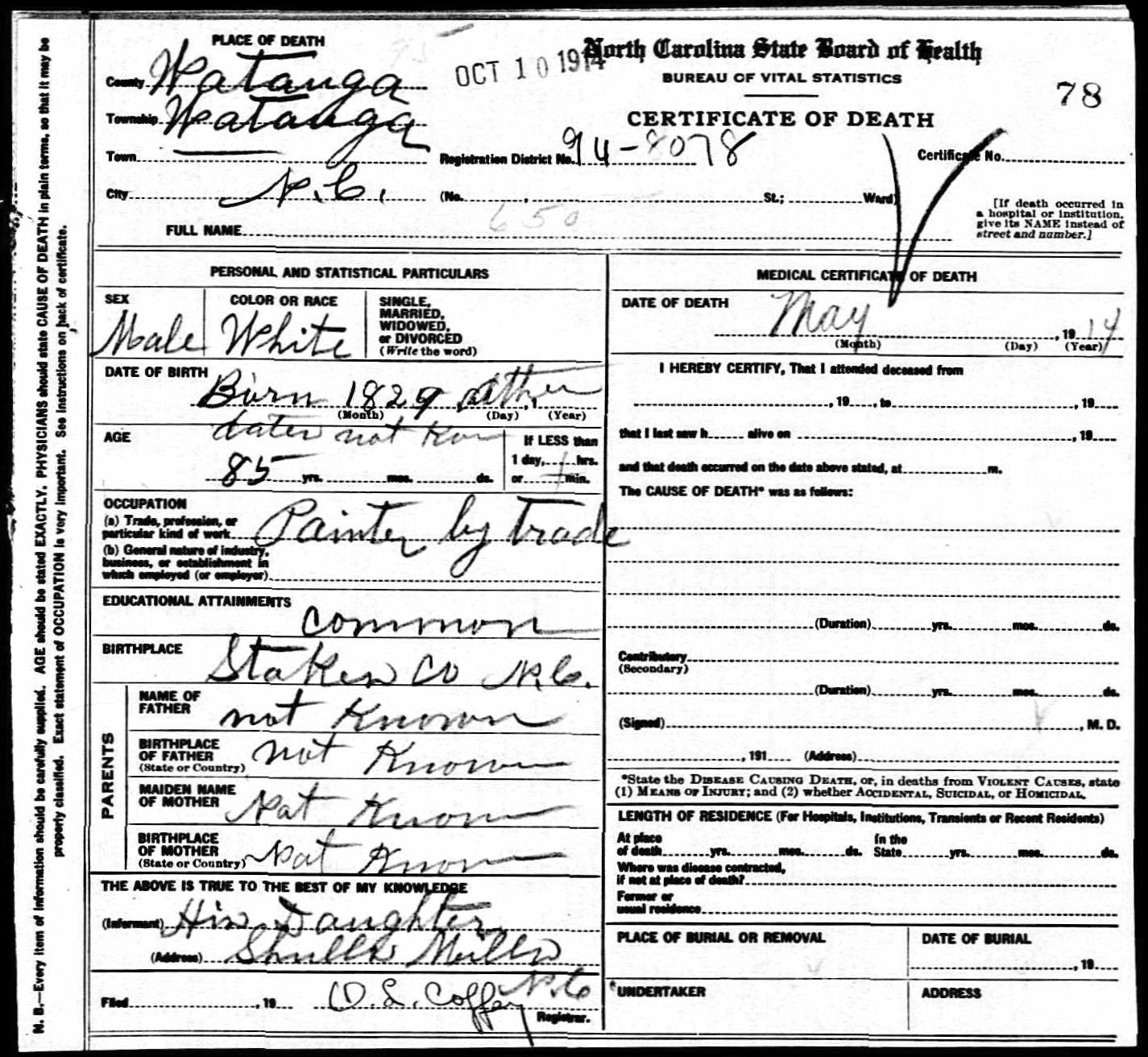
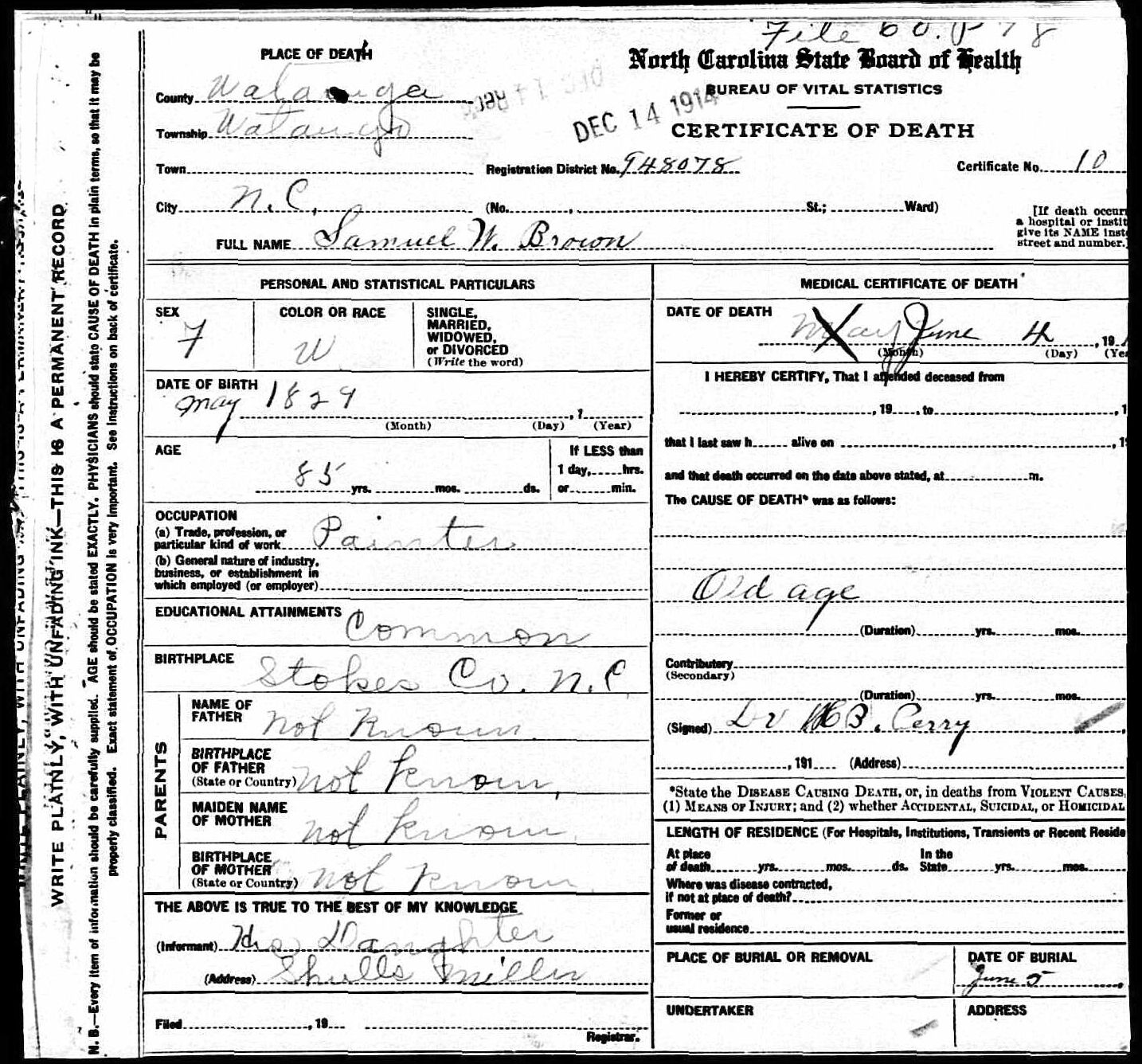
The other two certificates are similar with one listing his name as Samuel W. Brown, and the other not providing a name at all. He was 85 years old, born in May 1829. One says he died in May 1914, and the other says he died of old age on June 4, 1914. Both say he was a painter born in Stokes County and that both of his parents were “not known.” The information was provided by his unnamed daughter who lived in Shulls Mills.
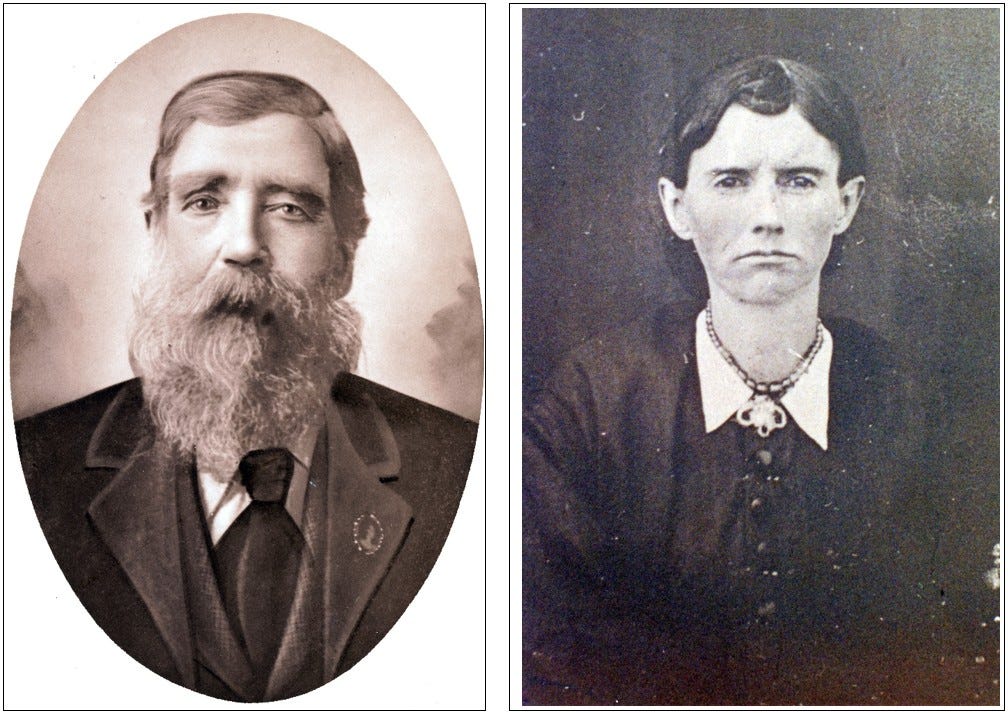
Samuel’s granddaughter remembered his beautiful handwriting and the fact that he was always well-mannered and well-dressed. His horse was named Bailey Peyton, and it was brown with a white mane and white tail. No one other than Samuel was allowed to ride him.
Descendants were told that Samuel went to Boone, NC, with a druggist and raised saddle horses. At that time in the 1800s, lead was used in paint, and a prescription to get the lead had to come from a druggist. Samuel either worked for or was the druggist, and when mixing his paints, he went into a closed room where no one could watch how he mixed the ingredients. He was paid $0.15 per day to mix paint, and he continued raising his saddle horses to supplement his income. Eventually he learned how to paint instead of only mixing paint for others, and his income rose from $0.15 per day to $10.00 per day.
Samuel W. Brown married Nancy Jane Joyce on August 23, 1855, in Martinsville, Henry County, VA. They had 12 children and lived the rest of their lives along a 100-mile long strip of the NC/VA border, gradually moving west from the Mayo River to Boone in Watauga County. They were listed in the 1860 Henry County census, the 1870 Stokes County, NC, census, and the 1880 Surry County, NC, census. Samuel is missing from the 1900 census, but Nancy was in Surry County with their youngest daughter.
Photos and information on Samuel W. Brown and his family were shared with me by two of his great granddaughters, Doris Davis Ward of Galax, Virginia, and Mary Lou Brown of Bluefield, West Virginia.
Samuel’s journey began in northeastern Stokes County, NC, where he was born about 1833. From 1850 to 1860 he was perhaps only five miles away in southwestern Henry County, VA. By 1870, he and his family had moved to Peters Creek in Stokes County, and by 1880 to Dobson in Surry County, NC. Samuel died in Shulls Mills, Watauga County, NC, in 1914.
Interact with the map above at webjmd.com/maps/swb-journey.html.
In her 1989 book Samuel W. Brown And His Descendants, Mary Lou Brown included an impressive amount of information on Samuel and his family. She included a note from Samuel’s granddaughter Mary Brown Price who remembered her father Colonel Taylor Brown saying that his father (Samuel) had a sister who married a Dodson. She also included the following notes on Samuel.577
I have been told that he was an orphan who was raised by a Dr. Peatross. I was also told that he had a sister who married Grover Dotson and moved to Calhoun, Missouri. (see Mystery Couple near the end of this book!) To date I have been unable to verify either story with factual data. Many cousins in various branches of the family from North Carolina have told me about Samuel painting stain glass windows in churches and in courthouses throughout North Carolina. They have also told of Samuel riding his horse named Bailey Payton.
Another clue about the origin of Samuel W. Brown comes from his marriage record. Henry County, VA, marriage register #1, page 3, lists the marriage of Samuel W. Brown (age 23, born Stokes County) and Nancy Jane Joyce (age 17, born Henry County) on August 23, 1855, in Martinsville. Her parents were listed as Alexander Joyce and Mary Joyce. His parents were listed as John Brown and Elizabeth Brown, and his occupation was farmer and painter.
Samuel (age 16) was listed in the 1850 Henry County, VA, census, and it states that he was born in NC. He was living with the Reed family in household #744/744, p54:
Robert Ried 37, physician, VA
Francis 35, VA
Nathaniel M. 13, school, VA
Mary 12, school, VA
Frances P. 5, VA
Virginia D. 3, VA
John 1, VA
Samuel Brown 16, overseer, NC
Edward Pollard 30, carpenter, VA
If the clues are correct, then Samuel W. Brown had a sister who married Grover Dodson, and they were the children of John and Elizabeth Brown. The 1850 census suggests that he was born in 1834, and his marriage record suggests 1832. He was 27 years old in 1860 which suggests a birth year of 1833. Later censuses and his death certificates push his birth year earlier, but since those are further removed from the time of the event, they are somewhat less reliable. I’ll use 1833 as his birth year.
Mary Lou Brown identified several marriages between a John Brown and Elizabeth in the area, and any – or none – of them could be Samuel’s parents.
Stokes Co: John Brown and Betsey Steward 2/23/1809
Stokes Co: John N. Brown and Betsey Freeman 2/26/1809
Surry Co: John Brown and Betsey Fry 8/5/1813
Wilkes Co: John Brown and Elizabeth Risdin 1/18/1783 [likely too old]
Wilkes Co: John Brown m Elizabeth Brown 9/15/1828
Rowan Co: John Brown Elizabeth Brown 7/21/1788 [likely too old]
Rowan Co: John Brown Elizabeth Sanderman 2/15/1802
The two Stokes County marriages seem most likely since that is where Samuel was born according to his death certificates.
With the help of Butch Johnson who is familiar with records from Stokes and Rockingham Counties, I looked at the Stokes County school census (familysearch image group 8194572). Records from 1845 to 1849 suggest that Samuel Brown and Nancy Brown were children of John Brown who lived in the northeast corner of Stokes County in the Sandy Ridge area at the border of Rockingham County. This was school district #9.
October 28, 1845: the District 9 list includes Samuel Brown and Matilda Brown with no other information on them. While they both have the Brown surname, there is no indication that they are from the same family. (images 611-612)
1846: the District 9 list includes the children of John Brown who attended school as Samuel Brown and Nancy Brown. (images 844-845)
March 11, 1848: the District 9 list includes Samuel Brown who was taught for 23 days. (images 1267-1268)
1848: the District 9 list includes all children between ages 5 and 21 including Jackson Brown, Robert Brown, Nancy Brown, and Milly Brown. There is no indication of how they might be related. (images 1415-1416)
April 9, 1849: the District 9 list includes all children between the ages of 5 and 21 including Jackson Brown, Robert Brown, John Brown, Joseph Brown, Nancy Brown, and Milly Brown. Samuel Brown is not in the list, perhaps suggesting that he had moved away or was no longer school-age. (images 1547-1548)
July 20, 1849: the District 9 list says that school was taught by John Vernon for 4 months and 5 days. The list of students who were taught during that time includes Robert Brown (22 days), John Brown (25), Joseph Brown (17), and Jackson Brown (11), (images 1614-1615)
October 8, 1858: an inventory of school houses by the superintendent of schools for Stokes County describes the building for District 9 as being a “log house hewn inside and out, good stone chimney, 2 glass windows, common benches for seats. House worth $80.00. School in session taught by B. F Wilson.” While Samuel was out of school and married by this time, perhaps this was the schoolhouse that he attended as a teenager. (images 1916-1919)
The 1846 entry is the most informative since it specifies the name of the parent and the children. While it clearly says “John Brown” and “children”, there is other writing that is less clear.
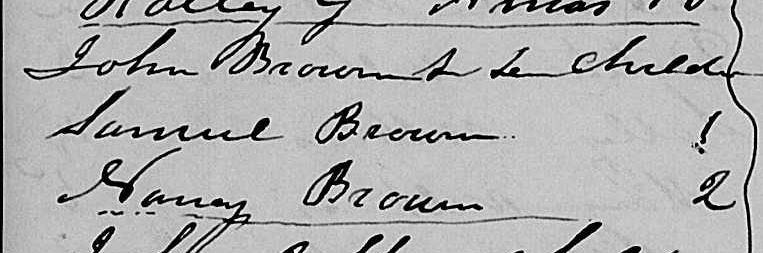
It could say “John Brown Sr, dec, children,” and if so, it suggests that John was deceased. One other entry in this list – the one for D. Gatewood and child Richard Gatewood – has a similar notation. Dudley Gatewood died in 1836 and his youngest child was Richard. Since Gatewood was deceased but still listed as the father of his school-age son, perhaps John Brown was deceased, also. Secondly, if this is John Brown Sr, then perhaps it indicates that he had a son named John Jr.
If Samuel had a sister named Nancy as suggested by the 1846 Stokes County school census, then perhaps she was the one who married Grover Dodson. If so, then there should be a marriage between Nancy and Grover. Or, perhaps it was another sister who married Grover Dodson. Further, Grover Dodson and his wife are said to have moved to Calhoun, Henry County, Missouri. Even with all of those clues, I have not been able to find a Grover Dodson who was the right age in the right place.
However, I did find a John Dodson who married Judy Brown on October 31, 1838, in Stokes County, with bondsman George Shaffer. Could it be possible that someone mis-remembered the Dodson name? Perhaps it was John Dodson who married one of Samuel’s sisters.
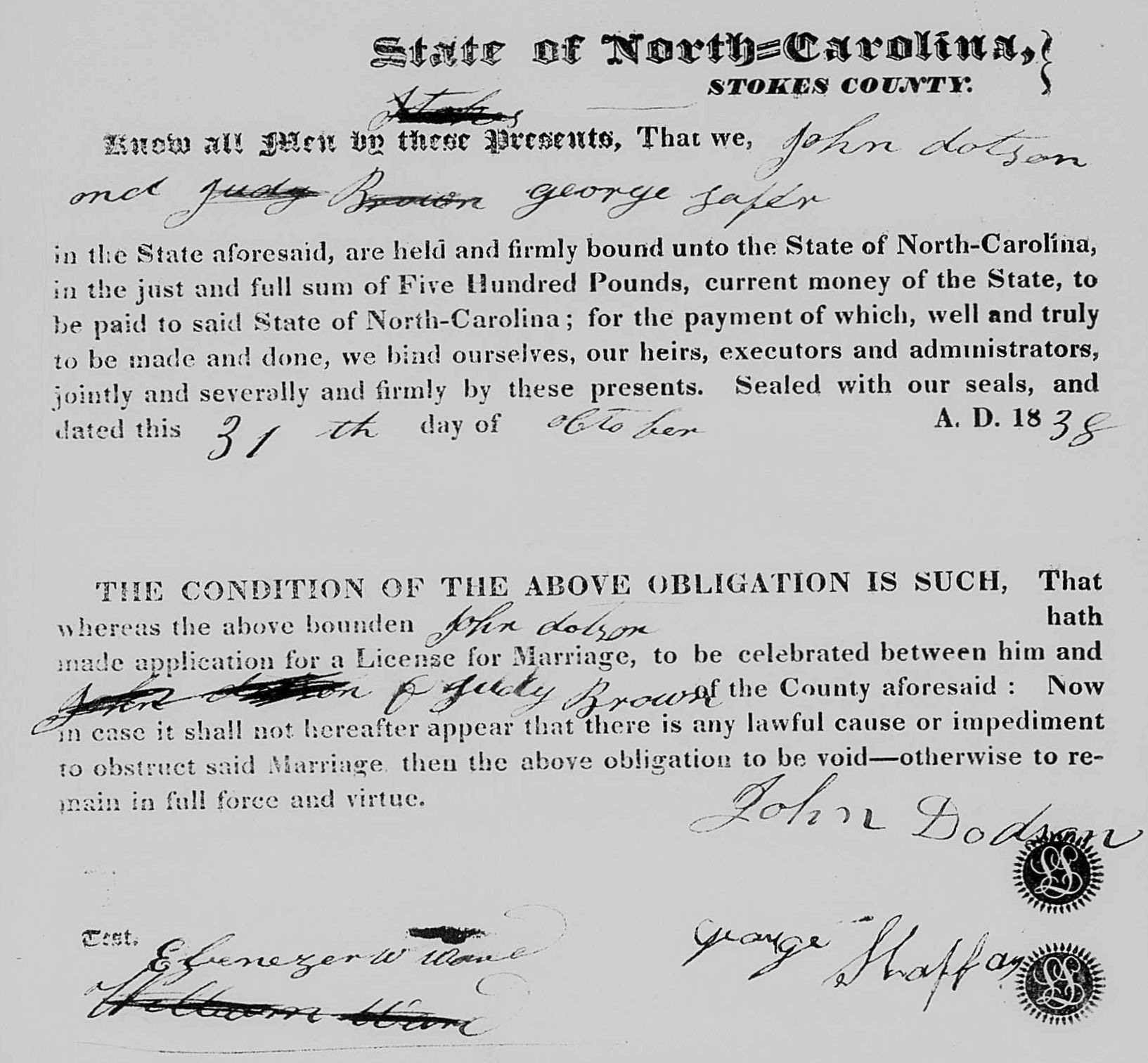
Based on census records, John Dotson, or Dodson, was born about 1812, and Judy was born between 1815 and 1820. In the 1850 and 1860 censuses, they were in Warren County, Kentucky. In 1870, they were listed in Springfield, Henry County, Missouri. Their youngest child was born in 1857, and he was named Samuel Brown Dodson. Could he be named after his uncle?
Judy Brown Dodson died on June 8, 1888, and was buried in the Combs Cemetery in Clinton, Henry County, MO, along with her husband. Her headstone says she was born on March 15, 1815.
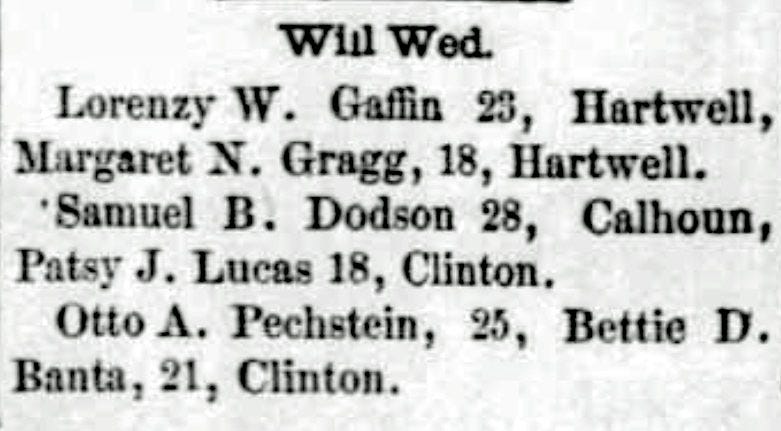
I think Judy is Samuel’s sister. She married a Dodson in Stokes County, moved to Henry County, MO, and named a son Samuel. On December 10, 1885, The Clinton Advocate published a wedding announcement for Samuel B. Dodson, age 28 of Calhoun, and Patsy J. Lucas, age 18 of Clinton. This confirms that the Dodson family was in Henry County and that they were in the town of Calhoun, just as it was told by Samuel Walker Brown’s granddaughter.
Let’s assume that Judy Brown was Samuel’s older sister, and see if DNA can provide support either for or against that assumption. If Judy Brown Dodson (1815-1888) was the sister of Samuel Walker Brown (1833-1914) – an assumption based solely on the story that Samuel had a sister who married a Dodson and moved to Calhoun, MO – then their descendants should share at least a small amount of DNA.
We are fortunate that several of Samuel’s descendants have taken DNA tests including descendants of at least three of his children. Among these test takers are two of his great grandchildren, meaning that they are only three generations removed from him. The challenge is to determine if a DNA segment is shared by a minimum of three Brown descendants, with at least one of them descending from a potential sibling of Samuel.
One DNA test by itself cannot solve this particular genealogy mystery. We need to compare DNA with other descendants and matches. When the DNA of a descendant of one of Samuel’s children is compared to that of a descendant of one of his other children, there is a high likelihood that they will share several DNA segments. This is particularly true if they are 2nd, 3rd, or 4th cousins. If Samuel and his wife are the only ancestors shared by these two descendants, then any shared DNA must have been passed down from Samuel or his wife. Those are the segments that we need to study!
The next step is to see if any DNA cousins with an unknown relation to Samuel also share those same segments. This method is called triangulation because the DNA of at least three descendants are used to focus on one segment that is shared among each of them. When combined with other family tree details including family names, dates, and places, an educated guess can be made about possible shared ancestors. In this case, a shared DNA segment among three Brown descendants could have been passed down from Samuel, Samuel’s parents, or perhaps his grandparents. The amount of shared DNA is used to estimate how closely two people are related, and it is used to determine candidates for the shared ancestor. I have identified three independent segments of DNA shared by multiple Brown descendants.
chromosome 4 from position 78 to 112 (29 cM)
chromosome 8 from position 106 to 119 (8 cM)
chromosome 2 from position 104 to 133 (27 cM)
The line of descent for the DNA matches on each of these chromosomes is shown in the next three images.
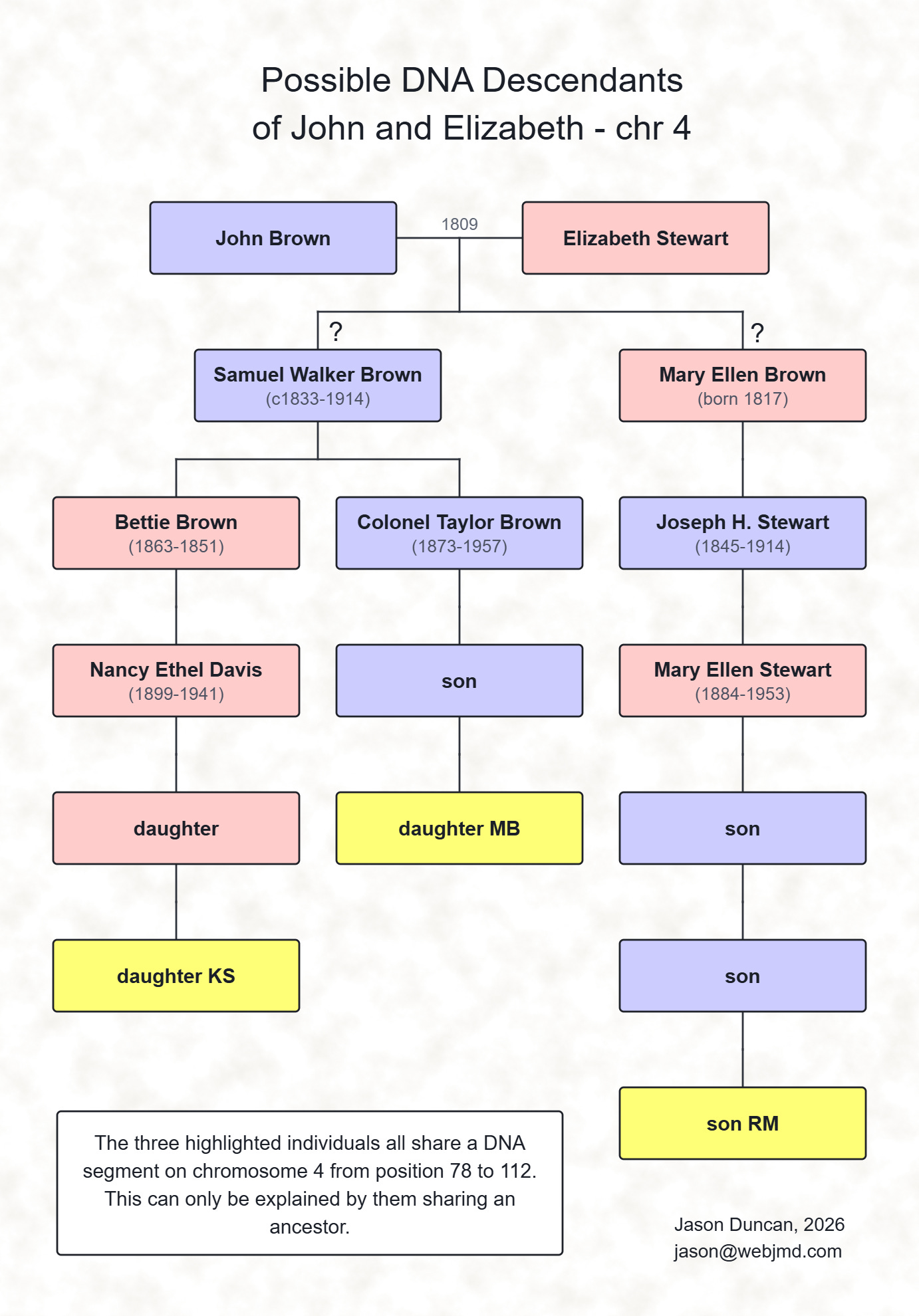
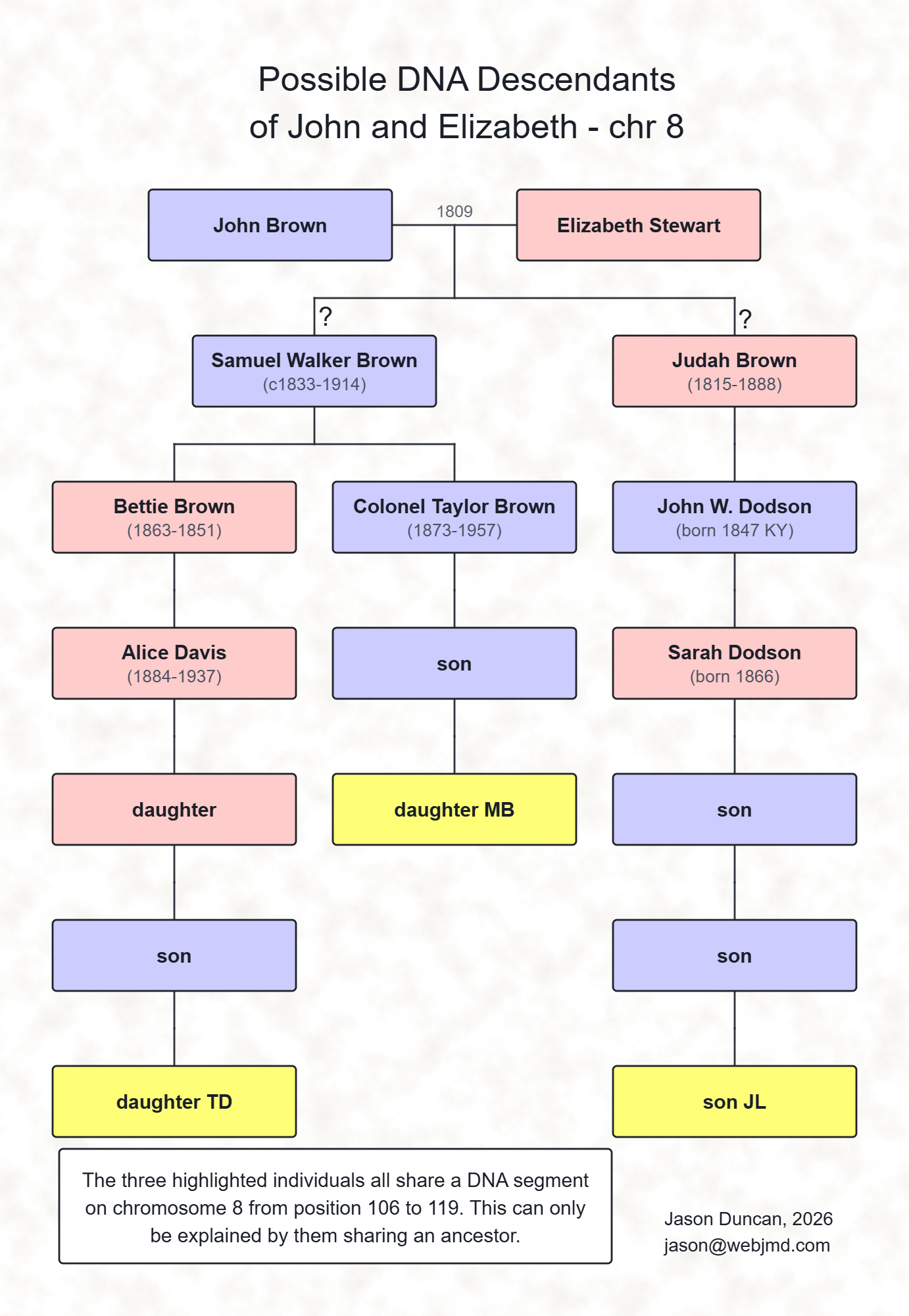
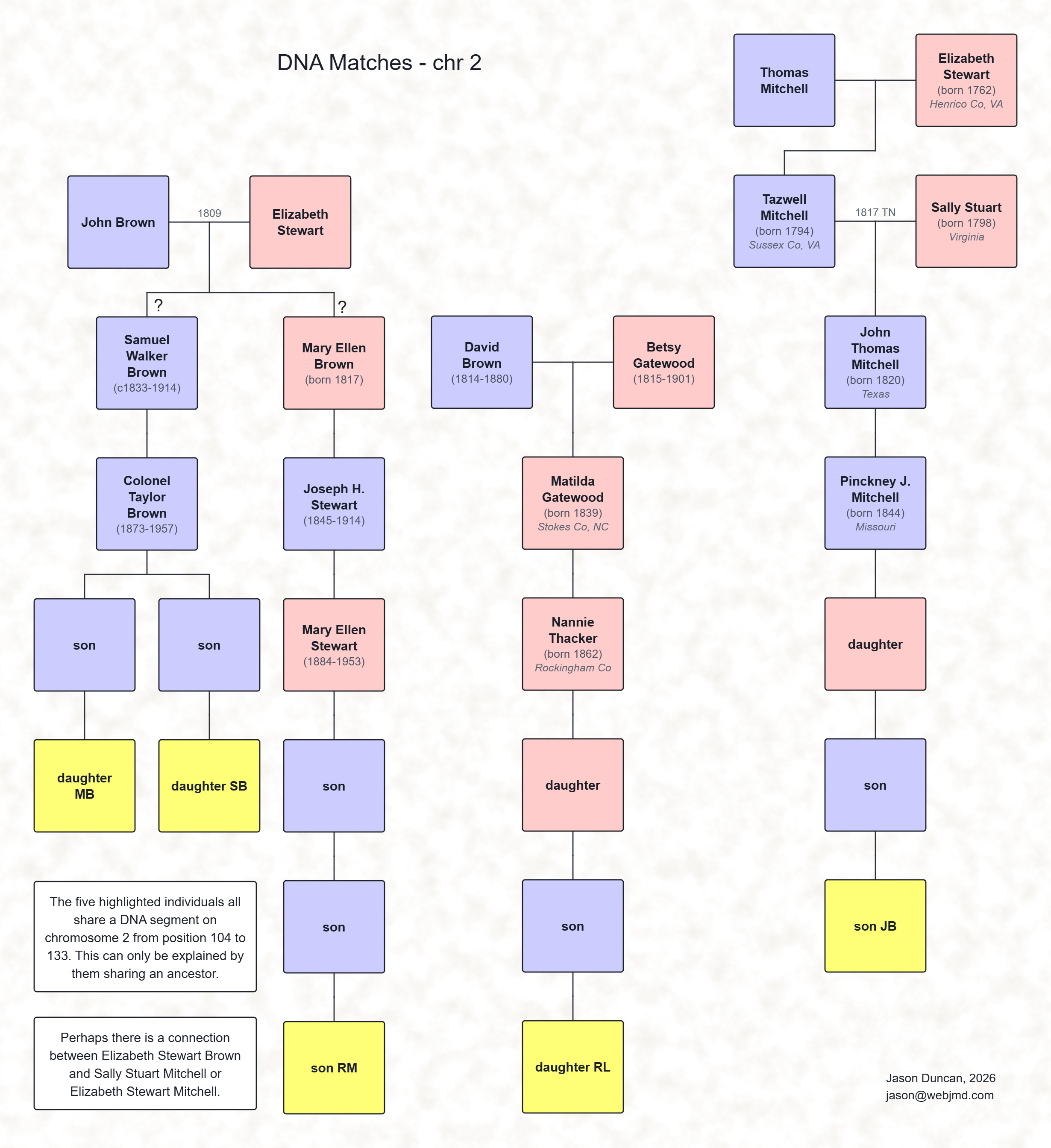
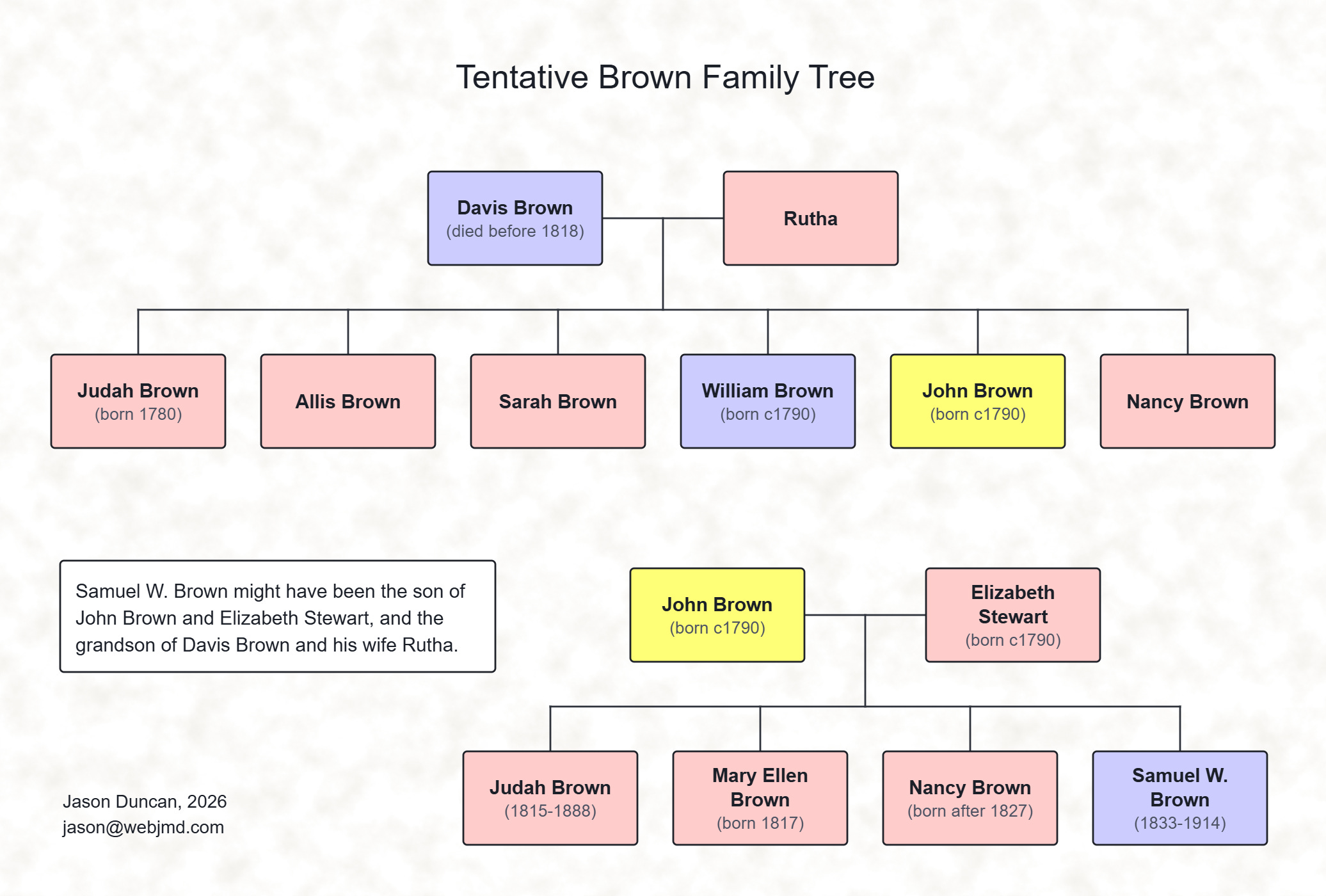
There is no proof that Samuel Walker Brown, Mary Ellen Brown, or Judah Brown are children of John Brown and Elizabeth Stewart who were married in Stokes County in 1809. However, there are reasons to consider John and Elizabeth as the leading candidates to be parents of all three.
Samuel’s parents were listed as “John and Elizabeth” on the 1855 Henry County, VA, marriage register.
The 1846 Stokes County school census lists John Brown’s children as Samuel and Nancy.
Descendants of Samuel, Mary Ellen, and Judah share the right amount of DNA to suggest that they were siblings.
Samuel had a sister who married a Dodson. Therefore, if Samuel was a son of John and Elizabeth, and Judah was his sister, then she was their daughter.
Online family trees show Mary Ellen Brown as the daughter of John and Elizabeth. However, they do not provide any proof of that relationship. Mary Ellen’s age and location do make it possible that she was their daughter, and no other parents have been suggested for her.
A Stewart connection is suggested by at least one DNA match, and it might represent a link to Elizabeth Stewart.
On chromosome 2, DNA cousin “RL” descends from Matilda Gatewood who was born about 1839. Her parents David Brown and Betsy Gatewood were married two years later in 1841. While Betsy Gatewood was likely Matilda’s mother, I do not know if David was her biological father. The 1846 school census lists Matilda Gatewood as the only school-age child of David Brown. Perhaps David was a brother or cousin of Samuel W. Brown.
A segment of chromosome 2 from position 104 to 133 is shared by two descendants of Samuel Walker, one descendant of Mary Ellen Brown, and one descendant of Sally Stuart, who was born in Virginia in 1798. It’s important to note that there is no proof yet that this shared DNA segment is from a Stewart ancestor. There are at least a dozen DNA matches who share this segment, but these are the only ones who have family trees that include a surname of interest – that being Brown, Stewart, or any other shared ancestor. More work needs to be done to find a shared ancestor within the family trees of these other matches.
Samuel Brown was listed several times in the Stokes County school census in District 9. The families included in that district are known to have lived in the northeastern part of the county with deeds describing their land as being on Buffalo Creek and Crooked Creek. I would expect John Brown, father of Samuel, to have also owned land in this area, and the following set of deeds seems to describe his property.
On July 16, 1795, Davis Brown was granted 100 acres on Buffalo Creek. The land had been entered by William Moore in 1779, but he transferred his entry to Brown. The land was on the Rockingham County line. (Stokes land grant file #146).
On February 5, 1818, John Brown bought 100 acres from Allis Brown, Robert Chandler, John Stewart, William Brown, and Nancy Brown of Stokes County. The land was divided diagonally by Buffalo Creek, and it adjoined the Rockingham County line. Today, this is on the southeast side of 3300 Amostown Rd. (Stokes DB 6, p398-9).
In March 1834, the Stokes County court issued an execution against John Brown and in favor of William M. Wall. Brown’s 100-acre tract on the waters of Buffalo Creek would be sold to pay his debt. The land was described as adjoining that of Samuel Stewart, Francis Amos, and others. (Stokes Civil Action Papers, 1833-1834, familysearch 102009851, image 576 of 931).
On July 24, 1834, John Brown, Judith Chandler, Sarah Stewart “heirs at law of the late Davis Brown” sold 50 acres to James Harris of Rockingham Co for $150. This was the northern half of the land granted to Davis Brown in 1795. John, Judith, and Sarah all signed with their marks. (Stokes DB 11, p19).
To summarize, Davis Brown bought 100 acres in 1795. He died before February 1818, and the land was settled by his heirs when John Brown, presumably his son, bought the property from his five siblings. In 1834, John Brown was in debt, and all or part of his 100-acre property would be sold to pay it. In July of that year, the northern half of the property was sold by the heirs of Davis Brown. Apparently, even though John bought the property in 1818, his two sisters still needed to sign the deed to sell it.
Davis Brown purchased 100 acres in Stokes County on Buffalo Creek along the Rockingham County line in 1795. Navigate and explore this map and adjoining properties at https://webjmd.com/maps/Stokes-Davis_Brown-map.html.
Until I see something that suggests otherwise, I believe that this 100 acres is the land owned by Samuel’s father John Brown and that this is likely where Samuel spent his early childhood. These records strongly suggest that John’s father was Davis Brown who had at least six children as listed below.
1. Judah Brown (born 1780)
2. Allis Brown
3. Sarah Brown born (1775-1794)
4. William Brown born (1785-1794)
5. *John Brown born (1785-1794)
6. Nancy Brown
Judah Brown married Robert Chandler in Stokes County on May 16, 1798. In 1860, she was listed as age 80, living in Rockford, Surry County, near several of her children. If my assumptions are correct, she was Samuel’s aunt, and she should not be confused with Samuel’s sister Judah Brown Dodson.
Allis (or, Alice?) signed with her mark in the 1818 deed.
Sarah Brown appears to have married John Stewart. The 1818 deed lists John Stewart as an heir, and the 1834 deed was signed by Sarah Stewart. There is one “John Steward” in the 1820 Stokes County census. Within the household, he was the only male (age over 45) living with one female (26-45), and three younger females. The oldest female who was born between 1775 and 1794 might be his wife Sarah.
William Brown signed with his mark in the 1818 deed. As shown below, he was likely living with his wife and two young children two houses away from his brother John Brown in the 1810 census.
Nancy Brown signed with her mark in the 1818 deed. In 1857, Franklin James declared in the Stokes County court that Nancy Brown, “a single woman,” was a lunatic. She was “some 50 years old,” and Wilson Fulton testified that she was in need of a guardian to manage her finances valued at $400. There is no proof, however, that this Nancy was the sister of John Brown. (Stokes Lunacy Records, familysearch 8357262, images 555-560).
If we’re looking for the family of John Brown and Elizabeth Stewart who were married in Stokes County in 1809, then they would first appear together in the 1810 census.
The name “John Brown” must be among the most common names in America then and now, and the 1810 Stokes County census supports that idea by including five men by that name! Fortunately, the census is grouped by district. While four John Browns were in Meadows District, only one was in Beaver Island District which included the northeast part of the county. The household consisted of only three people: a male and female (age 16-25) and a boy (under age 10). This would perfectly describe John and Elizabeth whose first child was a baby boy. If the census is correct, then both John and Elizabeth were born between 1785 and 1794.
It’s worth noting that the very next entry is for Robert Chandler whose household consisted of a male and female (both age 26-45) and six children under age 16. I believe this is the household of John’s older sister Judah Brown Chandler.
Additionally, two houses before John is the household of William Brown which consisted of a male and female (both age 16-25) and two children under age 10. I believe this is John’s brother William who was listed in the 1818 deed.
Moving forward to 1820, the Stokes County census lists only two men named John Brown. One is age (26-45) living with a female (16-25) along with one boy and five girls under the age of 10. While I am not certain, I believe this is not our family since the female is too young and there is not a boy in the 10-15 age group. I believe our John Brown is listed in a household of nine:
three males (0-9)
one male (26-45) [b1775-1794]
one male (over 45) [born bef 1775]
two females (0-9)
one female (10-15)
one female (26-45) [b1775-1794]
If this is our family, then John and Elizabeth correctly moved into the 26-45 age bracket, and perhaps the older man was one of their fathers. They had three boys and two girls under age 10, as well as a girl (10-15). The only problem with this is that there should be one boy age 10-15 to be in agreement with the 1810 census.
The 1830 Stokes County census includes three different John Brown households. One was in Sauratown District, another was in Meadows District, and no district was listed for the third family. It’s not clear which, if any, of these are our John Brown.
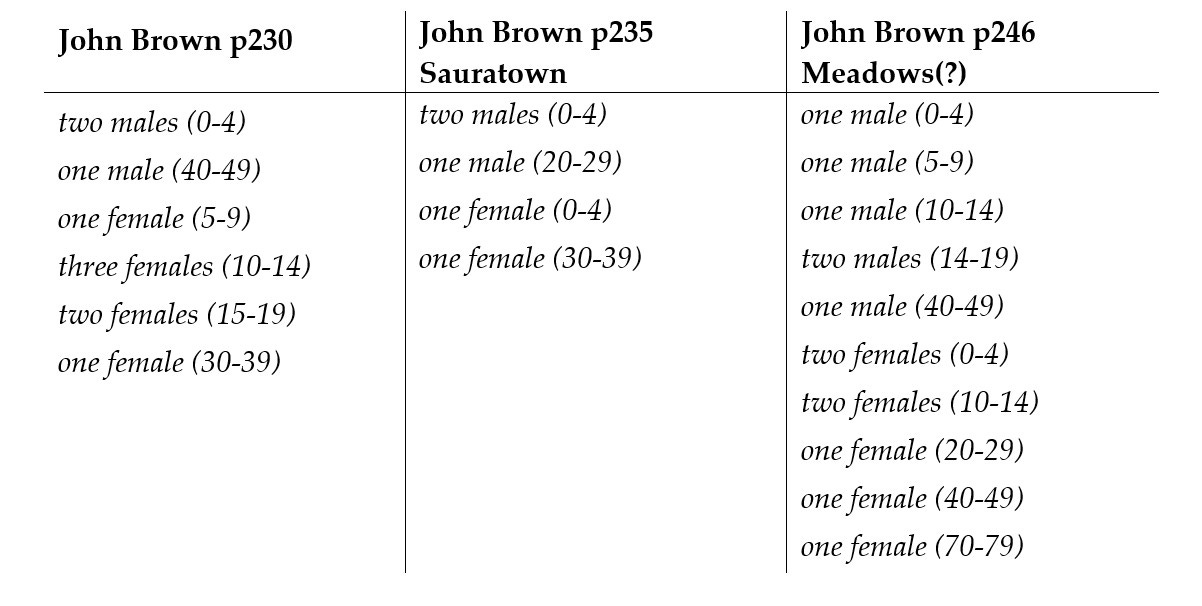
The 1840 Stokes County census was filed and recorded as part of Tyrrell County, but it is clearly labeled as part of Stokes. It only includes one John Brown household:
one male (5-9)
one male (15-19)
one male (20-29)
one male (60-69)
two females (10-14)
one female (15-19)
two females (20-29)
one female (60-69)
I do not believe this is our John Brown. I believe this is the household of John Brown and wife Ruth who were ages 75 and 70 in the 1850 Stokes County census, living with John (age 30), Elisha (28), Ruthy (26), and Peggy (20). They might be related, but they are clearly a different family.
It’s possible that one or both of Samuel’s parents had died before the 1840 census. The only mention of either of them after 1840 was when John was listed as the parent of Samuel in the 1846 school census, and as discussed previously, the notation by his entry could indicate that he was deceased.
I’ve made a lot of assumptions and guesses in this report, and some of them will almost certainly be found to be incorrect with further research. But for now, it’s helpful to produce a tentative family tree to present the possible members of the Brown family as they relate to Samuel W. Brown. This will aid in further research.
The evidence currently points to Samuel Walker Brown being the son of John Brown and Elizabeth Stewart of northeastern Stokes County. The strongest evidence is the 1855 marriage record naming his parents, the 1846 school census connecting Samuel to John Brown, the land records connecting John Brown to Davis Brown, and DNA evidence suggesting relationships among descendants. None of these records, individually or collectively, prove that these relationships are correct.
John Brown’s parents are generally listed as Davis Brown and his wife Rutha who were in Stokes County before 1795. Some sites suggest that they came from Cumberland County, VA, in the 1780s.
The challenge moving forward will be the same as that facing every genealogist who is researching the name Brown. It is extremely commonplace, and when paired with the first name John, there is always the possibility that a record refers to a different family.
One next step is to search for DNA cousins who have a Stewart/Stuart in their family trees. If a Stewart ancestor was in the right location at the right time, it might be possible to link that person with Elizabeth Stewart – that is, assuming she was the mother of Samuel W. Brown. If they also share a DNA segment with a descendant of Samuel, then that would be a significant clue that there is a close connection. With more people taking DNA tests every day, there is always a chance that the missing pieces could fall into place at any time.
More history and genealogy on my website.
If you have thoughts or information on this family, leave a comment or send me an email.
No posts
Comments
Nothing yet. Say the first thing.
Sign in to join the conversation.