
Recovering on Sunday from a recent chemotherapy blast, I found time to update the Webb-site HKSAR Accounts Explorer with the recently-released government accounts for the year ended 31-Mar-2025.
Buried in the Duties section in the General Revenue Account was a surprise: duties collected on tobacco plunged 40.4% from HK$7.25bn in 2023-24 to HK$4.32bn in 2024-25, adding another $3bn to the deficit.
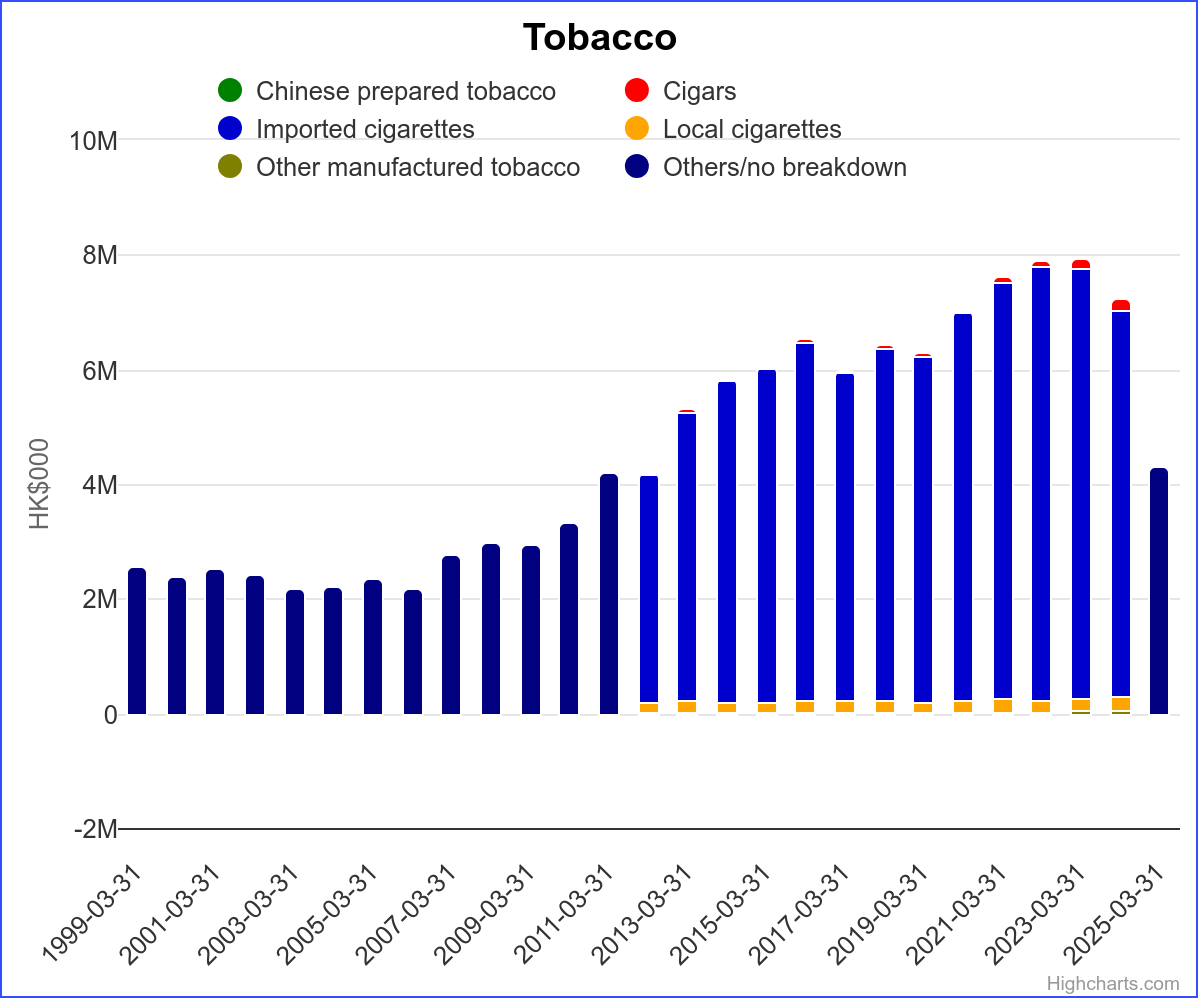
In prior years, we obtained the detailed breakdown from the Customs & Excise Department by special request (2024-25 is pending). As you can see, nearly all of the revenue is from cigarettes. In the budget on 28-Feb-2024, duty on cigarettes increased by $0.80 per stick to $3.306 with immediate effect. In the prior budget it was increased by $0.60 per stick. So each pack of 20 now attracts duty of $66.12, around 70% of the retail price.
Increased taxes do reduce demand, but it seems unlikely that over 40% of smokers quit in 1 year, leaving the rest to pay the duty at higher rates, particularly given that they theoretically don’t have the option of vaping products to satisfy their nicotine addiction (although we see them around). It is illegal to import or sell vaping products, which are probably a safer alternative to all the toxic compounds in cigarette smoke. From 30-Apr-2026, it will be illegal even to possess “alternative smoking products” in public places.
The most likely cause of the revenue collapse is that illicit cigarette imports are gaining market share - either smuggled in bulk or brought in from the mainland by individual shoppers. After the 2 duty increases, a pack of cigarettes in HK now costs 4-5x the mainland price, providing a substantial incentive for travellers to ignore the 19-stick limit on duty-free personal imports, given the relatively low risk and cost of being caught (see below).
A LegCo answer on 12-Feb-2025 included monthly data on tobacco duty revenue from 2018-2024. There’s always a surge in revenue in February despite it being the shortest month, with legal importers hedging against a possible duty increase in the budget. Annual revenue also increased during the COVID border shutdown from 2020-2022.
Another attachment to the LegCo answer showed fairly steady seizures of around 614m illicit cigarettes in calendar 2024 and 652m in 2023. The current duty on those alone would be about $2bn, and surely the interception rate is well below 100%.
Persons arrested jumped from 2,813 in 2022 to 10,994 in 2023 and 20,588 in 2024, indicating that most of them were at the border (which was basically closed until Jan-2023). But prosecutions are low, with just 597 prosecutions initiated in 2024 and 356 in 2023 - so only about 3% of arrests lead to prosecution. So if you get caught at the border, you’ll probably just get a warning. Some fines are just HK$100 (or maybe, 1 pack of cigarettes).
What, then, should HK do? Well the Government can’t get the “staunch support of the mother/fatherland” to increase duties to match ours, because about 23% of mainland adults (2% of women and almost half of men) still smoke (vs 9.1% in HK). Mainland incomes are lower, and the state also runs a lucrative tobacco monopoly. Jacking up prices would be a recipe for social unrest, and the state may just take the view that early deaths save on social security costs and help to reduce the demographic dependency ratio of an ageing population.
So if HK wants to recover the revenues and restore the deterrent against smoking then it needs a combination of higher enforcement rates and/or higher penalties. Each prosecution takes roughly the same amount of resources, so a multi-fold increase in the fines and more jail sentences with the same prosecution rate would increase the deterrence. It’s rather like the economics of illegal parking - drivers look at the probability of being ticketed in a given period, multiplied by the fixed penalty, resulting in an expected cost-per-hour which is often less than commercial parking.
Smoking is a horrible habit which I never had. As a terminal prostate cancer patient, I am often tempted (a temptation which I resist) to walk up to anyone smoking outside a building and tell them that they still have a choice that I don’t. They can dramatically cut their risk of a miserable death. 25% of cancer deaths globally are smoking-related. They also run much higher risk than non-smokers of death from heart disease and stroke. And they shouldn’t inflict second-hand smoke on anyone around them, including their children.
But we’re all going to die some time and I’m a libertarian. If you are informed of the risks but want to stuff yourself with junk food, become obese and die early from the consequences, then why should the rest of us interfere with that? Shouldn’t the same apply to smoking?
In theory yes, but in practice HK and many other places have heavily-subsidised public healthcare and extensive welfare systems, so the cost of such behaviour is distributed to everyone, including non-smokers. It is therefore justifiable to recover the extra cost of smoking-related illnesses from smokers through taxation and to look at whether other major causes of healthcare costs, including obesity, should be recovered. Some 33% of HK adults are obese and another 22% are overweight.
On 25-Mar-2025, the Government announced a capped copayment system for the Hospital Authority which increases fees but also caps the annual cost at HK$10,000. This plan is very similar to what I proposed on Webb-site back in 2008, although I suggested a much higher co-payment rate at 50% of actual costs for the first $20k and 25% of actual costs for the next $40k, with a total copayment cap of $20k (which should now be adjusted for inflation). But this is a promising start, and it’s a shame that it has taken 17 years and a yawning budget deficit to make that start. Higher healthcare co-payments should incentivise better habits.
There is more that can be done in other areas. For example, to incentivise take-up, the most effective charge for vaccinations is not necessarily zero. If people (particularly the elderly) received a payment for taking the time and travel costs to get a flu-jab then it might still result in a decent increase in our low vaccination rates and substantial savings on treating influenza in public hospitals, saving public funds overall.
Comments
Nothing yet. Say the first thing.
Sign in to join the conversation.