
I’ve been tracking Web3 security for a while now. and every quarter i tell myself “okay this time i’ll wait for all the reports to drop before writing anything.”
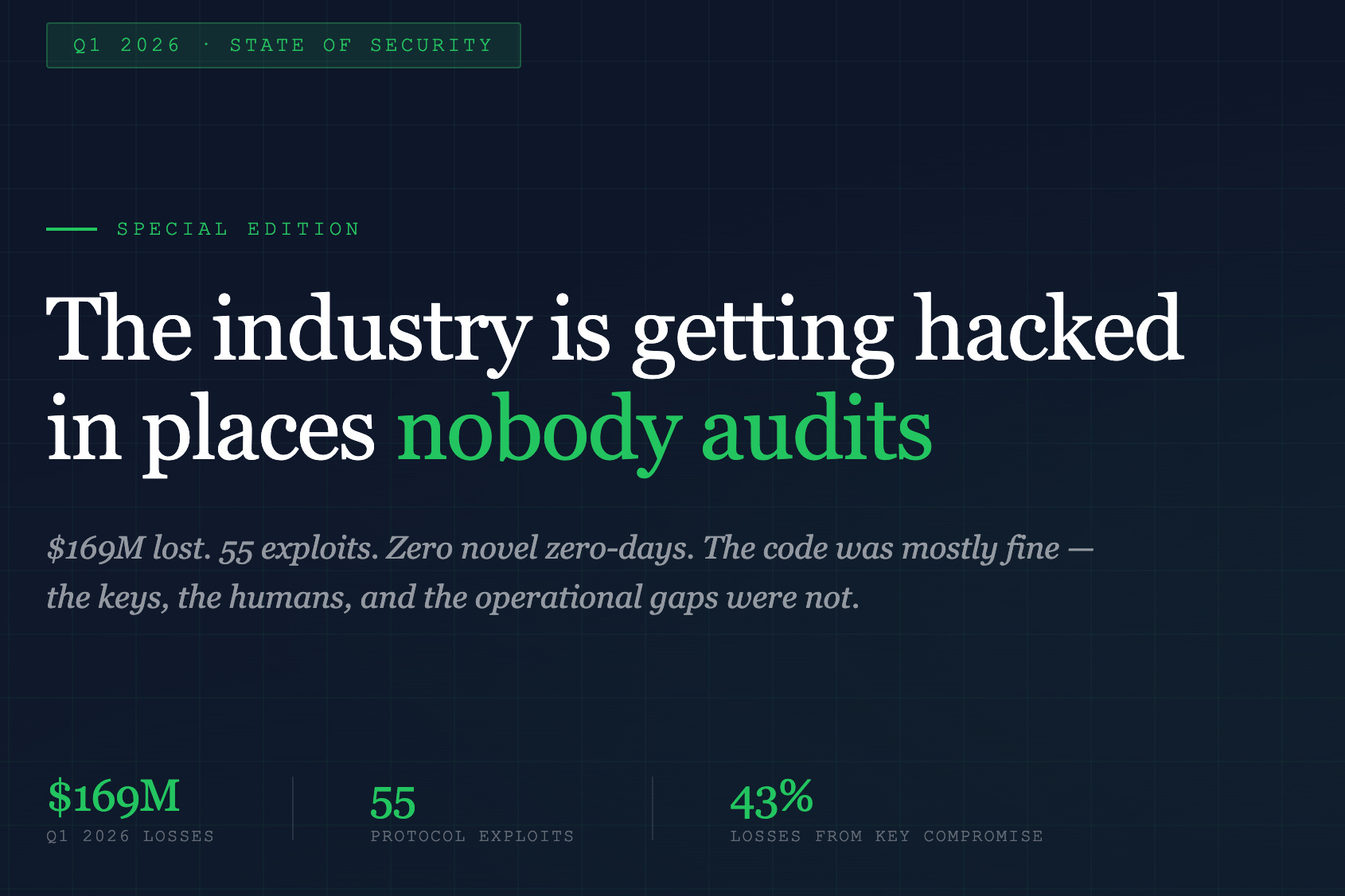
Q1 2026 made that easy. because once you read through all of it — the exploit reports, the quarterly tallies, the ransomware data, the AI threat analysis — a single pattern emerges so clearly it’s almost hard to write around.
the industry keeps getting hacked in places nobody audits.
not because the audits are bad. because the audits are looking at the wrong things.
let’s get into it.

Guardix.io – AI-Powered Security Audits for Solidity Smart Contracts
Most audit firms take weeks. guardix delivers a full security report in under 60 minutes.
30+ specialized AI agents scan your contracts across 14 vulnerability classes. every finding is cross-validated across multiple models and backed by a working exploit, auto-tested on a forked chain via foundry. no theoretical maybes just issues proven to be exploitable.
over $450M stolen across 50+ security incidents in 90 days. that’s the full Q1 picture — DeFi protocol exploits, access control failures, and broader ecosystem attacks combined.
break it down:
$169.4M came from 55 protocol-level exploits tracked across DeFi. these are the technical failures — flashloan attacks, oracle manipulation, logic bugs, missing access controls. January alone accounted for $105.4M of that. Step Finance ($40M), Truebit ($26.4M), and Matcha ($16.8M) drove most of the damage in a single month.
then in March, Resolv Labs lost $24.5M to a private key compromise — the exact same root cause as Step Finance two months earlier. same vulnerability class, twice in one quarter, $65M total from just that one attack vector. that’s not bad luck. that’s a pattern.
and then there’s the number that reframes the entire quarter: $285M from the Drift Protocol incident alone. not a smart contract bug. not a flashloan. not oracle manipulation. a social engineering attack on the humans who controlled the protocol. we’ll get into exactly how it worked — but understand what that means for the Q1 total.
the single biggest loss of the quarter didn’t touch a line of code.
Q1 2026 by the numbers:
$450M+ lost across 50+ incidents when you include access control and social engineering attacks
$285M from Drift Protocol alone — the quarter’s largest single incident, zero code vulnerabilities involved
$169.4M from 55 DeFi protocol-level exploits
$105.4M came from January alone
43% of protocol-level losses came from just 6 infrastructure failures
$65M lost to private key compromise across two separate incidents — same root cause, two months apart
smart contract exploits grew 13% year-over-year
private key hacks dropped 95% from 2025 levels — the Bybit-scale incident didn’t repeat
zero of the 55 protocol exploits involved a novel zero-day — every single one exploited a known, documented vulnerability class
that last point matters. not a single novel technique across 55 incidents. all documented. all preventable.
and yet the losses keep coming. which brings us to why.
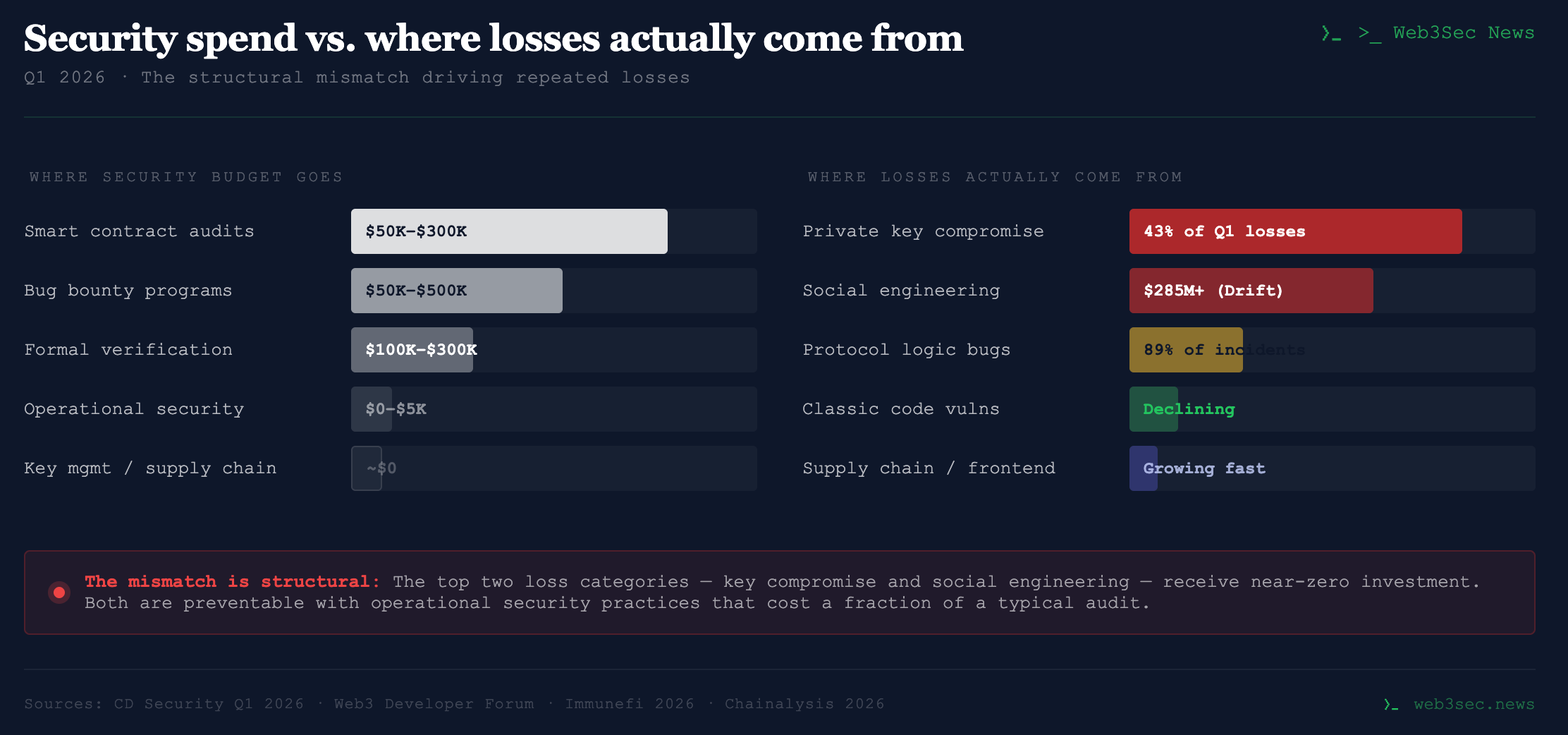
here’s what the data keeps showing.
a typical DeFi protocol’s security budget looks something like this:
smart contract audit: $50K–$150K
second audit from a different firm: $30K–$80K
bug bounty program: $50K–$500K allocated
formal verification (for high TVL): $100K–$300K
operational security training: $0–$5K
multisig signer vetting: informal or nonexistent
key management audit: almost never done
the spend is almost entirely on code. the losses are increasingly coming from humans, keys, and processes.
now back to Drift Protocol.
$285M stolen. zero code vulnerabilities exploited.
the attacker didn’t find a bug in the smart contract. they identified who the multisig signers were — using publicly available information from LinkedIn, GitHub, social media. they built enough credibility and manufactured enough urgency to get those signers to pre-sign transactions using Solana’s durable nonce feature.
a durable nonce means the signed transaction doesn’t have to be executed immediately — it can sit and wait. the attacker waited until the protocol’s timelock was removed, five days before the exploit fired, then executed.
no bug. no novel technique. just a patient, methodical social engineering campaign targeting the humans who had signing authority.
this is not a code problem. this is an operational security problem. and the industry’s entire security budget is pointed the wrong way.
as one 2026 security analysis put it: “Code was reviewed. Tools were run. Budgets were spent. Yet the highest-impact failures happened across boundaries that were never treated as one system: development, deployment, access, upgrades, integrations, and response.”
the auditors did their job. the code was reviewed. the loss happened anyway — because nobody reviewed the humans who could authorize transactions, or the process by which they were contacted, or the conditions under which a timelock could be removed.
that’s the gap. and at $285M in a single quarter, it’s no longer a gap you can rationalize your way around.
ranked by risk-adjusted impact — not just frequency, but how bad it got when these were exploited. based on Q1 2026 incident data across the ecosystem.
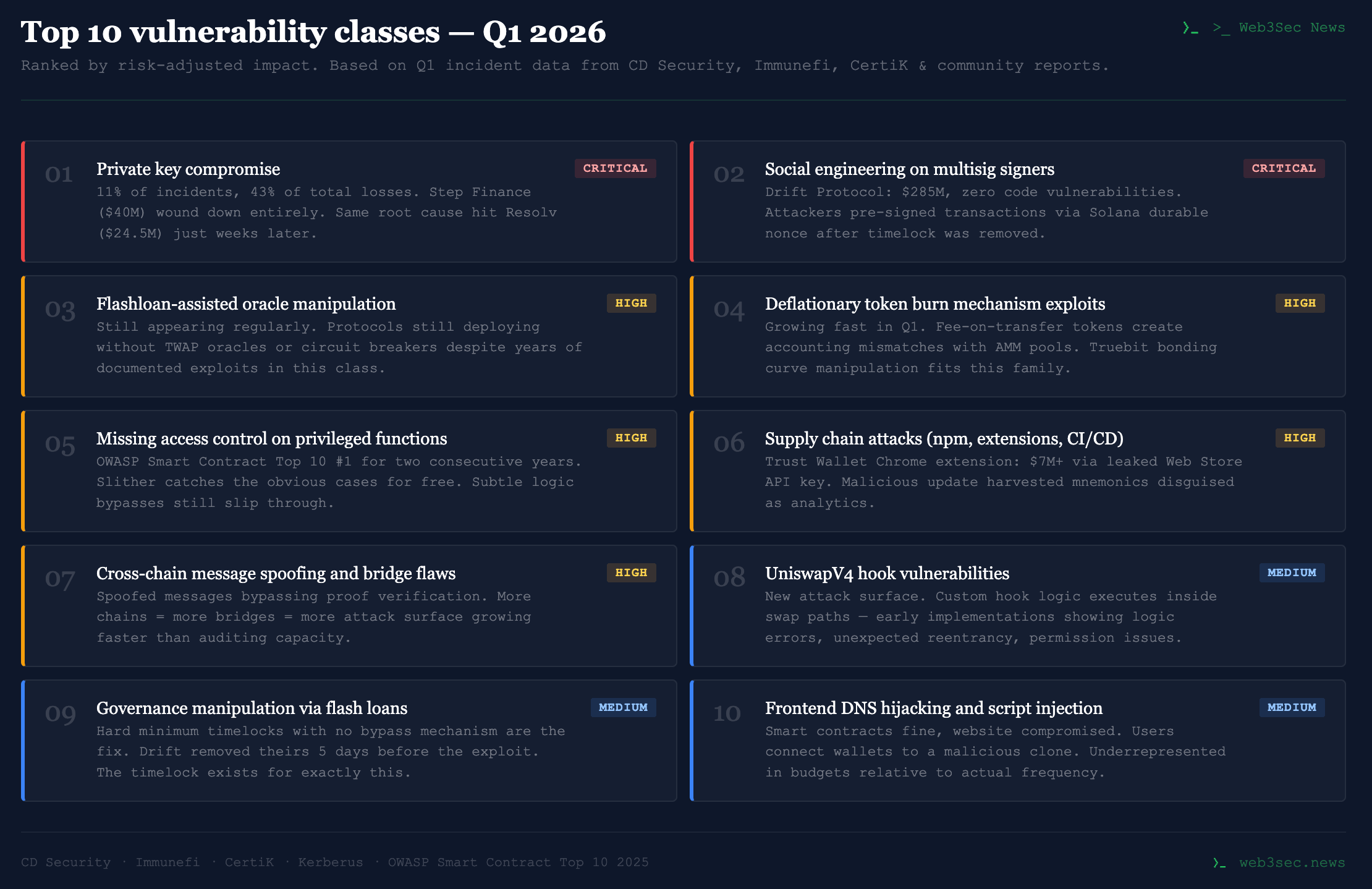
01. Private Key Compromise - CRITICAL
11% of Q1 protocol incidents. 43% of protocol-level losses. Step Finance lost $40M and wound down entirely. Resolv Labs hit the same way in March for $24.5M. two separate incidents, identical root cause, same quarter. the key itself is never the problem — the process around storing, accessing, and rotating it is.
02. Social Engineering on Multisig Signers - CRITICAL
Drift Protocol is the defining case this quarter and arguably one of the most important Web3 security incidents in recent memory. $285M extracted without a single line of vulnerable code being involved. the attacker spent time mapping the signers, building credibility through legitimate-seeming channels, then engineered a situation where signers pre-authorized transactions via Solana’s durable nonce mechanism.
the protocol had removed its timelock five days prior — removing the last line of defense. when the attacker executed, there was nothing left to stop it. this is the most underdefended attack surface in Web3 right now by a significant margin and the numbers prove it.
03. Flashloan-Assisted Oracle Manipulation - HIGH
still appearing regularly. protocols still deploying without TWAP oracles or circuit breakers despite years of documented exploits in this exact class. the fix is known and implemented widely enough that there’s no excuse — implementation keeps getting skipped anyway.
04. Deflationary Token Burn Mechanism Exploits - HIGH
grew significantly in Q1. tokens that burn on transfer create accounting mismatches when they interact with AMM pools or lending protocols that don’t account for fee-on-transfer behavior. not a new concept — new in how many protocols are still deploying without protecting against it.
05. Missing Access Control on Privileged Functions - HIGH
the most common finding in smart contract security for two consecutive years running. free automated tooling catches the obvious cases in seconds. what slips through is the subtle logic — a check that exists but can be bypassed through a specific call sequence that no automated tool considers.
06. Supply Chain Attacks (npm, Browser Extensions, CI/CD) - HIGH
one major incident this quarter involved a leaked browser extension API key — a malicious update pushed to users, harvesting mnemonic phrases disguised as routine analytics. the attack surface here is enormous and almost entirely unmapped for most protocols: npm dependencies, GitHub Actions, deployment pipelines, extension auto-update paths.
you can have perfect smart contracts and still lose user funds through this vector.
07. Cross-Chain Message Spoofing and Bridge Logic Flaws - HIGH
bridges lock concentrated value and rely on complex validation across multiple chains. spoofed messages bypassing proof verification are the emerging pattern.
more chains launching means more bridges, which means attack surface growing faster than auditing capacity can follow.
08. UniswapV4 Hook Vulnerabilities - MEDIUM
a genuinely new attack surface that didn’t exist before V4. custom hook logic executes before or after swaps, introducing arbitrary code into the swap execution path.
early hook implementations are showing logic errors, unexpected reentrancy, and permission issues. as adoption grows, expect this to become a primary audit target in the next two quarters.
09. Governance Manipulation via Flash Loans - MEDIUM
attacker borrows governance tokens, gains voting majority, passes a malicious proposal, extracts value, repays — all within one transaction. hard minimum timelocks with no bypass mechanism are the solution.
Drift removed theirs five days before the exploit. the timelock exists precisely for this reason and removing it in the days before an incident is, in retrospect, the single most consequential operational decision of Q1.
10. Frontend DNS Hijacking and Script Injection - MEDIUM
the smart contracts are fine. the website serving the frontend is compromised. users connect wallets to what looks like the legitimate interface and sign transactions that drain them. one of the most underrepresented attack surfaces in security budgets relative to how frequently it’s attempted.
monitoring DNS integrity, JS/frontend changes, and domain configuration anomalies in real time is the defense and it’s almost never deployed.
understanding the attack lifecycle matters because intervention is possible at multiple points. most protocols only defend against one of them — the execution layer.
that’s the last place you want to be catching problems.
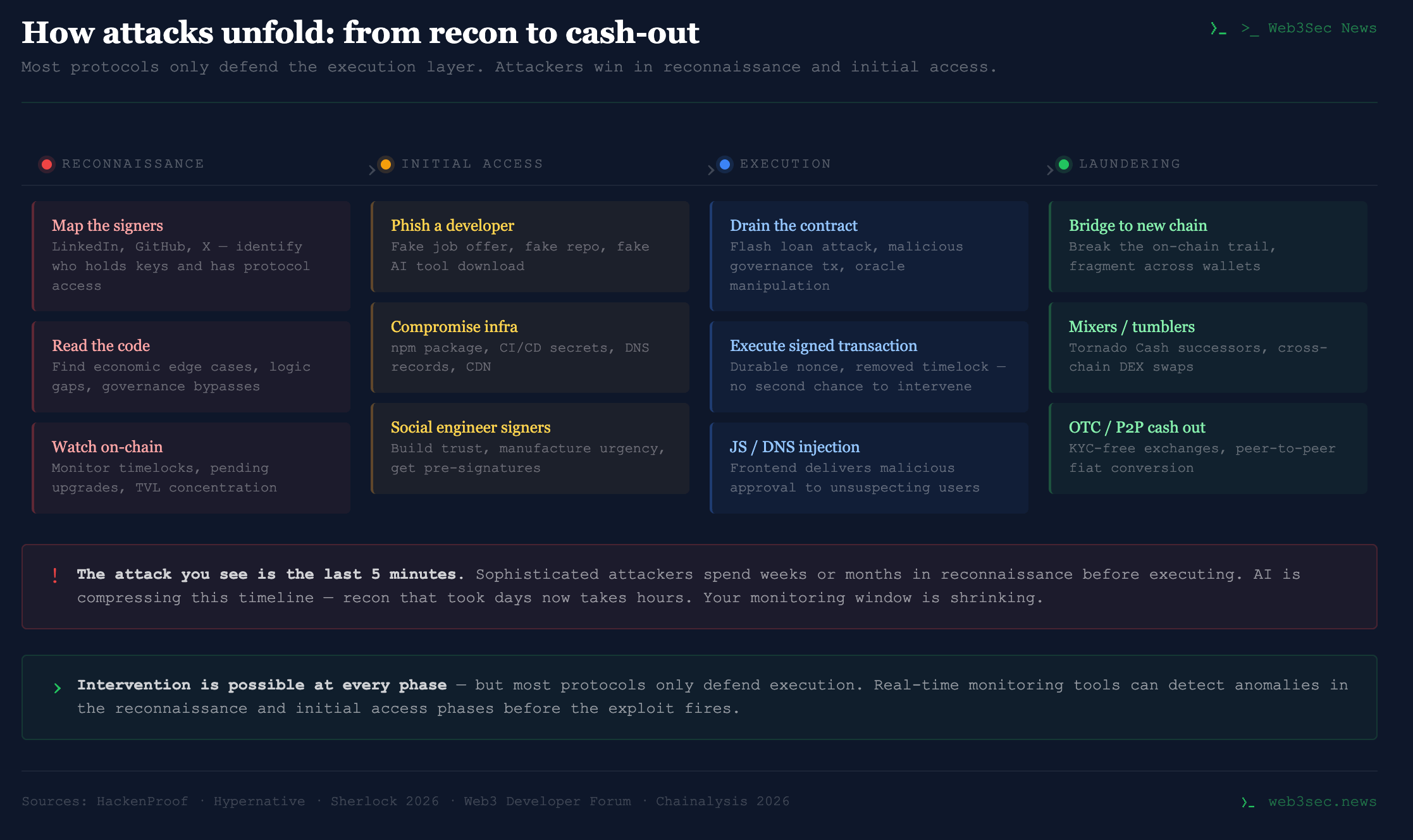
Reconnaissance — attackers map signers from LinkedIn, GitHub, and X. they read the code looking for economic edge cases and governance weaknesses. they watch on-chain for timelocks being removed, pending upgrades, TVL concentration.
the Drift attacker was in this phase for a long time before anything showed up on-chain.
Initial Access — fake job offers targeting developers, compromised npm packages, CI/CD secrets, social engineering on key holders. the Bybit hack started with a phished developer — machine infected, front-end code modified, users unknowingly approved malicious transactions that drained the exchange.
the access point was a person, not a contract.
Execution — flash loan attack, malicious governance transaction, pre-signed transaction waiting for the right moment. by this point intervention is extremely difficult. the Drift attack executed the moment the timelock was gone.
the pre-signed transaction had been sitting ready.
Laundering — bridge to a new chain, mixers, fragmentation across wallets, OTC conversion to fiat. state-linked actors like Lazarus Group are particularly sophisticated at this stage.
they’ve had years of practice moving billions through these pipelines.
the critical point: the attack you see is the last five minutes. sophisticated attackers spend weeks or months in reconnaissance before executing.
AI is now compressing this timeline — reconnaissance that took days now takes hours. the window is shrinking, which means detection speed matters more than it ever has.
real-time monitoring that catches anomalies before execution — unusual governance proposals, unexpected contract interactions, TVL concentration changes, frontend script modifications — gives you a window to respond. that window is often minutes.
minutes is enough if you have detection infrastructure in place.
it’s nothing if you don’t.
worth stepping back and looking at the full ecosystem, because the infrastructure enabling ransomware and the infrastructure enabling crypto protocol attacks are increasingly the same thing.
total ransomware payments in 2025 were $820M, down about 8% year-over-year, despite claimed attacks growing 50%. more attacks, fewer payments — that divergence tells a real story about how defenders have improved and how the economics are shifting.
claimed ransomware attacks grew 50% YoY — the most active year on record
share of victims who paid hit approximately 28% — potentially an all-time low
median ransom payment grew 368%, from $12,738 to $59,556
total ransomware payments: $820M across the year
fewer victims paying is a genuine win. improved incident response, better backups, more regulatory scrutiny — defenders have gotten meaningfully better. but the median payment nearly quadrupled — the attacks that land are landing much harder.
attackers are becoming more selective, targeting organizations where the damage of not paying outweighs the cost of paying.
the infrastructure convergence is the story that matters most for this community. the same bulletproof hosting providers, residential proxy networks, and malware loaders being used by financially motivated ransomware groups are also being used by state-linked actors — North Korea’s Lazarus Group, Iran-linked Charming Kitten, Chinese-affiliated operators.
they’re sharing infrastructure. sanctioning one hosting provider disrupts everyone using it simultaneously — criminal syndicates and state actors alike.
the initial access broker market is also worth watching. IAB inflow spikes typically precede ransomware payment increases by roughly 30 days — it functions as a leading indicator.
the price of victim access has dropped sharply over the past three years as automation and AI tooling flooded the market. more supply, lower prices, faster operations — the access broker market has industrialized.
Jaguar Land Rover. Marks & Spencer. healthcare providers with millions of patient records. these aren’t DeFi protocols — but the pipelines that funded those attacks, the initial access methods used, and the laundering infrastructure are connected to the same ecosystem that targets crypto. the threat landscape is not siloed.
it never was.
AI in security in 2026 is not “AI might help defenders someday.” it’s both sides, using it now, in active operations.
for researchers, AI accelerates reconnaissance, helps generate clearer proof-of-concept reports, and enables faster hypothesis testing across large codebases. more bugs found before attackers find them. genuinely positive.
for attackers, identical capabilities. AI-assisted reconnaissance can map protocol architecture, identify signer identities from public data, and model economic attack vectors in hours rather than days.
AI-generated phishing content personalizes at scale and adapts in real time based on how a target responds. ransomware groups are experimenting with AI-driven negotiation interfaces. it’s operational now, not theoretical.
“Both black hats and white hats are mastering AI. The difference is how that knowledge is applied.”
the bug bounty ecosystem is feeling the pressure. AI lowers the effort to generate plausible-looking vulnerability reports.
triage teams are dealing with higher volumes of lower-quality submissions. signal-to-noise ratio is getting worse, which risks discouraging the high-quality researchers who don’t want to compete in a flooded market.
one thing worth flagging directly: a credential theft campaign in March included a fake “Claude Code” Google Ad pushing malware. attackers watch what developers are downloading and build convincing fakes.
AI tool names are being weaponized as lures. if you’re installing anything AI-related, go to the official source directly. do not click ads.
AI agent frameworks are a new and almost entirely unmapped attack surface. one platform generated 280+ GitHub security announcements and 100+ CVEs between November 2025 and March 2026 alone.
agents that can take autonomous actions connected to wallets and protocols are going to be a major security story in the second half of 2026.
the industry is not ready for it.
security is a program you demonstrate, not a badge you display. the “we did an audit” credential is losing value fast — and institutional capital coming into crypto is accelerating that shift.
the four layers, ordered by how neglected they are:
Layer 1 — Operational security signer vetting, key management ceremonies, social engineering drills, hard minimum timelocks with no bypass mechanism, access control reviews. this is where the majority of Q1’s losses — including the quarter’s single largest incident — came from.
this is also where most protocols spend almost nothing. the cost of getting this right is a fraction of what a single incident costs.
Layer 2 — Supply chain and frontend monitoring DNS integrity, JS/frontend change detection, npm dependency audits, CI/CD access reviews, domain configuration monitoring. growing attack surface, almost entirely unmonitored at most protocols.
this is what DigiBastion was built to address — real-time detection of the infrastructure-layer attacks that sit completely outside traditional audit scope.
Layer 3 — Real-time on-chain monitoring anomaly detection, governance monitoring, pre-transaction screening, automated response playbooks. the window between detection and execution is often minutes.
monitoring needs to operate at that speed and response needs to be automated — manual processes can’t move fast enough.
Layer 4 — Code review smart contract audits, automated scanning, bug bounty, formal verification for high TVL. necessary. table stakes. not sufficient on its own anymore.
the questions institutional buyers and serious investors are already asking: who can sign transactions?
what happens during an upgrade? which third parties can touch production systems?
what’s the blast radius if one control fails? can you show me documentation that this is reviewed continuously, not just at launch?
teams that can’t answer those questions clearly will lose deals to teams that can. that’s already happening.
Anchorage Digital — the first federally chartered crypto bank in the US — chose to build its security layer on a bug bounty platform and made a strategic investment in it as part of the partnership.
the bar is moving upward and institutional capital is pulling it.
run free automated tooling on your codebase today — it catches real vulnerabilities and takes an afternoon to integrate into CI/CD. if you haven’t had a professional audit, get one. the average protocol logic exploit this quarter cost $2.1M.
an audit is a fraction of that. then take whatever remains of your security budget and put it on operational security — who are your signers, how are they vetted, what happens if one gets phished, and under what conditions can your timelock be removed.
understand how durable nonces work on your chain. Drift is the case study — pre-signed transactions sitting dormant until the right moment, no second chance to intervene.
never pre-sign under time pressure. verify requests through multiple independent channels. the attackers who hit Drift spent weeks building credibility before asking for signatures.
your verification process needs to be more friction than that.
bookmark the URLs of protocols you use regularly. before connecting your wallet anywhere, verify the URL character by character. use a hardware wallet for anything meaningful.
revoke token approvals periodically. be especially skeptical of anything AI-tool-related coming through an ad.
that vector is being actively exploited right now.
the access control and operational security gap is where the real work is. key management audits, signer vetting processes, supply chain analysis — genuine demand, not enough skilled practitioners.
the SEAL Alliance DNS and Domain Security framework is a solid starting point for the infrastructure side.
if you’re working in this space, reach out.
tooling builders: automated response that can pause a protocol or limit withdrawals on anomaly detection is still rare and underbuilt. AI agent security is almost entirely unexplored and is going to matter significantly in the next 12 months.
frontend and supply chain monitoring at scale is a real gap.
the attack frequency is there, the defensive tooling isn’t keeping up.
five years ago the dominant losses came from reentrancy bugs and missing input validation.
the losses have moved up the stack into access control, operational security, and social engineering.
that is actually a sign of progress — the lower layers are better defended now.
but the upper layers are where the $285M incidents happen.
the protocols that make it through the next two years will be the ones treating security as a continuous operational discipline.
the ones still treating it as a pre-launch checklist will keep showing up in quarterly loss summaries.
Q1 2026 made the stakes very clear.
the question now is whether the industry updates its mental model before Q2 writes the next report.
working on something in this space? building tooling, doing research in access control, supply chain, or frontend security, or just want to connect? DM @__Raiders on X.
No posts
Comments
Nothing yet. Say the first thing.
Sign in to join the conversation.