
During San Francisco Climate Week 2026, a compelling example of community-led clean energy took shape inside one of the city’s oldest institutions.
At Trinity St. Peter’s Episcopal Church, the oldest Episcopal church on the West Coast, faith leaders, community members, and clean energy advocates gathered to celebrate the installation of a new solar array that will help power the church’s next century of service.
The project, completed by IOF grantee and Builders Network member RE-volv in partnership with California Interfaith Power & Light, demonstrates how clean energy investments can directly strengthen the trusted institutions communities already rely on every day.
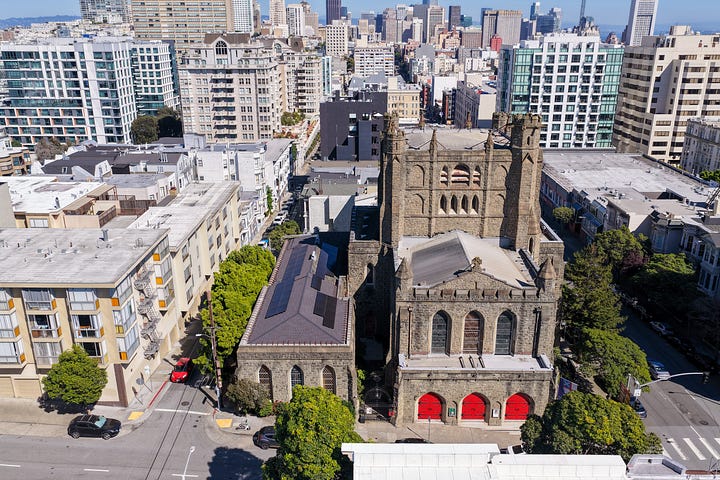
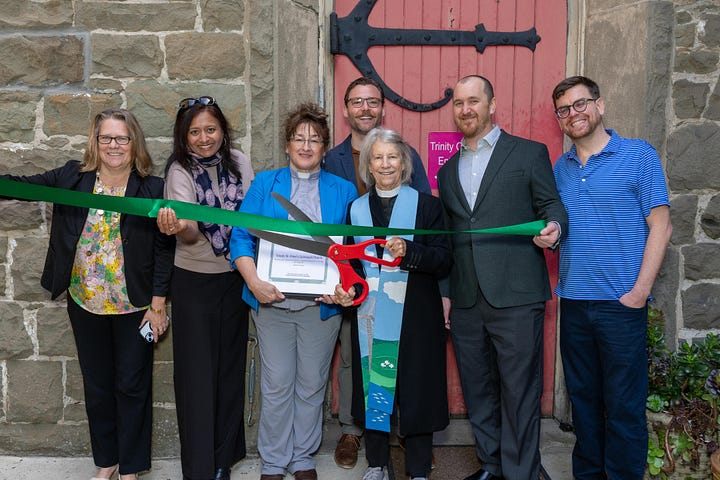
The system includes 47 solar panels generating roughly 20 kW of power and is projected to save the church an estimated $261,000 in energy costs over time. Those savings will allow Trinity St. Peter’s to expand the work it already does across the community, from food drives and neighborhood cleanups to broader social justice initiatives.
“Our church has been a constant in this neighborhood through every chapter of San Francisco’s history. Deciding to go solar ensures our doors remain open and our mission remains sustainable for the next century,” said Mike Chambers, Senior Warden of Trinity St. Peter’s as quoted in coverage by Solar Power World and Episcopal News Service. “Freeing up these funds means we can focus less on overhead and more on our neighbors. We are proud to prove that a historic faith community can lead the way toward a more equitable world.”
That idea, lowering overhead to expand mission-driven impact, is central to RE-volv’s work supporting nonprofits across the country. Through its zero-money-down financing model, RE-volv helps nonprofit community organizations, including faith institutions, begin realizing savings immediately, removing one of the biggest barriers to adopting solar in the first place.
Projects like this deliver far more than emissions reductions. They strengthen resilience, improve affordability, and help community institutions remain stable anchors during moments of uncertainty, demonstrating how even a 19th-century church can help lead on 21st-century energy solutions.
“When a community leader like Trinity St. Peter’s demonstrates its commitment to sustainability through adopting clean energy, that speaks volumes,” said Andreas Karelas, Executive Director of RE-volv. “It demonstrates to community members that local climate solutions are here now that lower electric bills, increase resilience, and create jobs, hopefully inspiring others to follow their example.”
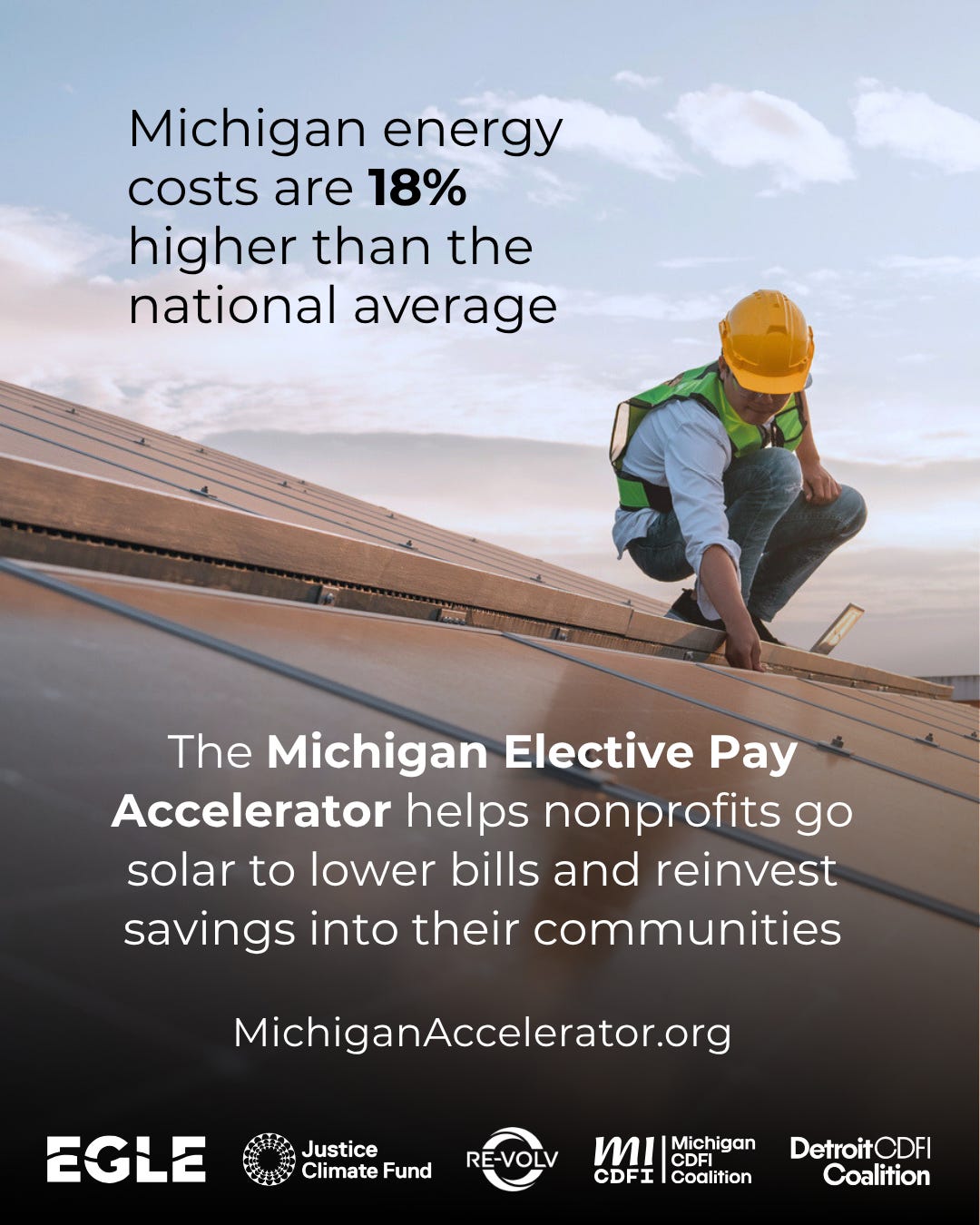
RE-volv has now helped finance more than 135 nonprofit solar projects nationwide, collectively saving organizations millions of dollars that can be reinvested into direct community services and mission-driven work. The organization is also expanding its impact through initiatives like the Michigan Elective Pay Accelerator, launched in partnership with Justice Climate Fund, and the Michigan and Detroit CDFI coalitions, with support from the Michigan Department of Environment, Great Lakes, and Energy (EGLE). The program is designed to help tax-exempt entities access federal clean energy tax credits through Elective Pay, unlocking new pathways for schools, houses of worship, and community organizations to adopt solar without taking on prohibitive upfront costs.
That work reflects a larger argument RE-volv Executive Director Andreas Karelas has advanced publicly: the clean energy transition is both an environmental AND an economic effort. In a recent op-ed for The Hill, Karelas argued that a clean energy-powered economy can help lower the cost of living, create good jobs, and strengthen communities. Projects like Trinity St. Peter’s shows what that vision looks like in practice, local institutions using clean energy savings to invest more directly in the people and neighborhoods they serve.
• • •
Cleveland Plain-Dealer: To keep the lights on, Ohio needs community energy now: Mryia Williams
The Hill: ‘Climate hushing’ or ‘kitchen table’? Democrats must decide.
Solar United Neighbors (SUN) produced a new video with Brandon Praileau, SUN’s Virginia Program Director. It tells the story of how he took his church solar and how it has benefited the congregation.
Comments
Nothing yet. Say the first thing.
Sign in to join the conversation.