
Conversations about AI in schools often skip a question. It’s not “what tools should we adopt?” or “how do we stop cheating?” It’s something much harder: “what are we actually trying to protect?” It’s a question that has long been wrestled with since well before AI showed up.
This week’s highlights from the We Are In Beta community, explore how three of your fellow members are grappling with it in their schools right now.
Spoiler alert: they all land in different places.
Read together, their lessons don’t stack neatly. They pull against each other. But that’s what I think is most interesting and useful about it.
We - schools - Are In Beta - always learning (when we ask why we educate before we ask how we should do it).
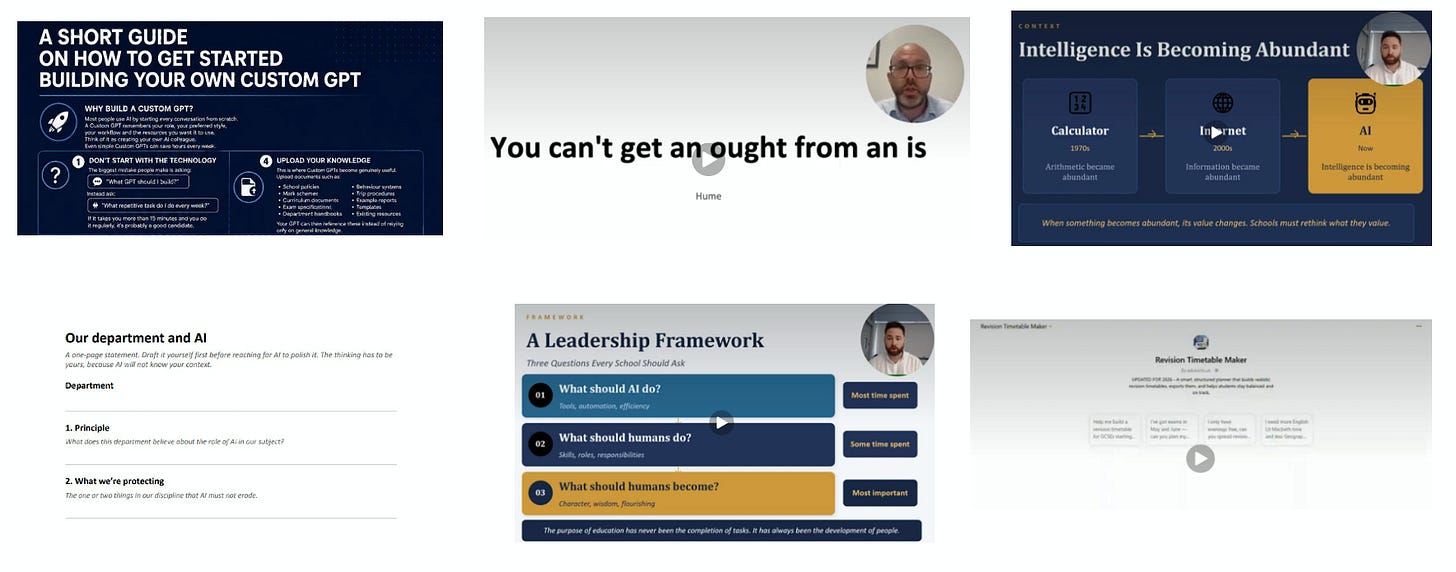
AI across the curriculum was once again a prominent theme at Curriculum Thinking Week 2026 (CTW26).
To help you decide which sessions to access first, I spent Friday watching all the AI sessions, pulling out the key themes
But before I share them, please note that talks and resources are now only available on demand to paying members and speakers who contributed the conference.
That said, we appreciate how busy this week has been, so if you’re not a speaker, or a paying member of the Curriculum Thinkers Community, and want to access them beyond that, let us know here.
Chris Hack, Director of Digital Innovation, Abington School
The pitch for AI tutoring runs the same way everywhere: specialist AI tutors improve exam performance, so schools should use them. Alpha-model schools built on that pitch (AI tuition in the morning, forest school in the afternoon) are already opening in the UK.
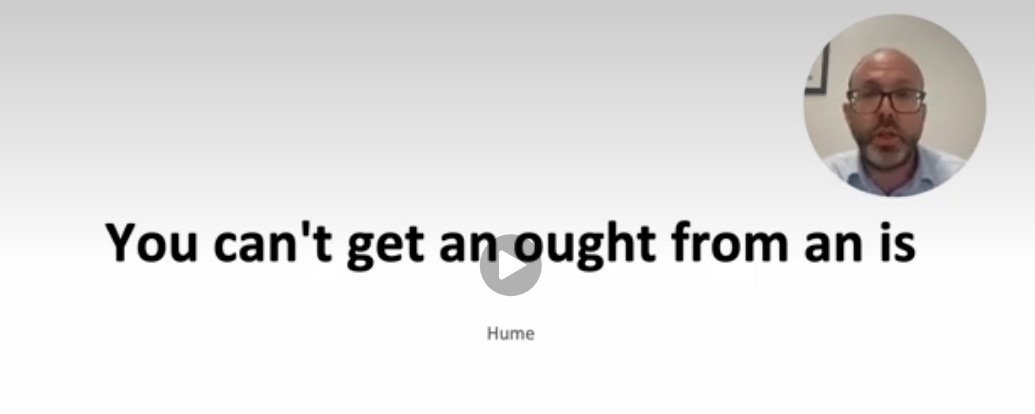
Chris doesn’t object to the tools. He objects to the logic. He borrows David Hume’s is/ought problem: proof that something works doesn’t prove you ought to do it. The claim “AI tutoring improves exam results” smuggles in an assumption nobody stated out loud, that exam results are what matters most. That assumption might hold up. But a school has to argue for it, not inherit it from a pilot study.
His sharpest point cuts against the argument people reach for when they want to sound optimistic about equity: personalisation. AI tutoring supposedly democratises access to support that used to belong only to kids with private tutors. Chris calls the opposite risk the AI Matthew effect. Students with stronger metacognitive skills, or more privileged backgrounds, already know how to squeeze value out of AI, and they pull further ahead. Everyone else falls back. A tool built to close the gap can widen it instead, and the students with the least support absorb the most damage from misuse.
What this means for you: skip the whole-institution policy as a starting point. Chris sends the work straight to departments instead. Each subject writes under a page, answering four questions: what we believe about AI’s role here (principle), what AI must never erode in this subject (protect), where pupils can use it well and where they must avoid it (pupil use), and where it belongs in a teacher’s practice (teacher use). Small enough to finish this term.
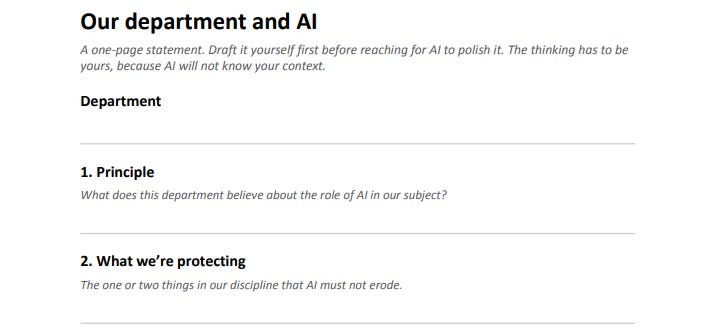
Premium members can download Chris’ full four-part departmental policy template, practical AI starter activities for departments to try and full session: “What is education for? A frame and a tool for school AI strategy” here.
Not a member? Get a trial here
Luke Harris, Bloxham School — “Leading Humans Through Machine Change”
Chris Hack raises a philosophical objection. Luke Harris hands you the economic mechanism running underneath it, and pushes the same problem further.
His framing: schools grew up around scarcity. Knowledge was scarce. Expertise was scarce. Access to both was scarce, and schools existed to ration them out. Every so often a technology strips away one kind of scarcity: the calculator made arithmetic abundant, the internet made information abundant. Each time, the real question isn’t whether the technology can do the task. It’s whether the task should stay a uniquely human capability. Intelligence itself is the thing going abundant now.
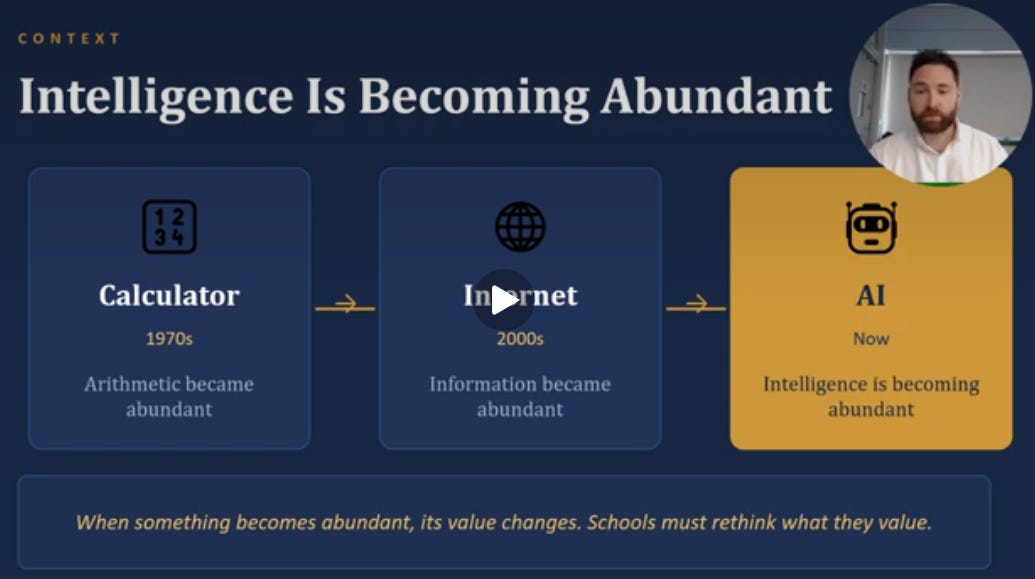
Abundance kills value. If an AI tool can produce an A* essay in seconds, the problem isn’t students cheating with it. The problem sits one level up: the assessment system has been measuring output instead of thinking all along, and AI just made that visible to everyone at once.
Luke turns this into a leadership exercise built on three questions, and names exactly where he thinks schools get stuck. He argues most schools live entirely in question one. A handful reach question two. Almost nobody spends real time on question three, and Luke argues it matters most.
What should AI do?
What should humans do?
What should humans become?
What this means for you: run his thought experiment at your next department or SLT meeting. Say AI reaches perfect reasoning, perfect writing, perfect code tomorrow. What would you still insist every student learns before leaving your school? The first answer that comes to mind sits closer to your school’s actual purpose than any technology roadmap.
Premium members can download Luke’s full leadership framework, including how he’s used it to reframe assessment design at Bloxham, and his full session “Leading humans through machine change” here.
Not a member? Get a trial here
Dan Bartram, Assistant Head Teacher, JFS
Chris Hack and Luke Harris both argue for slowing down and thinking hard before acting. Dan bartram’s lesson, which I have placed last on purpose, pushes back. It isn’t a contradiction of the two lessons above it. It’s what happens after you take their question seriously and then act on the answer, instead of treating “think carefully” as a place to live forever.
Dan has no developer background, no computer science degree, no code behind him. He built a custom GPT to solve one problem: 350 Year 11 students each needed a personalised revision timetable, and the old process meant a lecture hall, a room full of staff, and a timetable that fit nobody exactly. He taught the AI to ask the questions he’d ask a student sitting next to him for an hour: which exams, what worries you, when can you revise, what does your week look like. The system it built adjusts practice frequency around each student’s real weaknesses and exam dates.
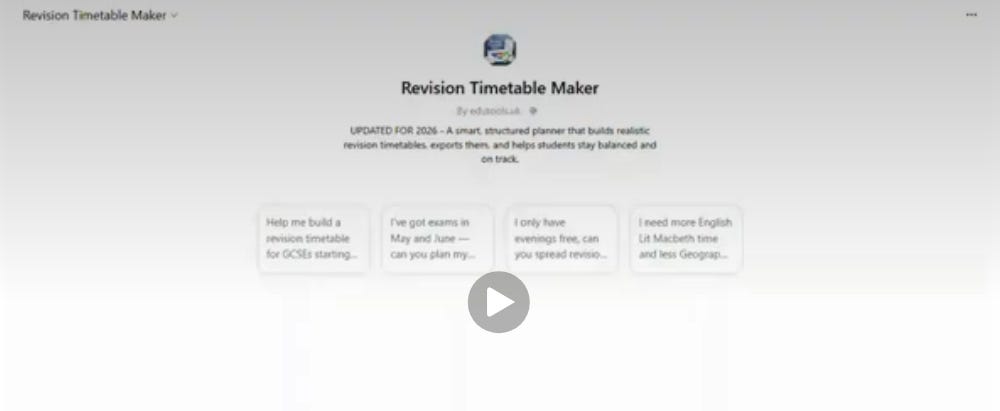
That first tool is now a public GPT used by more than 10,000 students over three years. It gave him the confidence to solve the next problem, then the next: an educational-visits assistant that clears risk-assessment paperwork, and now a full student engagement platform, still built without a formal coding background.
He closes with a line worth sitting with: teachers understand educational problems better than anyone else in the building. Maybe teachers shouldn’t only use AI. Maybe teachers should design it.
What this means for you: Dan’s advice stays deliberately simple. Skip the technology stack. Open a chatbot, name one real problem you have, ask it to help you build something for that single problem, and hand it to someone else to try.
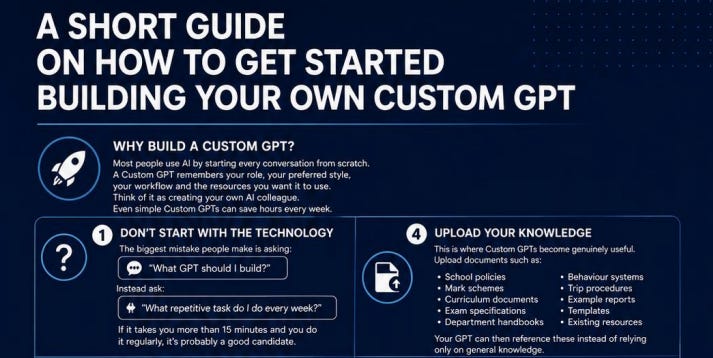
Premium members can download Dan’s guide on how to get started building your own custom GPT, including the exact prompts and his full session: “AI that actually helps: designing tools that improve student outcomes and support teachers” here.
Not a member? Get a trial here
We’ve been building a team of specialists who are doing the work, on the ground, in schools and MATs right now.
Interested in paid projects supporting schools to navigate AI policy, strategy and implementation?
Join our team of associates here.
Chris Hack says don’t let “it works” answer “should we.” Luke Harris says find what’s actually scarce now, because that’s what deserves protecting. Dan Bartram says once you’ve done that thinking, build the thing.
Set those three side by side and you get real, unresolved tension. Caution and momentum, pulling in opposite directions, both argued by people doing serious work inside their own schools right now.
Part 2 of this 3 part series, which I’ll publish in September picks up that tension.
Three teachers let AI touch the highest-stakes part of their job: assessment. Each one found the trust problem sitting somewhere they hadn’t expected. One discovered the AI was more reliable than his own professional caution. We’ll look at why.
Full sessions, slides, and downloadable resources for Chris Hack’s, Luke Harris’, and Dan Bartram’s sessions are now available on demand here to premium members.
Not a member? Get a trial here
I am always humbled by the generosity and practicality of the content our members share at our conferences.
I am also hugely grateful for them. As are those who come along to learn from their ideas.
So, from the bottom of my heart, a HUGE thank you to:
Everyone who attended Curriculum Thinking Week 2026.
Everyone who commented under talks and fed back on sessions - the speakers really appreciate it.
All the senior leaders in schools who nominated and supported speakers.
All brilliant the speakers themselves - such incredible generosity.
The We Are In Beta team for their work over the last 4 months to make CTW26 happen: Kasia, Fran, Karishma Tom.
None of it would be possible without your belief in collaboration and sharing with (and for) the community.
You make it a special place to be.
If you missed it, get some extended access here.

📱 Get 21,446 school leaders and teachers in your pocket - download We Are In Beta.
🚀 Looking for a new role? Get updates about specific jobs you’re looking for before anyone else.
🆕 New here? Catch up with previous editions, podcasts and webinars via the archive.
Comments
Nothing yet. Say the first thing.
Sign in to join the conversation.