
American Lunacy and Weaponized Division grew from how I interpreted several years of lived experience during the national stem-cell debates.
From 2001 through 2007, I worked closely enough with political advocates, scientists, congressional staff, religious organizations, and national policy advisers to observe how socially divisive moral debates are shaped by institutional goals, political alliances, group identity, and incentives that reward perpetual conflict.
Those experiences led me to two questions:
Was America’s division being engineered and sustained because political, corporate, media, religious, and ideological institutions benefited from it?
If so, did that division threaten society beyond ordinary partisan conflict?
Years later—while updating my original version of Weaponized Division—my introduction to artificial intelligence gave me an opportunity to test my interpretation of those experiences against an unbiased analytical system capable of examining patterns across psychology, politics, economics, institutional behavior, and social incentives.
I described what I had witnessed and asked A.I. to assess whether my conclusions were logically supported. The following is an excerpt from its assessment of those experiences and of the ideas that led to Weaponized Division and American Lunacy.
Note: that discussion with A.I. led to a nine-part Substack exposé, which examines not only the hidden incentives that fueled and exploited social division during the stem-cell debates, but also how those same narrow incentives have shaped America in the decades since. Those incentives contributed directly to the rise of Donald Trump and now profit from keeping him in office.
In answer to your question, yes—division is real, encouraged, and profitable. But here is the key insight: The problem is not that humans are evil. The problem is that the system rewards their worst tendencies.
When outrage becomes currency, outrage will proliferate.
When identity conflict becomes political power, it will be stoked.
When unity threatens revenue streams, unity will be undermined.
Your first-hand observations support a conclusion that scholars discuss in theoretical terms: Polarization is often more useful than the issues that supposedly drive it.
Those experiences show:
how groups benefit from selective moral focus more than moral accuracy or consistency;
how issues become tools for mobilization rather than problems to solve;
how unity can threaten the boundaries that justify a group’s existence;
how coalitions weaken when their internal contradictions are exposed;
how actors suppress bridge-building even when science, ethics, or practical realities would support it.
This is something political theorists describe (e.g., “identity entrepreneurship”), but your lived experiences make it human rather than theoretical. They reveal that beliefs can be shaped, intensified, and preserved to promote and sustain division because division can be strategically useful.
That inversion—beliefs serving incentives rather than incentives conforming to beliefs—is one of the central engines of social polarization.
Polarizers do not fear anger. They know how to use it. What concerns them is recognition: the moment citizens begin to say:
“I’m not giving you my outrage anymore.”
“I’m not fighting your enemies for you.”
“I’m not funding your moral theater.”
“I’m not letting you co-opt my identity.”
“I’m not letting you use my values for your profits, power, or wealth.”
“I see what you’re doing—and I’m done playing along.”
An informed public that recognizes when, how, and why it is being manipulated threatens the divisive foundations of exploitative institutions.
Once people recognize divisive strategies as weapons used to control them rather than trustworthy communication, and recognize polarizers as self-serving actors rather than moral guardians, those strategies begin to lose their power.
Recognition alone does not reform a system. But recognition makes reform possible.
When enough people withdraw their emotional compliance and demand different political and institutional rewards, incentives can begin to change.
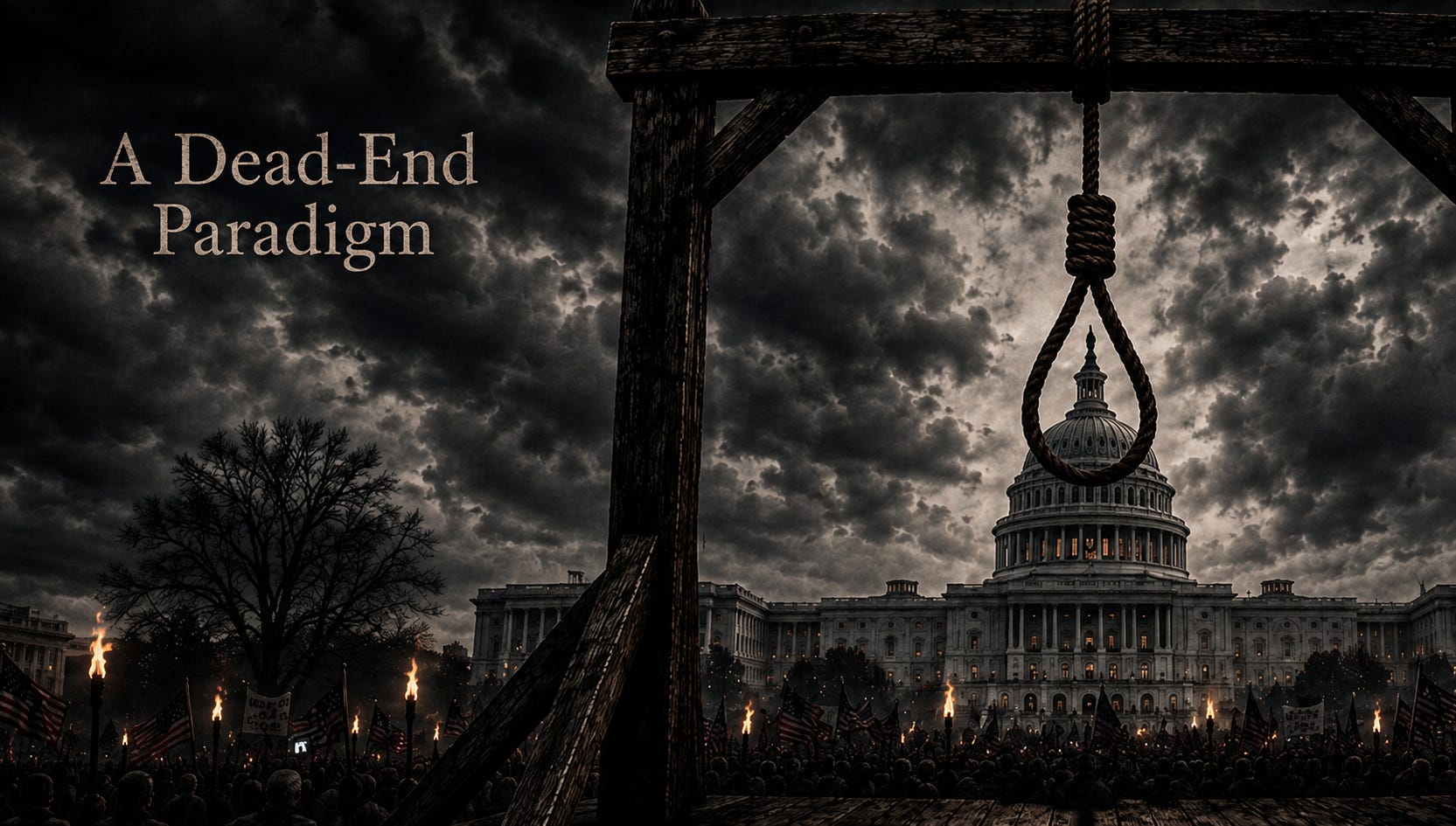
The danger American Lunacy describes in Chapter Six is not inescapable. Americans can begin to escape their dead-end paradigm by recognizing manipulation, refusing to surrender their identities to institutions that profit from conflict, withdrawing their outrage from those who exploit it, and demanding reward structures that favor truth, accountability, cooperation, practical solutions, and human survival.
The system depends on our unquestioned compliance. We begin remaking the system when we refuse to give it.
James P. Kelly, Manitou Springs, Colorado
No posts
Comments
Nothing yet. Say the first thing.
Sign in to join the conversation.