
A few weeks ago a successful CEO forwarded me an email with the subject line “Elon is targeting your retirement savings!‼️🚨” and asked me what she should do with her 401(k) given this news.
I understood her panic, but this email was dripping with scammy vibes and predatory fear-mongering. This email was perfectly designed to scare the shit out of you and convince you that you should cash out your 401(k) and buy gold (which is down ~22%+ from its peak in January of this year, by the way).
So how could this woman, someone who I know personally to be intelligent and successful, be so petrified by an email that was clearly a big scam?
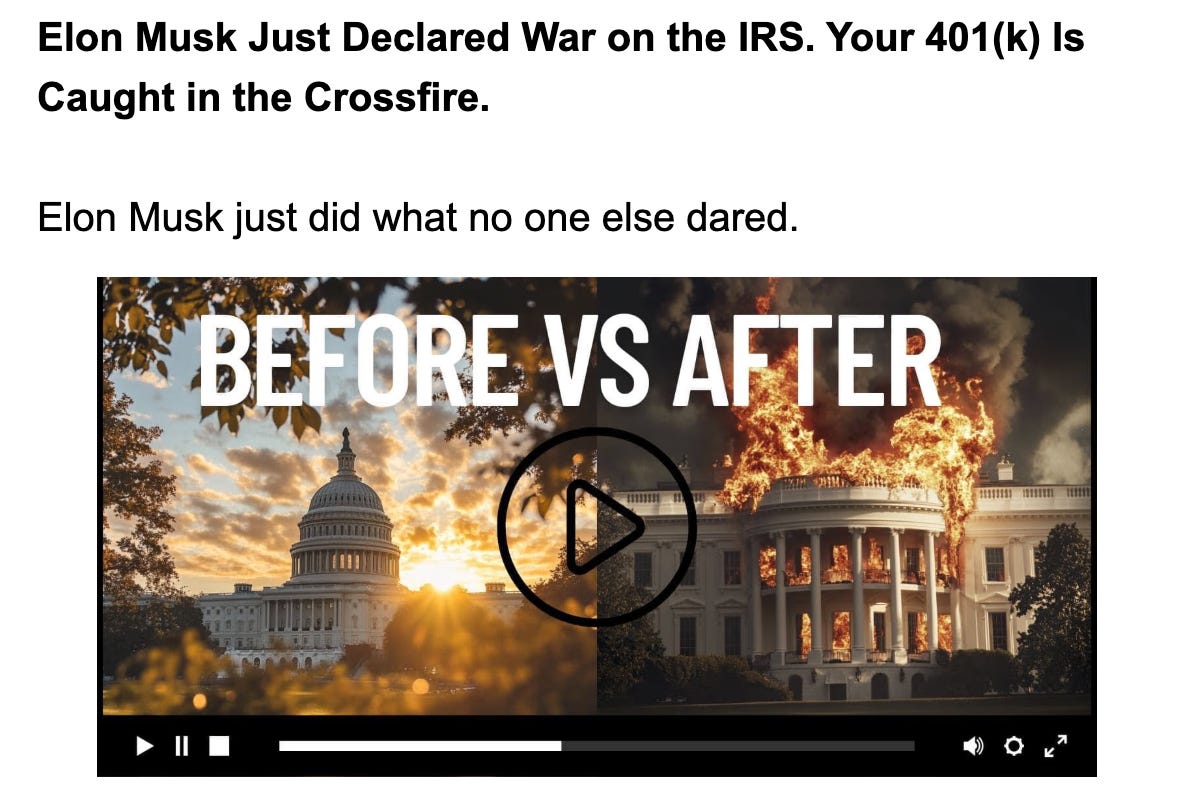
When headlines are loud and repetitive enough, anyone can fall victim to their own emotions and biases. But cashing out your 401(k) (which triggers taxes and a 10% early withdrawal penalty) because of a news cycle is almost never the right move.
So let me tell you where these headlines were actually coming from and then use it to show you something more important about your own money.
SpaceX went public on June 12th under the ticker SPCX — valued at up to $1.77 trillion, potentially the biggest IPO in history. For the first time, everyday people like you and me could buy a piece of it.
Here’s the connection to your 401(k):
Your retirement account is likely invested in index funds. An index fund is just a vehicle that holds a list of companies with something in common. The most well-known example of this is the S&P 500, which tracks the 500 largest US companies.
When you invest in an S&P 500 index fund, you automatically own a tiny slice of every company on that list. And when a new company gets added to an index, every fund tracking it has to buy that stock automatically — whether you chose it or not.
A company the size of SpaceX could eventually land in major indexes, which meant it could end up in your 401(k) by default. That’s what had people worried.
Here’s some examples of what happened by index:
S&P 500 (likely to be in your 401(k) — The S&P 500 held firm on their rules and SpaceX is blocked for at least another year, probably longer. To join, a company has to be public for at least 12 months and show four consecutive quarters of profit. SpaceX lost $4.28 billion in Q1 of 2026 alone.
Russell 1000 (another common 401(k) option, often labeled “large cap index fund”) — changed its rules. SpaceX will be included. But we’re talking about a small slice of a fund that holds 1,000 companies.
Nasdaq-100 / QQQ (more common in IRAs and brokerage accounts than 401(k)s) — also changed its rules. SpaceX expected to enter around July 2026 at about 0.5% of the fund.
The bottom line is that if SpaceX ends up in a fund you own, it will be a small fraction of a fund that holds hundreds of other companies. That’s exactly how index investing is supposed to work — no single company can make or break you.
I’m personally staying in index funds. Not losing sleep.
The SpaceX panic was loud. And while everyone was reading about Elon and index rules, most people still had no idea whether their own portfolio was actually growing the way it should be.
That’s the more important conversation. And it’s one most women I talk to have never had.
If you have a 401(k), IRA, or any investment account, you are already an investor — whether you claim that title or not. Your money has stock market exposure right now. And if you don’t know whether it’s growing, you’re winging it.
I know, because I did exactly this.
I opened a Roth IRA in my early 20s and then just... didn’t look at it for years. I told myself I was being responsible because I’d opened the account. But I had no idea what I was invested in, what my returns looked like, or whether anything was actually growing.
By the time I finally learned enough to understand what was happening, it had already cost me real money:
I had been invested in mutual funds that had very high fees (called expense ratios) that had already taken thousands of dollars of my hard earned money.
I was invested way too conservatively with a huge chunk of my money in bonds (not appropriate for someone in their 20’s, 30’s, or even 40’s I’d argue).
I see these two mistakes in 401(k)’s all the time.
I share my money fuck ups a lot because I want you to know that it’s okay if you were in the dark before (we were never taught how to optimize our money) but it’s not okay to continue to be a passenger of your financial life.
It took me one book (A Simple Path to Wealth by JL Collins) to understand what was happening with my account and that I had to make a change ASAP. Reading that one book and committing to taking control of my money easily saved me multiple six figures in future fees. The cost of not knowing is just a lot higher than most people realize.
Here’s a simple way to see where you stand:
1. Find your annualized returns. Log into your 401(k) or brokerage account and look for performance data across 3, 5, and 10 years.
2. Compare them to the S&P 500. Just Google “S&P 500” — you’ll see historical returns across the same timeframes. The long-term average is about ~10% annually.
3. Ask whether the gap makes sense. If your portfolio includes bonds, a lower return is expected — a 70/30 mix of stocks to bonds has historically returned around 8%. But if you’re seeing significantly lower returns with no clear explanation, that’s worth looking into.
While you’re in there, check your fees. Every fund has something called an expense ratio — a percentage that gets taken out of your returns every year. A 1% annual fee sounds small. Over 20-30 years, it can cost you tens of thousands of dollars in lost growth. Financial advisor fees are the same story.
Most 401(k)’s I see these days have index fund options that have an expense ratio (the annual fee expressed as a percentage) of less than .2%. For most people, there is no need to pay high fees to get diversified exposure to the stock market.
Most women I talk to aren’t avoiding their money because they don’t care. They’re avoiding it because they’re afraid of what they’ll find or because it feels too complicated to even know where to start.
When you do work up the courage to start engaging with your money the fear shrinks fast. Financial shame dies in the light too. Not because everything is perfect, but because you take more control of your money with every piece of financial knowledge you acquire.
The SpaceX IPO wasn’t going to take your money. But years of not knowing what’s in your account might.
Pull up your account this week. Just look. Pick one thing you’re invested in and learn more about it. That’s it. One step at a time.
I don't believe in gatekeeping money knowledge. Everything I point you to is either free, affordable, or something I'd personally vouch for. Consider this your permission slip to start.
So if you’re not sure where to start, be sure to head over to my Workshop Library where I’ve posted entire beginning investor trainings including one called 4 Ways to Make the Most of Your 401(k). Companies pay thousands of dollars for me to come present this workshop to their employees and now you can access it for free.
No posts
Comments
Nothing yet. Say the first thing.
Sign in to join the conversation.