

Mark got the call on a Tuesday.
A recruiter, a role he was actually qualified for, 34% more than he makes now, remote three days a week. The kind of offer people wait years for.
He said no before lunch. Didn’t run the numbers. Didn’t sleep on it. Told his wife it “wasn’t the right time” and went back to his spreadsheet.

You are reading Wealth GPS! This is a weekly space dedicated to practical financial planning and wealth building. We’re here to help you rethink money, trade old habits for clarity, and make better long-term financial decisions.
Glad to have you here. See how we build true financial clarity 👇
Here’s what wasn’t in that spreadsheet: 2011. Eleven months without a paycheck. $38,000 in savings gone. A mortgage payment he made by selling his wife’s car. When he finally got hired again, it was for $9,000 less than he’d made before and he took it the same day, no negotiating, because by then negotiating felt like a luxury for people who hadn’t learned their lesson yet.
Mark didn’t say no to the recruiter. He said no to 2011 happening again.
Caution runs the numbers. What Mark did was not caution.
What Mark did was protect a promise he made to himself fifteen years ago: never again let go of the bird in hand for the one in the bush - even when the bird in hand pays $9,000 less than it should and the one in the bush is standing right in front of him with an offer letter.
He’s not protecting a paycheck.
He’s protecting a man who swore he’d never be blindsided twice.
This isn’t only Mark’s mechanism. I watched a business owner keep a losing division open for six years ($360,000 and counting) because closing it meant admitting the 32-year-old who started it had been wrong.
Different balance sheet.
Same defendant.
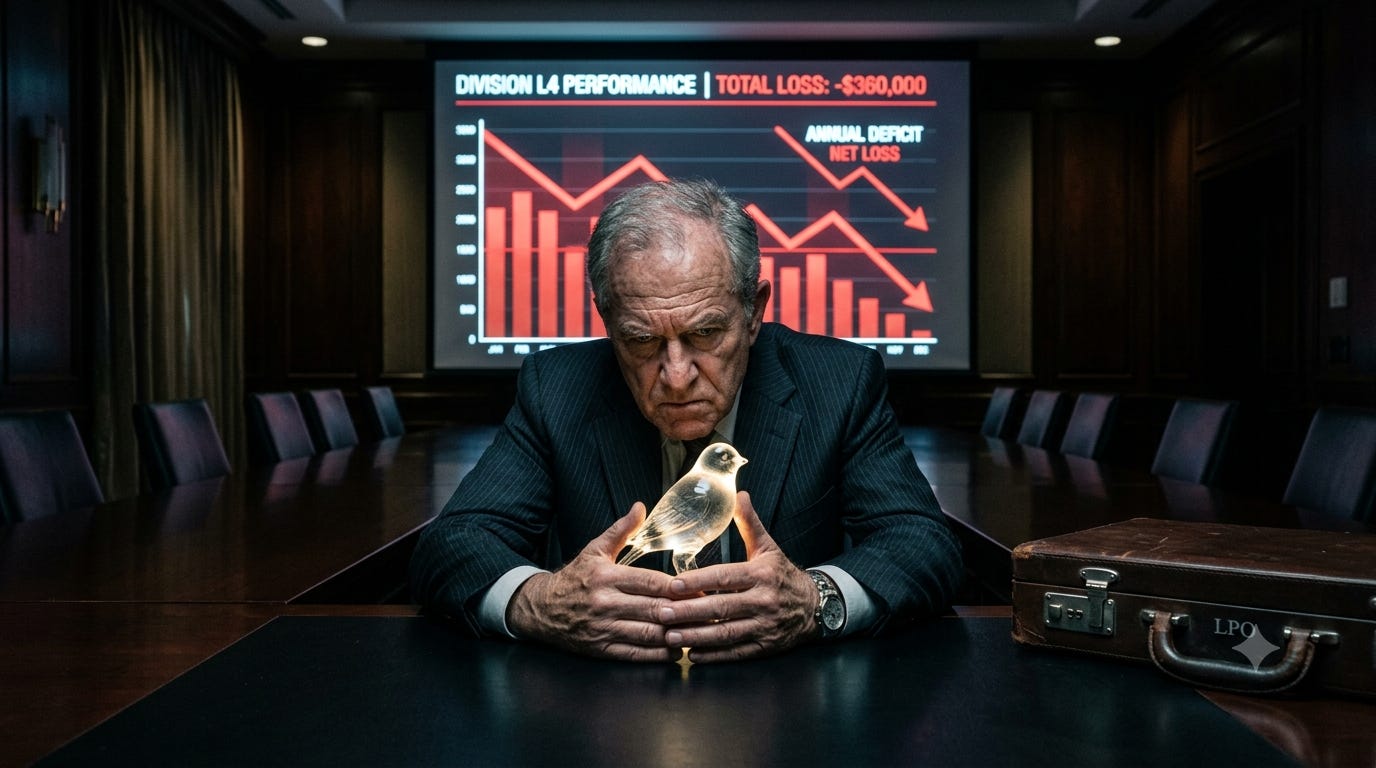
Here’s the question underneath both of them, and it’s the one that actually costs money to avoid:
If someone you didn’t particularly admire made this exact decision, for these exact reasons, would you still defend it?
Before you answer for Mark, answer for them.
Would you tell a stranger that turning down a 34% raise because of something that happened fifteen years ago is smart risk management? Would you call a $360,000 loss “patience” if it were someone else’s business, someone else’s ego on the line?
Now put a name to it.
Someone specific you don’t respect, making this exact call, for these exact reasons.
Defending it? Would you defend it if it wasn’t you?
Most people flinch before they answer. That’s not weakness.
That’s the fusion doing exactly what it’s built to do.
A decision fused to your identity stops being a decision.
It isn’t a choice anymore, but becomes a character reference.
It becomes a verdict about who you are and nobody cross-examines a character reference for yourself, or your own verdict.
It’s self-defense - the literal kind.
Here’s the loop, and it’s tighter than it looks:
The decision isn’t just a decision anymore. It’s evidence.
Evidence that you learned your lesson, that you’re not naive, that you’re the person who doesn’t get fooled twice.
Once a decision becomes evidence of who you are, examining the decision means putting yourself on trial.
So you don’t examine it. You defend it.
And every year you defend it, it fuses tighter to your identity, which makes the next examination even less likely, and the decision even more expensive to question.
The behavior protects the ego.
The ego makes the question unaskable.
The unasked question lets the behavior keep costing money, unexamined, indefinitely.
Mark isn’t taking that recruiter’s call again; the number was right, but the number was never what got evaluated.
And somewhere right now, you’re defending a decision a little too hard for what it’s actually worth on paper.
That’s usually not about the decision.
Somewhere right now, you’re defending a decision a little too hard for what it’s actually worth on paper. Ask the uncomfortable question before the ego forces you back into court.
Decision Autopsy and Uncomfortable Question were never two separate ideas. They were the “outside” and the “inside” of the same moment.
Both series examine symptoms of the same underlying thing: someone who makes a specific bad decision also tends to be dodging a specific uncomfortable question.
Decision Autopsy series looks at a decision from outside, after the fact, once the cost is visible.
Uncomfortable Question series looks at the exact same moment from inside it, before the cost; the question that gets skipped on the way there, while the avoiding is still happening.
The outside shows you what it cost. The inside shows you what it was protecting.
Read one and you get half the mechanism. Neither view alone tells you the whole thing.
Cross-Examined runs both at once, one pair per post. You get the whole thing - which is the entire reason Cross-Examined exists.
This post pairs Identity-Fused Decisions with If this decision were made by someone you don't admire, would you still defend it? Read together for the first time.
Everything else lives at Decision Autopsy and Uncomfortable Question hubs.
For our general positioning and philosophy see From Advice to Judgement and How to Stop Chasing Financial Advice and Start Making Better Money Decisions.
Missed the big one? Wealth GPS was featured monthly in the 10 Under-discovered Substack Financial Writers You Should be Reading - a curated collection of the best writing on personal finance on Substack.
Read all issues since the start of 2026 here to discover other fantastic finance writers.
The best investment you can make is in the quality of your own thinking. Join the inner circle to ensure your decisions are fueled by substance, not habit.
If this made you pause and think, please don’t just close the tab. Share it with someone who is in this situation or still looking for this kind of content. You have no idea how much time you could save them by sharing it.
Every graphic here is the creative genius of Leslie Paul Oosten.
His art captures the invisible struggles behind words and turns them into visual gold.
Authors: See 👇 how collaborating with him takes your posts to the next level!
Readers: Dive into his work and experience the most fun, creative corner of Substack!

Thank you for joining us,
Elizabeth
Elizabeth Blake is a retired Certified Financial Planner® with 25+ years of experience in personal financial planning. Her articles draw on patterns observed across hundreds of client relationships and thousands of interactions.
Disclaimer: The content in this publication is for informational and entertainment purposes only. It reflects the personal opinions of the author and should not be considered financial advice, recommendations, or a solicitation to buy or sell any financial products. Posts are written for a general audience and do not consider your specific financial situation. The author is a former financial planner and does not offer financial planning or advisory services through this publication.
Substack thrives on thoughtful conversation and sharing; feel free to re-stack this post, share it with others, or write your own Notes in response. You’re also welcome to download and use any free tools or resources provided; they were created you in mind and they are yours to keep. If you’d like to repost or quote from this article elsewhere, please credit the source and link back. For anything beyond brief excerpts, just reach out for permission.
Comments
Nothing yet. Say the first thing.
Sign in to join the conversation.