
When Sally Ekus joined us on Way-Word Writers to talk about the cookbook shelf, she said something that really surprised me.
You can find that podcast here: EPISODE 110: Inside Today’s Cookbook Market with Agent Sally Ekus
On average, people make three recipes from a cookbook they buy.
Three!
Not three a week. Three, total. And they spent $30 on it. I do too sometimes.
I guess what stunned me is that I’ve seen all the work behind the scenes. Most cookbooks have somewhere between 40 and 80 recipes. The author has spent three or four years writing it and taking photographs (or paid thousands of dollars for them out of their own pocket). And we spend roughly $30 for three recipes.
These statistics should be a death sentence for an entire category of publishing. If cookbooks are for making new recipes, they’re failing. And yet, they’re one of the few corners of the publishing industry that’s not just surviving but thriving.
It made me wonder why people actually buy cookbooks. And more, why do we buy books in general, if not to read for entertainment or utilize the wisdom and experience in them?
The three-recipe number Sally mentioned has been noticed by others in the cookbook world as well. The recipe-indexing community Eat Your Books has surveyed its own members—people who, by definition, are more engaged with cookbooks than the general population—and found that members who tracked their cooking averaged about three recipes per book they owned, with food writer Kate Gibbs putting the number for ordinary readers closer to two.
Meanwhile, cookbook sales keep climbing. According to NPD Group analyst Kristen McLean, cookbooks are the fourth-largest category of nonfiction in the United States, with sales hovering around 20 million units a year. Industry tracker Circana recently reported that baking cookbooks alone are up more than 80% in 2025; over 800,000 baking cookbooks were sold in twelve months. People are buying these books faster than they can get cocoa powder on the pages!
Sally said something during the episode that I keep returning to (while editing lol): “There has to be another reason to be buying, appreciating, taking these books out of the library.” Then she started listing what those reasons might be. Teaching tools. Time travel. Identity. Gifts.
Her own example was beautiful. A dear friend gave her a bridal cookbook for her wedding, and pasted her actual wedding invitation inside it. Twenty years later, Sally said, every time she opens that cookbook, she’s twenty years younger, standing at her wedding again. The recipes are almost beside the point. The book is a portal.
She also mentioned that she keeps a macro cookbook in active use right now where she writes notes in the margins — my boys devoured this, or don’t make this again. The cookbook becomes a journal. A document of what her family has eaten and what they’ve loved. A record of who they are at the table.
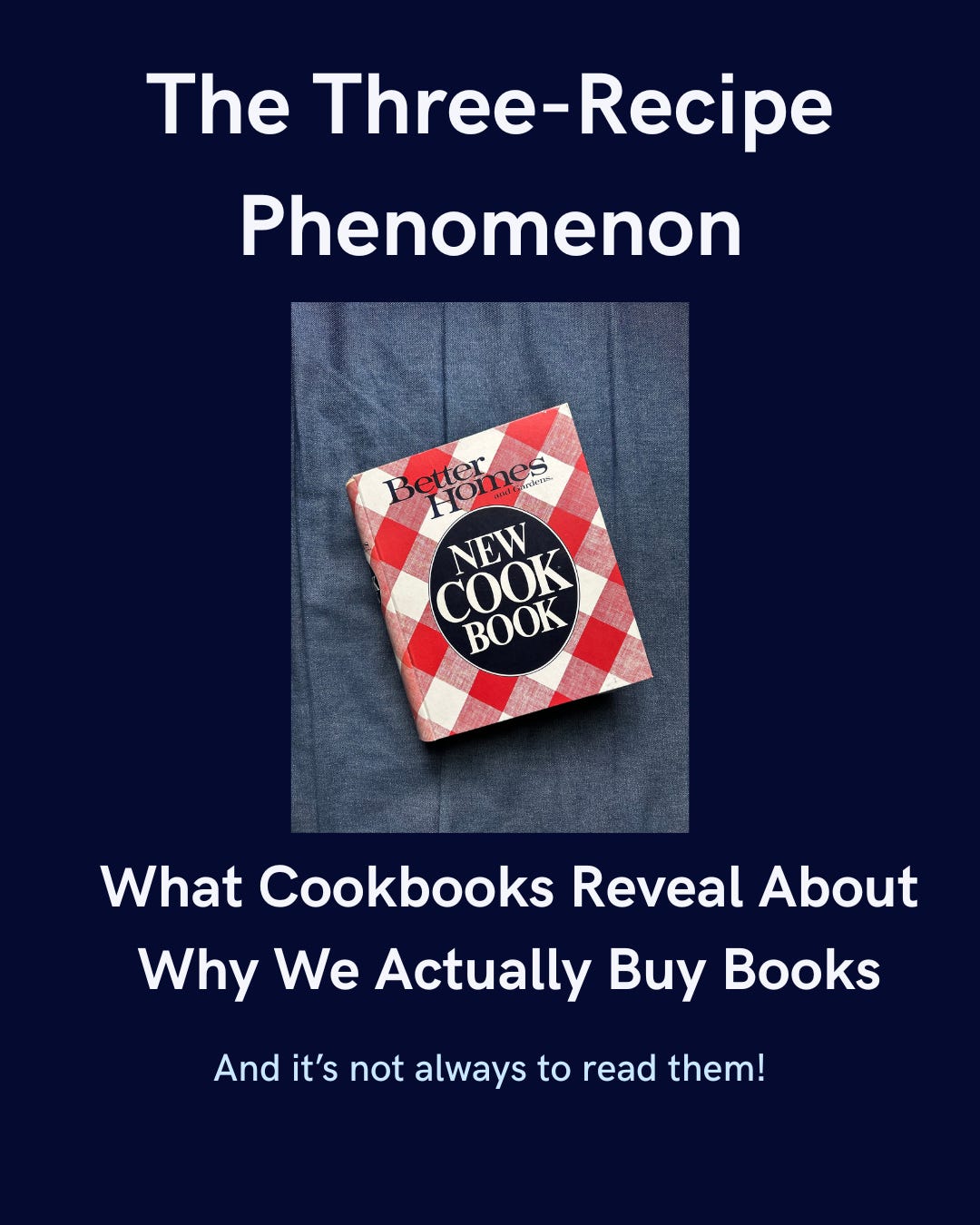
I have my own version of this. I got a Betty Crocker cookbook as a wedding gift, and it has taught me how to make almost everything Gram didn’t teach me how to make—pies, meatballs, biscuits, the kinds of foods you only fully trust when someone teaches you with authority. (I do skip anything involving gelatin. Some things are non-negotiable.) That book is older than several of my close friendships. If a fire broke out tomorrow, it would be one of the first things I grabbed.
Marketplace ran a piece in 2023 about a Baltimore writer named Leslie Gray Streeter who has 47 cookbooks in her kitchen and admitted that her “regular rotation” was about three or four. But Streeter said something else interesting: she loves that one day she’ll be able to pass these books, with their stains and check marks and food-spattered pages, on to her son. The cookbook isn’t an instruction manual. It’s an inheritance.
This is what we’re actually paying for. Not a recipe count. A relationship.
This is my take: the gap between purchase and use isn’t unique to cookbooks. It’s true of basically every book.
Most novels people buy don’t get finished. Surveys of e-reader data have shown for years that an enormous percentage of bestsellers are abandoned somewhere in the first hundred pages. Most self-help books don’t get applied. Most business books get skimmed. Most poetry collections get dipped into and shelved. The book a person is actually reading is almost always vastly outnumbered by the books on the shelf behind them, the ones they bought in earnest and then never quite got to that we lovingly call our TBR lists.
Cookbooks are not unusual because they have this gap. Cookbooks are unusual because they make the gap visible. You can literally count the food-stained pages. You can see which recipe has the corner folded down and which 140 do not. The novel hides its abandonment because you’d have to dig through someone’s e-reader stats to see the highlighted passages stop at 14%.
I think the cookbook industry is actually showing us something true about the entire publishing industry, which most categories are too discreet to admit: a huge part of what readers buy from us isn’t the content. It’s the promise of the content. The aspiration. The identity that comes with being the kind of person who owns this book. The relationship with the voice on the page.
If you’re writing a novel, or a memoir, or a middle grade fantasy, or anything in between, the temptation is to think of your story as the product. The book is the delivery mechanism. Everything else is packaging.
So why are special editions a thing? A BIG thing too.
Why do people own the hardcover first edition, the paperback, and the e-book?
Cookbooks show us that the product is something larger and stranger. The product is the experience of having bought your book. It’s the bookshelf next to the reader’s desk that says I am the kind of person who reads this. It’s the gift exchange where someone hands your book to a friend and says, this is going to mean something to you. It’s the second-hand copy that surfaces twenty years from now with writing in the margins and a folded receipt for a coffee for a bookmark.
That may sound like fluff, but it has very practical implications. Sally talked in the episode about how she evaluates cookbook proposals. The specific thing she said that stood out to me was that she looks at the platform, the voice, the content, ideally all three. Not because she’s collecting boxes to check, but because all three are answers to the same underlying question: who is this book for, and why will they keep it?
You should be asking the same thing about your novel or picture book or nonfiction proposal.
If readers only made the recipes, voice wouldn’t matter. You’d just need clean instructions and good photos. The fact that voice matters at all means people choose Samin Nosrat over a competing salt-fat-acid-heat reference because they want her on their shelf. (I do too.) I bought Salt, Acid, Fat, Heat because my daughter had it and loved it. We shared tidbits out of it and experiences with the recipes we made while a thousand miles apart.
To me, this is eye opening. Fundamentally, even if people do read books all the way through, which does happen a lot too, there are a lot of books out there being bought because of what people want to feel, how they want to be seen, and how they want to see themselves.
This is true of the novel on the nightstand, the picture book in the lap, and the YA paperback on the bus. Even if the reader is buying the story, they’re also buying time with you—the author. Some of that time will be spent reading. Some of it will be spent owning the book. Some of it will be spent gifting the book, talking about it at dinner, or seeing it on the shelf and, for a second, feeling like the kind of person who reads it.
All of that is the product.
Two practical things, and then it’s bye-bye time.
First, when you’re trying to articulate why your book matters—in a query, in a pitch, in a synopsis, in a Substack post—don’t only describe what’s in it. Describe what it does for the reader who keeps it. Sally’s complaint about people pitching “coffee table cookbooks” is a version of this: they’re using a format word when what they actually mean is I want my book to be beautiful enough that someone is proud to display it. That’s a totally different sentence, and it’s the one publishers, agents, and eventually readers are listening for. What does it mean to be the kind of person who owns your book? If you can answer that in one sentence, you’ve done a thing most authors never do.
Second (trying to be gentle here), the gap between buying and using is not a failure of you or your readers. They are not letting you down by not finishing chapter four. The Betty Crocker cookbook on my shelf has lots of gelatin of recipes I’ll never make, and that doesn’t make it a failed book. It makes it a successful one, because every time I open it, I trust it, am taught by it, and think about the person who handed it to me twenty years ago as well as all the times I’ve made the recipes in it and who was with me at which table in which state around the country. The relationship is the success. The recipes were the excuse.
Three recipes is, it turns out, plenty.
This article is a companion to our conversation with Sally Ekus, senior literary agent at Jean V. Naggar Literary Agency, on the cookbook market, platform, and what makes a great food book. You can find Sally’s Substack, Not So Secret Agent, for more info about the cookbook side of publishing.
No posts
Comments
Nothing yet. Say the first thing.
Sign in to join the conversation.