
There is a stretch of road in central Delhi that does not look like it should matter. It is not wide. It is not beautiful in the way the rest of Lutyens’ Delhi insists on being beautiful, with its wide avenues and its deliberate distances. Jantar Mantar is mostly known, if you are a tourist, for the eighteenth-century astronomical instruments it is named after, stone sundials built to read the sky with a precision that still startles people who visit them today. But if you have lived in Delhi any length of time, you know it for something else entirely. You know it as the place the city goes when it needs to be heard, and you know, if you are honest, that this government has never once listened there without first being forced to.
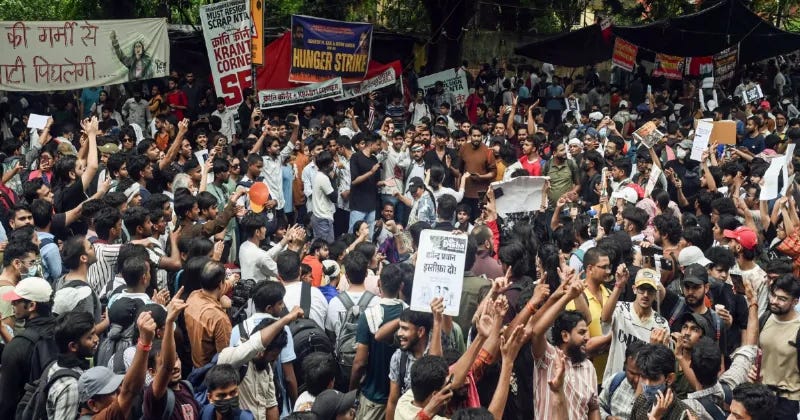
I have walked past it on ordinary days, when there was nothing happening at all, just the astronomical instruments sitting patiently in the heat, tourists photographing angles they do not understand. And I have walked past it on the other kind of day, when the road was full of people and the air had that particular density that only a few thousand raised voices can give it. It has always struck me as strange that the same seventeen hundred feet of pavement could hold both of those realities so easily, decades apart, again and again, as if the city needed one place set aside for its own conscience, because the people meant to hold that conscience inside Parliament have repeatedly proven they will not do it voluntarily.
My earliest memory of Jantar Mantar is not really mine. It belongs half to me and half to whoever brought me there, at 9, holding a hand through a crowd I was too small to see over, during the Anna Hazare protests of 2011. I remember almost nothing concrete, a sea of white caps, someone’s shoulder, the peculiar excitement of adults behaving like something enormous was happening, because something enormous was happening, even if I did not have the vocabulary yet to know what corruption meant or why a man refusing food in a tent could make the news every night. What I remember instead is the feeling of it. That this road was where the country came to be loud, and that being loud, here, was allowed, and that the government of that year at least had the decency to sit down eventually and talk.
I went back in 2019, older by then, old enough to understand exactly what I was protesting and why, when the road filled with women who stayed through Delhi’s cold to say that a citizenship law had no business asking them to prove they belonged in their own country. I remember the cold more than anything else, how people kept showing up anyway, night after night, with blankets and thermoses and a stubbornness that looked, from the outside, almost like faith, and I remember how long this same government made them wait, how many months of dismissal and delay it took before anyone in power treated the protest as anything other than an inconvenience to be waited out. Farmers came later, camped mostly at the city’s borders rather than at Jantar Mantar itself, and eventually went home having won a repeal, but only after more than a year, and only after too many of them died on those borders waiting for a government that had spent that entire year calling them names instead of opening a door.
And now, this July, I am watching the same road fill again, this time with people barely younger than I was the last time I stood there. This time it belongs to students, and to a demand so basic it is almost obscene that anyone should have to march for it. An exam meant to decide the shape of your entire life should not have been rigged before you ever sat down to take it, and a government that allowed that rot to fester should not need tear gas and detentions to answer for it. I keep thinking about the fact that I have now watched this road hold three different griefs across three different decades of my own life, run by three years of the same ruling establishment, and that each time, the shape of the crowd changes but the government’s instinct does not. Delay. Deny. Discredit. Only move when the cost of not moving becomes politically unbearable.
I want to be completely honest about where I stand, because I am tired of the fiction that standing nowhere is somehow more respectable than standing somewhere. I am with the students. I am with the Cockroach Janta Party, and I am done being polite about the government they are up against. I am with them because when a system tells an entire generation that the exam determining their future may have been leaked to whoever could afford to buy it in advance, the correct response is not patience. It is fury, organised and sustained until someone with power is forced to answer for it. NEET was supposed to be the one part of the machine that could not be gamed by money or connections, the promise, however imperfect, that a village kid with a torn textbook and a rented room near a coaching centre could outstudy a minister’s son and win the same seat on the same terms. When that promise breaks, it does not just break an exam. It breaks the last remaining story a lot of Indian families were telling their children about why the hard years were worth it, and it happened on this government’s watch, inside institutions this government is responsible for overseeing.
The Cockroach Janta Party did not choose Jantar Mantar by accident. You do not build a movement and then stumble onto that stretch of road. You go there because the ground already knows how to hold a protest. It has infrastructure the way a temple has infrastructure, not physical, mostly, but symbolic. A precedent. A memory the city carries even when individual Delhiites cannot quite remember which year which movement happened, only that it did, only that this is where it happens, and only that whoever was in power at the time eventually had to be dragged, kicking, into acknowledging it.
What I keep noticing, watching this particular protest unfold, is not only the argument itself, though I have made clear where I stand on that, but the machinery of care built around it almost overnight, entirely without instruction, and entirely without help from the state that should be providing it. Reports from the ground describe langars set up to feed thousands of strangers who arrived from outside Delhi with nothing but conviction and a train ticket. Vendors handing out pizza and biryani alongside volunteers ladling food from enormous pots, the way gurdwaras in this city have quietly fed protest movements for years without ever asking who deserves to eat and who does not. Nobody writes the history of who cooked what. Nobody credits the person who kept a water tanker running for four straight days in the July heat, while the same authorities cutting internet access and deploying barricades could not be bothered to send water of their own. That labour disappears the way it always disappears, not because it does not matter, but because movements get remembered for their most photographed moments, not their most necessary ones. If I am honest, this is the part of the story I find most moving, more than any speech from the stage. The instinct of ordinary people to feed other people’s children while the state meant to serve those same children was busy trying to break them up.
And then there is a man in a hospital who began a fast weeks ago and is, by his own account, requesting temporary release so he can walk with people less than half his age toward a Parliament that still has not properly agreed to see them. Sonam Wangchuk has spent years turning his own body into an argument, first for Ladakh’s statehood and its inclusion under the Sixth Schedule, now for students he has no formal reason to owe anything to except that he apparently believes some things are worth being hungry for, and both times the response from the people in charge has been the same tired mix of stalling and containment rather than an honest answer. I do not think it is naive to be moved by that. Hunger strikes carry a specific weight in this country that they do not carry everywhere else. Gandhi built an entire political grammar out of the idea that a body’s refusal could do what argument alone could not, and it says something damning about the current government that this old, deeply Indian language of protest is still the only thing that reliably makes it move at all.
The marchers were met at several points by barricades, by tear gas, by baton charges. Police have called this a measured, necessary response to crowds attempting to breach security lines. I do not believe them, and I am not going to write a sentence pretending I find that explanation credible. When the footage circulating shows students, many of them teenagers, some by multiple accounts caught in the same crush as older organizers, being struck and dispersed by force, the phrase law and order stops functioning as an explanation and starts functioning as a shield, the kind of language a government reaches for when it would rather describe what it did to a crowd than admit what it did to a child holding a placard. This is not an isolated overreaction by a few officers having a bad day. This is what this government does, again and again, whenever it is asked a hard question by its own young people, and I think it is long past time to say so plainly instead of dressing it up as an unfortunate incident.
What strikes me most is not the violence itself, which is at least legible. You can point to a baton, a canister, a barricade, and say this happened. It is the refusal underneath it. A government that had nothing to hide from a paper leak inquiry would not need tear gas to keep students away from the building where their grievance is supposed to be heard. Talks happen, eventually, but only after the road has been forced to fill, only after a hunger strike has put someone in a hospital bed, only after the optics have become too costly to ignore, never because listening was the first instinct. That pattern is not a coincidence, and I will not pretend it is. It is what this government does when it has stopped believing it owes its citizens an explanation by default. It waits to be made to explain itself, and it treats the making as the crime rather than the years of neglect that necessitated it. I will note, only because accuracy matters and because I do not want a single overstated detail to be used to discredit everything true in this piece, that some specific claims from this week, exact injury counts, who struck first at which barricade, are still being verified. That caveat does not soften my position. It is there so the position holds up.
Here is the thing about Jantar Mantar that I think its long memory actually proves, if you are willing to read it that way. None of these movements got what they wanted by being polite, and none of the governments facing them ever moved because politeness convinced them to. Hazare’s fast was theater, and it was also effective theater, because theater performed at the right pressure point can move institutions that reasoned argument alone cannot. The women who occupied that road through winter were not offered a seat at any table until they had made the absence of one impossible to ignore. The farmers left only after the government had run out of ways to wait them out, and only after paying a price in lives it never should have let them pay. If the students marching this month are loud, disruptive, occasionally chaotic, occasionally led by people the government would prefer to dismiss as a joke because of a deliberately silly party name, good. That is not a design flaw in Indian protest culture. It is very nearly the entire design, and it exists precisely because the institutions meant to respond to citizens without a fight keep proving that they will not.
Cities are supposed to forget. That is mostly what cities do, they pave over, they rebuild, they let one era’s argument dissolve into the next era’s traffic. Jantar Mantar seems to have made a strange, stubborn exception of itself, and I think that exception exists because successive governments in this country, this one very much included, have made it necessary. A nation that has forgotten how to let its citizens be loud in the street has usually also forgotten how to listen to them anywhere else, and a government that meets its students with lathis before it meets them with answers has told you everything you need to know about where it thinks power actually belongs.
I do not know how this particular chapter ends. Whether Dharmendra Pradhan resigns, whether the talks between Dipke’s party and the government produce anything with teeth, whether Wangchuk gets his temporary release before his body forces the issue for him. I know what I hope happens, and I have stopped pretending that hope is neutral. I hope the students win, plainly and completely, and I hope this government pays a real political cost for how long it made them wait and how hard it hit them on the way to being heard. The road itself will absorb this chapter the way it has absorbed every argument the country has brought there before, but I would like it absorbed as a defeat for the people who reached for tear gas before they reached for a conversation, not as one more incident quietly folded into the noise of a government that has never had to answer for any of them.
No posts
Comments
Nothing yet. Say the first thing.
Sign in to join the conversation.