
Every journey seems to end the same way. The suitcase is unpacked, the clothes find their way into the laundry, toiletries return to bathroom shelves, and for a brief moment the trip lingers in the untidiness of a half-empty backpack before ordinary life quietly resumes. Yet there is always one thing that refuses to return to normalcy. It finds a permanent place on a bookshelf, a desk, or a windowsill, and long after the tan fades, the photographs disappear into forgotten folders, and the itinerary becomes hazy, that object remains. Mine is a small wooden block-printing block from Jaipur. I was five years old when I insisted my parents buy it for me. I had absolutely no understanding of block printing, nor did I know why this oddly carved piece of wood fascinated me more than the colourful puppets, miniature camels, embroidered bags, and polished marble elephants surrounding it. Looking back, I realise it was the first souvenir I ever chose consciously. It has travelled with me through every house I have lived in, survived countless rounds of decluttering, and quietly outlived toys, gadgets, and possessions that once seemed far more important. I have never used it for what it was made for, yet I have never once considered throwing it away.
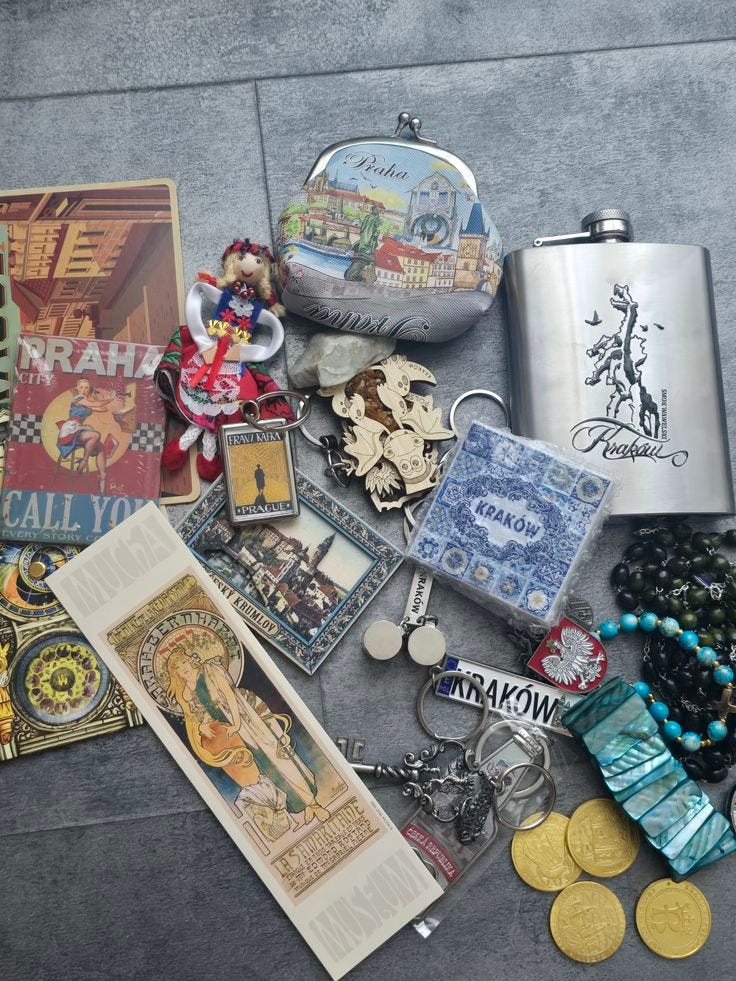
For years, I thought I was holding onto it because it reminded me of Jaipur. It was only much later that I realised it reminded me of something far more fragile than a city. It reminded me of the version of myself who walked through those bustling markets with the uncomplicated certainty that this small object somehow mattered. The block has become less about Rajasthan and more about childhood itself. Whenever I look at it, I do not simply remember a destination; I remember being five years old, holding my parents’ hands, overwhelmed by colours, sounds, and possibilities. It is astonishing how an object no larger than the palm of my hand can preserve an entire emotional landscape. To anyone else, it is merely carved wood. To me, it has become a biography.
Anthropologists have a name for this quiet relationship between people and things. They call it material culture, the study of how objects shape human life and how humans, in turn, shape objects with meaning. We often imagine culture as something expressed through language, rituals, traditions or beliefs, but anthropology asks us to pay attention to the ordinary things that surround us every day. The mug we drink from every morning, the books we refuse to lend, the jewellery passed down through generations, the faded letters tucked into drawers, and the souvenirs carried home from distant places all become part of the stories we tell about ourselves. Objects are never simply objects. They become vessels of memory, identity, love, grief, aspiration, and belonging. Their significance rarely lies in what they are made of, but in what they have silently witnessed.
This way of looking at objects was profoundly shaped by anthropologist Arjun Appadurai, who argued in The Social Life of Things that objects have biographies just as people do. We are accustomed to thinking of a souvenir as a commodity, something manufactured, displayed on a shelf, and purchased by a traveller. Yet its real life begins only after it is bought. A ceramic bowl becomes the centrepiece of family dinners. A scarf bought in Istanbul begins to smell faintly of someone’s favourite perfume. A pebble picked up absentmindedly from a beach survives three house moves and twenty years later still sits on a windowsill. The physical object changes very little, but its meaning expands with every passing year. It accumulates memories the way old cities accumulate layers of history. Its value is no longer determined by the price printed on its tag but by the life it has lived alongside ours.
Psychology offers another fascinating explanation for why these seemingly insignificant objects become indispensable. Research on autobiographical memory suggests that memory is not simply stored inside the brain waiting to be retrieved on command. Instead, our memories are deeply dependent on cues in the world around us. A familiar fragrance can instantly return us to a grandmother’s kitchen. A particular song can resurrect an entire summer. Likewise, an object can unlock moments that seemed permanently forgotten. The souvenir is not preserving memory in itself; it is preserving the doorway through which memory enters. Looking at an old metro ticket does not merely remind us that we once visited another city. It recalls the nervous excitement of navigating unfamiliar streets, the rain that began unexpectedly, the conversation we had over coffee, or the stranger who gave us directions. In that sense, souvenirs function less as containers of memory and more as keys to memories that otherwise remain hidden.
Perhaps this is why photographs and souvenirs feel fundamentally different. A photograph captures what stood before the camera, freezing a single moment in time with remarkable accuracy. A souvenir, however, asks us to participate. It requires imagination, recollection, and emotion to complete the story. Two people may own identical postcards from the same city, yet one becomes framed and cherished while the other remains forgotten inside a drawer. The object itself is not what matters. What matters is the relationship that develops between the object and the person who carries it home. Anthropology reminds us that meaning is not embedded within things; meaning is something we create through living with them.
This also explains why the most meaningful souvenirs are often the least impressive. As children, many of us collected keychains, magnets, or miniature monuments simply because they represented the places we visited. As we grow older, our souvenirs become quieter. We begin bringing home books from independent bookshops, handmade ceramics from local artisans, train tickets tucked into journals, pressed flowers from mountain walks, or café receipts folded inside novels. The object itself becomes almost secondary. What we seek is authenticity—not necessarily the authenticity of the place, but the authenticity of our own experience within it. We are no longer buying evidence that we visited somewhere; we are trying to preserve the feeling of having been there.
Consumer culture often encourages us to evaluate objects according to their usefulness or their market value. We ask whether something is worth buying, whether it will serve a practical purpose, or whether it deserves the space it occupies. Anthropology asks a different question altogether. Instead of asking what an object does, it asks what an object means. This distinction transforms the way we understand the possessions in our homes. Daniel Miller, whose work has profoundly shaped the anthropology of material culture, argued that our homes are not simply places where objects accumulate but spaces where identities are assembled. If a stranger were to spend an afternoon walking through someone’s house, examining the books on their shelves, the art on their walls, the magnets on their refrigerator, and the souvenirs scattered across their rooms, they would likely learn more about that person’s life than they ever could from a carefully written biography. Our homes are autobiographies composed not in words but in objects.
This idea becomes even more compelling when we think about museums. Museums are often described as collections of history, but perhaps they are better understood as humanity’s collective souvenir cabinet. Every broken pot, weathered tool, fragment of fabric, or ancient coin displayed behind glass once belonged to an ordinary person who could never have imagined that the object would one day represent an entire civilisation. Archaeologists reconstruct cultures not from speeches or philosophies alone, but from the material traces people leave behind. It makes me wonder what future archaeologists would conclude about us if they excavated our homes centuries from now. They might find shelves lined with fridge magnets, journals filled with boarding passes, drawers containing faded concert tickets, and boxes of seemingly meaningless keepsakes. They may never know the stories behind them, but they would recognise something deeply human in our impulse to preserve fragments of experience.
Perhaps this impulse reveals something fundamental about memory itself. Human beings have always searched for ways to resist forgetting. Before smartphones, we kept diaries. Before photographs, we painted portraits. Before digital archives, we carved stories into stone and passed heirlooms through generations. Souvenirs belong to this ancient tradition of externalising memory, of placing parts of ourselves into the material world so that they might survive the inevitable erosion of time. We often believe we buy souvenirs to remember places, but perhaps we buy them because we know that one day the details will blur, and we will need help remembering not just where we were, but who we were when we stood there.
I often think back to that small block-printing block from Jaipur and wonder why I chose it over every other object in the market. It seems strangely fitting now that the first souvenir I ever consciously bought was a block designed to leave impressions on fabric. Mine never stamped a single piece of cloth, yet it left an impression elsewhere. It became the beginning of a lifelong habit of bringing pieces of places home, not because I feared forgetting the places themselves, but because I sensed, long before I had the words to explain it, that ordinary objects possess an extraordinary ability to carry stories across time. Today, that carved block reminds me that the true purpose of a souvenir is not to preserve a destination. It is to preserve a fleeting version of ourselves before life quietly carries us somewhere else. Perhaps that is why the things we bring home matter so much. They are not simply reminders of where we have been; they are patient witnesses to who we have been, waiting silently on our shelves until one ordinary afternoon they return us, for just a moment, to a person we thought we had left behind.
No posts
Comments
Nothing yet. Say the first thing.
Sign in to join the conversation.