
I’ve recently fallen into the ever so slightly maniacal habit of annotating my books, because one day, in the far off future, someone will excavate my bookshelf and determine that the defining characteristic of my civilisation was the fact that I obviously had feelings. There are books with sentences underlined thrice, books with marginal exclamations and question marks and arguments directed at the author’s words and the names of individuals I had in my mind while reading and arrows indicating where two pages connect, and whole paragraphs that are designated only as marked because something in them made me stop reading for a few seconds. There are also pages full of notes written in my hand that I no longer have any idea of what they mean. They are, after all, sentences, grammatically sound English sentences that were written by someone I can no longer identify with, and that may be the weirdest fact of annotating. You believe you’re annotating a book, but really you’re annotating yourself.
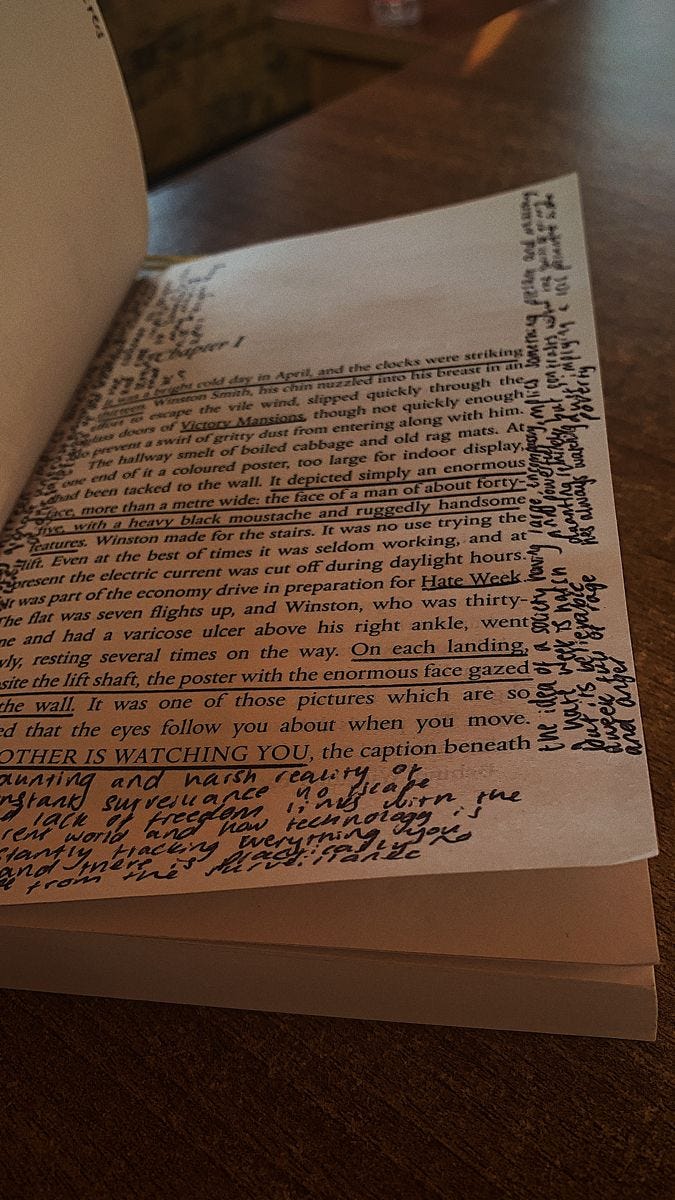
For something that feels so modern, especially as well tabbed, colour coded books are now a whole niche micro genre on BookTok and Bookstagram, annotation is actually a ridiculously old practice. Marginalia has existed in books and manuscripts for hundreds of years, long before anybody invented the contemporary terminology of active reading and centuries before you could buy highlighters in seventeen varieties of pastel. Medieval manuscripts contain marginal scribbles, amendments, cross references, declarations of ownership and drawings, and some margins are now so full of interventions that the main text is like having an argument take place around it. There is, for instance, a large collection of medieval manuscripts in the British Library whose margins are filled with jokes, graffiti, corrections and diagrams from readers, and different scribal hands have revisited many of the same texts at different periods. But the inscriptions were not all created with the same purpose. Some were to correct errors, some were to explain or expand, others were to make a claim to ownership, to engage with the text or even perhaps just because a reader had a blank space and an idea. What all of this has in common is evidence of something we sometimes forget when we think about books as complete objects: books themselves continue to grow, or at least they continue to accumulate meaning, long after the author has finished adding it.
This becomes even more fascinating as we consider the history of reader response criticism, which disputes the idea that there is really some meaning fully contained within the text itself that the observant reader may unearth. Louise Rosenblatt, through her landmark 1978 book The Reader, the Text, the Poem, proposed the transactional view of reading, which contends that literature’s meaning arises from a dynamic transaction between the reader and the text. The reader engages in this transaction with her previous associations, personal baggage and current perspectives. A book, therefore, is not necessarily the same book to every person who picks up the same print version. Annotation highlights the unvoiced part of this transaction. The words that the author prints to say something exist on one side of this encounter, and the marks that readers write beside them, in another handwriting, another kind of ink and another time, to show what they get out of the reading, provide the other half of the conversation. Two people can read the same paragraph and highlight opposite sentences, and for good reason. They are not reading from the same page at all because they are applying different kinds of life to the printed page.
Maybe that is why annotating a novel can feel so personal. When I underline a sentence in a novel because it conjures up an incident from years ago, I am not just pointing out a powerful piece of writing. I am pasting a fragment of my biography onto another person’s sentences. When I scrawl an observation about a character’s motivation in the margins, I am preserving proof of who I thought I was at a very specific point in time and space, and when I scribe the name of a friend into a margin because a sentence recalls that person to me, he has occupied the space in the text even though he has had nothing to do with it. A book, porous in this way, is saturated with the reader’s life and memories, friendships, disputes, sadness and silly in jokes, even though all that it contains is the story written by another person. In a sense, it is for this reason that two books, even of the same edition, can become such totally different things. One is kept carefully clean and the other accumulates underlines, stains, scribbles, folded corners and private associations that the author could never possibly have written.
There is also something intellectually intriguing about the simple act of annotating because it calls on us to stop and respond rather than simply process the words further. While studies of annotation do not automatically justify claims that writing in margins makes us all better readers, studies on annotating and active reading have shown that it can force readers to identify salient information, make links and connections, and transform information into their own voice. Research on handwriting has also suggested that doing so may promote greater processing than transcribing words verbatim, although we need to refrain from thinking of these findings as some universal truth about handwriting and typing. The contrast between transcribing and responding matters. When I underline something, I have been forced to make a value judgement about importance. When I scribble something in response, I make a decision on what significance it held and why. Those tiny gestures of selection change reading from passive encounter to active dialogue.
This may be the reason why I distrust reading as one thing. There is reading for the sake of some information, reading simply for the purpose someone commanded you to read, reading for an exam to come, reading for escape, reading for the sake of knowledge, and then the reading that sets out not so much to finish a book as to have an encounter with a book. With such an undertaking, the function of annotation shifts from annotation as an aide mémoire to annotation as the site of reply. For this reply you need neither a yes nor a no. You need an I don’t believe you, an I know somebody like this, a this is gorgeous, a this is so boring, an I hate this book, or a question as simple as well, why not? The author is unable to answer, which is perhaps why the margin seems to offer such a safe space for conversation.
When analysing marginalia, scholars have long relied upon markings by readers to track how different people approached books throughout history, and they have often been used to trace immediate reactions, intellectual resistance and personal curiosities that would otherwise not be readily available. The handwriting then becomes another kind of historical evidence, not only as a record of possessions but also as a record of what readers observed. There is something fascinating about knowing that a person who lived hundreds of years before you could have opened a page, stopped at the same sentence and felt compelled to leave a mark. The distance between you and that person suddenly collapses into the tiny space of the margin.
In addition to that, I find the connection between annotation and owning a book particularly fascinating. We often write our name inside books, sometimes as children, and so organically that it almost appears as if we possess an invisible contract with the book once we begin the small legal deed on the opening page. Historically, bookplates, ownership inscriptions and similar marks have allowed us to know which reader had the privilege of owning a book throughout its history, because the object has journeyed through the hands of those it graced. Annotation, however, does not merely claim a right of ownership over the object. It rather conveys this: I have visited here. To know that a person owned a book, in the case of a signature for example, is one thing. Compare it to a defiant and emphatic underline which shouts I have found value here, or perhaps an exasperated question mark that declares there was an obstacle in understanding, or a small note which reveals a thought in the exact second at which someone stumbled upon these words for the very first time. An ownership mark establishes possession, whereas an annotation can testify to impact.
Another reason why I never fully accepted the anxiety about ruining books by marking them is that I increasingly find myself drawn to books that bear signs of their earlier life. Of course I understand wanting to preserve such a beautiful object, and I genuinely appreciate when I find a pristine book that has been scarcely used, the pages still crisp and the spine all but uncracked. But increasingly, I am drawn to used books that bear signs of their earlier life: personal scribbles inside the cover, coffee stains set firmly into the page, dog eared pages with sentences underlined in a stranger’s hand, all of which I will likely never know the name of. There is something unexpectedly intimate about encountering the handwriting of another person within the pages of a book. At that moment, we share a tiny piece of each other’s consciousness, the trace of a mind that occupied the world before we did. A clean book says nobody touched these words. An annotated one says someone cared to leave their impression.
I think the tangibility of annotation is key. A written mark is a persistent creature in a way that information in the digital realm is not. While many e readers can be filled with highlights, search capabilities and digital annotations of greater sophistication, a handwritten line is different from a selected string of words. The digital mark is more like a signal. When you scribble a mark into a physical book, you permanently alter the page itself. The force of your pen, the colour of your ink and even the type of paper contribute to a unique mark, a record of the likes of which you cannot simply undo. An annotation is an incredibly small, almost ridiculously small, act of irreversible interaction, something that is at once less easily performed and more meaningful to observe in a world where nearly all communication is editable, invisible or easily deleted entirely.
And this is where the practice of annotation transforms into autobiography. While we may imagine autobiography to consist solely of carefully constructed personal narratives, most of us leave unintentional biographies everywhere: in photographs and old emails, in music playlists and saved conversations, in grocery receipts and in the discarded notes and letters we never got around to burning. The annotated book fits these categories quite nicely, as it provides snapshots of prior selves without explicit intention, a repository for what we loved, feared, joked about, found important, failed to comprehend and once ably defended. We live out our lives and then return years later to discover that the person who was reading The Count of Monte Cristo in 2004 may be as unfamiliar as she is an old lover. Returning to those old underlined sentences then becomes the equivalent of opening a long dormant correspondence.
I saw this phenomenon vividly when I returned to several books I had read and diligently marked up many years ago. Some inscriptions still feel entirely right. The underlinings I previously made out of intellectual fervour now seem hopelessly obvious, though sentences I had barely registered back then now feel devastatingly acute. My younger self had been reading words that had already existed forever, but those same exact words may, for me, be altered irrevocably by my later experiences. I am not exactly the same reader I was back then. The book has remained largely still while I have moved around it, and this may be one of the most beautiful things about reading: the text can remain unchanged while the person encountering it becomes almost unrecognisable.
Perhaps this is why the act of imprinting books can feel so strangely bound to mortality. Annotations are very small, even trivial at first sight, and still these scribbled lines or bold marked paragraphs are evidence of the human mind in response, of a consciousness briefly touching another consciousness for the first time. Someone somewhere in time stopped at this line on the page. A thought occurred, an emotion was stirred, a recognition was made and a faint impression was left. If the book survives long enough, centuries or perhaps even millennia, someone entirely alien to us can then encounter that tiny physical record. You and the writer who annotated the book may be gone, but the imprint may yet linger. This phenomenon can already be traced in centuries old manuscripts where scribbles fill the margins, providing us traces of readers now hundreds of years in our past. It is as though each annotation becomes a miniature memorial to the fact of our presence on this earth, even if only through the simple, profoundly important statement: this mattered to me.
What I love most about an annotated book, and what I may ultimately be reaching for above and beyond all the other reasons, is its refusal to allow a reading to be anything less than physical. So few of the books that we pass through actually leave evidence on us, or indeed anywhere on the page that signifies that we were ever present. Over time we become even further removed, not only from the writer on the page, but also from the version of ourselves who sat there with the book in our hands, a person who can eventually feel like a stranger. But one annotation puts an end to such a clean obliteration. It is proof that one human being stood in the presence of something called the text. It is, of course, left on the pages for its own reasons, but it is also an argument made to and through and by me.
Perhaps we annotate because the process of reading isn’t a one way transaction at all. An author leaves letters upon a page, and we respond to those letters with the entirety of our experience, and somewhere in the intermediary space that the author and reader inhabit is born new meaning. The underline is, by and large, the sum and substance of an annotation in its slightest form. It is a barely there stop sign, signalling that a particular line did not quite get past without notice. The note in the margin goes one step further still, and in doing so it hints at its ultimate significance. I was here, thought this one thing, then something shifted in my own life, and in the aftermath I felt somehow compelled to preserve some faint vestige of that shift for the other lives to come.
In the end, perhaps the best thing about annotated reading is the inability to distinguish one story from another: the words that were originally printed on the page, the meanings you imagined while reading them, and the particular annotations that reveal the sort of person you were when you first touched these books. When one closes these books and moves on, the book remains. The human who turned the page changes, but the annotations linger, and what remains is more than mere reading. They stand as a testament to this: in this one moment, on one piece of paper, someone existed, looked upon words, felt passionately with their whole mind and body enough to halt their steps, and decided to mark the page as a record of their passage.
No posts
Comments
Nothing yet. Say the first thing.
Sign in to join the conversation.