
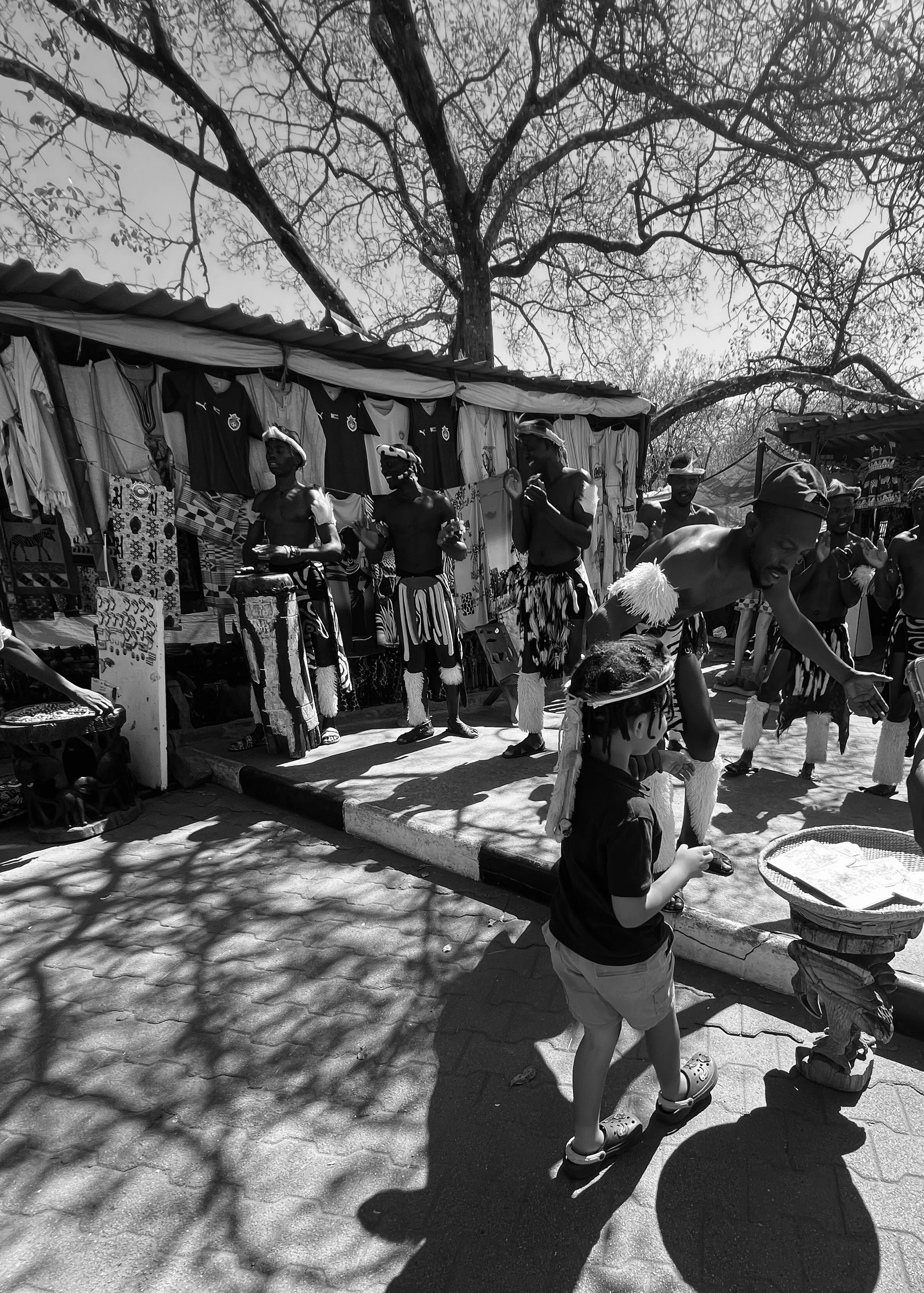
I was on holiday in Southern Africa with my family last year when a group of tribal dancers began performing. They were dressed in traditional clothing and wearing elaborate headdresses. My seven-year-old son was captivated. Within seconds, he’d joined the dancing.
Afterwards, we left to look in some shops and, in what felt like about thirty seconds, realised he had disappeared. Every parent knows that panic. One minute you’re on holiday. The next you’re mentally preparing a Netflix documentary about your failures.
When I eventually found him, he was proudly wearing one of the headdresses. He’d sneaked away, returned to the dancers and traded his baseball cap for it.
Later, somebody explained that in the tribe the headdress traditionally symbolised manhood and status. Young men weren’t simply given one. They earned it through a series of rites and achievements.
My son had bypassed the entire process through a combination of charm and opportunistic bartering. Thank God he didn’t trade our rental car!
For most of human history, communities have developed rituals marking the transition from childhood into adult life. The details varied, but the message was remarkably consistent, you belong, you have a role, and the tribe needs you.
There is an old saying you have probably heard, ‘it takes a village to raise a child’. I recently heard a youth worker add a darker twist;
“If a child doesn’t feel part of the village, they burn the village down.”
Sounds a bit dramatic, but there’s something psychologically profound hiding inside it.
I work with a lot of young people. Depending on who you ask, they’re either the most anxious generation in history or the most entitled. Sometimes both before lunch. I’ve certainly met young people who struggle with confidence, resilience and mental health. I’ve also met young people who are thoughtful, entrepreneurial and far more socially conscious than I was at their age.
The stereotypes contain fragments of truth. NHS England data shows the proportion of 16–24 year-olds experiencing a common mental health condition has risen from 18.9% in 2014 to 25.8% in 2023–24. A rise of more than a third in a decade.
But there’s a bigger picture. I don’t see a generation that has suddenly become weaker. I see a generation growing up in circumstances fundamentally different from those experienced by their parents.
I was a teenager in the 1990s. Britpop dominated the charts. Euro 96 made football feel like a national religion. There was an overriding feeling of optimism set to the tune of ‘Things Can Only Get Better’ by D:Ream. My bedroom contained football posters, a CD player and enough Lynx Africa to make Greta Thunberg retrospectively angry. But I didn’t spend that much time in it.
Bedrooms were somewhere you slept, whilst life happened elsewhere.
You had a Saturday job. You went to football. You hung around with your friends. You annoyed your parents in person rather than via WhatsApp.
Perhaps this is partly nostalgia. Every generation remembers its youth more positively than it was, but something deeper has shifted.
Recently, Alan Milburn’s review of barriers facing young people highlighted the growing number spending large amounts of time isolated from work, education and wider society. The numbers back this up, we are now approaching one million young people aged 16 to 24 who are entirely outside work and education.
The term “bedroom generation” has entered the lexicon. The phrase feels symbolic of something larger.
For most of human history, young people were not expected to wait around for adulthood to begin. Anthropologists often point out that adolescents occupied a vital role within tribes and communities. They were strong enough to contribute but young enough to take risks. Older generations preserved knowledge. Younger generations explored possibilities.
In evolutionary terms, young people were the tribe’s research and development department. They challenged assumptions, explored new territory and occasionally did things that made elders despair. They were also often the first people to notice when the village had stopped working.
Some things never change. What has changed is the route into adulthood.
Today, many young people face a different landscape. Whilst previous generations climbed the housing ladder, this generation was told the ladder exists, then watched it get bought by a hedge fund, listed on Airbnb and rented back to them at £1,400 a month.
Entry-level jobs are becoming less secure. Artificial intelligence is beginning to reshape industries before many young people have even entered them. Nothing boosts confidence quite like discovering your dream career may already be having performance reviews with a chatbot. University often comes with significant debt attached. The cost of participation in ordinary life continues to rise.
Even football tells part of the story.
I recently heard a fan reminiscing about how he paid for match tickets through a Saturday job as a teenager. Today, the atmosphere inside football grounds has changed, because many young fans simply cannot afford the same experience.
This matters because young people energise society.
Throughout history, youth movements have driven political reform, cultural change, music, art and social progress. Punk emerged from youth unemployment and economic decline. The civil rights movement relied heavily on young activists. Every generation complains about young people, but every generation also depends on them.
Psychologists have long understood that hope is not simply optimism. Hope emerges when people can see a desirable future and believe their actions might help them reach it. Remove either of those things and people begin to disengage. It isn’t that they stop caring. It’s that caring starts to feel pointless.
The issue isn’t whether young people have hope. Most do. The problem is that many are trying to build a future whilst reading headlines that sound like rejected plots from Black Mirror.
For generations, the assumption was simple, your children would have it better than you. Increasingly, parents are no longer sure that’s true, and that changes the emotional atmosphere of a society.
At the same time, today’s young people are carrying burdens previous generations never experienced. Before securing a first job or renting a first flat, they are already navigating climate anxiety, global conflicts, social media comparison and questions about whether entire professions may be transformed by technology.
The whole world arrives in their pocket before adulthood has properly begun. By seventeen, many know more about geopolitics than I did at thirty. Unfortunately, they also know the average house price within a fifty-mile radius. And yet we often respond by asking why they seem anxious. Perhaps the more interesting question is why we expect otherwise.
Which brings me back to that quote.
If a child doesn’t feel part of the village, they burn the village down.
I don’t think most young people want to burn anything, hopefully not my children, because I’m not insured for arson or civil unrest. What I hear far more often is something quieter, uncertainty about where they fit, whether the future is attainable and whether the promises made by society still apply.
The real challenge facing us is not whether young people are resilient enough for the future. It is whether we are building a future they can imagine belonging to.
Because a society can survive hardship surprisingly well if its young people still believe they have a stake in what comes next.
When they stop believing that, history suggests the village has a problem.
My son traded a baseball cap for a headdress. He wanted a place in the story. We’ve responded to an entire generation asking the same question by putting the story behind a paywall.
Most young people aren’t asking for special treatment. They’re asking for something much older than that.
A reason to believe there’s a place for them in the village.
Comments
Nothing yet. Say the first thing.
Sign in to join the conversation.