
A little plug for the seal tours up top: this weekend’s forecast is looking excellent, with more of this milder winter weather that makes being out on the harbor in winter totally enchanting. We’ve seen seals on every trip out this year so far—some days more than fifty—with excellent views and lots of waterfowl. This is a really special time of year for wildlife in the harbor, as many species of birds are using the local waters as a staging area ahead of migration. The seals seem unfazed by all this whacky weather we’ve had, and are as cooperative as ever. The other week, in addition to our wonderful seals, we had an Iceland gull hanging out on the rocks nearby. We also regularly see great cormorants, several scoter species, horned grebes, scaup, long-tailed ducks, and both red-throated and common loons (to name just a few). It’s a pretty special part of New York City! Writer Sabrina Imbler, author of an excellent book about the ocean called How Far the Light Reaches came out on one recently and wrote it up in their newsletter NYC Creatures, if you want to read about someone else’s experience on the tour. In addition to sending out great dispatches about wildlife in NYC, Sabrina does the hard work of aggregating monthly wildlife tours and other programs in the area, so I’d definitely recommend subscribing!
This weekend’s tours are scheduled for:
9:30 AM on Saturday February 28th
and
10:00 AM on Sunday March 1st
The full calendar for the rest of these winter tours, which run through March 22nd, can be found right here!
Okay, now Whale Oil!
I’ve been putting this one off, in part because it touches on some of the things I’m writing about in my book and I guess, for whatever reason, I’ve been reluctant to create too much overlap between this newsletter and that project. The book is about forage fish—small, abundant marine creatures such as menhaden, herring, anchovies, and sardines—while Moby-Dick is about whales, which are some of the largest animals to ever exist. You’d think there wouldn’t be too much overlap there, but in addition to the significant ecological relationships that connect these animals, there are big commonalities in the histories of how people have made use of them over time.
Some of my book is about reduction fishing: the practice of grinding down fish and processing them into oil, paste, proteinous meal, and various other byproducts. Over history, beginning about as far back as history goes, people have done this with herring, anchovies, smelt, and other small fish—smushing them up, rendering them down, and creating grease, oil, meal, and other substances named for their textures. Indigenous first nations in North America did this in prehistory, as did the Romans. It happened at large scale during the industrial period, and on various coastlines at different times over history. Our species has used those byproducts to do all sorts of things. Little fish have weatherproofed clothing and homes, and lubricated machines, and preserved foods. They were turned into glues, and paints, and sealants, and solvents. They were burned to generate light and warmth.
Today, fish reduction takes place at industrial scales. Huge, sophisticated factory ships—some capable of processing down these animals at sea by the thousands of tons—haunt coastlines around the world, harvesting wildlife at staggering scales grind it down. These boats suck up krill and sardines and anchovies and a whole host of other marine creatures to churn them and burn them into oil and meal, which is used in a bunch of products you’d never really expect—pet food, and fertilizer, and cosmetics, and paint. These reduction fisheries and the products they create constitute a huge, fascinating, essentially hidden layer of the global economy, and that’s one of the things I’m exploring in the book.
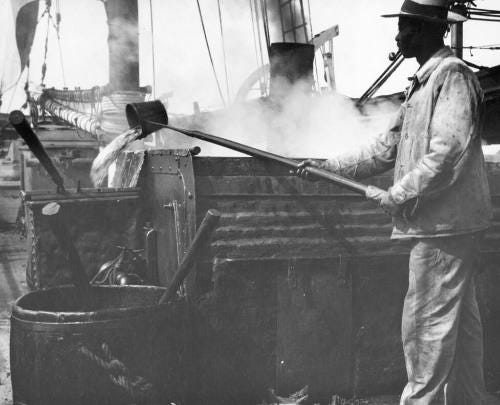
If you’ve read Moby-Dick, the concept of a factory ship rigged for pursuing marine life and reducing it down into its basic components is probably familiar! That’s because the 19th-century whale fishery was a reduction fishery, and the Pequod, like whaling ships around the world at that time, was a factory ship. After a whale was caught, it was broken down, taken aboard, and rendered underway. This process is exhaustively described by Melville in Chapter XCVI, “The Try-Works,” with some of the preparation described in the preceding chapters.
At the risk of repeating myself too many times, my writing about Moby-Dick here at Landlubber isn’t focused on the book’s literary construction (although I’m in awe of it) as much as it is on the glimpses the novel offers of a vanished maritime world. But the passages about breaking down a whale are crucial to both literary-analytical readings and historical ones, so we’ll spend a little time here mixing the two of them!
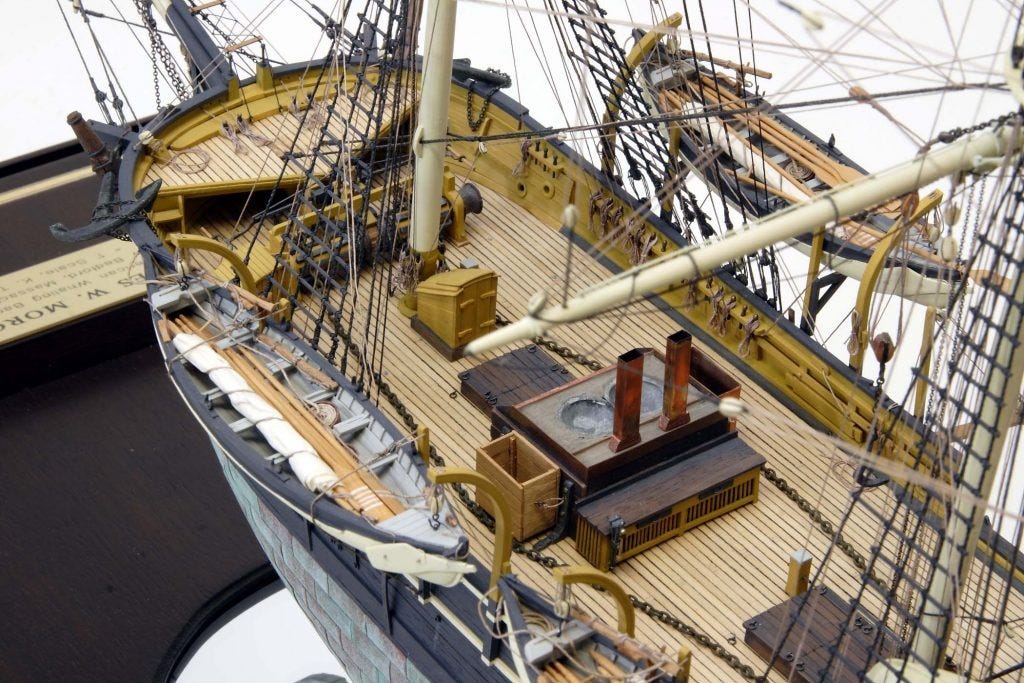
For those of us in this for the history lessons, it’s here, in the try-works chapter, that we get a look at the process for refining an entire whale into oil. The details, from the placement of the furnaces, to the tools, to the procedures for rendering, all the way down to the smells, are by all accounts fairly accurate. This is a faithful depiction of what breaking down a whale at sea looked like in the first half of the 19th century. Here’s a little description of the furnace, followed by a photograph of a model of the whaler Charles W. Morgan, with the works visible in the middle.
“Besides her hoisted boats, an American whaler is outwardly distinguished by her try-works. She presents the curious anomaly of the most solid masonry joining with oak and hemp in constituting the completed ship. It is as if from the open field a brick-kiln were transported to her planks.
The try-works are planted between the foremast and mainmast, the most roomy part of the deck. The timbers beneath are of a peculiar strength, fitted to sustain the weight of an almost solid mass of brick and mortar, some ten feet by eight square, and five in height. The foundation does not penetrate the deck, but the masonry is firmly secured to the surface by ponderous knees of iron bracing it on all sides, and screwing it down to the timbers. On the flanks it is cased with wood, and at top completely covered by a large, sloping, battened hatchway. Removing this hatch we expose the great try-pots, two in number, and each of several barrels’ capacity. When not in use, they are kept remarkably clean. Sometimes they are polished with soapstone and sand, till they shine within like silver punch-bowls. [...]
Removing the fire-board from the front of the try-works, the bare masonry of that side is exposed, penetrated by the two iron mouths of the furnaces, directly underneath the pots. These mouths are fitted with heavy doors of iron. The intense heat of the fire is prevented from communicating itself to the deck, by means of a shallow reservoir extending under the entire inclosed surface of the works. By a tunnel inserted at the rear, this reservoir is kept replenished with water as fast as it evaporates. There are no external chimneys; they open direct from the rear wall.”
Now, here’s how Melville describes the reduction process:
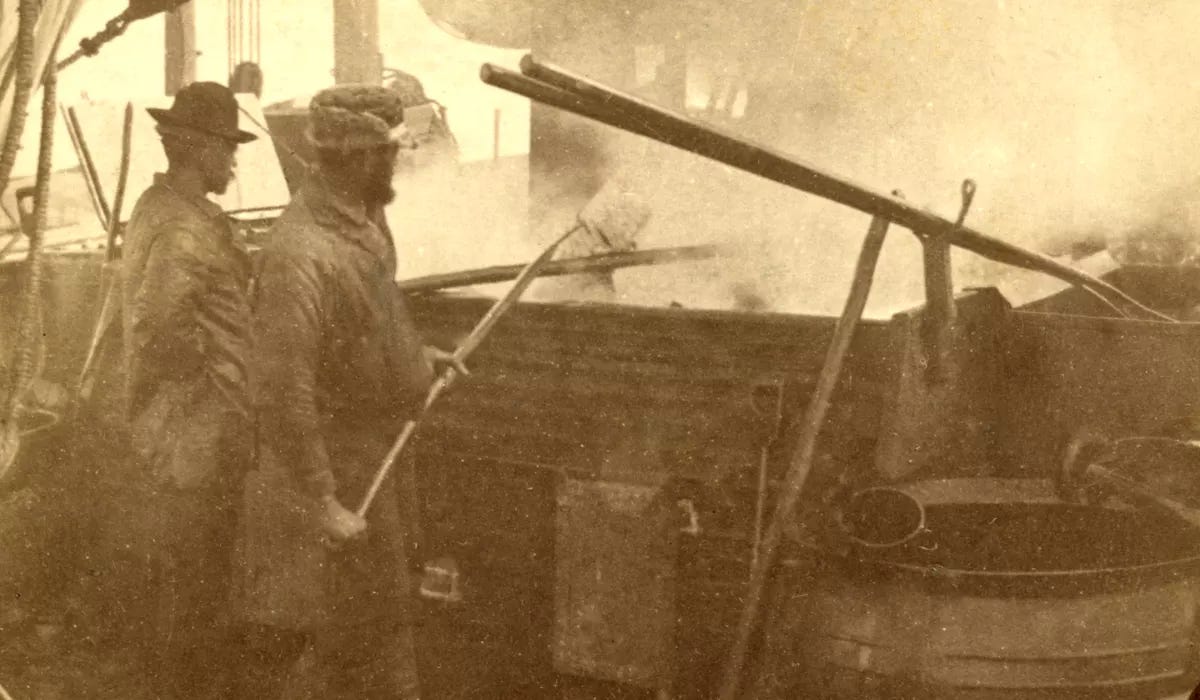
“All ready there? Off hatch, then, and start her. You cook, fire the works.” This was an easy thing, for the carpenter had been thrusting his shavings into the furnace throughout the passage. Here be it said that in a whaling voyage the first fire in the try-works has to be fed for a time with wood. After that no wood is used, except as a means of quick ignition to the staple fuel. In a word, after being tried out, the crisp, shrivelled blubber, now called scraps or fritters, still contains considerable of its unctuous properties. These fritters feed the flames. Like a plethoric burning martyr, or a self-consuming misanthrope, once ignited, the whale supplies his own fuel and burns by his own body. Would that he consumed his own smoke! for his smoke is horrible to inhale, and inhale it you must, and not only that, but you must live in it for the time. It has an unspeakable, wild, Hindoo odor about it, such as may lurk in the vicinity of funereal pyres. It smells like the left wing of the day of judgment; it is an argument for the pit.
By midnight the works were in full operation. We were clear from the carcase; sail had been made; the wind was freshening; the wild ocean darkness was intense. But that darkness was licked up by the fierce flames, which at intervals forked forth from the sooty flues, and illuminated every lofty rope in the rigging, as with the famed Greek fire. The burning ship drove on, as if remorselessly commissioned to some vengeful deed. So the pitch and sulphur-freighted brigs of the bold Hydriote, Canaris, issuing from their midnight harbors, with broad sheets of flame for sails, bore down upon the Turkish frigates, and folded them in conflagrations.”
For readers engaging with the novel as a work of literature, the passages here are important. It’s at this moment, amid the fumes of oil and flesh burning away, that we see the horror of the enterprise brought into focus. Suddenly, the ominous tones of foreboding and mystery are replaced with outright hellish, apocalyptic imagery. (The reference here, in that last sentence, is to a famous naval attack by the Greeks against the Ottoman fleet in 1822—Greek fireships attacked the Turkish flagship at night, igniting its powder stores and killing around 2,000 Ottoman sailors).
If we’re to understand Ahab as a sort of evil hero—a demonic anti-protagonist along the lines of Shakespeare’s Macbeth, or Milton’s Satan in ‘Paradise Lost’—this is the moment in which the journey, the route, and even the boat itself, all the way down to its whalebone tiller, go awry, becoming “inverted.” In terms of narrative progression, this is the point of no return from which we can only watch the rest of the grim story play out. After the Try-Works, it’s more or less a straight descent towards the Pequod’s undoing.
This raises a question that is, I believe, also relevant to both a literary and historical reading of this book, which is: was the industrial whale fishery monstrous? If so, was it understood as such at the time? Would the average whaler have seen it that way? Did Melville?
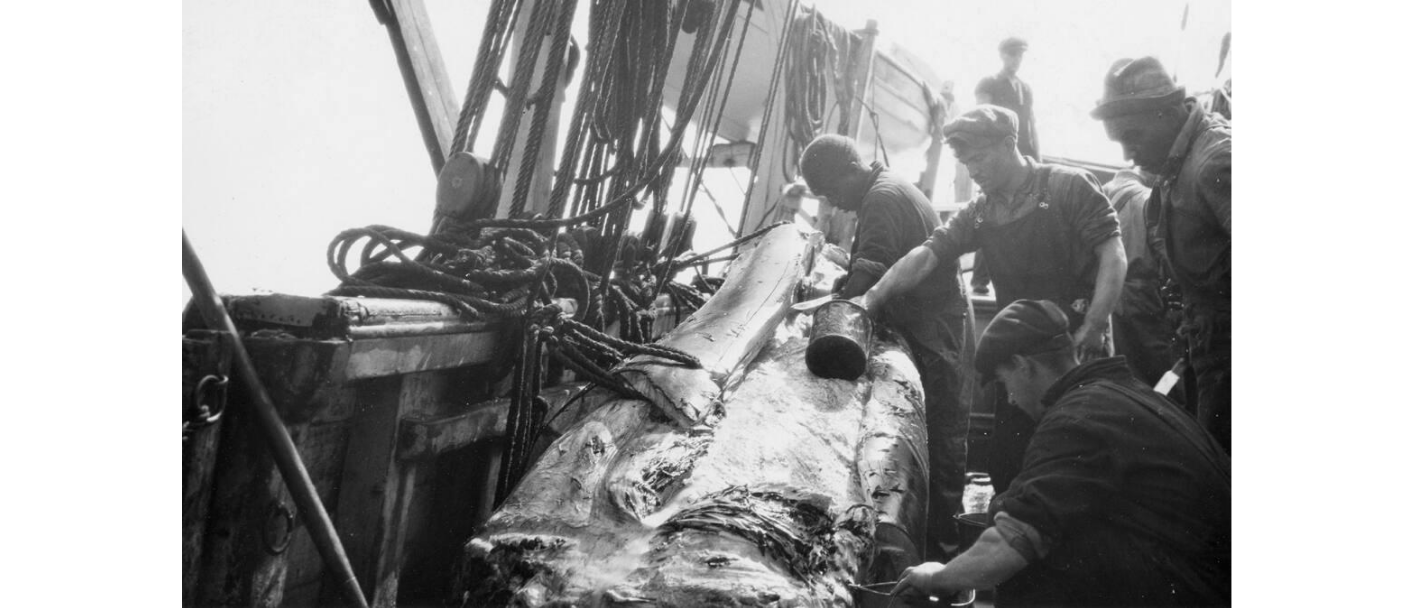
In any literary interpretation of Moby-Dick, it’s important to at least think about that question because without doing so, it’s impossible to really understand Ahab’s corruption, or the significance of his abandoning the Pequod’s mission to pursue the whale Moby-Dick instead. Is Ahab defiling something noble by inverting the otherwise lofty enterprise of whaling to seek revenge on a single whale? Or is whaling already perverse? And if it’s already perverse, then what type of perversion of the already perverse are we looking at? Is the monomaniacal pursuit of the white whale at the expense of the mission a different kind of evil altogether? Something that takes a systematic, “necessary” evil carried out for the benefit of society and disfigures it into something absurd, fruitless, doomed, and meaningless? Or does the Pequod’s fatal voyage represent the monstrosity of whaling brought to its apotheosis: a laying bare of the true barbarism that underlies this supposedly noble Quaker maritime tradition?
A novel doesn’t need to definitively answer questions like that, and there are passages scattered around Moby-Dick that support different, conflicting perspectives. When Ishmael meets owners Peleg and Bildad for the first time, we get a hint that there might be something untoward about hunting whales. Bildad, as a Quaker, is described as “a sworn foe to human bloodshed,” but Ishmael notes a “lack of common consistency” in his character, as the captain has “spilled tuns upon tuns of leviathan gore.” On the other side you have Chapter XXIV, “The Advocate” a self-contained treatise on the nobility of whaling, arguing that whalers are braver, more noble, less violent, etc. than those who dedicate themselves to all sorts of other supposedly high status occupations. There’s a little bit of an ironic tone at play, as well as the implication that your average person in the second half of the 19th century would not view someone who worked on a whaler as an entirely wholesome character, the business of whaling being, Ishmael notes, “regarded among landsmen as a rather unpoetical and disreputable pursuit.”
It’s also a little sticky to rely too heavily on our narrator as we attempt to untangle these moral questions, since Ishmael is something of an odd duck in that regard himself. In the novel’s third sentence, he frames his impulse to take to the sea as his way of satisfying dark, even violent impulses, disembarking whenever he finds himself “involuntarily pausing before coffin warehouses, and bringing up the rear of every funeral” he meets. The ocean is, in his own words, his “substitute for pistol and ball.”
If we want to use Moby-Dick as a literary field trip back to the strange, bygone 19th-century maritime world, these questions about the moral standing of the whale fishery are obviously of interest. Understanding how these people viewed their work lets us understand them more deeply and assess them more fairly. It might even give us some insight about our present day practices around fishing, mineral resources extraction, oil, etc.
We also have some right to take their actions a little personally, since we’re living in the ecological aftermath of all that whale slaughter. Millions of whales were killed since the industrial whaling industry was born in the 1600’s (with many more than you’d expect dying in a late wave of whaling activity that stretched all the way to the 2000’s). North Atlantic right whales, subject to extraordinary industrial fishing pressure in the period described in Moby-Dick, currently number just 384 individual animals, and could plausibly go extinct in my lifetime. I think it’s fair for us to ask how culpable the average whaler was for activity that seems, from our semi-enlightened point of view in the 21st Century, to amount to a crime against nature.
It’s clear that Melville thought about those ethical questions as he wrote, although Moby-Dick doesn’t present, in my opinion, an unambiguous picture of how these men understood their work. He gets fairly playful with the morality stuff throughout the novel, inverting the expected virtuousness and villainousness of the characters (cannibals, Quakers, mutineers, etc) and deliberately fogging up questions of right and wrong, good and evil, black and white, etc.
Nevertheless, it’s interesting to me that Melville chooses the burning and boiling down of whale flesh in the try-works as the moment in which to emphasize the complete moral corruption of the Pequod. “[A]s the wind howled on, and the sea leaped, and the ship groaned and dived,” Ishmael tells us, “and yet steadfastly shot her red hell further and further into the blackness of the sea and the night, and scornfully champed the white bone in her mouth, and viciously spat round her on all sides; then the rushing Pequod, freighted with savages, and laden with fire, and burning a corpse, and plunging into that blackness of darkness, seemed the material counterpart of her monomaniac commander’s soul.” It is here that we see the entire crew, ship, etc. contaminated finally and entirely by Ahab’s madness, and here that Melville deploys the unambiguous imagery of hell, death, apocalypse, etc, describing the harpooneers working the oil as “devils in the forking flames.”
The reason I find this interesting is that the “trying out” of a whale into oil was not some exceptionally grotesque or obscure practice in this business. This is the work they were supposed to be doing. It was the entire purpose of whaling! At the time, whale oil illuminated city streets, taverns, and homes. It was useful—essential you could even argue—to the production of light in many circumstances. As Ishmael notes in Chapter XXIV, his treatise on the greatness of whaling: “though the world scouts at us whale hunters, yet does it unwittingly pay us the profoundest homage; yea, an all-abounding adoration! for almost all the tapers, lamps, and candles that burn round the globe, burn, as before so many shrines, to our glory!”
So why is the try-works chapter written as if hell itself has sprung from the bowels of the ship to consume it, when this is whaling as it’s supposed to be? Here, after all, is the final extraction of the very stuff that made this work so lucrative in the first place. Any effort to mount a half-decent defense of these whalers against the charge that they indiscriminately butchered whale populations around the world, would likely be built around the production of this oil. All of 19th Century society was, after all, complicit to some degree in this, just as you and I, because of the minerals inside of our electronic devices, and the oil that powers the society we exist in, share at least some measure of responsibility for the circumstances under which those things are extracted for our use.
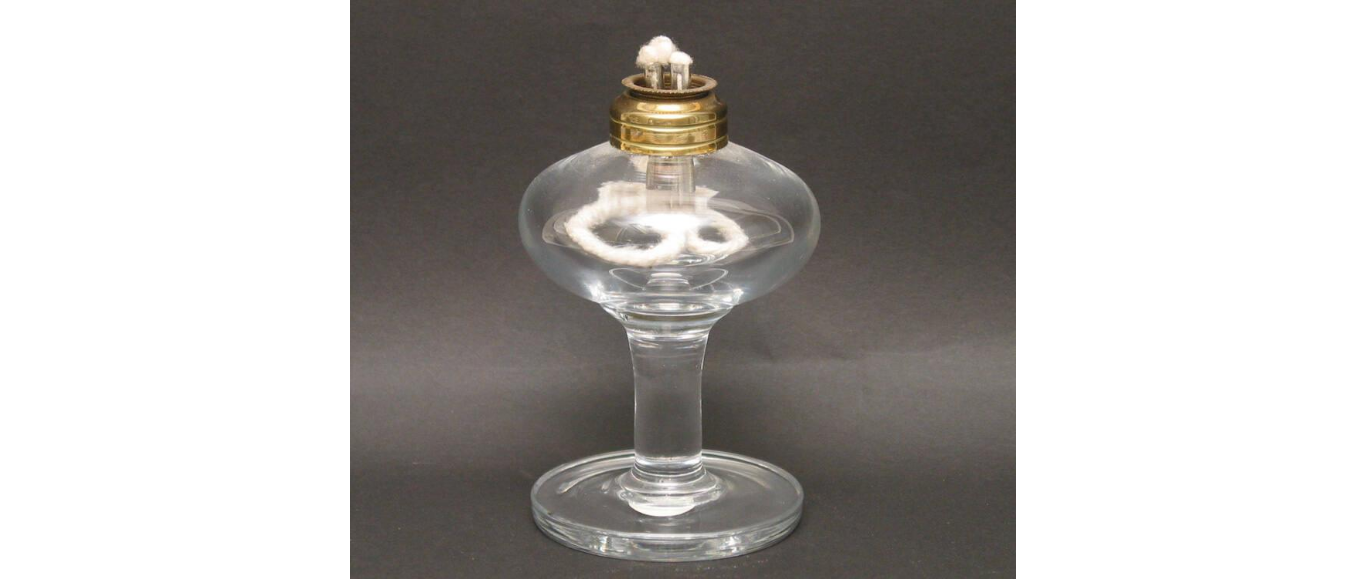
Elsewhere, it’s true—particularly in Ahab’s disputes with Starbuck—the neglect of the precious oil is framed as Ahab’s chief sin. He has abandoned his duty to stock up on oil, and thus abandoned the entire purpose of the voyage (profit), in order to pursue his white whale. Still, it’s hard to avoid feeling as if the novel, at the level of language and imagery, frames the reduction of the whale as the moment in which true evil begins, like so much acrid smoke, to consume this voyage.
My last question—one that I’ve been asking myself a lot as I work on my book about forage fish—is: is there something particularly untoward, wrong, or environmentally backwards, about reduction fishing, specifically? Are we sinning against nature more when we pull animals out of the water by the hundreds of thousands of tons to render them into new materials than we are when we fish them for food? Does burning these animals down for oil and meal, as opposed to eating them, make us more…wicked? Does it make us more likely to deplete their populations?
The book I’m writing doesn’t necessarily seek to answer that question, but it’s definitely something I’ll mull over in a few sections. I don’t have space for my full thoughts on the matter here, since we’re already thousands of words into this installment, but it’s something that interests me a lot. It’s a complex question—one that forces us to look at everything from the ecology of the animals in question, to the economic and social benefits they provide in their reduced form, to the second-level environmental impacts of the reduction process. With the small, abundant forage fish that tend to be subject to reduction fishing today, answering it also requires fairly complex mathematical work, since the standard methods for assessing fish populations tend to fall apart when faced with the complex volatility of sardine or herring populations. Just last year, a correction to a scientific assessment of the Atlantic menhaden population led to what I can only describe as a shit show at the subsequent meetings of the board responsible for setting catch limits along the East Coast, at which the Omega Protein Corporation, a huge reduction company that operates along the Western Atlantic, always has the most to gain or lose.
It’s a hotly contested issue, subject to intense, occasionally vitriolic, contemporary debates between conservation organizations, industrial fishing corporations, and countless groups of recreational and commercial fishers with opposing interests in how it gets answered. Beyond the already fraught question of how far our right to extract natural resources from the planet extends in the first place, the debate requires anyone who participates to open up a real can of worms by considering the “best uses” of those fish, which is its own thorny topic and one ultimately subject to at least some degree of subjectivity. If you want to learn a little bit more about that issue you can take a look at some of my previous reporting in Slate, or just wait for me to finish writing my book. If you want to take a look at the nitty-gritty play-by-play accounts of the sometimes heated deliberations of the management board responsible for regulating the harvest of Atlantic menhaden (the largest local reduction fishery) and get some insight from someone who has spent lots of time and energy on getting fisheries management right, Charles Witek has covered the subject expertly over the years in his blog One Angler’s Voyage (this one, about the aforementioned error in menhaden counting, is a great place to start).
Comments
Nothing yet. Say the first thing.
Sign in to join the conversation.